


I lost $1,200 in evaluation fees in 2023 before I realized the game was rigged.

James Mitchell
Penganalisis Dagangan Kanan
☕ 11 minit baca
Apa yang akan anda pelajari:
I lost $1,200 in evaluation fees in 2023 before I realized the game was rigged. I passed a two-phase challenge with a firm that 'accepted US clients,' only to have my first payout request met with radio silence, then an email saying their 'partner broker' had terminated services. The account vanished. My mistake? Not understanding that for a US trader, finding prop firms that accept us clients isn't just about rules, it's about survival in a regulatory war zone. The landscape has been bombed and rebuilt since 2024. Here's what's actually left standing.
Let's get this out of the way: most of the big, famous prop firms you see on YouTube? They don't want you. FTMO, The5ers, FundedNext – they've all pulled out or severely restricted US clients. The reason isn't personal; it's a legal grenade that went off in early 2024.
The core issue is that prop firms operate in a gray area. They're not brokers, so they're not directly regulated by the CFTC or SEC as such. They sell you an 'evaluation,' a simulated account. If you pass, they give you a 'funded' simulated account and share the pretend profits. Clever, right?
Regulators started asking tough questions. The CFTC's action against MyForexFunds in 2024 was the warning shot. Then, MetaQuotes (the company behind MT4 and MT5) dropped the hammer. In February 2024, they revoked licenses from prop firms serving US clients without a formal broker partnership. Overnight, the primary platform for retail traders became a no-go zone for many firms serving Americans.
This created a split in the industry. Offshore firms simply blocked US IP addresses. Others scrambled to partner with actual, regulated US brokers or shift to alternative platforms like cTrader, DXtrade, or TradeLocker. The ones that survived this purge are the prop firms that accept us clients today, but their model had to change. They're now often tied to a specific broker's infrastructure, which adds a layer of legitimacy but also constraints.

Warning: If a firm offers you MT4/MT5 access as a US client in 2026, be deeply suspicious. Ask exactly which broker is providing the platform license. If they can't give you a clear answer, walk away.
So, what's legal? A firm can operate if it's structured as an educational or talent-discovery service that uses a licensed broker's trading environment. Your challenge fee is for the evaluation service. Your profit split is from the firm's own capital, which it allocates based on your simulated performance. It's a tightrope walk, and the firms still in this game are the ones who've built a compliant tightrope.

💡 Petua Winston
The daily loss limit isn't a suggestion, it's a tripwire. Size your positions so that three consecutive bad trades won't hit it. If that means trading micro lots on a $100k eval, so be it.
Everyone talks about the profit split. I want to talk about the failure tax. The dirty secret of this industry is that it's built on the 90%+ of traders who blow their evaluation accounts. The fees from failed challenges are the firm's primary revenue. Knowing this changes how you should view the costs.
Evaluation Fees: The Price of a Lottery Ticket
You'll pay anywhere from $50 for a tiny account to over $500 for a $100k+ challenge. Some firms, like OneFunded, offer refundable fees (they take it back from your first profit split). Most don't. I treat this fee as a sunk cost, a tuition payment. In 2024, I bought a $299 challenge from a now-defunct firm. I passed, but the firm folded before my first payout. That $299 bought me a brutal lesson in counterparty risk.
The Profit Split Illusion
Yes, the standard is 80/20. Some offer 90/10 or even 100% after a threshold. Apex Trader Funding, for instance, lets you keep 100% of the first $25,000. Sounds great. But here's the catch: these splits are on net profits. They deduct commissions, spreads, and sometimes even platform fees first. On a high-frequency scalping strategy, commissions can murder your net.
Let's do math with real numbers from a current firm, CTI. They charge $5 per lot commission. If you're scalping 10 lots a day on EUR/USD, that's $50 in daily commissions. You need to make well over that just to break even for the firm. Your 80% split only kicks in after their costs are covered.

Example:
- Gross Profit for the period: $1,000
- Commissions & Fees: $350
- Net Profit: $650
- Your 80% Share: $520 The firm gets $130 (20% of net) PLUS the $350 in fees. Their total take is $480. Your "80% split" was effectively a 52% split of the gross.
Payout Schedules & Traps
Weekly payouts are a sales pitch. Many firms have a "first payout" delay of 30 days. Others have minimum withdrawal amounts. Always read the payout terms more closely than the profit split. A fast-paying firm is a sign of financial health. I prioritize firms known for 24-48 hour payouts, like RebelsFunding, because it means they have the liquidity and aren't relying on float.
“Your 80% split only kicks in after their costs are covered. The firm's cut is the split plus all the fees.”
This list is volatile. A firm that's safe today might be gone in six months. As of early 2026, here are the types of firms still actively and reliably serving US clients, based on community reports and my own tracking.
The Futures-Focused Shops: These are often the most stable because they work with established US futures brokers (like NinjaTrader, Rithmic).
- Apex Trader Funding: The giant in this space. They use NinjaTrader/Rithmic. use is lower (1:10 on micros), but it's a real, regulated pipeline. Payouts are consistent.
- Topstep: Another veteran. More structured, with a clear path from evaluation to funded account.
The Forex & Multi-Asset Survivors: These firms migrated to non-MetaQuotes platforms post-2024.
- Goat Funded Trader: Uses DXtrade. Known for good customer service and straightforward rules. They offer scaling plans up to $800k.
- OneFunded: Uses Match-Trader. Their refundable fee model is a nice twist that aligns their success with yours.
- Funded Trading Plus: Works with ThinkMarkets via TradingView. A good option if you live on TradingView charts.
The High-use, High-Risk Offshore Options: A few offshore firms still accept US clients via crypto payments and alternative platforms. The regulatory protection here is near zero. You're trading on their word. I don't recommend this path, but traders still do it for the higher use (like 1:500 from firms like IC Funded).
| Firm Type | Example | Platform | Key Pro | Key Con |
|---|---|---|---|---|
| Futures-Focused | Apex Trader Funding | NinjaTrader, Rithmic | Regulatory clarity, stable | Lower use, futures only |
| Forex Survivor | Goat Funded Trader | DXtrade | Good support, multi-asset | Still a gray-area model |
| High-Risk Offshore | IC Funded | cTrader | Very high use | No US regulatory oversight |
Your choice boils down to this: do you want the relative safety of a futures-based model tied to US brokers, or the flexibility (and risk) of a forex/multi-asset firm on a new platform? I moved my own capital to futures models after 2024. The peace of mind is worth the lower use.
You can be the best chart reader in the world and still fail a prop firm challenge. The rules aren't about trading; they're about risk management for them. Ignore them at your wallet's peril.
The Daily Loss Limit: This is the silent killer. It's usually a fixed dollar amount or a percentage of your starting balance. Hit it, and your challenge is instantly failed. It doesn't matter if you're down 0.5% on the day. If that drop hits their magic number, you're out. This rule single-handedly makes aggressive scalping strategy a terrible idea for evaluations. One bad trade can trigger it.
The Maximum Drawdown Rule: This is the overall loss limit. It's often static, based on your initial balance. Here's the evil part: some firms calculate it from your starting balance, not your highest balance. If you start a $100k account with a 5% max drawdown ($5,000), and you make $10,000, your account is now at $110,000. Your max loss is still $95,000 ($100k - $5k). You can give back all your profits and then hit the drawdown. Other firms use a trailing drawdown from the peak equity, which is slightly more fair.
The Consistency Rule: Some firms require a minimum number of trading days. Others forbid making all your profit in one trade. They're looking for 'consistent' winners, not lottery ticket buyers.
The Time Limit: You often have 30 days to pass each phase of a challenge. This pressures you to trade when you shouldn't.

Pro Tip: Before buying a challenge, use a position size calculator and work backwards from their daily loss limit. If the daily loss is $500 on a $50k account, your maximum position size might be terrifyingly small. This will tell you immediately if your strategy is compatible.
The only way to beat these rules is to trade smaller than you ever thought possible. Your goal isn't to get rich in the evaluation; it's to survive. I failed three challenges early on because I treated the capital as 'real' and traded my normal size. I was profitable over the month, but I violated the daily loss rule twice on volatile XAU/USD swings. My strategy worked; my rule adherence didn't.
💡 Petua Winston
Your first withdrawal is a test. Make it a small, quick one. A firm that drags its feet on $200 will be a nightmare on $2,000.
“Finding prop firms that accept us clients is a filtering exercise for stability, not for the highest profit split.”
Gone are the days of just downloading MT5. The 2024 MetaQuotes ban forced a platform revolution for US prop traders. This isn't all bad. Some of the new platforms are actually better.
cTrader: This is the go-to for many firms now. It's slick, fast, and has better charting than MT5 out of the box. The execution is often very good. If you're used to MT5, there's a learning curve, but it's a short one.
DXtrade & Match-Trader: These are web-based platforms that are surprisingly strong. They're built for prop firms. The upside is you can trade from any browser. The downside is you're reliant on their web stability and may have fewer advanced order types.
TradingView Integration: This is a game-saver for many traders. Firms like Funded Trading Plus let you execute directly from your TradingView charts. If you do all your analysis there anyway, this removes a huge friction point.
The Execution Question: You're not trading on a direct market feed. You're trading on the firm's (or their broker's) simulated environment. Slippage and requotes can happen, especially during news events. I've seen worse execution during the NFP report with a prop firm than I ever did with my own IC Markets account. Test the platform in a demo first. See how your orders fill during London open or the US cash open.
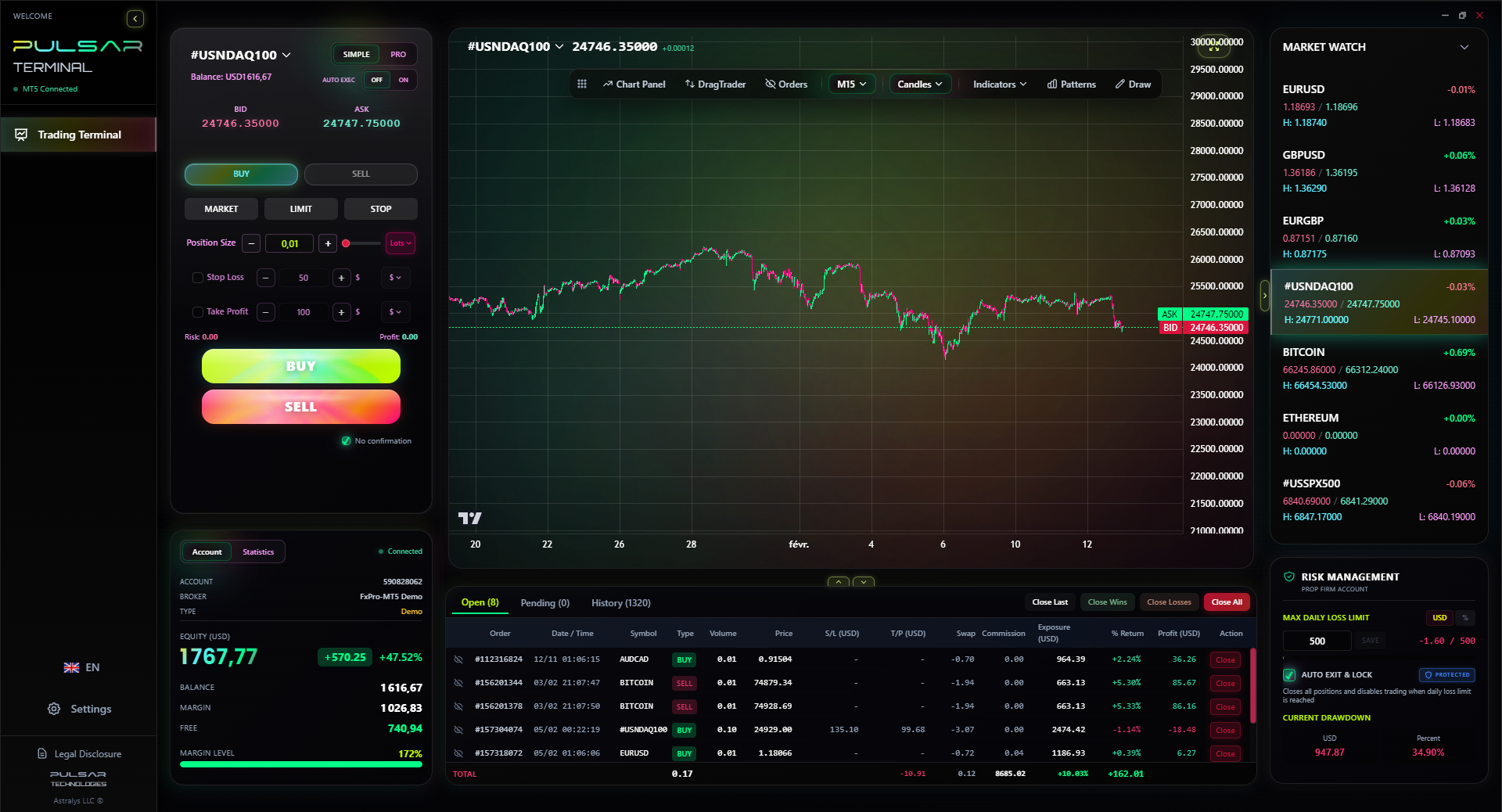
The key is to not get attached to a platform. Your edge should be in your strategy, not in your ability to click buttons on MT5. Be prepared to adapt. I now keep my main analysis on TradingView and just use the execution platform to place and manage trades. Tools that bridge this gap, like Pulsar Terminal for MT5, become less relevant in this new multi-platform world, unless your specific firm still offers MT5 access through a broker partnership.
Managing multiple partial take-profits and trailing stops is key to surviving prop firm drawdown rules, and a tool like Pulsar Terminal automates this complex order management directly on supported platforms.
After blowing up, passing, getting stiffed, and finally finding a reliable setup, here's my distilled advice for a US trader in 2026.
- Start Small, Think Big. Buy the smallest, cheapest evaluation the firm offers. Your goal is to learn their rules and platform quirks. A $50,000 account challenge has the same rules as a $10,000 one. Prove you can navigate the minefield with less capital at risk.
- Trade Like a Robot. Your evaluation trades should be boring. Use hard stops every single time. Your risk per trade should be a fraction of the daily loss limit. I never risk more than 0.25% of the account balance per trade in an eval. It feels painfully slow, but it's the only way to avoid the random margin call from a volatile spike.
- Document Everything. Screenshot your challenge start, your progress, your payout request, and the confirmation. If a firm gives you any trouble, you have evidence. The reputable firms won't mind this at all.
- Withdraw Early, Withdraw Often. Once funded, request your first payout as soon as you're eligible. Don't let profits accumulate. A firm that pays your first $500 quickly is a firm that's likely to pay your $5,000 later. This is the ultimate stress test.
- Have a Real Broker Account. Never rely on a prop firm as your sole trading income. Keep your own Exness or Pepperstone account alive with a small amount of capital. Prop firm payouts are a fantastic performance bonus, but they are not a salary. The regulatory sword of Damocles is always hanging over this industry.
, finding prop firms that accept us clients is a filtering exercise. You're filtering for financial stability, transparent rules, and a history of timely payouts - not for the highest profit split or the shiniest ad. The firms that survived the 2024-2025 purge are, generally, tougher and more real. That's good for you. It means if you can pass their gauntlet, you might actually get paid.
FAQ
Q1Why did so many prop firms stop accepting US clients?
Two main reasons: 1) Increased regulatory scrutiny from the CFTC and SEC, questioning their business model. 2) A February 2024 crackdown by MetaQuotes (maker of MT4/MT5) that revoked platform licenses from prop firms serving US clients without a formal broker partnership. This made it operationally impossible for many firms.
Q2Is it legal for US residents to trade with prop firms?
It's a legal gray area, not explicitly illegal. The trader isn't breaking laws. The prop firm bears the legal risk by structuring itself as an educational/evaluation service using a broker's licensed platform. The legality hinges on the firm's specific structure and partnerships, which is why many have exited the US market to avoid the risk.
Q3What's the biggest difference for US clients now vs. before 2024?
The platform. Before 2024, you'd likely use MT4/MT5. Now, you'll probably use cTrader, DXtrade, Match-Trader, or trade directly via TradingView. The environment shifted away from MetaQuotes almost entirely for US-focused prop firms.
Q4Do US prop firm traders pay taxes on their profit splits?
Yes. The IRS treats profit splits from prop firms as ordinary income (or business income if you're structured as a business). You will receive a 1099-MISC or similar form from the firm if they are US-based. If the firm is offshore, you are still legally required to report the income. Consult a tax professional.
Q5What's a realistic profit split for a US trader?
80/20 is still the standard benchmark, but it's a split of net profits (after commissions/fees). Due to higher operational costs for US-friendly firms, commissions can be steeper. A realistic effective take-home after all costs is often between 60-75% of your gross trading profits.
Q6Are there any prop firms that offer MT5 to US clients in 2026?
Very few, and only if they have a direct, legitimate partnership with a regulated US broker that provides the MT5 license. If a firm casually offers MT5, it's a major red flag. Always ask for the name of the broker partner providing the platform.
Q7Should I use a VPN to join a prop firm that blocks the US?
Absolutely not. This violates their terms of service and likely constitutes fraud. If you pass and make money, they will discover your location during KYC (Know Your Customer) verification for payout and will close your account, keeping all profits. It's a surefire way to lose your evaluation fee.
Pelajaran Prof. Winston
:
- ✓Treat evaluation fees as tuition, not investment.
- ✓Daily loss limits kill more accounts than bad analysis.
- ✓Net profit splits are far lower than advertised gross splits.
- ✓Your first payout is the only proof that matters.
Sejauh mana artikel ini berguna?
Klik bintang untuk menilai
Pandangan Dagangan Mingguan
Analisis & strategi mingguan percuma. Tiada spam.
Tentang Penulis
James Mitchell
Penganalisis Dagangan Kanan
Berpangkalan di New York dengan lebih 9 tahun pengalaman perdagangan. Fokus pada pasangan USD utama, cabaran prop firm, dan landskap peraturan AS.
Komen
Anda mungkin juga suka

Cara Trading Forex Sukses: 7 Prinsip dari Trader Profesional
Cara trading forex sukses dengan 7 prinsip trader pro: manajemen modal, disiplin, journal trading, backtest. Data nyata, bukan janji profit palsu.
Jam Trading Forex Terbaik untuk Trader Indonesia: Panduan Lengkap dengan Tabel Waktu
Panduan jam trading forex untuk trader Indonesia. Tabel 4 sesi dunia, jam emas 20:00-00:00, sesi mana yang harus dihindari. Data akurat + tips dari trader berpengalaman.
Top 5 Sàn Forex Uy Tín Nhất 2026: Review Jujur dari Trader Indonesia
Top 5 sàn forex uy tín 2026 untuk trader Indonesia. Review jujur: spread, deposit, withdraw, dukungan lokal. Exness, XM, IC Markets & lebih.
All these calculators are built into Pulsar Terminal with real-time data from your MT5 account. One-click position sizing, automatic risk management, and instant calculations.
