


Over 90% of traders who sign up for a prop firm challenge fail it.

Rajesh Sharma
Penganalisis Forex Kanan ·  India
India
☕ 12 minit baca
Apa yang akan anda pelajari:
- 1Is This Even Legal? The SEBI & RBI Reality Check
- 2The Game: How Prop Firm Challenges Actually Work
- 3The Real Cost: Fees, Splits, and Hidden Traps
- 4Firms Used by Indian Traders: A Quick Comparison
- 5The Rules That Will Break You (And How to Survive Them)
- 6Prop Firm vs. Your Own Broker Account: The Real Choice
- 7Getting Started: A Step-by-Step Plan for Indians

Over 90% of traders who sign up for a prop firm challenge fail it. That's not a guess, it's the industry's dirty little secret. In India, the dream of trading with a firm's capital is sold hard, but the reality is a minefield of rules, fees, and psychological tests designed to keep your money, not give you theirs. I've seen traders blow ₹50,000 on challenge fees before they even place a real trade. Let's cut through the marketing and look at what these prop trading firms in India actually offer, what they cost, and whether you stand a chance.
This is the first question every Indian trader asks, and for good reason. The short answer is yes, but with massive caveats that most firms won't highlight in their ads.
You're not dealing with a typical broker. These international prop firms operate on a specific model: they sell you an evaluation service (a 'challenge'), not an investment. If you pass, they grant you a simulated account with virtual capital. Your profits and losses in that sim are tracked, and if you're profitable, they pay you a share from their own capital pool. Because they're not pooling investor funds or offering securities in India, they typically don't need SEBI registration. Your payment for the challenge is for a service, not a deposit.
However, your involvement is governed by two key Indian regulators. The Reserve Bank of India (RBI) oversees your foreign exchange transactions under the Liberalised Remittance Scheme (LRS). You're allowed to pay for international services, including these challenge fees. More critically, you must report any profit payouts as income for tax purposes. I've had students get tripped up here, forgetting that a payout in USDT is still taxable income in INR.

Warning: SEBI is actively scrutinizing this space. In 2025, they moved to clearly define 'proprietary trading' and are cracking down on the misuse of prop terminals by local brokers. While international firms sit in a grey area, the regulatory winds are shifting. Always ensure any firm you use has transparent terms and a clear track record of payouts to Indian residents.
The real legal risk isn't you getting in trouble for trading. It's you sending ₹25,000 to a fly-by-night operation that vanishes when you hit your profit target. Due diligence is non-negotiable.

💡 Petua Winston
Your first prop firm challenge fee is tuition, not an investment. Budget for at least three failures before you even think about passing.

Forget the 'get funded fast' hype. The model is a sophisticated filter. Here’s the standard two-stage gauntlet.
The Evaluation Phase (The 'Challenge')
You pay a fee (say, ₹8,000 for a $50,000 account). You get a demo account with strict rules:
- Profit Target: Usually 8-10%. On a $50K account, that's $4,000-$5,000.
- Daily Loss Limit: Often 3-5%. Hit that, and your challenge is failed. No second chances that day.
- Maximum Drawdown: Your account equity can never fall below a certain level from the starting balance, typically 6-10%. This is the silent killer. It's tracked including open positions and floating losses.
- Minimum Trading Days: You might need to trade for 5-10 days minimum. This stops you from hitting a single lucky trade and passing.
You have 30 days, maybe more, to hit the target without breaching any rule. Sounds simple? It's designed to be the opposite.
The Funded Account Phase
If you pass, you get a 'funded' account. The rules often relax slightly, but new ones appear. Now you have a 'consistency rule.' Your biggest winning day in a payout period can't be more than, say, 30-40% of your total profits. This prevents a risky, all-in strategy. You then get a profit split, commonly 80% to you, 20% to the firm. Some offer 90/10 or even a 100% split for a higher monthly fee.

Example: You pass a $100,000 challenge. In your first payout period, you make $6,000 in profit. With an 80/20 split, you request a withdrawal of $4,800. The firm processes it (usually weekly or bi-weekly). Your account balance is reset to $100,000, and you keep trading.
The entire system is built to find consistently disciplined traders, not lucky gamblers. Most retail traders are the latter, hence the 90% failure rate. Your first lesson in swing trading or any strategy here is learning to manage these rules, not just the market.

“The advertised 'account size' is a fantasy. What you're really buying is the right to be tested.”
Let's talk numbers in Rupees, because that's what matters to your wallet. The advertised 'account size' is a fantasy. What you're really buying is the right to be tested.
Upfront Challenge Fees: This is your ticket to play. For a standard evaluation:
- $10,000 Account: ~ ₹4,200 - ₹6,300
- $50,000 Account: ~ ₹8,400 - ₹12,600
- $100,000 Account: ~ ₹16,800 - ₹25,200
- $200,000+ Account: ₹33,600+
These are non-refundable. Some firms offer 'free retries' or discounts on a second attempt if you fail, but that's just marketing to get you to pay again.
Profit Splits: This is where they hook you. 80% to you sounds amazing. But remember, you only get this after passing the challenge and after making profits that exceed any minimum withdrawal threshold. That 80% is also of the net profit, not gross. If you have a losing week, you dig yourself out before you see a paisa.
The Scaling Plan Myth: Many firms promise to add more capital to your account if you perform well. The targets for scaling are often aggressive, pushing you to take more risk just when you should be consolidating. I've seen traders with a comfortable $100K account blow up trying to hit the unrealistic target to get to $150K.
Payment Methods: For Indian traders, UPI is a godsend for paying challenge fees - instant and low-cost. For receiving payouts, bank transfers (INR) or USDT (crypto) are most common. Factor in any forex or crypto conversion fees the firm or your bank might charge. That 80% split can quickly become 75% after fees.
The biggest hidden cost? Opportunity cost and psychological damage. Spending six months and ₹50,000 failing challenges could have been spent building your own capital with a solid position size calculator and a proven strategy. I made this mistake early on, chasing the big account number instead of building my skills with what I had.

I won't tell you which is 'best' - that depends on your style. But here are the ones I see my Indian students using most, with the cold facts.
| Firm | Key Feature for Indians | Big Catch | Payout Method for India |
|---|---|---|---|
| FTMO | The old-school name. High trust factor. | One of the most expensive challenge fees. Strict consistency rules. | Bank Transfer (INR), Crypto, Wise |
| The5%ers | Growth-focused model. They increase your capital aggressively. | Higher profit targets for scaling. Can pressure your strategy. | Bank Transfer, Crypto |
| Blue Guardian | Lower fees, instant funding options. Popular for scalping strategy. | Relatively new. Always verify recent payout reviews. | Crypto (USDT), Bank Transfer |
| FundedNext | Offers 'stretchy' drawdowns and balance-based rules. | The rules can be confusing. You must read the dashboard carefully. | Crypto, Bank Transfer, UPI (for fees) |
| True Forex Funds | Known for good trading conditions on MT4/MT5. | Had a major blow-up in 2024, restructured. Proceed with caution. | Crypto, Bank Transfer |
My personal experience? I used FTMO years ago. Passed a $100K challenge on my second try (first try, I blew the daily loss on a volatile XAU/USD move). The payout was smooth via USDT. But the monthly fee for the account, even with profits, ate into returns. I found it more stressful and less profitable than growing my own capital with a broker like Pepperstone where I had full control.

Pro Tip: Don't get seduced by the largest account size. Start small. A $10,000 challenge tests your discipline just as well as a $100,000 one, and it costs you a fraction when you inevitably fail the first few times. Your goal is to learn the process, not get rich on attempt one.
💡 Petua Winston
The 'Maximum Drawdown' rule isn't a line in the sand; it's a cliff edge. Always calculate your risk so a full stop-loss hit keeps you miles away from it.
“Over 90% of traders who sign up for a prop firm challenge fail it. That's not a guess, it's the industry's dirty little secret.”
This is where mentors earn their keep. The trading rules aren't just guidelines, they are the primary opponent.
1. The Daily Loss Limit (The Guillotine): This is the most common killer. It's usually a percentage of the initial balance, not your current equity. On a $50K account with a 5% daily loss limit, you have $2,500. Lose that from your starting point, game over. This forces absurdly conservative position size calculator use. A few bad trades in a morning session, and you're done for the day, watching a potential recovery happen without you.
2. The Maximum Drawdown (The Silent Killer): This is the trickiest. It's often a trailing drawdown from the starting balance or the highest equity. If your challenge starts at $50,000 with a 10% max drawdown, your account cannot fall below $45,000 at any point, including during open trades. If you're in a trade that goes $4,000 against you, even if you think it will come back, the system will fail you the moment your equity hits $45,000.01. This rule alone invalidates many common 'hold and hope' strategies.
3. The Consistency Rule (The Dream Crusher): You pass the challenge, get funded, and start making money. Then you have a monster win. If that single day's profit is more than, say, 30% of your total profits for the payout period, you can be flagged or even have your account revoked. They want steady, boring profits, not lottery tickets. This rule actively punishes the home-run mentality many traders have.
Survival Tactics:
- Your risk per trade must be tiny. Think 0.5% of the account, not 1-2%.
- Use a trailing stop or breakeven function aggressively to protect open profits and guard the max drawdown. (This is where a tool that automates this on MT5 is useful).
- Treat the daily loss limit as a hard stop for the entire day. If you're down 2%, walk away. Live to trade tomorrow.
- The rules make tools like the RSI indicator or MACD indicator almost secondary. Your primary indicator is your account equity screen.

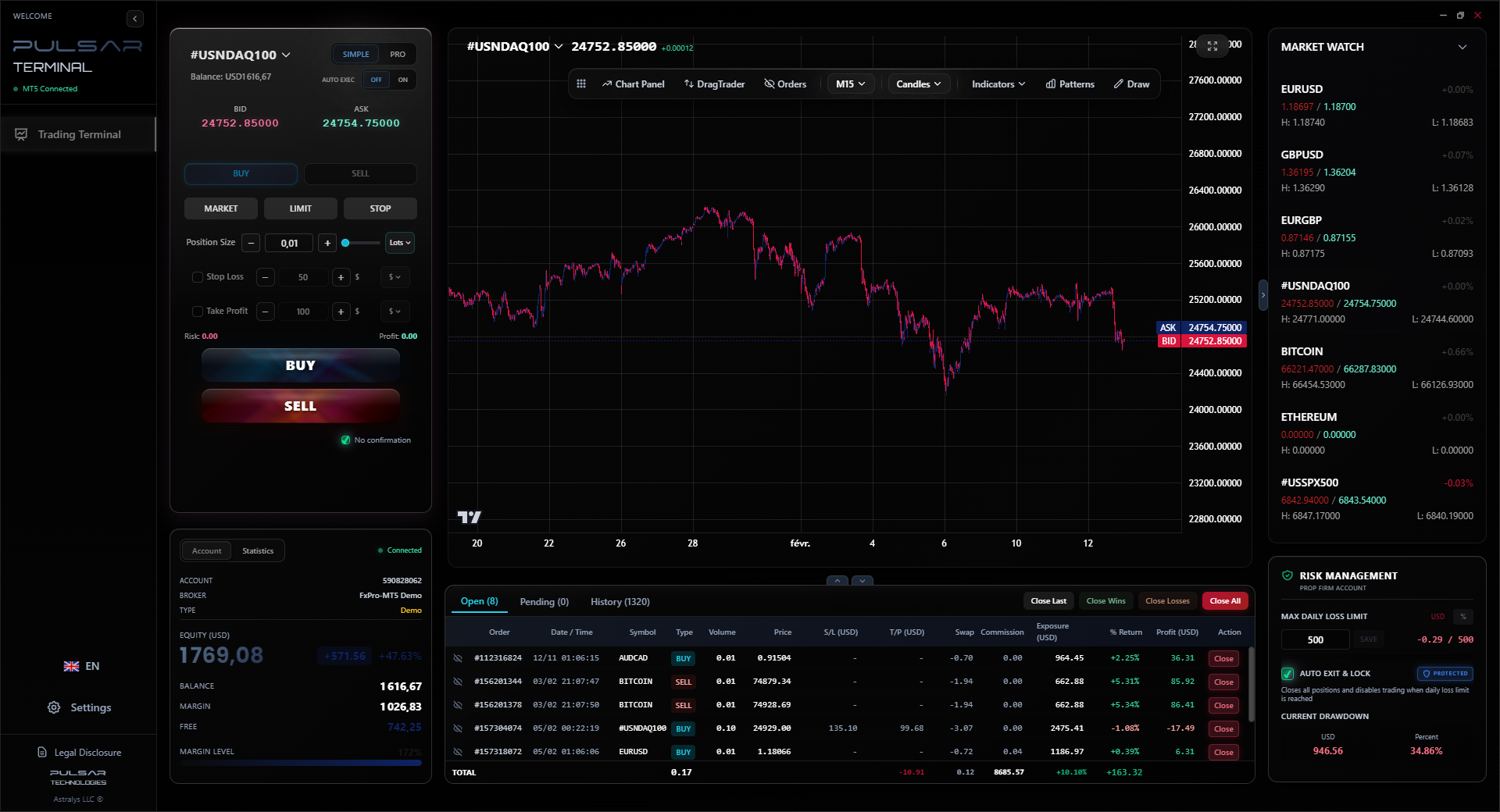
Managing prop firm rules like daily loss and max drawdown is a constant manual headache; Pulsar Terminal automates this monitoring and can protect your account directly on your MT5 platform.
This is the core strategic decision. Why give 20% of your profits to a firm and follow their draconian rules when you can keep 100% and trade freely?
The Case for a Prop Firm:
- Capital Access: It's the only reason. If you have ₹50,000 in savings, trading a $100,000 prop account (simulated) gives you exposure to larger moves. It's use without a margin call from your broker (though the firm's rules are worse).
- Forced Discipline: The rules, if you can follow them, instill brutal risk management. This is valuable training.
- No Direct Financial Risk: You can't lose more than your challenge fee. Your personal savings are safe.
The Case for Your Own Broker (Like IC Markets or Exness):
- Keep All Profits: That 20% saved compounds dramatically over time.
- Complete Freedom: Trade any style, hold trades as long as you want, no consistency rules. Your swing trading plan is yours to execute.
- True Ownership: You build your own capital. A $10,000 personal account you grow to $15,000 is all yours, forever. A $100,000 prop account can be revoked if you break a rule.
- Lower Long-Term Cost: After a few payouts, the total fees paid to a prop firm could have been seed capital in your own account.
I have two accounts. A personal one with IC Markets that I've nurtured for years, and a small prop account I use to keep my discipline razor-sharp. The prop account makes money, but my personal account is my real wealth builder. The prop firm is a gym; your broker account is the real sport.
“The prop firm is a gym; your broker account is the real sport.”
If you're determined to try, here's how to not waste your money.
Step 1: Master a Strategy First, For Real. Do not use the prop challenge as a learning platform. That's like paying ₹10,000 to take your driving test having never driven. Take your own capital, even if it's just ₹20,000 in a demo or a small live account with XM, and trade for 6 months. Be consistently profitable. Use a journal. Understand your win rate, average win/loss. The prop firm will test this consistency mercilessly.
Step 2: Choose the Smallest, Cheapest Challenge. Start with a $10,000 or $25,000 account. The goal of your first challenge is NOT to pass. The goal is to learn how to pass. Expect to fail. Your ₹4,200 fee is tuition. Did you blow the daily loss? Did you misunderstand the drawdown? Learn. Adjust.
Step 3: Simulate the Rules Religiously. Before you pay a paisa, trade your personal account as if you were in a challenge. Set your own daily loss limit. Track your drawdown from a fixed starting point. Enforce a minimum trading day rule. This mental practice is priceless.
Step 4: Execute and Withdraw. If you pass, trade the funded account even more conservatively. The pressure to perform is immense. Withdraw your first profit share as soon as you're eligible. Getting that first payout into your Indian bank account is a psychological milestone that makes it real.
Step 5: Re-evaluate. After 3-6 months of being funded, ask yourself: Is the stress of their rules worth the 80% split? Could I have made more by focusing this energy on my own capital? For many, the answer leads them away from prop firms and towards becoming their own fund manager. And that's the real endgame.
💡 Petua Winston
If you can't be consistently profitable with a $5,000 personal account, you have zero business in a $100,000 prop challenge. The size of the account doesn't change you, it just magnifies your mistakes.

FAQ
Q1Do I need to pay tax on profits from prop trading firms in India?
Absolutely, yes. Any profit payout you receive, whether in USD, INR, or crypto, is considered taxable income under the head 'Income from Business or Profession' or 'Other Sources' in India. You must convert the foreign currency amount to INR at the prevailing RBI rate on the date of receipt and include it in your ITR. Keep all payout records.
Q2What is the success rate for Indian traders in prop firm challenges?
The global failure rate is 80-90%, and there's no reason to believe it's different for Indians. The rules are universal and designed to filter out most applicants. Success requires pre-existing, proven discipline. Most who pass have already been profitable with their own capital for a significant period.
Q3Can I use UPI to pay for prop firm challenges?
Most major international prop firms now accept UPI for challenge fees, as it's the dominant payment system in India. It's fast and avoids international transaction charges. For profit payouts, however, you'll typically receive funds via international bank transfer or cryptocurrency (like USDT).
Q4Is hedging or using Expert Advisors (EAs) allowed?
It depends entirely on the firm's specific policy. Many firms now allow both hedging and EAs, but you must check their FAQ. Some prohibit certain high-frequency EAs or arbitrage strategies. Never assume it's allowed - violating this rule leads to instant account termination and loss of fees.
Q5What happens if I breach a rule by a very small amount, like 0.1%?
You fail. Immediately and automatically. The rules are algorithmically enforced with zero tolerance. There is no 'warning' or 'leniency for a small breach.' The system is binary: within limits or failed. This is why precise position size calculator use and constant equity monitoring are critical.
Q6Are there any Indian-owned prop trading firms?
The classic retail-facing 'challenge' model is dominated by international firms. In India, 'proprietary trading' typically refers to the desks of registered stockbrokers (like Zerodha's proprietary book) who trade the firm's capital, not offer funded accounts to the public. SEBI's new regulations are clarifying this space, making true Indian versions of FTMO less common due to regulatory complexity.
Pelajaran Prof. Winston
:
- ✓Treat your first ₹5,000 challenge fee as a learning cost, not an investment.
- ✓The Maximum Drawdown rule fails more traders than the market itself.
- ✓Master a strategy with your own capital before you ever pay for a challenge.
- ✓A funded $100K account is less valuable than a personally-owned $20K account.
Sejauh mana artikel ini berguna?
Klik bintang untuk menilai
Pandangan Dagangan Mingguan
Analisis & strategi mingguan percuma. Tiada spam.
Tentang Penulis
Rajesh Sharma
Penganalisis Forex Kanan
Lebih 10 tahun berdagang di pasaran India dan Asia Selatan. Bermula dengan derivatif mata wang NSE sebelum beralih ke forex antarabangsa. Pakar dalam pasangan USD/INR dan pasaran membangun.
Komen
Anda mungkin juga suka

Cara Trading Forex Sukses: 7 Prinsip dari Trader Profesional
Cara trading forex sukses dengan 7 prinsip trader pro: manajemen modal, disiplin, journal trading, backtest. Data nyata, bukan janji profit palsu.
Jam Trading Forex Terbaik untuk Trader Indonesia: Panduan Lengkap dengan Tabel Waktu
Panduan jam trading forex untuk trader Indonesia. Tabel 4 sesi dunia, jam emas 20:00-00:00, sesi mana yang harus dihindari. Data akurat + tips dari trader berpengalaman.
Top 5 Sàn Forex Uy Tín Nhất 2026: Review Jujur dari Trader Indonesia
Top 5 sàn forex uy tín 2026 untuk trader Indonesia. Review jujur: spread, deposit, withdraw, dukungan lokal. Exness, XM, IC Markets & lebih.
All these calculators are built into Pulsar Terminal with real-time data from your MT5 account. One-click position sizing, automatic risk management, and instant calculations.
