


Most traders I meet in Lagos think a pullback is a sign the trend is over.

Olumide Adeyemi
Perintis Dagangan Afrika Barat ·  Nigeria
☕ 10 minit baca
Apa yang akan anda pelajari:
- 1What Exactly Is a Pullback? (It's Not a Reversal)
- 2How to Spot a Real Pullback (And Avoid the Fakeouts)
- 3Your Playbook: Entry, Stop Loss, and Take Profit Strategies
- 4Mistakes We Make in Nigeria (And How to Fix Them)
- 5The Best Tools for the Job (Keep It Simple)
- 6The Mind Game: Psychology of Trading Pullbacks
- 7A Complete Example: From Chart to Profit
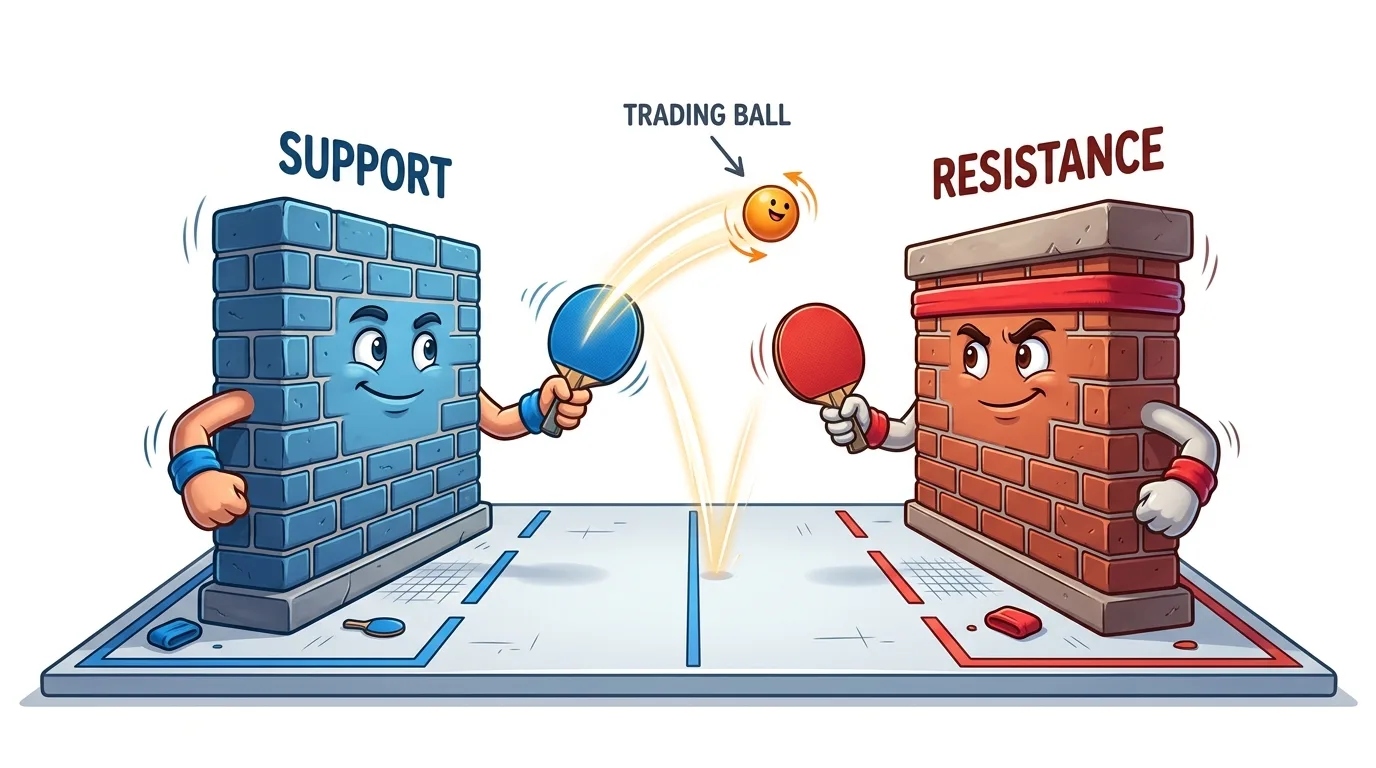
Most traders I meet in Lagos think a pullback is a sign the trend is over. They see price dip after a big move and immediately think 'reversal'. That's how you get stopped out right before the trend resumes and leaves you behind. I've lost more money fighting trends than I care to admit. Let's set the record straight: a pullback isn't your enemy, it's your invitation to join a strong move at a better price.
A pullback is a temporary pause or counter-trend move within a larger, established trend. Think of it like catching your breath during a sprint. The overall direction is still up (or down), but price is taking a quick breather. The key word is temporary.
A reversal, on the other hand, is a permanent change in trend direction. Telling the difference is the whole game. In a healthy uptrend, pullbacks often find support at previous resistance levels, moving averages, or Fibonacci retracement levels. In a downtrend, they find resistance at previous support.
Here's a simple analogy from the Lagos market: If the price of garri goes from ₦500 to ₦800 per bag (a strong uptrend), then dips back to ₦650 for a few days before shooting up again, that's a pullback. If it goes from ₦800 all the way back down to ₦500 and keeps falling, that's a reversal. Your job is to bet on the ₦650 level holding.

Warning: The most common mistake is calling every dip a pullback. In a weak or choppy market, what looks like a pullback is often just random noise. You need a clear, strong trend first. Don't force it.
You can't just buy every dip. You need rules. I look for three things before I even consider a pullback trade.
1. The Context: Is There a Strong Trend?
This is non-negotiable. You need a clear, impulsive price move beforehand. On your chart, higher highs and higher lows for an uptrend, or lower highs and lower lows for a downtrend. I like to use a simple 50-period Exponential Moving Average (EMA) on the 1-hour or 4-hour chart. If price is consistently above it (for uptrend) or below it (for downtrend), you have your context. Trading a pullback in a sideways market is a sure way to lose.
2. The Retracement Depth: How Far Back Is Too Far?
Not all pullbacks are created equal. A shallow pullback is often stronger than a deep one. I primarily use Fibonacci retracement levels. Draw it from the start of the impulsive move to its end.
- Ideal Zone: The 38.2% to 61.8% retracement levels are the sweet spot. This is where institutional players often step back in.
- Warning Zone: A move beyond the 78.6% level starts to look more like a potential reversal. I'm very cautious here.
Let me give you a real example from last month on GBP/USD. There was a strong impulsive move up from 1.2600 to 1.2800 (200 pips). It then pulled back right to the 50% Fib level at 1.2700. That was my signal. I entered a buy, set my stop loss just below the 61.8% level, and rode it back up for a 120-pip gain. Using a position size calculator was crucial here to manage my risk on that stop.
3. The Price Action Signal: The Confirmation
This is your trigger. Price reaching a Fib level isn't enough. You need a sign that buyers (in an uptrend pullback) are stepping back in. I look for:
- A bullish engulfing or pin bar candlestick pattern at the support level.
- A break of a minor downtrend line drawn on the pullback itself.
- Momentum divergence on an oscillator like the RSI indicator showing selling pressure is fading.
Wait for the confirmation. It might mean you enter a few pips later, but it saves you from countless fakeouts.

💡 Petua Winston
The market's job is to make the most people wrong. A deep pullback that shakes out the weak hands often creates the strongest subsequent move. Don't fear it; understand it.

“A pullback isn't your enemy, it's your invitation to join a strong move at a better price.”
Now for the practical part. How do you actually place the trade?
Entry: I use a two-step approach. First, I place a pending buy limit order (for an uptrend pullback) at my key level, say the 50% Fib. But I only allocate half my intended position size. If I get a strong price action confirmation candle, then I enter the second half of my position on a market order. This averages my entry and confirms momentum.
Stop Loss: This is critical. Your stop must be placed where your pullback thesis is proven wrong. For a buy on a pullback, that's below the next significant support level. Often, this is just below the 61.8% or 78.6% Fib level. Never place your stop loss arbitrarily. If the stop is too tight, you'll get taken out by normal market noise. I learned this the hard way early on, getting stopped out of perfect trades because I was scared of a 30-pip loss, only to watch the trade go 150 pips in my direction.
Take Profit: I'm a fan of multi-target exits. Here’s a typical structure for a 100-pip risk (stop loss distance):
- TP1: At 50 pips profit (1:0.5 risk-reward). Close 30-50% of position. This covers costs and locks in some profit.
- TP2: At the previous swing high (the start of the pullback). This is a 1:1 or better reward.
- TP3: Let a portion run, using a trailing stop to capture any extended trend move.
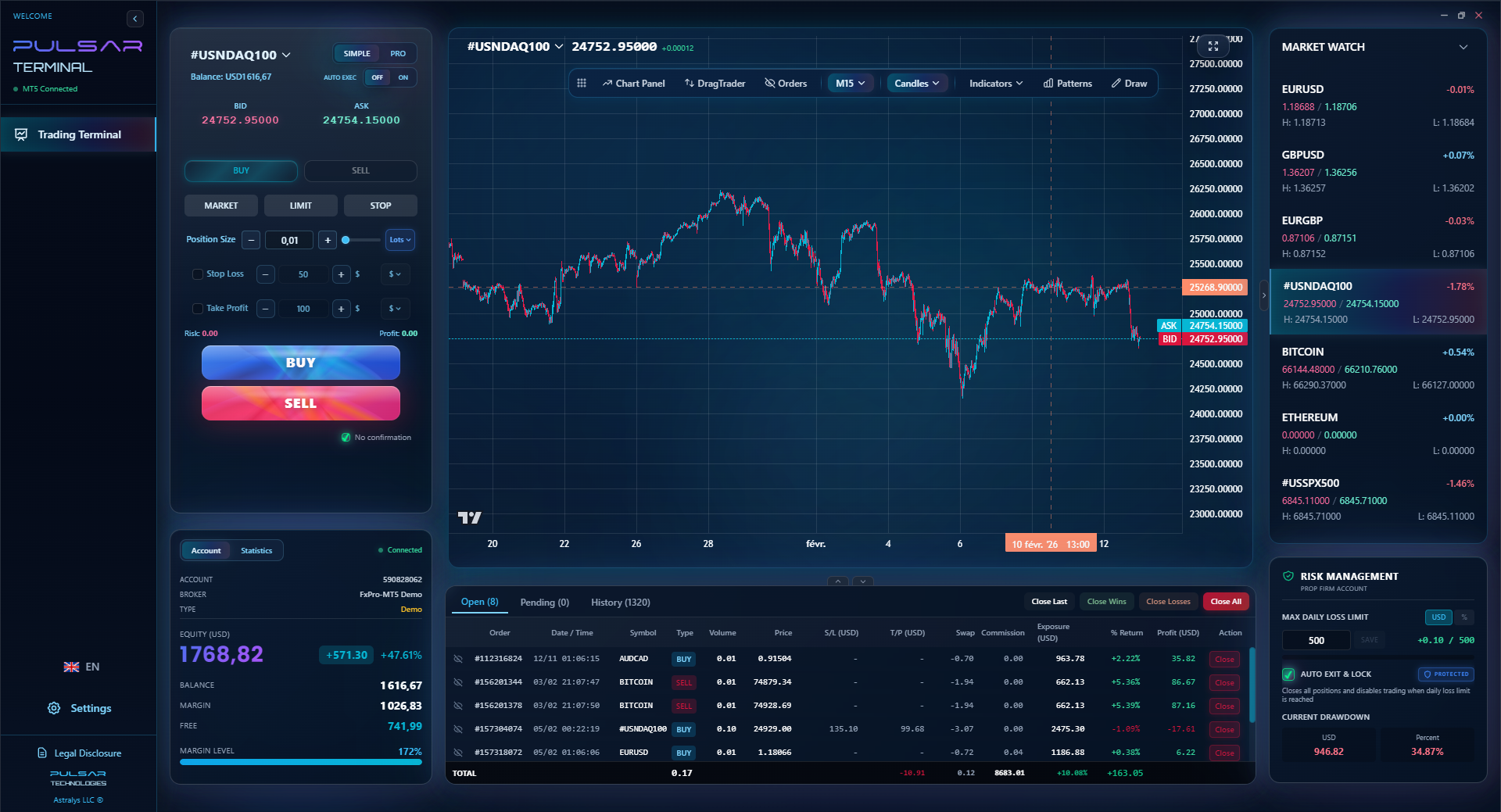
This method takes the emotion out of it. You're not praying for one big win; you're executing a plan. This structured approach to multiple targets is something tools are built for, letting you set it all up with one click instead of manual orders.
Managing multi-target exits and trailing stops manually on MT5 is clunky, but Pulsar Terminal lets you set the entire plan with one drag-and-drop order.
Let's get local. I've seen these patterns repeat in trading groups from Abuja to Port Harcourt.
1. Chasing the Pullback Too Early: We see the trend, see the first tiny dip, and jump in. That's not a pullback; that's just a minor pause. Wait for the move to actually develop and reach a logical level of support/resistance. Patience isn't just a virtue here, it's a profit center.
2. Ignoring Higher Timeframes: You're looking at a nice pullback on the 15-minute chart, but on the 4-hour, the market is clearly in a range. The higher timeframe always wins. Always check the daily and 4-hour chart for trend direction before executing on a lower timeframe. This is a core principle of swing trading that applies here.
3. Risking Too Much on 'Sure Things': A pullback trade looks so logical, so obvious, that you're tempted to double your usual position. This is a trap. No trade is a sure thing. A sudden news event can blow through your level. Always use consistent position sizing. I once risked 5% on a 'textbook' EUR/NGN pullback setup that got ruined by a central bank announcement. It took two weeks of good trades to recover that loss.
4. Not Accounting for the Spread: With some currency pairs and certain brokers popular here, the spread definition can be wide, especially during off-peak hours. If your target is only 15 pips away and the spread is 3 pips, you've already given up 20% of your potential profit. Factor this in. Stick to major pairs like EUR/USD during active sessions, or use brokers known for tight spreads like IC Markets or Pepperstone.
💡 Petua Winston
Your first profit target should be to recover your spread and commission. Taking partial profit there turns the rest of the trade into a 'free ride' and removes immense psychological pressure.

“Wait for the confirmation. It might mean you enter a few pips later, but it saves you from countless fakeouts.”
You don't need a dashboard full of flashing indicators. These are my essentials.
| Tool | Purpose | How I Use It |
|---|---|---|
| Fibonacci Retracement | Identify potential pullback depth. | Drawn from swing low to high (uptrend) or high to low (downtrend). Watch 38.2%, 50%, 61.8%. |
| Moving Averages | Define trend and dynamic support/resistance. | 50 & 200 EMA. In an uptrend, price often pulls back to the 50 EMA. |
| Horizontal S/R Levels | Identify static areas where price may react. | Previous daily highs/lows, weekly opens. |
| RSI or MACD | Gauge momentum during the pullback. | Look for bullish/bearish divergence as price reaches support/resistance. The MACD indicator histogram can show fading momentum. |
That's really it. The chart itself - the candlesticks and price action - is your most important tool. All the indicators do is help you read the story price is already telling.

Pro Tip: Combine tools for confluence. The strongest setups occur when price pulls back to a Fibonacci level that also aligns with a moving average and a previous horizontal support level. Three reasons for price to bounce are better than one.

This is where most fail. Trading a pullback feels wrong psychologically. You're buying when price is falling, or selling when it's rising. It goes against your gut.
The Feeling of Being 'Wrong': From the moment you enter, the price might continue going against you for a bit. That floating loss messes with your head. You start questioning your analysis. This is why your pre-defined stop loss is sacred. It's your "I was wrong" exit point. Without it, a small pullback trade can turn into a hope-and-pray disaster that triggers a margin call.
The Need for Patience: Sometimes the pullback takes time. It might consolidate for hours or days before resuming. You need the patience to hold your valid setup and not close it out of boredom. Conversely, you need the patience to wait for the setup to fully form instead of jumping in early.
My rule: Once the trade is on and my stops and targets are set, I walk away. I might set a price alert, but I don't sit and watch the screen. I learned this after ruining a perfect XAU/USD (gold) pullback trade by micromanaging it and exiting early with a tiny profit, missing a $40 per ounce move.
Remember, you're not trading to be right on every single candle. You're trading to execute a high-probability plan over dozens of trades. Let the probabilities work.

“You're not trading to be right on every single candle. You're trading to execute a high-probability plan over dozens of trades.”
Let's walk through a recent trade I took on USD/NGN using a parallel market rate (always be mindful of where you're executing).
- Trend Identification: On the 4-hour chart, USD/NGN was in a clear uptrend, making higher highs and higher lows, holding above the rising 50 EMA.
- Impulse Move: Price rallied from ₦1,450 to ₦1,520.
- The Pullback: Price started declining back towards the 50 EMA. I drew my Fib from ₦1,450 (low) to ₦1,520 (high).
- The Setup: Price stalled right at the 61.8% Fib level (₦1,478) which also coincided with the 50 EMA and a previous minor resistance-turned-support level. Confluence.
- The Trigger: A 4-hour bullish engulfing candle formed at that exact zone.
- The Trade: I entered a BUY at ₦1,480. My stop loss was placed at ₦1,470, below the 78.6% Fib. That's a 10 Naira risk per unit.
- The Management:
- TP1: ₦1,495 (15 Naira profit, closed 40% of position).
- TP2: ₦1,510 (30 Naira profit, closed another 40%).
- I let the final 20% run with a trailing stop, which was eventually hit at ₦1,525.
This is the blueprint. Find the trend, wait for the pullback to a logical zone, get confirmation, execute with defined risk, and manage your exits mechanically. It's not sexy, but it's profitable. For those who trade fast, a similar disciplined approach is key for a scalping strategy, just on a compressed timeline.
FAQ
Q1What's the best timeframe to trade pullbacks?
There's no single 'best', but a multi-timeframe approach works well. Identify the primary trend on the 4-hour or daily chart. Then, look for the pullback and your entry trigger on the 1-hour or 30-minute chart. This ensures you're trading in the direction of the larger trend.
Q2How do I know if it's a pullback or a reversal?
You never know for sure until after the fact. That's why we use stop losses. Signs of a reversal include price breaking key trend structures (like making a lower low in an uptrend), breaking major moving averages with momentum, and showing strong, impulsive price action against the old trend. A pullback tends to be more choppy and hesitant.
Q3Can I trade pullbacks with a small account?
Absolutely, but you must be extra disciplined. Your position size needs to be tiny so that your stop loss (which must be placed at a logical, wider level) doesn't risk a large percentage of your account. Use a position size calculator religiously. A common mistake with small accounts is using a stop loss that's too tight just to reduce risk, which gets you stopped out prematurely.
Q4Which forex pairs are best for pullback trading?
Pairs with strong, clear trends and good liquidity. Major pairs like EUR/USD, GBP/USD, and USD/JPY are excellent. Avoid exotic pairs or pairs that are known for being range-bound during your trading session. Gold (XAU/USD) also often exhibits clean trend and pullback behavior.
Q5What if the pullback goes past my entry level and hits my stop loss?
That means your analysis was wrong for this trade. It happens. The key is that your stop loss did its job and protected you from a much larger loss. Do not re-enter immediately out of frustration. Go back to the charts. If the break of your level was powerful, it might now be a reversal. If it was a false break (wick through your level then a quick recovery), you might get a new signal. Wait for fresh confirmation.
Q6Is pullback trading suitable for beginners in Nigeria?
It's one of the more logical strategies for a beginner to understand conceptually. However, the discipline required - waiting, not chasing, accepting you'll be wrong sometimes - is the hard part. Start in a demo account. Practice identifying clear trends and drawing Fibonacci levels. Paper trade for at least a month before risking real money. Also, ensure you use a reputable, well-regulated broker like XM or Exness that offers a proper demo environment.
Pelajaran Prof. Winston
:
- ✓Always define the primary trend first; no trend, no pullback trade.
- ✓The 38.2%-61.8% Fibonacci zone is the high-probability entry area.
- ✓Place your stop loss where the pullback thesis is invalidated, not where your pain threshold is.
- ✓Use multi-target exits: secure partial profits early, let winners run.
- ✓A single confirmed signal at a level of confluence is worth ten early entries.
Sejauh mana artikel ini berguna?
Klik bintang untuk menilai
Pandangan Dagangan Mingguan
Analisis & strategi mingguan percuma. Tiada spam.
Tentang Penulis
Olumide Adeyemi
Perintis Dagangan Afrika Barat
Salah seorang pendidik dagangan forex paling aktif di Nigeria. 8 tahun pengalaman dagangan dari Lagos. Pakar dalam strategi modal rendah dan cabaran prop firm untuk pedagang Afrika.
Komen
Anda mungkin juga suka

Cara Trading Forex Sukses: 7 Prinsip dari Trader Profesional
Cara trading forex sukses dengan 7 prinsip trader pro: manajemen modal, disiplin, journal trading, backtest. Data nyata, bukan janji profit palsu.
Jam Trading Forex Terbaik untuk Trader Indonesia: Panduan Lengkap dengan Tabel Waktu
Panduan jam trading forex untuk trader Indonesia. Tabel 4 sesi dunia, jam emas 20:00-00:00, sesi mana yang harus dihindari. Data akurat + tips dari trader berpengalaman.
Top 5 Sàn Forex Uy Tín Nhất 2026: Review Jujur dari Trader Indonesia
Top 5 sàn forex uy tín 2026 untuk trader Indonesia. Review jujur: spread, deposit, withdraw, dukungan lokal. Exness, XM, IC Markets & lebih.
All these calculators are built into Pulsar Terminal with real-time data from your MT5 account. One-click position sizing, automatic risk management, and instant calculations.
