


Let me be straight with you: most Nigerian traders who try scalping forex end up funding their broker's next luxury car, not their own account.

Olumide Adeyemi
Perintis Dagangan Afrika Barat ·  Nigeria
☕ 13 minit baca
Apa yang akan anda pelajari:
- 1What Forex Scalping Really Is (It's Not What You Think)
- 2The Nigerian Regulatory Maze: Can You Even Scalp Legally?
- 3The Real Costs of Scalping for a Nigerian Trader
- 4Choosing a Broker & Setting Up Your Battle Station
- 5A Simple, Tested Scalping Strategy & The Trader's Mindset
- 6Pitfalls That Will Wreck Your Nigerian Scalping Account
- 7Final Verdict: Is Scalping Forex Right for You in Nigeria?
Let me be straight with you: most Nigerian traders who try scalping forex end up funding their broker's next luxury car, not their own account. I've seen it a hundred times. The promise of quick, small profits is intoxicating, especially when you're trading with limited capital. But the reality is a grind that chews up beginners and spits them out. I know because I was one of them. In this guide, I'm not selling you a dream. I'm showing you the exact mechanics, the real numbers, and the psychological toll of trying to scalp the Naira pairs and majors from Lagos. I'll prove why this strategy demands more discipline than any other, and who it actually works for.
When Nigerian traders hear 'scalping,' they picture clicking buttons all day and watching money roll in. That's the fantasy. The reality is sitting for six hours to make two good trades that net you $15 after costs. Scalping is the art of capturing tiny price movements, usually 5 to 20 pips, and getting out before the market turns. You're not hunting for 100-pip swings. You're a mosquito, trying to sip a little blood without getting swatted.
In our market, this often means trading the EUR/USD or GBP/USD during the London session overlap, or even the USD/NGN non-deliverable forwards (NDFs) if your broker offers them. The goal is frequency. Where a swing trader might aim for 3 good trades a month, a scalper wants 3 good trades a day. But here's the kicker: that frequency is what kills most people. It multiplies your exposure to two deadly things: transaction costs and your own emotions.
I learned this the hard way in 2015. I had a 'system' based on the 1-minute chart and the RSI indicator. I'd take 10 trades a day, aiming for 7 pips each. On paper, that's 70 pips. In reality, the spread was 1.8 pips on my broker's standard account. My 'win' was actually 5.2 pips. Over 10 trades, that's 52 pips in spread costs alone, not counting commissions. I was basically working for the broker. That month, I made 22 pips total after 200 trades. The broker made over 400 pips from me in spreads. Let that sink in.

Warning: Scalping amplifies every flaw in your execution. A slow internet connection in Lagos during a rainstorm? That's a 5-pip slippage. An emotional revenge trade after a loss? That's your daily profit target gone in seconds. This isn't a side hustle; it's a high-intensity job.

💡 Petua Winston
Your first profit target in scalping should be to cover your monthly fixed costs: VPS, data, generator fuel. That's your real 'break-even.'
“Scalping amplifies every flaw in your execution. A slow internet connection in Lagos during a rainstorm? That's a 5-pip slippage.”
This is where it gets messy, and you need to pay close attention. There's no law against you, as an individual, using your own money to trade forex. The confusion is about who you can trade with.
For years, we operated in a grey area. You'd sign up with an international broker like Exness or IC Markets, fund with your card, and trade. Simple. But the regulatory goalposts are moving.
The Securities and Exchange Commission (SEC) now has the Investments and Securities Act, 2025 (ISA 2025). This act makes it illegal for any platform to offer online forex trading to Nigerians without being formally registered with the SEC. The aim is to weed out scams, which is good. However, the practical enforcement and the full list of registered entities are still developing.
Meanwhile, the Central Bank of Nigeria (CBN) has its own stance. Some recent interpretations suggest they want Nigerians to only use CBN-approved brokers for forex transactions. But most international brokers popular for scalping aren't CBN-approved; they're regulated offshore (like by the FSA in Seychelles or the CMA in Kenya).
What This Means for Your Scalping
Right now, you can still technically access these brokers. Payment methods might be your first hurdle. Funding an international broker account with your Naira card can be flagged or blocked by your bank, as they enforce CBN directives on forex outflow. This is why e-wallets (Skrill, Neteller) and crypto have become lifelines for many traders.
The biggest risk isn't a knock on your door. It's the withdrawal risk. If regulatory pressure increases, a broker might restrict or slow down withdrawals for Nigerian clients to comply with unclear local rules. Your scalping profits are useless if you can't get them out.
My advice? Stick with large, reputable international brokers that have a long track record of serving Nigerian clients and offer multiple withdrawal options. I've had consistent success with brokers like Pepperstone and XM for withdrawals via crypto and Skrill. Their offshore entities understand our market constraints.

Pro Tip: Always do a small test withdrawal before you commit serious capital to any broker. If they can't return $50 to you smoothly, imagine trying to get $5,000 out later.
“Your scalping profits are useless if you can't get them out of the broker.”
Forget the advertised spreads. Your real cost of doing business has four major components, and they'll make or break your scalping career.
-
The Spread: This is the difference between the buy and sell price. On a standard account for EUR/USD, you might see 1.5 pips. If your profit target is 7 pips, you're already down 1.5 pips from the start. You need the market to move 8.5 pips in your favor just to hit your target. That's a 21% bigger move required. This is why scalpers gravitate towards ECN or Raw accounts that offer spreads from 0.0 pips but charge a commission.
-
The Commission: This is a fee per lot traded. A typical good rate is $6 per standard lot (100,000 units) round turn. Let's do the math for a Nigerian trading mini lots (0.1 lot).

📊 Example: You scalp 0.1 lot on EUR/USD. Commission = $6 * 0.1 = $0.60 per trade. You take 10 trades a day. That's $6 in commissions daily, or about ₦9,000 (at ~₦1500/$). You need to make at least $6 in profit just to cover commissions.
-
The Tax Man: The Federal Inland Revenue Service (FIRS) wants 10% of your capital gains. If you scalp your way to a ₦500,000 profit this year, you owe ₦50,000. Most traders 'forget' this. Don't. Keep a simple spreadsheet. It's a business expense, and treating it as one keeps you professional.
-
The Hidden Cost: Slippage. This is the difference between your requested price and your filled price. During high volatility (like news events), your 7-pip target can fill at 5 pips, or your stop loss can fill 3 pips worse. In 2020, I got caught in a GBP news spike. My stop loss was at 1.2810. It filled at 1.2795. A 15-pip loss instead of a 7-pip loss. That one trade wiped out a day and a half of careful work.
Here’s a comparison of two common paths:
| Cost Factor | Standard Account (e.g., Spread 1.5 pips) | ECN/Raw Account (e.g., Spread 0.2 pips, $6 commission/lot) |
|---|---|---|
| Cost per 0.1 lot trade | ~$1.50 (in spread) | ~$0.20 (spread) + $0.60 (comm) = $0.80 |
| Better for... | Beginners, very small accounts (<$500) | Serious scalpers, larger accounts. Lower total cost at higher volumes. |
The lesson? You must know your pip value and your exact cost per trade before you even think about entering. Use a position size calculator every single time.
“Your scalping profits are useless if you can't get them out of the broker.”
Your broker and setup aren't just details; they're foundational. A bad choice here means you lose before the market opens.
Broker Criteria for a Nigerian Scalper:
- Low, Consistent Spreads: Look at the EUR/USD spread during the London open (8 AM - 11 AM our time). It must be tight and stable. Widening spreads will murder your strategy.
- Fast Execution & No Requotes: This is non-negotiable. You need ‘Instant Execution’ or ‘Market Execution’ models. If you get requotes (where the broker asks you to accept a new price), walk away. You're already late.
- Accepts Nigerian Clients Reliably: As discussed, this is key. XM, Exness, and IC Markets have historically been solid. Check their current terms for Nigeria monthly.
- Deposit/Withdrawal Options: You need a broker that accepts funding methods that work for you. For many, this is now crypto (USDT) or e-wallets like Skrill.
Your Technical Setup:
- Internet: A dedicated, high-speed fibre line. No ‘Glo’ or ‘MTN’ data sharing. The ₦5,000 extra per month is your cheapest insurance.
- Hardware: Two monitors minimum. One for your main chart, one for your trade terminal and news feed. A trading laptop isn't a luxury.
- Platform: MetaTrader 4 (MT4) is still the king for scalping due to its lightweight stability. MetaTrader 5 (MT5) is more powerful but can be heavier. Most serious scalpers I know, including myself, use MT4.
- VPS: A Virtual Private Server. This hosts your MT4 platform on a server in London or New York with a 1ms connection to the broker. It eliminates Lagos power and internet issues. It costs about $20-$30 a month. If you're serious, it's mandatory.
My setup? I use a Raw account with IC Markets, trade on MT4 hosted on a VPS in London, with a fibre backup at home. My total monthly fixed cost (VPS, data, electricity backup) is around ₦50,000. I have to make that in profit first.
💡 Petua Winston
Never scalp during the first 30 minutes after a major CBN announcement on the Naira. The spreads on all pairs will widen, and liquidity is a ghost.
“Ten trades a day feels productive. But if 7 are losses due to overtrading, you're just paying the broker.”
I'm going to give you one simple framework. It's not a holy grail. It's a structured way to play the probabilities. I use variations of this on the EUR/USD guide and XAU/USD guide.
The 1-Minute Momentum Scalp (London Session):
- Chart: 1-minute and 5-minute EUR/USD.
- Indicators: 20-period Exponential Moving Average (EMA) on the 5-minute chart. That's it. No clutter.
- The Play:
- Only trade during the first 3 hours of the London session (7 AM - 10 AM WAT). Liquidity is high, spreads are low.
- On the 5-minute chart, price should be clearly above or below the 20 EMA, showing a short-term trend.
- Switch to the 1-minute chart. Wait for a pullback towards the 20 EMA on the 5-min, but not crossing it.
- On the 1-min chart, enter on a candle close in the direction of the 5-min trend, after the pullback.
- Risk Management:
- Stop Loss: 7-10 pips. Never more.
- Take Profit: 8-12 pips. Aim for a 1:1.2 risk-reward ratio.
- Maximum daily loss: 25 pips. Once you hit it, you shut down. No debate.
The Mindset (This is 80% of the Game): Scalping is psychological warfare against yourself. You will have 5 losing trades in a row. It's normal. The amateur sees this as a failure and starts doubling lot sizes to 'get back fast.' This is the express lane to a margin call.
The professional sees 5 losses as a statistical event. They check if they followed their rules. If they did, they keep trading the same lot size. The math will work out over 100 trades. Your job is not to be right on every trade. Your job is to execute your plan on every trade, and to protect your capital so you can stay in the game.
I keep a trading journal. Every night, I review. Not just wins and losses, but my emotional state. 'Felt impatient after second loss,' 'took trade outside session rules.' This feedback loop is what turns a losing scalper into a breakeven one, and a breakeven one into a profitable one.
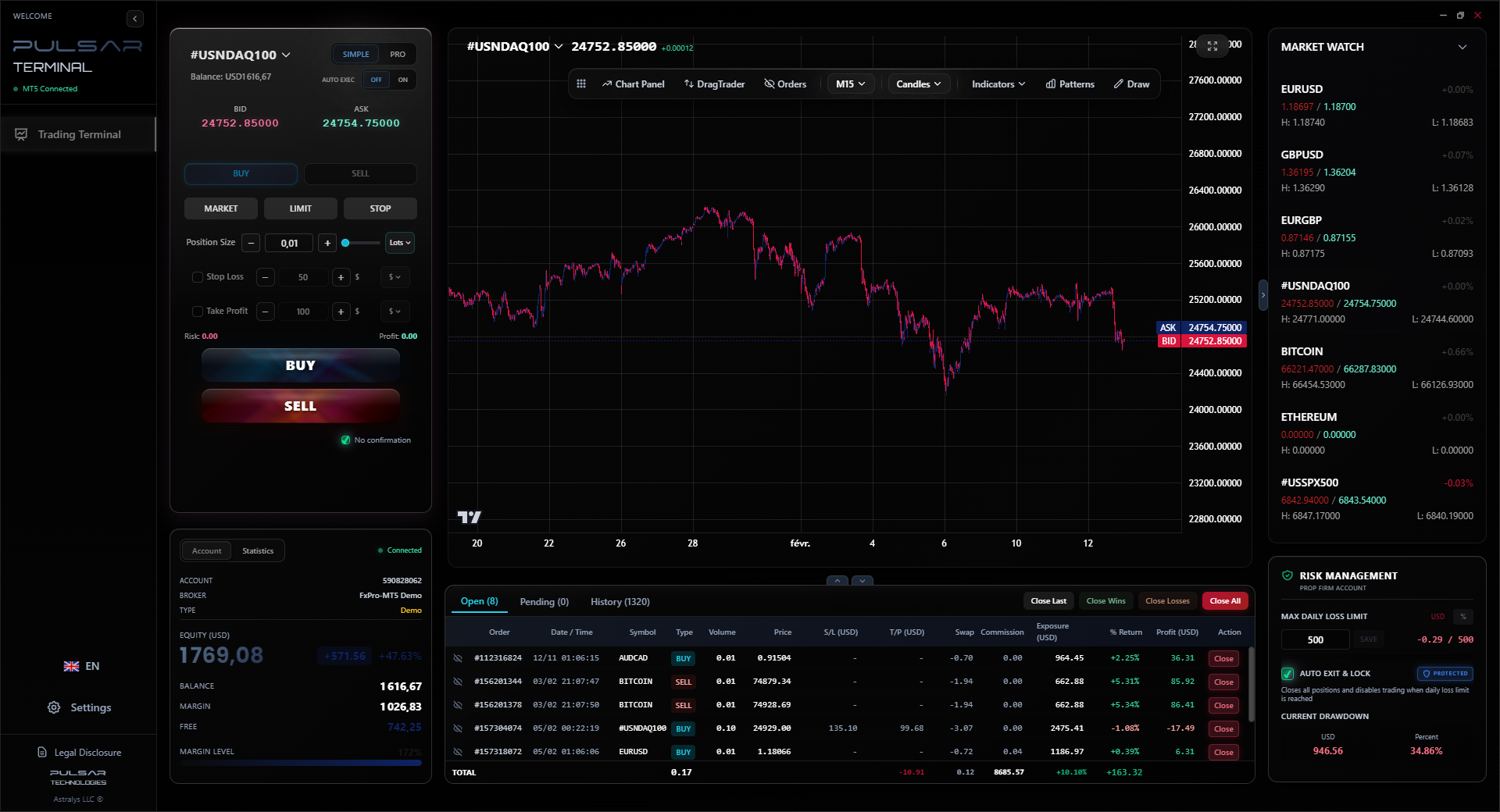
Managing multiple trades with tight stop losses is exhausting, which is why tools like Pulsar Terminal automate partial closures and breakeven moves directly on your MT5 charts.
“Ten trades a day feels productive. But if 7 are losses due to overtrading, you're just paying the broker.”
Let's talk about the specific ways I've blown up accounts, so you don't have to.
1. Scalping the Naira Pairs (USD/NGN): It's tempting to trade what you know. Don't. The liquidity in the NDF (Non-Deliverable Forward) market for retail traders is often poor. Spreads can be 50-100 pips wide. That's your entire profit target gone before you start. The price can also gap massively on CBN announcements. Stick to the major forex pairs with high liquidity.
2. Trading During Nigerian News or Power Transitions: You're in a trade, and 'NEPA takes light.' Your generator takes 30 seconds to kick in. That's a lifetime. Your VPS solves this. Also, avoid trading around major Nigerian economic announcements unless you're specifically news trading (which is a different, riskier beast).
3. Ignoring Time Zones: The sweet spot for scalping is when two major sessions overlap (London & New York, 1 PM - 4 PM WAT). The Asian session (2 AM - 8 AM WAT) is often slow and range-bound, perfect for getting chopped up. Don't force trades when the market is sleeping.
4. No Pre-Plan for Withdrawals: You've made ₦300,000. Great. How do you get it? If your only funding method was a card that's now blocked for forex, you're stuck. Plan your exit before you fund. Use a method for deposit that you know works for withdrawal (e.g., fund with USDT, withdraw to your Binance wallet).
5. Confusing Activity with Productivity: Ten trades a day feels productive. But if 7 are losses due to overtrading, you're just paying the broker. It's better to take 2 high-quality trades and be done. This was my biggest mental shift. I went from needing to trade to needing to be right. The scalping strategy is about precision, not volume.
💡 Petua Winston
If you find yourself constantly moving your 7-pip stop loss 'to give the trade room,' switch to a swing trading demo for a month. You're not a scalper; you're a hopeful swing trader in disguise.
“The market has no mercy for the unprepared.”
After 12 years, here's my honest assessment.
Scalping is probably NOT for you if:
- You have a full-time job that you can't ignore during trading hours.
- You have less than $1,000 in risk capital (the costs will eat you alive).
- You are an emotional person who hates being wrong.
- You want 'passive income.' This is as active as it gets.
- You don't have the discipline to follow a boring, repetitive plan for months before seeing consistent results.
Scalping MIGHT work for you if:
- You can treat it like a professional skill, requiring daily practice and study.
- You have at least $2,000 you can afford to lose (and I mean truly afford).
- You are mechanically disciplined and can follow rules even when they feel stupid.
- You have the technical setup (VPS, good internet) and are willing to pay the monthly overhead.
- You understand that success looks like a 55% win rate and small, steady gains, not doubling your account every month.
For most Nigerians starting out, I recommend learning with swing trading on higher time frames. It teaches you market structure and patience with less pressure. You can always graduate to scalping later.
My journey? I scalped for three years before I was consistently profitable. I blew up two accounts. The third one stuck because I finally respected the costs, mastered my mindset, and stopped trying to get rich tomorrow. Now, it's a reliable part of my income. But it's a grind, not a hack. If you choose this path, go in with your eyes wide open. The market has no mercy for the unprepared.
FAQ
Q1Is forex scalping illegal in Nigeria?
No, scalping as a trading strategy is not illegal. The legal concern is about which brokers you use. Trading with your own money is legal, but using unregistered international platforms exists in a regulatory grey area. The main risk is withdrawal difficulties, not prosecution.
Q2What is the best broker for scalping in Nigeria?
There's no single 'best,' but look for brokers with proven reliability for Nigerian clients, raw/ECN accounts with low fixed commissions, and fast execution. Based on long-term track records, Pepperstone, IC Markets, and Exness are often cited. Always verify their current terms for Nigeria and test withdrawals first.
Q3How much money do I need to start scalping forex?
Realistically, at least $1,000. With less, the transaction costs (spreads, commissions) become too large a percentage of your account. You also need capital to withstand a string of losses without blowing up. Many start with $500 and wonder why they fail; it's often due to inadequate capital for the strategy's costs.
Q4Can I scalp forex on my phone in Nigeria?
Technically yes, but I strongly advise against it. Scalping requires lightning-fast execution, multiple screens for monitoring, and absolute reliability. Mobile data can lag, apps can freeze, and screen size limits your analysis. It's a great way to lose money. Use a proper desktop setup with a VPS.
Q5Do I pay tax on my scalping profits in Nigeria?
Yes. The FIRS requires a 10% Capital Gains Tax on your net annual trading profits. While many traders ignore this, it is a legal obligation. Keep detailed records of all trades, deposits, and withdrawals to calculate your true profit accurately.
Q6What time is best for scalping in Nigeria?
The London session (7 AM - 4 PM WAT) is ideal, especially the overlap with the New York session (1 PM - 4 PM WAT). This is when liquidity and volatility are highest for major pairs like EUR/USD, offering the best conditions for capturing small, quick moves.
Q7Why do most Nigerian forex scalpers fail?
They fail due to a combination of high transaction costs relative to their small accounts, poor internet/power infrastructure, emotional overtrading, a lack of a strict risk management plan, and choosing the wrong brokers or instruments (like illiquid Naira pairs).
Pelajaran Prof. Winston
:
- ✓Know your true cost per trade: Spread + Commission + Slippage.
- ✓A 25-pip daily loss limit is non-negotiable for survival.
- ✓Use a VPS. Your Lagos generator is not a trading tool.
- ✓Fund with a method you can withdraw with. Plan your exit first.
- ✓Scalping is a 55% win-rate game. Embrace the grind, not the dream.
Sejauh mana artikel ini berguna?
Klik bintang untuk menilai
Pandangan Dagangan Mingguan
Analisis & strategi mingguan percuma. Tiada spam.
Tentang Penulis
Olumide Adeyemi
Perintis Dagangan Afrika Barat
Salah seorang pendidik dagangan forex paling aktif di Nigeria. 8 tahun pengalaman dagangan dari Lagos. Pakar dalam strategi modal rendah dan cabaran prop firm untuk pedagang Afrika.
Komen
Anda mungkin juga suka

Cara Trading Forex Sukses: 7 Prinsip dari Trader Profesional
Cara trading forex sukses dengan 7 prinsip trader pro: manajemen modal, disiplin, journal trading, backtest. Data nyata, bukan janji profit palsu.
Jam Trading Forex Terbaik untuk Trader Indonesia: Panduan Lengkap dengan Tabel Waktu
Panduan jam trading forex untuk trader Indonesia. Tabel 4 sesi dunia, jam emas 20:00-00:00, sesi mana yang harus dihindari. Data akurat + tips dari trader berpengalaman.
Top 5 Sàn Forex Uy Tín Nhất 2026: Review Jujur dari Trader Indonesia
Top 5 sàn forex uy tín 2026 untuk trader Indonesia. Review jujur: spread, deposit, withdraw, dukungan lokal. Exness, XM, IC Markets & lebih.
All these calculators are built into Pulsar Terminal with real-time data from your MT5 account. One-click position sizing, automatic risk management, and instant calculations.
