


I remember staring at my screen in 2021, watching GBP/JPY climb towards 155.80.

Olumide Adeyemi
Perintis Dagangan Afrika Barat ·  Nigeria
☕ 10 minit baca
Apa yang akan anda pelajari:
- 1What Exactly Is a Sell Limit Order?
- 2Why This Order is a Game Saver for Nigerian Traders
- 3How to Place a Sell Limit Order: A Step-by-Step Walkthrough
- 4When to Use a Sell Limit: The Three Best Setups
- 5The Pitfalls: Common Mistakes & How to Dodge Them
- 6Your Order Filled: Now What? Managing the Trade
- 7Sell Limit vs. Sell Stop vs. Market Sell
- 8Choosing a Broker in Nigeria: What Matters for Limit Orders
I remember staring at my screen in 2021, watching GBP/JPY climb towards 155.80. I was convinced it would reverse there. Instead of waiting patiently with a sell limit order, I got impatient and sold at 155.60, thinking I was getting a head start. The pair kept climbing another 25 pips, hitting my stop-loss for a $120 loss, before finally turning around and crashing right through my original target. That's the exact moment I learned the hard, expensive lesson about the power of the sell limit in forex. It’s not just an order type, it's a discipline.
Let's break it down simply. A sell limit order is a pending order you set to sell a currency pair at a price higher than where the market is currently trading. You're telling your broker, "Hey, if the price rallies up to this specific level, please open a sell trade for me."
Think of it like this: you see a bottle of Coke at a shop for ₦500. You believe if it goes up to ₦550, people will stop buying and the price will fall. So you tell the shopkeeper, "If you ever price this at ₦550, sell it for me immediately." That's the essence of a sell limit. You're anticipating a reversal from a higher price.
The key difference from a market order is control. A market order gets you in right now, at whatever price is available. A sell limit order gets you in at your chosen price, but only if the market comes to you. It requires patience. It's a tool for traders who believe a currency pair is overbought and due for a pullback.

Example: EUR/USD is currently trading at 1.0850. You analyze the chart and identify strong resistance at 1.0900. You believe if price reaches 1.0900, it will likely reverse and move lower. You place a sell limit order at 1.0900. Your trade will only be activated if and when the market price rises to touch 1.0900.
Our market conditions make the sell limit more than just convenient, it's often essential. First, consider the Naira's volatility. With swings that can exceed 10% in a quarter, trying to manually enter trades during fast moves is a recipe for slippage and emotional decisions. A sell limit locks in your plan.
Second, let's talk about our internet and power situation. How many times has your light gone off or your data slowed to a crawl right as a trade was setting up? I've lost count. By placing a sell limit order in advance, you're not relying on a perfect connection at the exact moment of entry. Your trade is queued up and waiting.
Finally, there's the psychological factor. Seeing a pair like USD/NGN (or a major pair you're trading) rocket upwards can trigger FOMO (Fear Of Missing Out). You might jump in early, like I did with that GBP/JPY trade. The sell limit order removes that emotion. It executes your plan mechanically, based on your analysis, not your adrenaline. For managing precise entries around key levels, a tool like a good position size calculator paired with a disciplined sell limit strategy is how you build consistency.

💡 Petua Winston
A sell limit is a vote of 'no confidence' in a price level's sustainability. Only vote where the chart shows a history of rejection.
“A sell limit order isn't just an order type, it's a discipline that protects you from your own impatience.”
On MetaTrader 4 or 5
This is where most of us operate. It's straightforward. Right-click on the chart where you want the order. Select 'Trading' and then 'New Order'. A window pops up. Change the 'Type' from 'Market Execution' to 'Pending Order'. Then, from the dropdown menu, select 'Sell Limit'.
Now, you'll set your 'Price'. This is the specific level where you want your sell trade to open. Let's say the current price of Gold (XAU/USD) is $2320, and you want to sell if it rallies to $2340. You'd enter 2340.00 in the price field.
Next, set your Stop Loss (SL) and Take Profit (TP). This is non-negotiable. Never place an order without them. If your analysis says the reversal could go to $2300, set your TP there. If you're wrong and price breaks above $2345, maybe your SL goes at $2350. Always define your risk first. You can learn more about setting these levels in our guide on XAU/USD.
Important Settings: Expiry and Comment
You'll see an 'Expiration' date/time. This is useful. Maybe you only think the resistance will hold for the next 48 hours. You can set the order to cancel automatically after that. The 'Comment' field is for you. I always note the reason, like "Sell Limit - Daily Resistance & RSI Divergence." It helps during review.

Warning: Be crystal clear on the difference between Sell Limit and Sell Stop. A Sell Limit is placed ABOVE current price to sell a rally. A Sell Stop is placed BELOW current price to sell a breakdown. Mixing these up is a classic, costly mistake.
Not every chart pattern calls for a sell limit. You use it when you have a clear reason to believe price will reverse from a higher level. Here are the three scenarios I look for.
1. Trading Against a Strong Resistance Level
This is the most common use. You identify a clear horizontal resistance level where price has reversed multiple times before. The more touches, the stronger it is. You also look for confluences like a round number (e.g., 1.1000 on EUR/USD) or a key Fibonacci retracement level (like the 61.8% or 78.6%). You place your sell limit a few pips below the exact resistance to account for the spread and ensure you get filled before the reversal.
2. Fading an Overbought Rally with Indicators
Price is in a strong uptrend, but your momentum indicators are screaming "overbought." The RSI indicator is above 70, or the MACD indicator is showing bearish divergence (price makes a higher high, but MACD makes a lower high). You don't know the exact top, but you can identify a potential reversal zone. You place a sell limit in that zone, betting that momentum is exhausted.
3. The "False Breakout" or "Bull Trap" Play
This is a more advanced but powerful strategy. Price breaks above a known resistance level, tempting all the breakout buyers to jump in. You place a sell limit just above that broken resistance level, anticipating that the breakout will fail and price will snap back down. It's risky, but the reward can be huge if you catch the trap. This is a favorite among traders who practice swing trading.
💡 Petua Winston
Your limit order price should make the market say 'ouch.' Place it where a rally would logically run out of willing buyers.
“The biggest losses come from placing sell limits in a roaring bull market. Don't try to stop a train with your bare hands.”
I've made most of these, so learn from my wallet.
Mistake 1: Placing it too close to the current price. If EUR/USD is at 1.0850 and you put a sell limit at 1.0855, you're not giving the market room to breathe. You'll likely get filled on a minor wiggle, not a meaningful reversal. Give your level some space.
Mistake 2: Ignoring the broader trend. The biggest losses come from placing sell limits in a roaring bull market. "The trend is your friend" exists for a reason. Selling into a strong uptrend is like trying to stop a moving train with your bare hands. Use sell limits for counter-trend moves within ranges, or at the very end of a trend when you see clear exhaustion signals.
Mistake 3: Forgetting about major news. This one stung me bad. I had a perfect sell limit setup on GBP/USD at 1.2850 ahead of a US CPI inflation report. The news hit, price spiked through my level, took me out, and then reversed violently. I was right on the direction but got stopped out because I didn't account for the news volatility. Always check the economic calendar. If major news is due, either widen your stop loss significantly or stay out.
Mistake 4: Not adjusting for broker execution. Some brokers, especially market makers, might have slightly different rules or slippage on limit orders. It's one reason I prefer ECN/STP brokers with transparent execution. Always test your broker's order execution in a demo account first. You can compare execution quality in our reviews of brokers like IC Markets or Pepperstone.
Congratulations, your sell limit order has been executed. You are now in a short trade. The work isn't over.
First, monitor price action around your entry. Does it immediately reject from your level and start falling? Good sign. Does it hover there, struggling to move down? Might be a sign of weakness. Does it quickly slice through your level? That's a danger signal.
Your initial plan included a stop loss and take profit. Stick to them. However, there are advanced techniques for adjusting. One is moving your stop loss to breakeven once the trade has moved in your favor by a certain amount (e.g., 1.5x your risk). This turns a risky trade into a free roll.
Another is using a trailing stop. This is where technology really helps. Instead of manually dragging your stop loss down as price falls, a trailing stop does it automatically, locking in profits while giving the trade room to run. Managing multiple trades with manual trailing stops can be a headache, which is why many serious traders look for tools that automate this process directly on their MT5 platform.
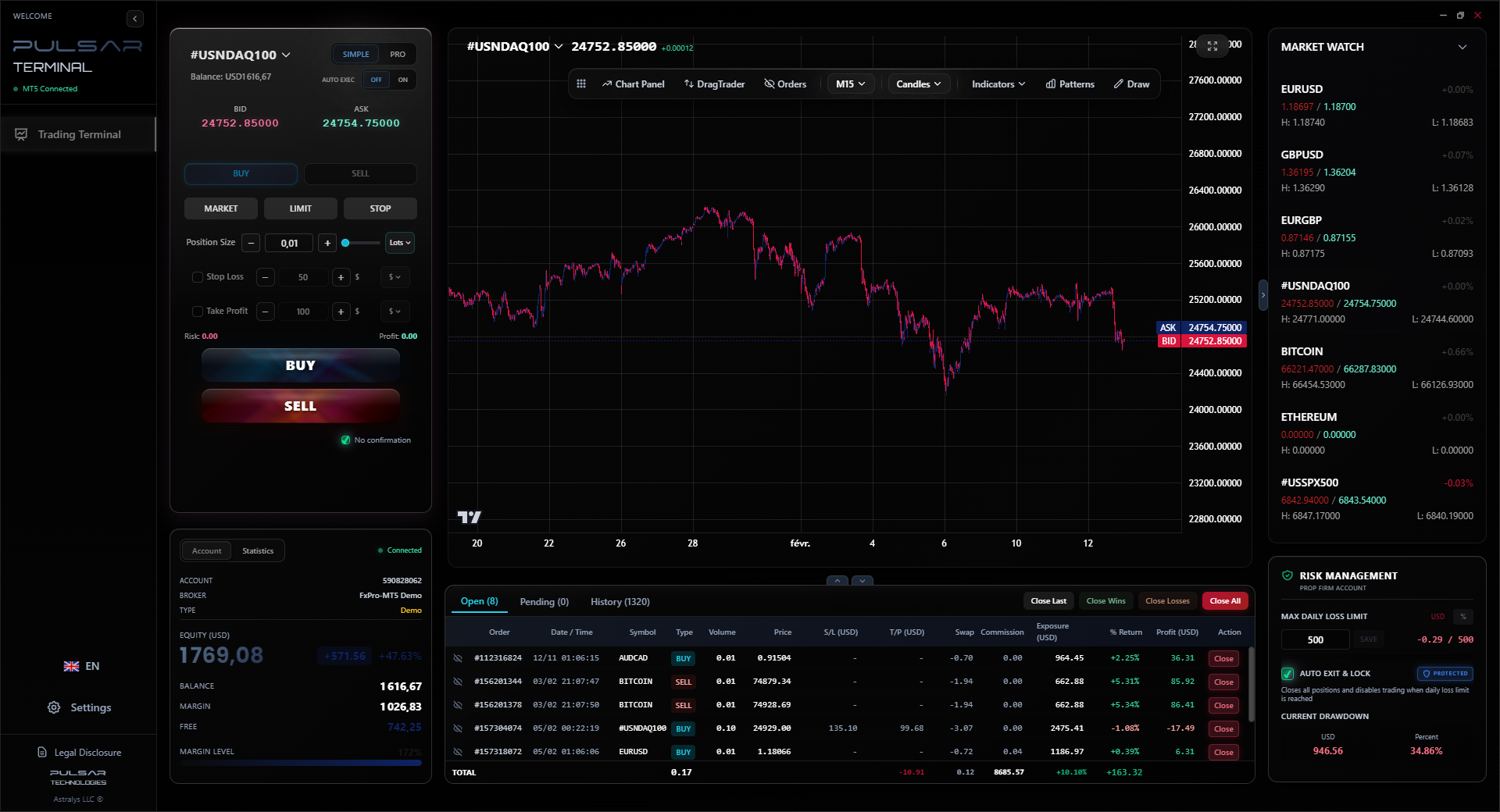
Managing multiple trades and adjusting stops manually is time-consuming, which is why a tool like Pulsar Terminal that automates trailing stops and breakeven moves directly on MT5 can be a serious efficiency boost.
“In Nigeria, with our power and internet challenges, a pending order is a trade you've already made, waiting for the market to agree.”
It's crucial to know your tools. Here’s a quick comparison table:
| Order Type | Where You Place It | When It Executes | Best For... |
|---|---|---|---|
| Sell Limit | ABOVE current market price | When price rises TO your level | Selling a rally at a predicted reversal point. |
| Sell Stop | BELOW current market price | When price falls TO your level | Selling a breakdown after support breaks (a breakout trade). |
| Market Sell | N/A (immediate) | IMMEDIATELY at best available price | Getting into a short trade right now, accepting the current price. |
A real example from last month: USD/CAD was ranging between 1.3600 and 1.3500. I placed a sell limit at 1.3585 (near the top) and a buy limit at 1.3515 (near the bottom). This is a classic range-trading strategy using both types of limit orders. I got filled on the sell limit, took 45 pips profit, and never even got close to my buy limit order that time.
💡 Petua Winston
If you find yourself constantly moving your sell limit order closer to the market out of impatience, close the platform and walk away. You're about to trade emotionally.
Not all brokers are equal when it comes to executing your precious sell limit orders. Here’s what to look for:
Execution Type: Prefer an ECN/STP broker over a Market Maker. ECN brokers typically have no conflict of interest with your trade; they just pass it to the market. This generally means faster, more reliable execution on your limit orders with less chance of manipulation or re-quotes.
Spreads and Commissions: For a sell limit strategy, you often aim for precise entries. A broker with tight, consistent spreads is vital. A wide spread means your sell limit might need to be placed further from the resistance to ensure a fill, which hurts your potential profit. Check if they offer raw spread accounts. For instance, Exness and XM offer accounts with very low spreads, which is ideal for this.
Platform Stability: MT4/MT5 are standards, but does the broker's server connection hold up during high volatility? There's nothing worse than your platform freezing just as price approaches your level.
Deposit/Withdrawal: This is the Nigerian reality. Can you fund your account reliably? Look for brokers that support local bank transfers, credit/debit cards (though mind the CBN limits), and e-wallets like Neteller or Skrill. Smooth withdrawals are just as important. The recent CBN reforms improving FX liquidity for BDCs should, in theory, make it easier to eventually get your profits back into Naira, but it's still a process you need to research with your chosen broker.
FAQ
Q1Can a sell limit order guarantee I get filled at my exact price?
Not always, but it's the best tool for the job. In normal market conditions with good liquidity (like trading EUR/USD during London hours), you'll usually get filled at or very near your price. During extreme volatility or low liquidity (like after major news), you might experience slippage, where you get filled at a worse price. Using a reliable ECN broker minimizes this risk.
Q2What's the difference between a Sell Limit and a Take Profit on a buy trade?
Great question, they get confused. A Sell Limit is a pending order to open a NEW sell trade. A Take Profit is an exit order attached to an existing BUY trade to close it for a profit. If you're in a buy trade and want to exit at a higher price, you use a Take Profit, not a Sell Limit.
Q3How far above the current price should I place my sell limit?
There's no fixed number of pips. It should be placed at a technically significant level you've identified through analysis: a previous resistance, a Fibonacci level, a trend line, etc. The distance depends entirely on where that level is relative to the current price. It could be 10 pips away or 100.
Q4Do I pay extra fees for using a sell limit order?
No, brokers don't charge extra fees just for placing a pending order like a sell limit. You will always pay the spread (the difference between buy/sell price) when the order executes, and if you're on a commission-based account, you'll pay the commission per lot traded.
Q5What happens if the price gaps past my sell limit order?
If the market opens at a price significantly higher than your sell limit (a gap up), your order will be filled at the first available price, which could be much higher than you wanted. This is a risk over weekends or around major news events. Using an expiry date on your order or canceling it before known high-risk events can help manage this.
Q6Is a sell limit order good for scalping?
Absolutely. For a scalping strategy, precision is everything. A sell limit lets you pre-set your entry at a precise level (like a 1-minute chart resistance), so you're not chasing the market. It's perfect for executing a fast, planned scalp without emotional interference.
Q7Can I modify or cancel a sell limit order after placing it?
Yes, at any time before it is executed, you can right-click on it in the MT4/MT5 'Trade' tab and modify the price, stop loss, take profit, or expiry, or cancel it entirely. Once it's triggered and becomes a live trade, you can only modify the stop loss and take profit.
Pelajaran Prof. Winston
:
- ✓A Sell Limit executes ABOVE current price to sell a rally.
- ✓Always pair it with a Stop Loss and Take Profit before placing.
- ✓Use it at confirmed resistance, not just any high point.
- ✓Avoid using it just before major scheduled news events.
- ✓It turns your analysis into automated, emotion-free action.
Sejauh mana artikel ini berguna?
Klik bintang untuk menilai
Pandangan Dagangan Mingguan
Analisis & strategi mingguan percuma. Tiada spam.
Tentang Penulis
Olumide Adeyemi
Perintis Dagangan Afrika Barat
Salah seorang pendidik dagangan forex paling aktif di Nigeria. 8 tahun pengalaman dagangan dari Lagos. Pakar dalam strategi modal rendah dan cabaran prop firm untuk pedagang Afrika.
Komen
Anda mungkin juga suka

Cara Trading Forex Sukses: 7 Prinsip dari Trader Profesional
Cara trading forex sukses dengan 7 prinsip trader pro: manajemen modal, disiplin, journal trading, backtest. Data nyata, bukan janji profit palsu.
Jam Trading Forex Terbaik untuk Trader Indonesia: Panduan Lengkap dengan Tabel Waktu
Panduan jam trading forex untuk trader Indonesia. Tabel 4 sesi dunia, jam emas 20:00-00:00, sesi mana yang harus dihindari. Data akurat + tips dari trader berpengalaman.
Top 5 Sàn Forex Uy Tín Nhất 2026: Review Jujur dari Trader Indonesia
Top 5 sàn forex uy tín 2026 untuk trader Indonesia. Review jujur: spread, deposit, withdraw, dukungan lokal. Exness, XM, IC Markets & lebih.
All these calculators are built into Pulsar Terminal with real-time data from your MT5 account. One-click position sizing, automatic risk management, and instant calculations.
