


I remember staring at my screen one Thursday afternoon, watching the EUR/ZAR climb relentlessly.

David van der Merwe
Pedagang Pasaran Membangun ·  South Africa
☕ 11 minit baca
Apa yang akan anda pelajari:
- 1What Exactly Is a Shooting Star?
- 2Breaking Down the Anatomy: Your Checklist
- 3Trading the Shooting Star in South Africa: A Practical Plan
- 4Potholes on the Road: Mistakes I've Made (So You Don't Have To)
- 5Stacking the Odds: How to Confirm the Signal
- 6Is It a Shooting Star or Something Else?
- 7Making It Work in Your Trading Routine
I remember staring at my screen one Thursday afternoon, watching the EUR/ZAR climb relentlessly. It had been a solid uptrend for days, and the rand was looking weak. My gut said buy more, but something on the chart gave me pause. Right at the top of a key resistance level, a perfect little candle formed. It had a tiny body near the bottom and a long wick shooting up like a warning flare. I ignored it, convinced the trend would continue. The next day, the pair dropped 180 pips. That was my expensive introduction to the power of the shooting star forex pattern. Let's make sure you don't make the same mistake.
Forget the fancy jargon. A shooting star is simply a red flag on your chart. It's a single candlestick that screams, 'The buyers are exhausted, and the sellers are about to step in.'
Visually, it's easy to spot once you know what you're looking for. Picture this: the market has been moving up in a nice rally. Then, a candle forms where the price opens near its low, rallies hard during the period (creating a long upper wick or 'shadow'), but then gets slammed back down to close near where it opened. The result is a small real body at the bottom of the range with a long tail above it. It looks like a star falling from the sky, hence the name.
The psychology is crucial. That long upper wick shows that buyers pushed the price up, but sellers aggressively stepped in and drove it back down, erasing all those gains by the close. It's a clear sign of rejection at a higher price. I used to think any candle with a long wick was a shooting star, but that's a quick way to get burned. For it to be a true shooting star, it must appear after a defined uptrend. Seeing one in the middle of a choppy range doesn't count; it's just noise.

Warning: A common rookie mistake (one I've made) is confusing a shooting star with an inverted hammer. They look identical! The only difference is the context. An inverted hammer forms at the bottom of a downtrend and is a bullish reversal signal. Always check what the market was doing before the candle formed.
Let's get specific. You can't just eyeball it. To qualify as a valid shooting star, the candle needs to pass this three-point checklist. Miss one, and the signal's reliability drops like a stone.
The Three Non-Negotiables
First, the trend. There must be a prior uptrend. This could be over several days on the daily chart or just a few hours on the H1. No uptrend, no shooting star. It's that simple.
Second, the candle structure. The real body (the difference between open and close) should be small and at the lower end of the candle's range. The upper shadow should be at least twice the length of the real body. The longer the shadow, the stronger the rejection. A lower shadow is ideally very small or non-existent.
Third, the close. The candle should close at or very near its low. A close in the bottom 25% of the range is a good rule of thumb. If it closes in the middle, it shows indecision (a doji), not rejection.
Here’s a quick table to keep it straight:
| Feature | What to Look For | Why It Matters |
|---|---|---|
| Prior Trend | Clear, identifiable uptrend. | Establishes context for a potential reversal. |
| Upper Shadow | Long - at least 2x the body length. | Shows strong selling pressure rejecting higher prices. |
| Real Body | Small, and at the low end of the range. | Indicates buyers lost control by the close. |
| Lower Shadow | Very short or absent. | Confirms sellers maintained pressure throughout. |
I got caught once on the USD/ZAR because I saw a great-looking long wick, but the body was smack in the middle. The pair just consolidated for two days before continuing up. That was a $120 lesson in paying attention to the close. For managing the risk on these trades, always use a position size calculator to keep your losses sane.

💡 Petua Winston
A true shooting star needs a story. The long wick is the climax where buyers fail. The small body at the low is the resolution where sellers win. If the candle doesn't tell that story, it's just a candle with a long wick.
“A shooting star is not a magic bullet. It's a single sentence in the market's story.”
Spotting the pattern is only half the battle. The real skill, especially with our volatile ZAR pairs, is in the execution. Here’s the step-by-step plan I follow now.
Step 1: Wait for Confirmation. This is the golden rule. Never, ever enter a trade on the shooting star candle itself. You need to see the next candle close below the shooting star's real body. This confirms the sellers have taken control. Patience here will save you from countless false signals.
Step 2: Entry and Stop Loss. My entry is usually a sell order placed a few pips below the low of the confirmation candle. Your stop loss must be placed above the high of the shooting star's wick. That’s where all the buying was rejected, so if price breaks back above there, the signal is invalidated.
Step 3: Take Profit. I use a risk-to-reward ratio of at least 1:1.5. So, if my stop is 50 pips away, I look for a profit target of 75 pips minimum. A good initial target is often the nearest significant support level or a key moving average. For bigger moves, I might use a trailing stop. Managing multiple targets is easier with tools that let you set partial closures, a feature I wish I had years ago.

Example: Let's say you spot a shooting star on EUR/ZAR at 20.5000, with a high at 20.5200 and a low at 20.4950. The next candle closes at 20.4900 (confirmation). You sell at 20.4880. Stop loss at 20.5220 (above the wick). That's a 40-pip risk. Your first take profit could be at 20.4380, for a 100-pip reward (a 1:2.5 ratio).
Our market has unique quirks. SA forex brokers like Exness or IC Markets offer tight spreads on major pairs, but ZAR crosses can be wider. Factor that into your profit targets. Also, be hyper-aware of local events - SARB announcements, budget speeches, or load-shedding news - can cause massive, pattern-breaking spikes. A shooting star formed during such news is worthless.
We learn more from our losses than our wins. Here are the classic errors that will separate you from your rands.
Trading It in Isolation. This was my biggest early flaw. A shooting star is not a magic bullet. I'd see one and jump in, ignoring everything else. You must look at the bigger picture. Is there a major resistance level (like a previous swing high or a psychological number) coinciding with the pattern? If not, the signal is weak.
Ignoring Volume. While forex doesn't have centralised volume, you can look at tick volume or volume on the equivalent futures contract. A shooting star with high volume shows strong participation in the rejection. A low-volume shooting star is suspect and more likely to fail.
Placing the Stop Loss Incorrectly. Putting your stop just above the candle's body is asking for trouble. The market will often poke above the body to stop out retail traders before reversing. You must give the trade room and place your stop beyond the extreme of the wick.
Forgetting About Timeframes. A shooting star on a 5-minute chart is mostly noise. A shooting star on a daily or weekly chart is a serious event. The higher the timeframe, the more significant the signal. I focus on H4 and daily charts for my primary signals. For quicker, riskier plays, some traders use it on lower timeframes as part of a scalping strategy, but the win rate is lower.
I once took a shooting star signal on GBP/ZAR on the M15 chart during the London open. It looked perfect. I didn't check that it was sitting right on a major daily support level. The 'reversal' lasted all of 30 pips before the pair rocketed back up, hitting my stop. The daily support trumped the tiny 15-minute signal. Lesson learned.
💡 Petua Winston
The most profitable shooting stars I've taken weren't the most perfect-looking ones. They were the ugly ones that appeared after a parabolic, emotional rally. That's when the rejection is most meaningful.
“Patience isn't just waiting for the pattern; it's waiting for the market to confirm the pattern.”
Professional traders don't rely on one indicator. They stack probabilities. A shooting star becomes a high-conviction setup when other tools agree.
1. Key Support & Resistance. This is the most powerful confirmation. If your shooting star forms right at a well-established resistance level, the chance of a reversal skyrockets. It's like the market is hitting a ceiling and bouncing off.
2. Momentum Indicators. I often use the RSI indicator. If a shooting star forms while the RSI is above 70 (overbought), that's a strong confluence. Similarly, a bearish divergence on the MACD indicator (price makes a higher high, MACD makes a lower high) appearing with a shooting star is a screaming sell signal.
3. Fibonacci Retracement Levels. In a strong uptrend, price will often pull back to a Fib level (like 61.8% or 78.6%) before continuing up. If a shooting star forms at one of these levels during the pullback, it can signal the end of the correction and the resumption of the downtrend.
A Real Trade Example: In early 2023, USD/ZAR was in a downtrend and pulled back to the 61.8% Fibonacci level. Right at that level, a daily shooting star formed while the RSI poked above 70. That was three confirmations (Fib, RSI, candlestick). I took the short. The entry was around R18.25, stop at R18.45, target at R17.85. The pair dropped to R17.70 over the next two weeks. That's the power of confluence.

Pro Tip: Don't get indicator overload. Pick one or two confirmation methods you understand deeply. I use horizontal resistance and RSI. More than that, and you'll get analysis paralysis. The goal is to be precise, not to use every tool in the box.
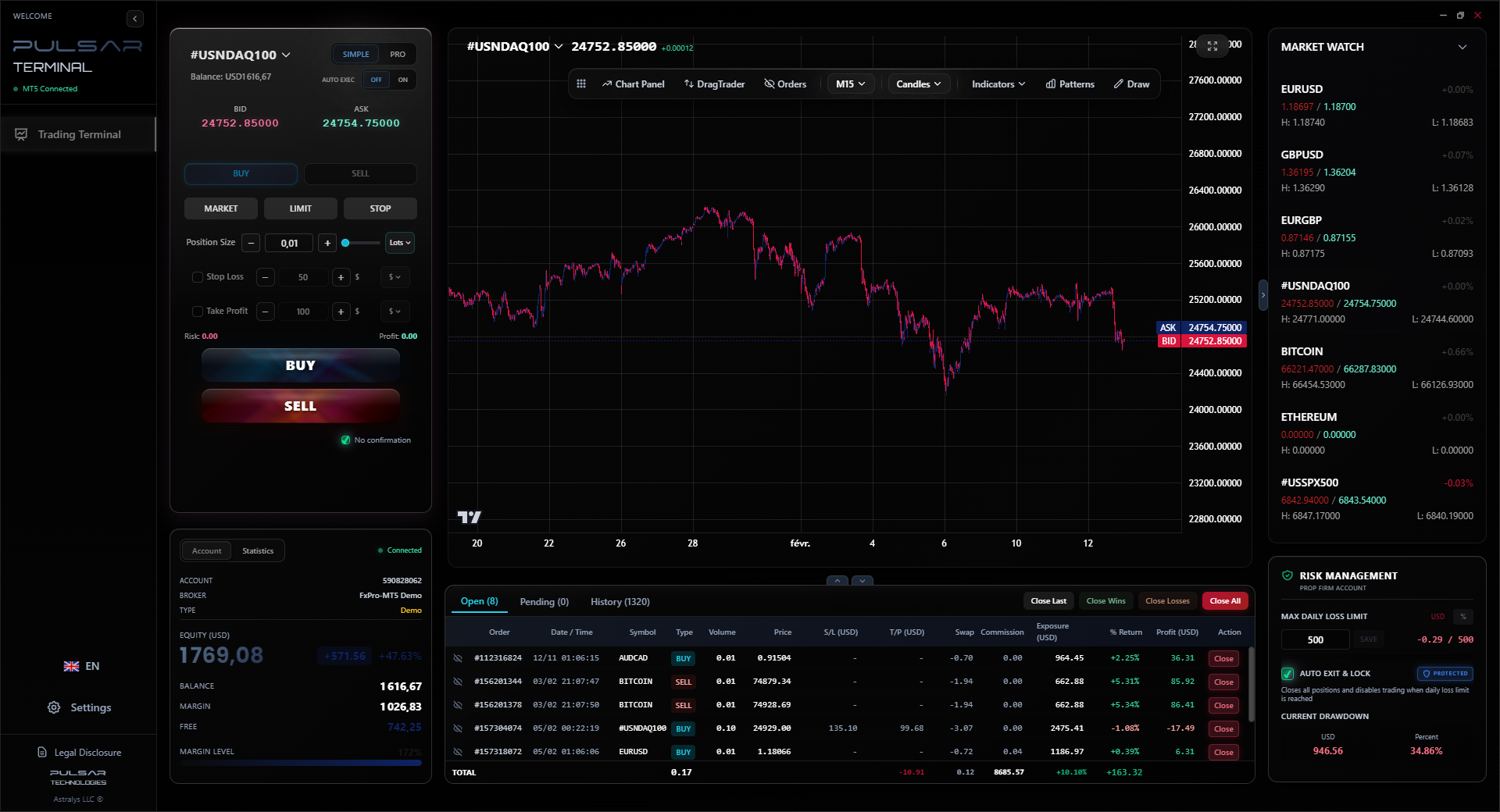
When trading shooting star reversals, managing multiple take-profit levels and a trailing stop is key, and Pulsar Terminal lets you set that up with a single drag-and-drop directly on your MT5 chart.
The chart is full of look-alikes. Knowing the difference keeps you out of bad trades.
Shooting Star vs. Hanging Man: Both have small bodies and long lower shadows. The critical difference? The trend. A hanging man is a bearish reversal pattern that forms at the top of an uptrend. A shooting star has a long upper shadow. If you see a long lower shadow at a top, it's a hanging man, warning of a potential drop.
Shooting Star vs. Inverted Hammer: As mentioned, they're identical twins in opposite situations. Inverted hammer = bottom of downtrend, bullish signal. Shooting star = top of uptrend, bearish signal. Always label your charts with the prior trend to avoid this mix-up.
Shooting Star vs. Spinning Top: A spinning top has a small body with shadows on both sides, showing pure indecision. A shooting star shows clear rejection to the upside. If the lower shadow is as long as the upper shadow, it's not a reliable shooting star.
Here’s a quick mental filter: 'Long wick up, in an uptrend, close near the low.' Say that to yourself when you see a candidate. If all three aren't a clear 'yes,' walk away. Understanding these nuances is what separates a swing trading pro from an amateur.
💡 Petua Winston
Think of confirmation as your co-pilot. The shooting star says 'maybe turn here.' A break below the low and an overbought RSI say 'definitely turn here.' Wait for your co-pilot to agree.
“The difference between a shooting star and a random candle is the trend that came before it.”
So how do you actually use this day-to-day without getting overwhelmed?
Scanning: I start my analysis on the daily chart. I look for obvious uptrends and then scan for any candles with prominent upper wicks near highs. That's my candidate list. Then I drop down to the H4 chart to refine the entry and check for additional confluence on a lower timeframe.
Journaling: Every shooting star you trade - win or lose - should be recorded. Note the currency pair, timeframe, where the stop and target were, what confirmations you used, and the outcome. After 20-30 trades, you'll see patterns. You might find shooting stars work brilliantly on EUR/USD but are terrible on AUD/NZD for your style. I learned mine have a higher win rate when combined with a bearish MACD indicator cross.
Risk Management: This pattern is no excuse for reckless betting. One shooting star trade should never risk more than 1-2% of your capital. The spread on exotic pairs can eat into your profit, so factor that in. And for heaven's sake, know what a margin call is and how to avoid it. Over-leveraging on a single candlestick signal is a recipe for disaster.
The shooting star isn't a standalone strategy. It's a precision tool. Use it to identify potential turning points within your broader view of the market. Maybe you're fundamentally bearish on the rand, but you're waiting for a technical entry. A shooting star at resistance gives you that entry with a clear, defined risk. That's how you use it like a pro.
FAQ
Q1Can a shooting star be green (bullish)?
Technically, yes, but it's much weaker. The classic, stronger shooting star has a red (or black) body, showing the close was below the open, reinforcing the bearish close. A green body with a long upper wick still shows rejection, but it indicates the bulls managed to close it higher. I treat green shooting stars with more caution and require stronger confirmation.
Q2What's the best timeframe to trade shooting stars?
For reliability, stick to H4 and above. The daily chart is king for significant signals. On lower timeframes like M15 or M5, you'll see many more shooting stars, but most are just noise from normal market volatility. These can be used for scalping, but your win rate will be lower and you need razor-fast execution.
Q3How reliable is the shooting star pattern?
No pattern is 100%. On its own, it's a decent alert. But when combined with other confirmations (like resistance or overbought RSI), its reliability improves dramatically. In my journal, my win rate on confirmed shooting star setups is around 65-70%. Unconfirmed ones are closer to 50% - basically a coin flip.
Q4Do shooting stars work on all currency pairs?
They appear on all pairs, but they can be more effective on pairs with strong, clear trends. Major pairs like EUR/USD or USD/JPY often provide cleaner signals. With volatile exotics like USD/ZAR or EUR/TRY, the patterns can be messier and require wider stops due to higher volatility.
Q5Should I use a shooting star to go long if I see it in a downtrend?
Absolutely not. If you see what looks like a shooting star (long upper wick) during a downtrend, it's not a shooting star. It's likely an inverted hammer, which is a bullish reversal signal. The trend context defines the pattern. Trading a 'shooting star' in a downtrend is a fundamental misunderstanding that will cost you money.
Q6How many pips should I expect from a shooting star trade?
There's no fixed number. It depends on the pair's volatility and the timeframe. On a daily EUR/USD shooting star, a 50-150 pip move is common. On USD/ZAR, moves can be 200-400 pips. Your target should be based on the next level of support, not a random pip count. Always use a risk-to-reward ratio of at least 1:1.5.
Pelajaran Prof. Winston
:
- ✓Always require a prior uptrend - no trend, no signal.
- ✓Wait for the next candle to close below the star's body for confirmation.
- ✓Place your stop loss above the high of the shooting star's wick, not its body.
- ✓Combine with other tools like RSI >70 or key resistance for high-probability trades.
- ✓Risk no more than 1-2% per trade, regardless of how perfect the pattern looks.
Sejauh mana artikel ini berguna?
Klik bintang untuk menilai
Pandangan Dagangan Mingguan
Analisis & strategi mingguan percuma. Tiada spam.
Tentang Penulis
David van der Merwe
Pedagang Pasaran Membangun
Pedagang berpangkalan di Johannesburg dengan 11 tahun dalam mata wang pasaran membangun. Pakar dalam pasangan ZAR, dagangan terkawal FSCA, dan analisis pasaran Afrika Selatan.
Komen
Anda mungkin juga suka

Cara Trading Forex Sukses: 7 Prinsip dari Trader Profesional
Cara trading forex sukses dengan 7 prinsip trader pro: manajemen modal, disiplin, journal trading, backtest. Data nyata, bukan janji profit palsu.
Jam Trading Forex Terbaik untuk Trader Indonesia: Panduan Lengkap dengan Tabel Waktu
Panduan jam trading forex untuk trader Indonesia. Tabel 4 sesi dunia, jam emas 20:00-00:00, sesi mana yang harus dihindari. Data akurat + tips dari trader berpengalaman.
Top 5 Sàn Forex Uy Tín Nhất 2026: Review Jujur dari Trader Indonesia
Top 5 sàn forex uy tín 2026 untuk trader Indonesia. Review jujur: spread, deposit, withdraw, dukungan lokal. Exness, XM, IC Markets & lebih.
All these calculators are built into Pulsar Terminal with real-time data from your MT5 account. One-click position sizing, automatic risk management, and instant calculations.
