


I remember the first time I blew up an account.

David van der Merwe
Pedagang Pasaran Membangun ·  South Africa
☕ 12 minit baca
Apa yang akan anda pelajari:
- 1The Myth vs. Reality of Forex Wealth in SA
- 2Playing by the Rules: Regulation & Tax
- 3The Real Numbers: Costs & Starting Capital
- 4Trading the ZAR: Local Market Dynamics
- 5The Actual Path to Consistent Profits
- 6Picking Your Tools: Brokers & Platforms
- 7Pitfalls Every South African Trader Faces (And How to Dodge Them)
- 8The Long Game: Building Wealth, Not Just Profits
I remember the first time I blew up an account. It was 2014, and I'd just read some forum post about a 'South African forex millionaire' who turned R10,000 into R2 million in a year. Inspired, I threw R8,000 into a USD/ZAR trade with massive use, convinced I'd found the secret. A surprise SARB interest rate announcement sent the Rand soaring against my position. I ignored my stop loss, hoping for a reversal. It never came. I got a margin call and lost R7,200 in a single afternoon. That experience taught me more about the reality of wealth in this market than any guru's story ever could. Let's talk about what it really takes.
You've seen the Instagram ads: the guy on a Camps Bay balcony, Rolex glinting, next to a Lambo he supposedly bought with forex profits. Let's be brutally honest. The identities and verified net worth of the actual richest forex traders in South Africa are not public knowledge. The truly successful ones are private, often institutional traders, fund managers, or individuals who treat trading as a serious business, not a get-rich-quick scheme.
Why the secrecy? Real wealth attracts attention - from SARS, from family, from scammers. The loudest voices are usually selling a course, a signal service, or an unregulated investment pool. The FSCA has cracked down hard on this. In 2024, they fined a signals provider over R1 million and debarred him for 10 years for operating without a license. That's the reality check.
The real metric isn't who has the flashiest car, but who has sustained profitability over years. I know a trader in Johannesburg who has consistently netted between R300,000 and R500,000 a year for the last eight years. He drives a Toyota Hilux. His wealth is in his systems, his discipline, and his compound growth. He's never been featured on a magazine cover, but he's the real deal. That's the model to study.

Warning: Anyone publicly claiming to be one of South Africa's richest forex traders and offering to 'manage' your money or sell you secrets is almost certainly violating FSCA regulations. Always check their FSP number on the regulator's website.

💡 Petua Winston
The market's job is to make you feel smart right before it takes your money. Your plan's job is to stop that from happening.
If you want to build lasting wealth here, you have to start on the right side of the law. The Financial Sector Conduct Authority (FSCA) is your watchdog. Trading with an FSCA-licensed broker isn't just a suggestion; it's your primary layer of protection. It means client funds are segregated, and you have a formal recourse if something goes wrong.
The use Cap
Since 2021, the FSCA has capped use for retail traders at 30:1. This was a game-saver for many newcomers. On a R10,000 account, that's a max position size of R300,000. It feels limiting when you're chasing huge wins, but it prevents the kind of catastrophic, account-blowing losses I experienced early on. Some brokers like AvaTrade offer higher use (up to 1:400) on 'professional' accounts, but qualifying for that requires proving significant experience and portfolio size.
The SARS Conversation
Here's the non-negotiable part everyone tries to avoid: tax. SARS views frequent forex trading profits as income, not capital gains. You're taxed at your marginal income tax rate. If you're in the 45% tax bracket, that's a significant chunk. I learned this the hard way in my third year of profitable trading. I had a great year, made about R220,000 in net profit. I didn't keep clean records, just a bunch of broker statements. My accountant spent 40 hours untangling it, and the bill was huge. Now, I use a simple spreadsheet logging every trade, deposit, and withdrawal from day one.
South Africans have a foreign capital allowance (R10 million per annum) to send funds abroad. You can use this to fund an international broker account, but remember: SARS taxes you on worldwide income. Trading with an offshore broker like IC Markets or Pepperstone doesn't make your profits tax-free. The onus is on you to declare it.
“SARS views frequent forex trading profits as income, not capital gains. You're taxed at your marginal income tax rate.”
Let's talk numbers, because the fantasy ends when you see the spreads and fees. South Africa's forex market is huge for the continent - daily volume is over $21 billion - but you need to know what it costs to play.
Trading Costs:
- Spreads: This is your main cost. On the EUR/USD, you can find raw spreads as low as 0.0 pips with an ECN broker like Exness or IC Markets, but you'll pay a commission (say, $7 per lot). A standard account might have a fixed spread from 0.8 pips with no commission. You need to do the math for your trading style. For a scalping strategy, those tiny spreads are critical.
- Swap Rates: Holding a position overnight costs or earns you interest. On USD/ZAR, these can be significant. I once held a short USD/ZAR position over a weekend and forgot about the swap. The three-day charge wiped out 30% of my intended profit. Always check the swap calculator before holding.
How Much Do You Really Need? You can technically start with R150 at some brokers. But let's be practical. With R150 and 30:1 use, your position sizing is a nightmare. One bad trade and you're done. A serious beginner should aim for at least R5,000 to R20,000. This allows for proper position size calculator use and psychological comfort. My most consistent growth period started when I began with R15,000 and never risked more than 1% (R150) on any single trade.

Example: Trading USD/ZAR with a 50-pip stop loss. Account: R10,000. Risk per trade: 1% = R100. Pip value for a standard lot (100,000) on USD/ZAR is roughly R60. To risk only R100, your position size must be micro. This is why starting too small forces you to use dangerous use to see meaningful gains.
This is where local knowledge gives you an edge. The South African Rand isn't just another currency pair; it's a mood ring for global risk and local politics.
The USD/ZAR is your main playground. It's volatile, liquid, and reacts sharply to a few key drivers:
- Commodity Prices: The Rand is a 'commodity currency.' Strong gold and platinum prices often strengthen the ZAR. I keep a live chart of gold (XAU/USD) next to my USD/ZAR chart. A sharp rise in gold has frequently preceded a ZAR rally. (Check our XAU/USD guide for more on trading gold).
- US Dollar Strength: When the USD is strong globally, USD/ZAR tends to rise. Watching the EUR/USD for clues on broad USD direction is a staple of my analysis.
- Local Politics & SARB: Budget speeches, credit rating announcements, and SARB interest rate decisions are major event risks. The rate decision in 2014 that blew up my account? I traded the rumor, not the news. Now, I either close positions before major announcements or use guaranteed stop losses (which cost extra but are worth it).
Popular Platforms: MT4 and MT5 are king here. Most local brokers support them. The familiarity is good, but don't get stuck using only the basic indicators. The real pros I know use advanced tools for market profiling and order flow, which you can add on with third-party software.
Payment methods are easy. Use a broker with a ZAR account to avoid conversion fees. Deposits via FNB or Standard Bank EFT are usually quick, and withdrawals back to your South African bank account are seamless with FSCA-regulated entities.
💡 Petua Winston
If you can't calculate your exact maximum loss before you click 'buy,' you're not trading, you're gambling. Use a position size calculator, every single time.
“A serious beginner should aim for at least R5,000 to R20,000. This allows for proper position sizing and psychological comfort.”
Forget the Lamborghini. Focus on the process that builds sustainable wealth. It's boring, but it works.
1. Education Over Emotion: Learn technical analysis properly. Don't just slap a moving average on a chart. Understand support/resistance, price action, and maybe one or two indicators deeply, like the RSI indicator or MACD indicator. I wasted two years jumping between 10 different indicators before mastering price action and volume.
2. Develop a Written Plan: Your plan must answer: What pairs do you trade? What's your entry/exit strategy? What's your risk per trade (I recommend 0.5%-1%)? A plan removes emotion. In 2020, during the March market chaos, my plan forced me to stick to my 1% risk rule. I had 4 losing trades in a row (R400 down), but the 5th trade was a winner that caught a huge USD/ZAR move and netted R1,500. The plan kept me in the game.
3. Specialize: The most successful trader I know in SA only trades GBP/USD and USD/ZAR. He knows every quirk, every typical daily range. He doesn't get distracted by shiny new crypto pairs. Find your niche.
4. Track Everything: Use a journal. Note the entry/exit price, the reason for the trade, and, crucially, your emotional state. You'll start to see patterns - like losing more when you trade out of boredom.
5. Think in Percentages, Not Rands: Aim for a consistent monthly return on your capital, like 3-5%. On a R100,000 account, that's R3,000-R5,000 a month. Compounded over years, that's real wealth. Chasing 50% months is what leads to blow-ups.

Pro Tip: Start with a demo account, but transition to a live micro account as soon as you're consistently profitable on demo for two months. The psychological pressure of real money is a different beast. Start with a small amount you can afford to lose completely.
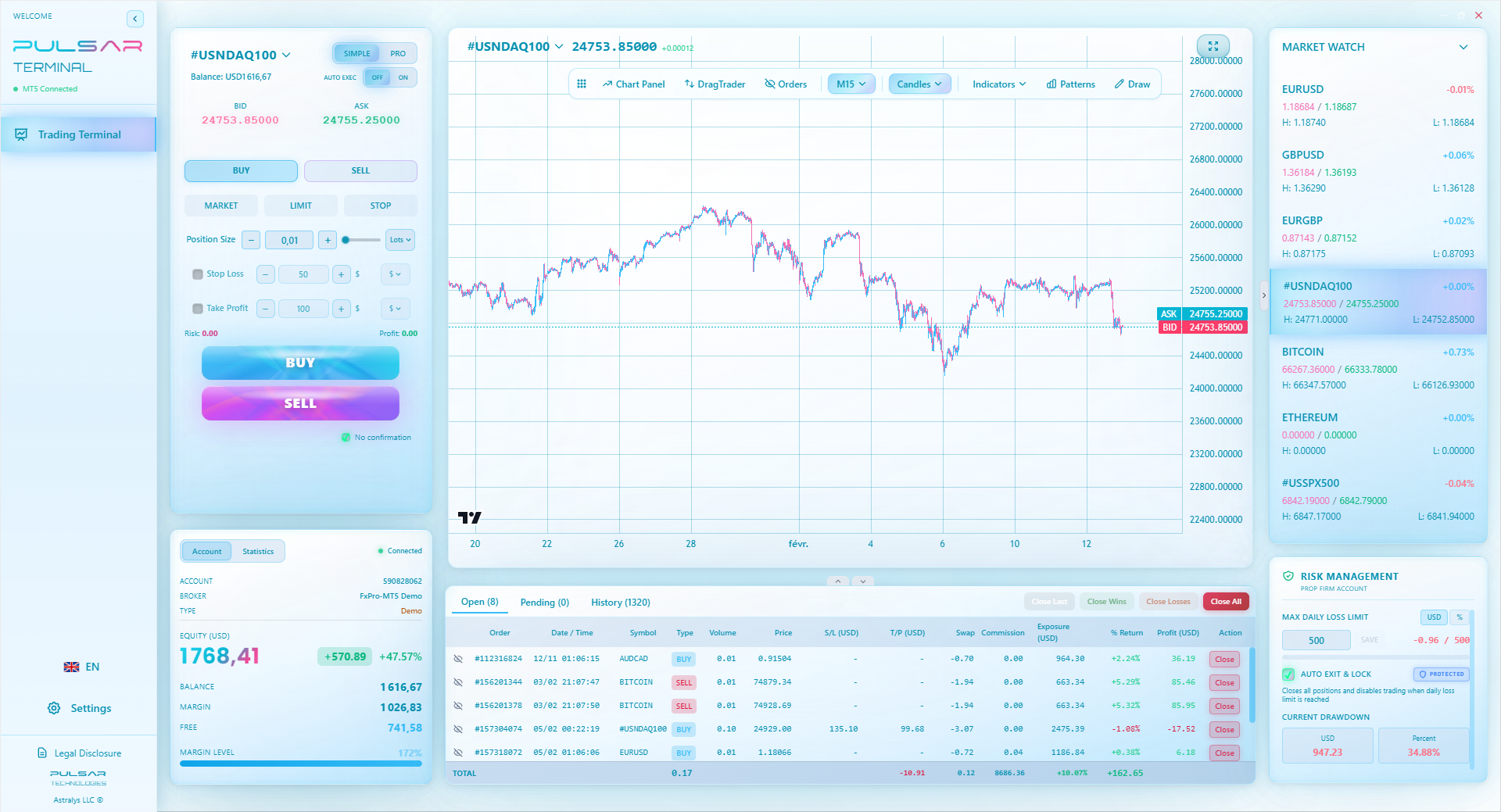
Sticking to a detailed trading plan with precise order management is what separates professionals from hopefuls, and tools like Pulsar Terminal automate this discipline directly on your MT5 platform.
Your broker is your business partner. Choosing wrong can cost you money through slippage, poor execution, or worse. Here’s a quick comparison of some top FSCA-regulated options for 2026:
| Broker | FSCA Licensed? | Min. Deposit (ZAR approx.) | Key Feature for SA Traders |
|---|---|---|---|
| IG | Yes | ~R5,800 | Tier-1 global regulator, excellent research. |
| AvaTrade | Yes (FSP 45984) | ~R1,800 | Fixed spreads, good for beginners. |
| XM | Yes | ~R90 | Very low minimum deposit, lots of educational resources. |
| IC Markets | Yes | ~R3,600 | the best raw spreads/execution for active traders. |
| Exness | Yes | ~R180 | Commission-free accounts with tight spreads on majors. |
I've had personal accounts with three of these. My main account for the past four years has been with an ECN broker for the tight spreads, as my style evolved into more frequent trading. When I was starting out and prone to holding trades longer, a broker with fixed spreads was less stressful.
For platforms, MT5 is becoming the new standard. It allows for more advanced order types and better backtesting. Whichever you choose, make sure your broker offers ZAR-based accounts to simplify your accounting for SARS.
Remember, the FSCA's use cap of 30:1 applies to all these brokers for retail accounts. Don't be lured by an offshore broker offering 500:1; it's a giant red flag that they're not complying with local rules meant to protect you.
“The goal isn't to be the richest forex trader in South Africa for a month. It's to build a resilient, income-generating skill that lasts decades.”
We have unique challenges here. Knowing them is half the battle.
Pitfall 1: Ignoring Tax Until It's Too Late. Set up your record-keeping from trade #1. Use a simple spreadsheet: Date, Pair, Long/Short, Entry, Exit, P&L (Rands). Export your broker statements monthly and reconcile. When SARS comes knocking (and if you're profitable, they will), you'll be ready.
Pitfall 2: Chasing 'Black Tax' Returns. You might feel pressure to generate huge returns quickly to help family. This leads to over-leveraging. I've seen it destroy more traders than any bad strategy. Separate your trading capital from your family obligations. Trade to grow your business, not to pay next month's bills.
Pitfall 3: Load Shedding & Internet. It's a real operational risk. You must have a plan: a UPS for your router and PC, and the broker's mobile app installed and logged in on your phone with data. I once had a trade hit my take-profit during load shedding. My UPS kept the internet on for 5 extra minutes - just long enough to close the trade and bank R800. Without it, I'd have been at the mercy of the market.
Pitfall 4: The Prop Firm Trap. Prop firm challenges are popular. They promise you access to large capital. But their rules are brutal - strict daily loss limits and drawdown rules that often lead to failure. They're a business model designed for you to fail the challenge. If you go this route, treat the challenge fee as expensive education, not an investment. The skills you need to pass are the same you need to trade your own account successfully: discipline and risk management.
💡 Petua Winston
Your first profitable year is a fluke. Your second is luck. Your third is the beginning of a career. Don't confuse the early stages.
The goal isn't to be the richest forex trader in South Africa for a month. It's to build a resilient, income-generating skill that lasts decades.
This means reinvesting profits strategically. Don't just let your account balance grow and increase your position size recklessly. Withdraw a percentage of your quarterly profits (after setting aside tax!). Use it to invest in other assets - property, ETFs, a business. This diversifies your wealth and reduces the psychological pressure on your trading.
It also means continuous learning. The market changes. The strategies that worked on USD/ZAR in 2018 are different now. I dedicate at least 5 hours a week to studying charts, reading market analysis, and reviewing my trades. It's a profession, not a hobby.
Finally, manage your psychology. Trading in isolation is tough. Find a community of serious traders (not a signal-sharing WhatsApp group) where you can discuss ideas and stay accountable. The loneliness of trading can lead to bad decisions just for the sake of 'action.'
The richest forex traders in South Africa, the ones who are genuinely successful, understand this. They've built systems, they manage risk obsessively, and they play the long game. You can too. Start small, learn constantly, protect your capital, and let compound growth do the heavy lifting. That's the real secret no one sells in a R5,000 course.
FAQ
Q1Who is the richest forex trader in South Africa?
There is no publicly verified answer. The individuals with the greatest sustained wealth from forex trading are private and not in the public eye. The FSCA does not publish such data, and any individual claiming this title while selling services is likely misleading you. Focus on building your own verified track record instead.
Q2Is forex trading legal and safe in South Africa?
Yes, it is legal, provided you use a broker licensed by the Financial Sector Conduct Authority (FSCA). This is the key to safety. FSCA regulation ensures client money segregation, fair practice, and gives you a formal complaints channel. Trading with an unregulated offshore entity is extremely risky and not recommended.
Q3How much tax do I pay on forex profits in SA?
SARS typically treats frequent trading profits as ordinary income, taxed at your marginal income tax rate (which can be up to 45%). It is not treated as capital gains. You must declare all profits (including from offshore brokers) and keep detailed records of every trade, deposit, and withdrawal for SARS.
Q4What is a realistic monthly return from forex trading?
A consistent, sustainable monthly return for a skilled retail trader is between 3% and 10% on their trading capital. Promises of 50% or more per month are unrealistic and lead to dangerous risk-taking. A 5% monthly return, compounded, can grow a R50,000 account to over R160,000 in two years.
Q5What's the best currency pair for South African beginners?
Many start with USD/ZAR because they follow local news. However, its volatility can be punishing. Beginners might find more stable, predictable price action in major pairs like EUR/USD or GBP/USD, which have tighter spreads and more available analysis. You can always add USD/ZAR later.
Q6Can I use my R10 million foreign investment allowance for forex trading?
Yes, you can use this allowance to transfer funds to an international broker. However, remember that the allowance is for moving capital abroad. Any profits you generate from trading with that capital are still fully taxable in South Africa as income in the year you earn them.
Q7Why is my broker offering me 500:1 use if the FSCA caps it at 30:1?
If your broker is offering use above 30:1 to you as a South African resident, they are almost certainly not FSCA-licensed and are operating from offshore. This is a major red flag. You will have little to no legal protection, and your funds could be at significant risk.
Pelajaran Prof. Winston
:
- ✓Verified wealth in forex is private, not advertised.
- ✓FSCA regulation and SARS compliance are non-negotiable foundations.
- ✓Start with R5k-R20k capital for realistic position sizing.
- ✓Aim for sustainable 3-10% monthly returns, not lottery wins.
- ✓Trade with a written plan and a 1% maximum risk rule.
Sejauh mana artikel ini berguna?
Klik bintang untuk menilai
Pandangan Dagangan Mingguan
Analisis & strategi mingguan percuma. Tiada spam.
Tentang Penulis
David van der Merwe
Pedagang Pasaran Membangun
Pedagang berpangkalan di Johannesburg dengan 11 tahun dalam mata wang pasaran membangun. Pakar dalam pasangan ZAR, dagangan terkawal FSCA, dan analisis pasaran Afrika Selatan.
Komen
Anda mungkin juga suka

Cara Trading Forex Sukses: 7 Prinsip dari Trader Profesional
Cara trading forex sukses dengan 7 prinsip trader pro: manajemen modal, disiplin, journal trading, backtest. Data nyata, bukan janji profit palsu.
Jam Trading Forex Terbaik untuk Trader Indonesia: Panduan Lengkap dengan Tabel Waktu
Panduan jam trading forex untuk trader Indonesia. Tabel 4 sesi dunia, jam emas 20:00-00:00, sesi mana yang harus dihindari. Data akurat + tips dari trader berpengalaman.
Top 5 Sàn Forex Uy Tín Nhất 2026: Review Jujur dari Trader Indonesia
Top 5 sàn forex uy tín 2026 untuk trader Indonesia. Review jujur: spread, deposit, withdraw, dukungan lokal. Exness, XM, IC Markets & lebih.
All these calculators are built into Pulsar Terminal with real-time data from your MT5 account. One-click position sizing, automatic risk management, and instant calculations.
