


Here's a statistic that should make you pause: over 70% of retail traders who jump into forex with a South African broker blow their first account within six months.

David van der Merwe
Pedagang Pasaran Membangun ·  South Africa
☕ 12 minit baca
Apa yang akan anda pelajari:
Here's a statistic that should make you pause: over 70% of retail traders who jump into forex with a South African broker blow their first account within six months. Meanwhile, the average buy-and-hold investor on the JSE has probably made money over the last decade just by sitting on the Top 40. This isn't about which is 'better.' It's about which one is better for you, your capital, and your temperament. I've lost money in both arenas, and I've made it back. Let's cut through the marketing nonsense and look at the real stock exchange vs forex battle on home turf.
This is where most newbies get it wrong before they even place a trade. You're not just clicking buttons, you're buying into completely different economic stories.
On the Johannesburg Stock Exchange (JSE), you're buying a piece of a company. When you buy a share of Naspers or FirstRand, you're betting on that company's management, its profits, its sector, and the South African economy. Your success is tied to dividends, earnings reports, and boardroom decisions. It's ownership.
In the forex market, you're trading a currency pair, a direct exchange rate. When you trade USD/ZAR, you're betting on the relative strength of the US dollar versus the South African rand. You're trading macroeconomic forces: interest rates set by the SARB vs the Fed, commodity prices, political stability, and global risk sentiment. You own nothing but a speculative position.

Warning: Don't romanticize forex as 'trading the economy.' You're trading perceptions of the economy, often amplified by use, which is a much more volatile and emotional beast.
I learned this the hard way in 2018. I was long on USD/ZAR because the fundamentals looked solid (rising US rates, shaky SA politics). I was right on the macro, but a sudden, sharp 'risk-off' move in global markets caused a short-term rand rally that hit my stop-loss. The long-term trend continued up without me. The market can be irrational longer than you can be solvent, especially with use. Understanding the instrument is step one. Managing your reaction to it is where the real swing trading or scalping strategy work begins.
If you don't understand the costs, you're not trading, you're just donating. The fee structures between the JSE and forex are like comparing a restaurant bill to a taxi meter.
JSE: The Upfront Bill
Trading shares on the JSE has multiple, layered costs. Let's say you buy R50,000 of Sasol shares.
- Broker Commission: Varies wildly. A platform like EasyEquities might charge ~0.25% (R125). A full-service broker could be R115 flat + 0.35% on the excess over R40k (R115 + R35 = R150).
- Securities Transfer Tax (STT): 0.25% on the purchase value. That's R125. Gone immediately.
- Strate Fee: 0.005787% of the trade value. About R2.89.
- FSCA Levy: 0.0002%. Basically nothing (10 cents).
- VAT: 15% on most of the above fees. Add another R40 or so.
Total to open: Roughly R300-350 on a R50k trade. To break even, Sasol needs to rise about 0.7% just to cover your entry costs. Then you have custody fees if you hold.
Forex: The Running Meter
Forex costs are built into the price. Your main enemies are the spread definition and swap rates.
- The Spread: On a major pair like EUR/USD with a good FSCA-regulated broker, you might get a 0.8 pip spread. On USD/ZAR, it's wider, often 30-50 pips. On that R50k equivalent position (about $2,700 at 18.50 ZAR/USD), a 40-pip spread on USD/ZAR costs you about R115 upfront.
- Commission: Some brokers charge a commission per lot instead of baking it into the spread. It might be $5 per 100k traded.
- Swap/Overnight Financing: This is the big one for holding positions. If you're long a currency with a lower interest rate than the one you're short, you pay daily. Holding USD/ZAR long (earning US interest, paying SA interest) might have been profitable when SA rates were low, but now? You need to check the daily rate. It can add up or chip away at profits over weeks.

Example: I once held a GBP/JPY short for three weeks in 2021. I was up 120 pips on the trade, but the negative swap cost me the equivalent of 45 pips. My 'winning' trade felt a lot less impressive. Always check the swap calculator before you go to bed.
The takeaway? JSE costs are high but mostly upfront and transparent. Forex costs are lower to enter but are continuous and can sneak up on you, especially if you're a scalping strategy trader taking many trades. You need a position size calculator for both, but for very different reasons.
“Forex gives you the rope to hang yourself much, much faster. Discipline isn't just important, it's the only thing that matters.”
This is the single biggest differentiator, and the reason for that 70% failure rate I mentioned. use is a power tool. In the wrong hands, it's a weapon pointed at your own account.
JSE use: It's conservative. You might get 2:1 or 3:1 margin on certain blue-chip shares through a CFD provider. Some brokers offer 5:1 on indices. This means with R10,000, you can control R20,000-R50,000 worth of shares. A 10% move against you wipes out 20-50% of your capital. Risky, but not instantly lethal.
Forex use (Post-FSCA): This changed the game. Before 2021, you could get 500:1 from international brokers. Now, for retail clients with FSCA-regulated brokers, use is capped at 30:1 for major forex pairs. For minors and exotics like USD/ZAR, it's often lower, like 20:1.
Let's do the math with 30:1. With that same R10,000, you control R300,000 worth of currency. A 3.33% move against you wipes out your entire capital. In forex, a 3% daily move isn't even front-page news. A bad gap open on a Sunday night or a surprise SARB announcement can do that before you can blink.

Pro Tip: The FSCA cap is for your protection, but it's still dangerous. I never use more than 10:1 on my live account, even if 30:1 is available. My most painful lesson was in 2015, using 50:1 on a EUR/CHF trade. The SNB removed the peg, and my account was gone in 60 seconds. Poof. A margin call isn't a warning, it's an autopsy.
Brokers like XM or IC Markets might offer higher use to professional clients or through their offshore entities, but that comes with the loss of FSCA protection. It's a trade-off. The stock exchange vs forex debate on risk is simple: forex gives you the rope to hang yourself much, much faster. Discipline isn't just important, it's the only thing that matters.

💡 Petua Winston
The FSCA use cap is a seatbelt, not an airbag. It won't stop the crash if you're speeding; it just might keep you from flying through the windshield. Trade like the cap is 5:1.
Your lifestyle dictates which market suits you better. Are you a 9-to-5 worker or a night owl?
The JSE has strict hours: 9:00 to 17:00 SAST, Monday to Friday. That's it. If news breaks on a Saturday, you're sitting on your hands until Monday morning. Liquidity can be thin at open and close, and for small-cap shares, the spread between bid and ask can be wide. You're trading the South African business day.
The forex market is open 24 hours a day, 5.5 days a week. It closes Friday evening (NY) and opens again Sunday evening (Asia). This is fantastic if you have a day job. You can analyze the markets at night, set your orders, and manage trades before or after work. The major sessions (London, New York) overlap in our afternoon, which is when volatility and volume are highest.
But 24-hour access is a double-edged sword. It means the market can move against you while you sleep. I've woken up to both pleasant surprises and heart-dropping disasters. If you trade USD/ZAR, our local session (when SA data drops) is important, but the pair will also react to US data released at 16:30 SAST. You need to be aware of the global calendar.
For active traders, the forex schedule is more flexible. For long-term investors who don't want to watch screens, the JSE's limited hours are a feature, not a bug. You buy, you set a sensible stop, and you check in weekly. No need to stress about what the Japanese yen is doing at 3 AM.
“The stock exchange vs forex isn't a choice between good and bad. It's a choice between a marathon and a series of sprints.”
Trying to use the same approach on the JSE and forex is like using rugby tactics in a soccer match. The playing field is different.
JSE Analysis: Heavily fundamental. You're analyzing company financials (P/E ratios, dividend yields, debt levels), industry trends, and management. Technical analysis works for timing entries and exits, but the long-term driver is value. Is this company cheap relative to its future earnings? You might hold for months or years, collecting dividends. Tools like the MACD indicator or RSI indicator can help spot trends or overbought conditions on the chart of a share like Anglo American.
Forex Analysis: Overwhelmingly macro and technical. Fundamental analysis means digesting central bank statements, inflation data (CPI), employment numbers, and geopolitical events. You're not valuing an asset; you're gauging capital flows. Because of this, price action and technical patterns often lead the way. The charts tell you what the big money is doing, not just what it's saying. Support/resistance, order flow, and momentum indicators are king.
My personal shift happened around 2017. I was a decent stock picker but kept getting whipsawed applying the same 'buy the dip' mentality to forex. A stock can be 'oversold' and stay that way. A currency pair can be 'oversold' on the RSI indicator and crash another 500 pips if a central bank intervenes. I had to unlearn holding and learn to react. Forex rewards agility. The JSE rewards patience.
This is also where your tools matter. Managing multiple take-profit levels or a trailing stop on a fast-moving forex pair is clunky on a basic MT5 platform. Having a tool that lets you drag-and-drop orders and set automated rules is a massive edge, turning complex strategies into simple clicks.
💡 Petua Winston
Your first R10,000 in the market is tuition, not investment. Expect to pay it. The goal is to learn as much as possible before it's gone. The JSE offers a slower, more expensive course. Forex is the accelerated crash course.
Uncle SARS always gets his share. Ignore this at your peril. The tax treatment is another key point in the stock exchange vs forex comparison.
JSE Investments:
- Dividends: Subject to Dividend Withholding Tax (DWT) at 20%, which is usually withheld by the company before you receive the payment. You don't need to declare it separately unless you're a non-resident.
- Capital Gains: When you sell a share for a profit, you incur Capital Gains Tax (CGT). It's included in your taxable income. The annual exclusion is R40,000 for individuals. The effective rate is up to 18% (for individuals) depending on your income bracket. You only pay when you sell (realize the gain).
Forex Trading: This is the murkier area, and I strongly advise consulting a tax professional. The general consensus (not legal advice!) is:
- If you trade frequently, with the intention of making a profit from short-term price movements, SARS will likely view your profits as revenue (ordinary income). This is taxed at your marginal income tax rate (up to 45%).
- If you make a few large, long-term speculative trades (e.g., holding a USD/ZAR position for a year based on an investment view), you might argue for CGT treatment (lower effective rate). But it's a grey area.
- Record-Keeping is Non-Negotiable: You must log every single trade: entry price, exit price, date, time, profit/loss in Rands. Your broker statements are your bible. SARS doesn't care if your broker is Exness or Pepperstone; if you're a South African tax resident, your worldwide trading income is taxable.
I learned this after my first profitable year. I had a stack of trades and no coherent log. My accountant charged me a small fortune to untangle it. Now, I use a simple spreadsheet updated daily. The tax man cometh, whether you trade stocks or XAU/USD.
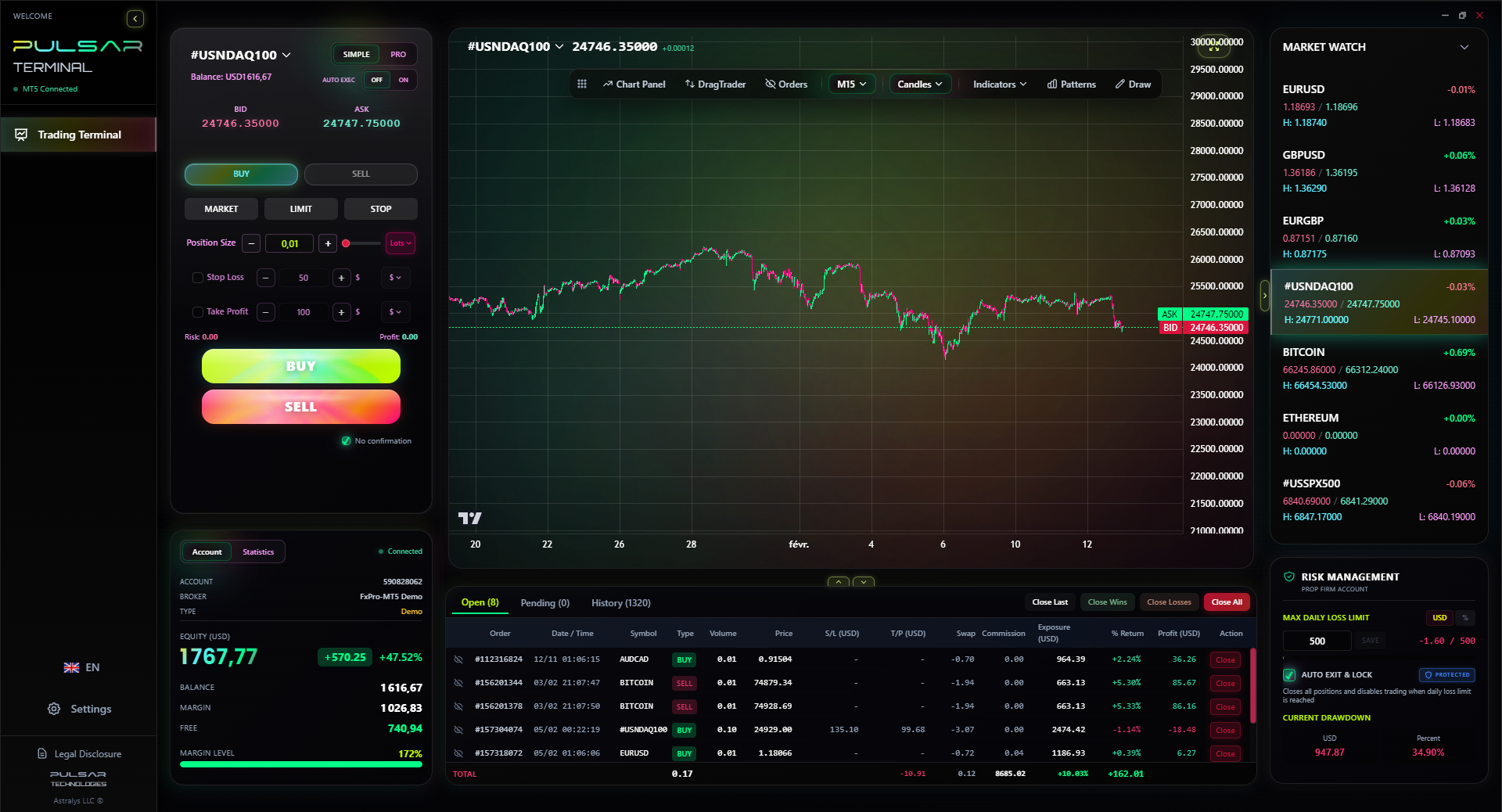
Managing complex forex strategies with multiple exits is where most traders fail; Pulsar Terminal automates this with drag-and-drop multi-TP/SL and partial closures directly on your MT5 charts.
“If you don't understand the costs, you're not trading, you're just donating.”
So, after all that, where should you put your money? Let's make it simple.
Choose the JSE if you:
- Have a longer-term investment horizon (1+ years).
- Prefer fundamental analysis and understanding businesses.
- Want to build a portfolio that generates dividend income.
- Are uncomfortable with high use and 24-hour market risk.
- Can tie up capital and not panic during market downturns.
- Are okay with higher upfront transaction costs.
Choose Forex if you:
- Want to trade short-term price movements (days, weeks, months).
- Are fascinated by global economics and central bank policy.
- Need flexible trading hours outside the SA workday.
- Have the discipline to use low use and manage risk ruthlessly.
- Understand that costs are in the spread and swaps, not just commissions.
- Are prepared for intense volatility and the psychological pressure that comes with it.
My final, opinionated take? Start with the JSE. Learn about risk, position sizing, and emotional control with an instrument that moves slower. Use a demo account to get a feel for forex's pace. Once you've consistently not blown up a simulated forex account for six months, then consider a small live stake. The stock exchange vs forex isn't a choice between good and bad. It's a choice between a marathon and a series of sprints. Most people aren't built for the sprints. Be honest with yourself about which one you are.
And whatever you choose, get your tools in order. Whether it's a strong position size calculator or a platform that automates your exit strategy, your edge isn't just your analysis, it's your execution.
FAQ
Q1Is forex trading safer than trading on the JSE?
No, it's generally riskier for retail traders. The high use available in forex (even at the FSCA cap of 30:1) amplifies both gains and losses, allowing you to lose your capital much faster than with typical JSE margin. The JSE's lower use and the inherent long-term value of shares provide a slower, more forgiving environment for learning.
Q2Can I trade the JSE with the same broker I use for forex?
Sometimes, but not always. Many international forex brokers (like IG) offer CFDs on South African indices (like the Top 40) and sometimes on major JSE shares. However, if you want to actually own the physical shares, receive dividends, and vote at AGMs, you need a dedicated South African stockbroker (like EasyEquities, PSG, or your bank's trading platform).
Q3What is the minimum amount needed to start trading forex vs. the JSE in South Africa?
Forex can be started with very little. Brokers like Exness allow deposits from $10 (roughly R185). However, trading with such a small amount is almost pointless due to position sizing and risk. A more realistic starter amount is R5,000-R10,000. For the JSE, platforms like EasyEquities allow you to buy fractional shares with as little as R10, but to make trading costs sensible, a minimum of R2,000-R5,000 per position is more practical.
Q4How does the FSCA's 30:1 use cap affect my forex trading?
It limits your maximum buying power. With R10,000, you can control a maximum of R300,000 worth of currency (10,000 x 30). Before the cap, some brokers offered 500:1 (R5 million control). The cap protects you from extreme, instant wipeouts, but 30:1 is still very powerful and dangerous. A 3.33% move against you still wipes out your entire capital.
Q5Which market has more opportunities for day trading?
Forex, without a doubt. The 24-hour market, high liquidity in major pairs, and lower transaction costs (tight spreads) make it more suitable for frequent, short-term trades like scalping. The JSE's limited hours, higher fixed costs per trade, and generally slower-moving shares make it less ideal for pure day trading, though it's possible with CFDs on indices or liquid blue chips.
Q6Do I pay more tax on forex profits or JSE capital gains?
You likely pay a higher effective tax rate on active forex profits. If SARS deems your forex trading a revenue activity (which frequent trading suggests), profits are added to your income and taxed at your marginal rate (up to 45%). JSE capital gains are subject to CGT, with an annual exclusion and an effective max rate of 18%. Always consult a tax professional.
Pelajaran Prof. Winston
:
- ✓JSE costs are upfront (STT, brokerage); Forex costs are continuous (spread, swap).
- ✓FSCA caps forex use at 30:1, but 10:1 is the professional's limit.
- ✓Forex profits are likely taxed as income (up to 45%); JSE gains as capital (max 18%).
- ✓Trade JSE for long-term value; trade Forex for short-term volatility.
Sejauh mana artikel ini berguna?
Klik bintang untuk menilai
Pandangan Dagangan Mingguan
Analisis & strategi mingguan percuma. Tiada spam.
Tentang Penulis
David van der Merwe
Pedagang Pasaran Membangun
Pedagang berpangkalan di Johannesburg dengan 11 tahun dalam mata wang pasaran membangun. Pakar dalam pasangan ZAR, dagangan terkawal FSCA, dan analisis pasaran Afrika Selatan.
Komen
Anda mungkin juga suka

Cara Trading Forex Sukses: 7 Prinsip dari Trader Profesional
Cara trading forex sukses dengan 7 prinsip trader pro: manajemen modal, disiplin, journal trading, backtest. Data nyata, bukan janji profit palsu.
Jam Trading Forex Terbaik untuk Trader Indonesia: Panduan Lengkap dengan Tabel Waktu
Panduan jam trading forex untuk trader Indonesia. Tabel 4 sesi dunia, jam emas 20:00-00:00, sesi mana yang harus dihindari. Data akurat + tips dari trader berpengalaman.
Top 5 Sàn Forex Uy Tín Nhất 2026: Review Jujur dari Trader Indonesia
Top 5 sàn forex uy tín 2026 untuk trader Indonesia. Review jujur: spread, deposit, withdraw, dukungan lokal. Exness, XM, IC Markets & lebih.
All these calculators are built into Pulsar Terminal with real-time data from your MT5 account. One-click position sizing, automatic risk management, and instant calculations.
