


Let me be blunt: searching for a 'top 100 forex brokers list' is one of the worst ways to choose a broker in Nigeria.

Olumide Adeyemi
Perintis Dagangan Afrika Barat ·  Nigeria
☕ 9 minit baca
Apa yang akan anda pelajari:
Let me be blunt: searching for a 'top 100 forex brokers list' is one of the worst ways to choose a broker in Nigeria. Those lists are often paid ads, outdated, or completely ignore our unique situation. I learned this the hard way, losing a chunk of my first deposit to a broker that was 'highly ranked' but had impossible withdrawal terms. The real game isn't about finding a name on a list; it's about understanding the Nigerian landscape and matching a broker's strengths to your trading style. I'll show you exactly how to do that, cutting through the noise.
When I started, I devoured those lists. Broker A was #1 for spreads, Broker B was #1 for platforms. It felt like research. It wasn't. It was a distraction.
These lists have three fatal flaws for us. First, they're generic. A broker perfect for a German trader under strict EU use caps is useless for a Nigerian looking at different opportunities. Second, they rarely verify if a broker even accepts Nigerian clients or offers Naira payment options. I once spent hours comparing two 'top 10' brokers only to find their sign-up page didn't list Nigeria as a country. Total waste.
Finally, and most importantly, they gloss over regulation. For a Nigerian trader, a broker's international license isn't a nice-to-have; it's your primary line of defense. Since our local framework for online forex isn't fully developed yet, your money's safety hinges entirely on that foreign regulator - be it the FSCA in South Africa, the ASIC, or others. A list that prioritizes 'bonuses' over this is dangerous.

Warning: A broker offering the world's best conditions is worthless if you can't get your money out. Always, always verify their license with the actual regulator's website before depositing a single Naira.
Before you even look at a broker's spreads, you need to understand the ground rules here. Trading forex is legal for individuals. Full stop. But the regulatory environment has a specific shape.
The Central Bank of Nigeria (CBN) and SEC are the main players, but their focus is on the official forex markets and interbank trading. For you and me trading online with international brokers, there's no specific local licensing framework yet. This means we rely on brokers regulated abroad. It's not unregulated; it's differently regulated. Your safety net is that FSCA or CySEC license.
Here’s the kicker the CBN has clarified: while you can trade, Nigerian banks are prohibited from giving you official forex to fund these trading accounts. You'll be using your card or other payment channels, which often means fees. Factor that in.
And then there's the taxman. All your trading profits are subject to a 10% Capital Gains Tax. It's on gross profits. If you make 500,000 Naira in a year, set aside 50,000. I didn't account for this in my second year, and let's just say the surprise wasn't pleasant. It's a real cost of doing business here.
Funding Your Account
This is where the rubber meets the road. Look for brokers with solid local payment partners. Depositing and withdrawing should not feel like a cross-border heist. Brokers that have integrated with local payment processors get a huge tick in my book. If the only option is an international wire that costs $50, find another broker. Those fees will eat your account alive, especially if you're starting small or practicing scalping strategies with frequent withdrawals.

💡 Petua Winston
A broker is a utility, not a strategy. Your edge comes from your analysis and discipline, not their platform's color scheme. Choose for safety and reliability, not bells and whistles.
“High use isn't for amplifying profits on tiny accounts. It's for sophisticated traders with strong risk management to use a tiny portion of their capital efficiently.”
Forget the ranking. Use this filter instead. If a broker doesn't pass all these, move on.
- Accepts Nigerian Clients: Non-negotiable. Check their sign-up page.
- Strong International Regulation: Look for FSCA, ASIC, CySEC, FSA (Seychelles), BVI FSC. Check the license number on the regulator's site.
- Reasonable Naira Deposit/Withdrawal: Low fees, reliable local partners. Test the withdrawal process with a small amount first.
- Platform & Tools: Do they offer MT4/MT5? If you're into advanced charting, check their tools. I once chose a broker for its low spread but hated its proprietary platform; I was constantly fighting the software instead of trading.
Now, here’s where personal preference comes in. Your trading style dictates the next criteria.
| Your Trading Style | Priority #1 | Broker Feature to Seek |
|---|---|---|
| Scalper | Cost per trade | Raw spreads (0.0 pips) + low commission. Every pip counts. |
| Swing Trader | Overnight costs | Low swap rates (rollover fees). You hold trades for days. |
| Beginner / Small Account | Risk management | Flexible position sizing, micro-lots, good educational content. |
| High-Volume Trader | Execution quality | True ECN/STP model, no requotes, deep liquidity. |
My own mistake? I was a swing trader obsessed with raw spreads. I paid a commission on every trade I held for a week, chasing a 0.1 pip advantage that was completely irrelevant to my strategy. I paid more in commissions than I 'saved' on the spread. Match the broker to your actual habits.
This is a major differentiator for Nigerian traders. Many international brokers offer us use much higher than what's allowed in places like Europe or the UK. We're talking 1:500, 1:1000, even 'unlimited'.
It sounds like a superpower. It's more often a curse.
Here’s my confession: I blew up my first serious account because of use. I deposited $200, got 1:1000 use, and suddenly had $200,000 in buying power. I felt like a king. One bad trade on EUR/USD and a 20-pip move against me wiped out 40% of my real capital. The margin call came fast. I was trading a size meant for a $10,000 account with a $200 one. Stupid.
High use isn't for amplifying profits on tiny accounts. It's for sophisticated traders with strong risk management to use a tiny portion of their capital efficiently. For most of us, it's a trap that magnifies losses and emotional decisions.

Pro Tip: When you see high use, don't use it. Cap your use manually in your MT4/MT5 settings to 1:50 or 1:100. Use a position size calculator for every single trade. Treat high use as a privilege you're not yet qualified for, not a feature to exploit.
“Choosing a broker is the most important trade you'll ever make.”
Let's move from theory to practice. Here’s a no-BS look at a few brokers commonly used in Nigeria, based on my experience and that of traders I know. This isn't a ranking, just observations.
XM: A solid all-rounder for beginners. Their Standard account has no commissions, spreads start around 0.8 pips on EUR/USD, and the minimum deposit is just $5. Their customer support is actually responsive. Where they shine for new traders is education. But if you're a high-volume scalper, the commission-free spreads might be too wide. Check our full XM review for more details.
Exness: Famous for two things: extremely high use and tight spreads. They offer some of the lowest spreads I've seen, often hitting 0.0 pips on majors. Their registration and verification process is famously quick. The trade-off? Such high use demands extreme discipline. I know profitable traders who use Exness for its execution, but they have iron-clad risk rules. It's not a playground.
IC Markets: A favorite among serious retail traders, especially for scalping and algo trading. Their Raw Spread account offers true ECN pricing. The minimum deposit is higher ($200), but you're paying for top-tier execution and the MetaTrader suite. If you're graduating from a beginner broker and want professional-grade infrastructure, this is a strong contender. Our IC Markets review breaks down their account types.
Pepperstone: Another excellent choice for active traders. Great execution on both MT4/5 and cTrader. Their Razor account is similar to IC Markets' offering. They are heavily regulated (ASIC, FCA, etc.), which adds a layer of security. I've found their charts and tools to be very reliable, which matters when you're basing entries on indicators like the RSI or MACD.
The point is, each has a personality. XM is the welcoming teacher. Exness is the high-octane race car. IC Markets and Pepperstone are the professional workshops. Which environment suits you?
💡 Petua Winston
The first profit you should aim to withdraw is your own initial deposit. If that process is smooth, you've passed the most critical test of a broker's legitimacy.
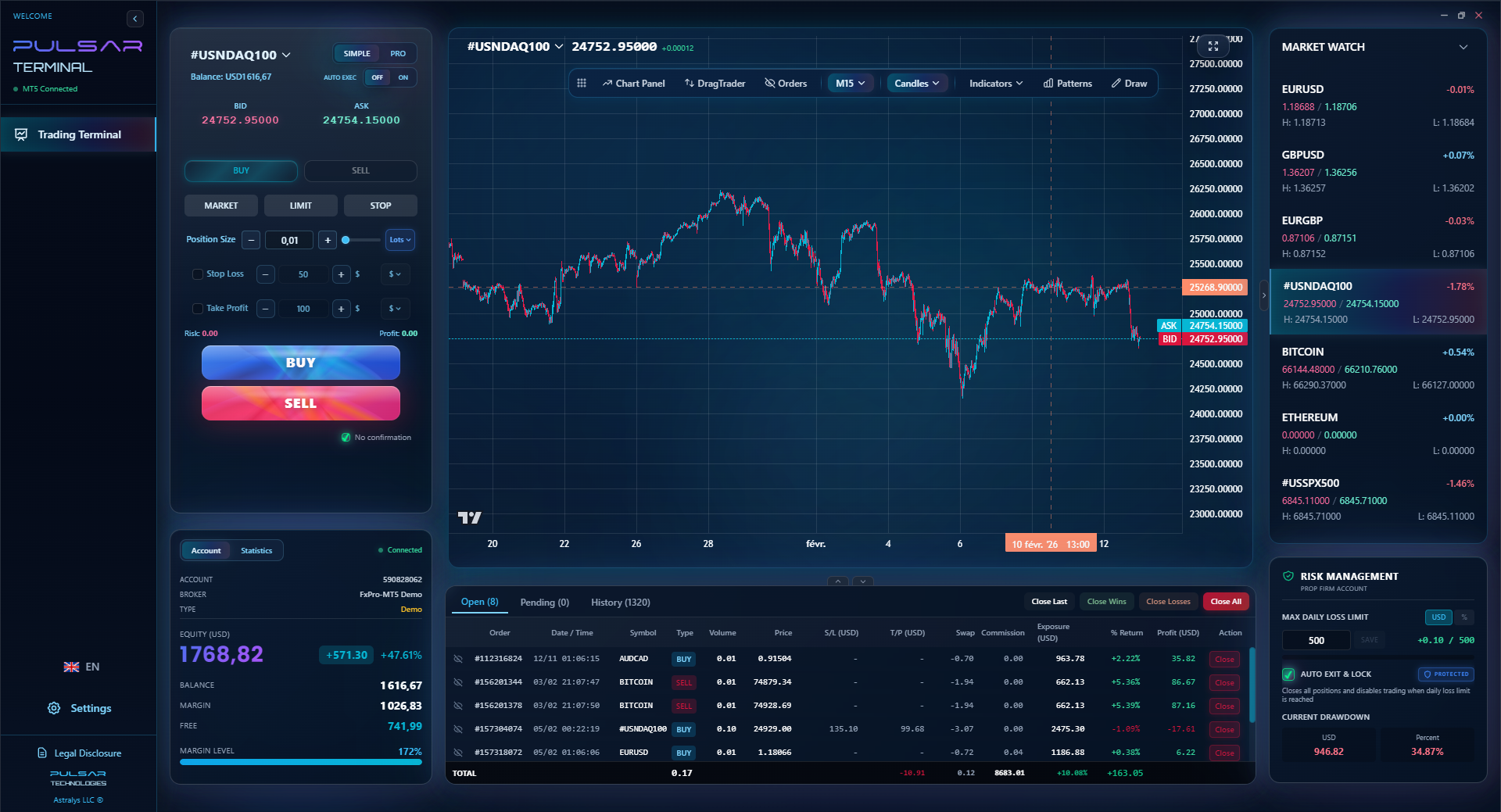
Once you've chosen a reliable broker, managing complex trades and risk becomes the next challenge, which is where tools like Pulsar Terminal for MT5 can automate your strategy and protect your capital.
If you see any of these, close the tab immediately. I've fallen for a couple of these myself.
- "Guaranteed Profits" or "No Risk": Trading is risk. Anyone saying otherwise is lying.
- Difficulty Withdrawing: If the withdrawal page is hidden, has mysterious fees not listed on the site, or requires endless new verification steps, your money is in trouble.
- Only a PO Box Address: A legitimate, internationally regulated broker has a real office address in the country of its regulation.
- Pressure to Deposit More: A 'account manager' calling you to deposit more to 'recover losses' is a scam. Full stop.
- Unregulated or Offshore-Only: If their only license is from a vague offshore jurisdiction with no reputation for financial oversight, you are not a client; you are a target.
The biggest red flag of all? A broker that's perfect on every single 'top 100' list metric but fails the basic Nigerian reality test of easy Naira deposits and verified international regulation.
“Your safety net is that FSCA or CySEC license, not a spot on a 'top 100' list.”
So here’s what you actually do, step by step.
- Define Yourself: Are you a beginner? A swing trader? A would-be scalper? Be honest.
- Shortlist by Regulation: Pick 3-4 brokers from reputable reviews (like ours) that are known to accept Nigerians and have strong international licenses.
- Open Demo Accounts: Not for one day. For a full month. Trade your strategy on their platform. Test execution speed during news events. Feel the platform. Is the charting smooth? Can you place orders easily?
- Test the Money Flow: Make a small, real deposit (the minimum). Then, immediately request a withdrawal of part of it. This tests the most critical function. If it's smooth, you're good.
- Start Small: Fund your chosen account with only what you can afford to lose. Your first real goal isn't profit; it's to successfully make a withdrawal of your profits.
Choosing a broker is the most important trade you'll ever make. It's not about finding the 'best' one in the world. It's about finding the right one for you, here in Nigeria. Do the work, ignore the flashy lists, and you'll build your trading on a solid foundation, not marketing hype.
FAQ
Q1Is forex trading legal in Nigeria?
Yes, forex trading is legal for individuals in Nigeria. However, the Central Bank of Nigeria (CBN) does not specifically license international online retail brokers. Nigerian traders therefore use brokers regulated by reputable foreign authorities like the FSCA, ASIC, or CySEC.
Q2What is the best use for a beginner in Nigeria?
Despite many brokers offering 1:500 or 1:1000, the best use for a beginner is 1:50 or lower. High use dramatically increases risk. Use a position size calculator for every trade to manage your risk, regardless of the available use.
Q3How do I pay taxes on forex trading profits in Nigeria?
All profits from forex trading are subject to a 10% Capital Gains Tax. You are responsible for declaring this income and paying the tax to the Federal Inland Revenue Service (FIRS). Keep detailed records of all your trades and withdrawals.
Q4Why can't I use a Nigerian bank to fund my forex account directly?
The CBN prohibits Nigerian banks from providing customers with foreign exchange from the official market specifically for funding forex trading accounts with international brokers. You must use alternative payment methods like debit/credit cards or payment processors offered by your broker.
Q5What is more important, low spreads or good regulation?
Good regulation is infinitely more important. A broker with slightly higher spreads but strong regulation (FSCA, ASIC) is always safer than an unregulated broker with 0.0 pip spreads. Your first priority is the safety of your deposited funds.
Q6Can I trade Gold (XAU/USD) with Nigerian brokers?
Yes, most major international brokers that accept Nigerian clients offer CFDs on Gold (XAU/USD). Always check the specific instrument list and trading conditions, like spreads and swap rates, as they can vary. You can learn more in our XAU/USD guide.
Q7How do I know if a broker is a scam?
Major red flags include guaranteed profits, pressure to deposit more money, difficulty processing withdrawals, only having a P.O. box for an address, and being regulated only in obscure offshore jurisdictions with no financial oversight reputation.
Pelajaran Prof. Winston
:
- ✓Regulation trumps every other broker feature.
- ✓Manually cap your use at 1:50 as a beginner.
- ✓Test withdrawals with a small sum first.
- ✓Pay your 10% Capital Gains Tax on profits.
- ✓Match the broker's strengths to your trading style.
Sejauh mana artikel ini berguna?
Klik bintang untuk menilai
Pandangan Dagangan Mingguan
Analisis & strategi mingguan percuma. Tiada spam.
Tentang Penulis
Olumide Adeyemi
Perintis Dagangan Afrika Barat
Salah seorang pendidik dagangan forex paling aktif di Nigeria. 8 tahun pengalaman dagangan dari Lagos. Pakar dalam strategi modal rendah dan cabaran prop firm untuk pedagang Afrika.
Komen
Anda mungkin juga suka

Cara Trading Forex Sukses: 7 Prinsip dari Trader Profesional
Cara trading forex sukses dengan 7 prinsip trader pro: manajemen modal, disiplin, journal trading, backtest. Data nyata, bukan janji profit palsu.
Jam Trading Forex Terbaik untuk Trader Indonesia: Panduan Lengkap dengan Tabel Waktu
Panduan jam trading forex untuk trader Indonesia. Tabel 4 sesi dunia, jam emas 20:00-00:00, sesi mana yang harus dihindari. Data akurat + tips dari trader berpengalaman.
Top 5 Sàn Forex Uy Tín Nhất 2026: Review Jujur dari Trader Indonesia
Top 5 sàn forex uy tín 2026 untuk trader Indonesia. Review jujur: spread, deposit, withdraw, dukungan lokal. Exness, XM, IC Markets & lebih.
All these calculators are built into Pulsar Terminal with real-time data from your MT5 account. One-click position sizing, automatic risk management, and instant calculations.
