


I lost R8,400 in one afternoon back in 2018 because I treated gold like a currency pair.

David van der Merwe
Pedagang Pasaran Membangun ·  South Africa
☕ 11 minit baca
Apa yang akan anda pelajari:
- 1The Core Differences: Volatility & Market Behavior
- 2Real Costs for a South African Trader
- 3use, Margin & The FSCA Rules
- 4Choosing Your Battles: Which Market Fits Your Strategy?
- 5Practical Tips for Getting Started in 2026
- 6Mistakes I Made (So You Don't Have To)
- 7My Verdict: Where Should a South African Focus?
I lost R8,400 in one afternoon back in 2018 because I treated gold like a currency pair. I'd been scalping EUR/USD successfully, so when I saw gold dropping, I jumped in with the same tight stop-loss and aggressive position size. Gold didn't care about my forex rules. It spiked back up $15 in minutes on some Middle East headline I hadn't even seen, wiping out a week's profits. That painful lesson cost me real money, but it taught me the fundamental truth: trading commodities vs forex isn't just about different charts. It's about completely different beasts, each with their own rhythm, rules, and risks. If you're trying to decide where to put your capital in 2026, you need to understand these differences in your bones, not just on paper.
Let's start with the most important distinction: what actually moves these markets. Forex is primarily about interest rates, economic data, and central bank policy. When the South African Reserve Bank (SARB) announces a rate decision, the ZAR pairs react immediately. It's a relative game, comparing one economy against another.
Commodities trade on physical supply and demand. Gold reacts to real-world fear (geopolitical tension), inflation expectations, and actual mining output. Oil moves on OPEC decisions, inventory reports, and global economic growth forecasts. This creates fundamentally different volatility patterns.
Forex volatility is often more consistent and predictable during specific sessions. The London/New York overlap is liquid and fast. Commodities can sit dead for hours, then explode on a single headline. I remember trading Brent Crude in 2022. It was drifting sideways for a full Asian session. Then a US inventory report dropped, showing a massive drawdown. The price shot up $3.50 in under 90 seconds. That kind of explosive, news-driven move is more common in commodities.

Warning: Don't use the same stop-loss distances for both. A 20-pip stop on EUR/USD might be reasonable. On XAU/USD (gold), that's often just market noise. I learned this the hard way and now use at least a $15 (150 pip) stop on gold for any swing trade.
Another key difference is the trading day. Forex is a 24-hour market from Monday to Friday. Some commodities, like US Oil (WTI), have formal trading halts. There's a daily settlement period. If you're not aware of these times, you can get caught out. Always check your broker's specific trading hours for commodity CFDs.

💡 Petua Winston
The market doesn't know you have a stop-loss. A news gap in oil can blow straight through it, turning a 2% risk into a 10% loss overnight. Always size for the worst-case scenario, not the expected move.
“Trading commodities vs forex isn't just about different charts. It's about completely different beasts.”
This is where many new traders get tripped up. The advertised 'low costs' never tell the full story. Let's break down what you'll actually pay trading from South Africa in 2026.
Spreads & Commissions
For forex, the majors (like EUR/USD) are incredibly cheap. On a good ECN account with a broker like IC Markets review, you can get spreads from 0.0 pips plus a commission of about $7 per standard lot. That's fantastic for high-volume scalping strategy. But try trading USD/ZAR? The spread can easily be 80-150 pips because it's an exotic pair with lower liquidity. Your cost to enter and exit is immediately higher.
Commodities are a different ball game. The spread on XAU/USD (gold) might be 25-50 cents ($2.5 to $5.0) per ounce during active hours. On Oil (CL), it could be 3-5 cents per barrel. This doesn't sound like much until you calculate the pip definition value. Because one full point move in gold is $10 per standard lot, that 50-cent spread is a $5 cost before you even start.

Example: Opening a 1-lot trade on Gold (XAU/USD) with a 35-cent spread.
- Spread cost: 0.35 * $10 per point = $3.50
- If gold moves $1 in your favor, your profit is $10 - $3.50 = $6.50. Your trade needs to overcome that $3.50 hurdle first. On a small move, the spread eats a huge percentage of your profit.
Overnight Fees (Swap Rates)
This is critical for swing trading. In forex, swaps are based on the interest rate differential between the two currencies. Sometimes you earn a small credit for holding a position.
Commodity swaps are almost always a debit. You're paying to hold a CFD position on a physical asset you don't own. The fees can be substantial. Holding a long position in oil over a weekend could cost you $20-$30 per lot in swap fees. I once held a silver trade for two weeks, made a $120 profit, but paid $45 in swaps. My net gain was almost cut in half. Always check the swap calculator before holding commodity positions long-term.
“I lost R8,400 in one afternoon because I treated gold like a currency pair.”
South Africa's regulator, the Financial Sector Conduct Authority (FSCA), changed the game in 2021 by capping use for retail traders at 30:1 on major forex pairs. This is a big deal and aligns us with Europe. It's designed to protect you from blowing up your account too quickly, and honestly, it's a good rule for most beginners.
But here's the practical reality for trading commodities vs forex in 2026:
| Instrument | Typical FSCA Retail use | What It Means for Margin |
|---|---|---|
| EUR/USD (Forex Major) | Up to 30:1 | Margin of ~3.33% required. |
| USD/ZAR (Forex Exotic) | Often lower, e.g., 20:1 | Margin of 5% required. |
| Gold (XAU/USD) | Up to 20:1 (FSCA) | Margin of 5% required. |
| Oil (CL) | Often 10:1 | Margin of 10% required. |
See the pattern? Commodities generally come with lower use. Why? Higher volatility. A broker doesn't want a $5 move in oil wiping out your account and triggering a margin call they have to cover.
Some international brokers might offer South Africans higher use on 'professional' accounts, but qualifying isn't easy. You need to prove significant trading experience and portfolio size. My advice? Learn to trade well with 30:1 or less. If you need 500:1 to make money, your strategy is the problem, not the use.
The lower use on commodities means you need more capital per trade. Trading one standard lot of gold ($100,000 contract) at 20:1 requires $5,000 in margin. That's a serious commitment for a South African account. It forces you to be more selective with your commodity trades, which isn't a bad thing.

Pro Tip: Never max out your use. Just because you can use 30:1 doesn't mean you should. I rarely use more than 10:1 on any trade, especially with commodities. It gives the trade room to breathe against volatility.
“I lost R8,400 in one afternoon because I treated gold like a currency pair.”
Your personality and available time should dictate your market, not the other way around. I've forced myself into strategies that didn't fit, and it's a sure way to lose money.
Are you a scalper or day trader with fast reflexes? Forex might be your home. The high liquidity of majors like EUR/USD means you can get in and out quickly with minimal spread definition cost. You can make 20-30 trades a day if that's your style. The 24-hour nature means you can trade around your job. I know a guy in Cape Town who only trades the first two hours of the London open, pure scalping strategy on GBP pairs, and does very well.
Are you a patient swing trader or trend follower? Commodities could be a better fit. They trend more reliably than forex pairs, which often range. Once gold or oil gets moving in a direction, it can run for weeks. You don't need to stare at the screen all day. You set your trade, manage your risk, and check in a few times a day. This suits someone with a full-time job. My most profitable trades have been 2-3 week swings on gold, using the MACD indicator on the daily chart to catch the momentum.
What about news trading? Both work, but differently. Forex reacts to scheduled economic calendars (CPI, NFP, rate decisions). Commodities react to unscheduled geopolitical news and supply data. If you're good at interpreting economic data, trade forex. If you're a news junkie who follows global politics and energy reports, look at commodities.
Honestly, I split my time. About 60% of my capital is in longer-term commodity swings (mostly gold and oil), and 40% is for shorter-term forex plays on the EUR/USD guide and GBP/USD. This diversification helps smooth out the equity curve.
💡 Petua Winston
Your biggest edge is patience. Most commodity trends take days to develop. Most forex scalps fail in minutes. If you're constantly clicking buttons, you're just paying the spread. Wait for the chart to come to you.
“use amplifies losses faster than gains. It's a multiplier for your mistakes.”
Let's talk about the nitty-gritty of setting up to trade from South Africa today.
Broker Choice is Critical. You must use an FSCA-regulated broker. It's not just about legality; it's about fund safety. Brokers like Pepperstone review and Exness review have strong local presence and regulation. Look for ZAR-denominated accounts. This lets you deposit and withdraw in Rands without nasty conversion fees eating into your profits.
Deposits & Withdrawals. Use Instant EFT or a local payment gateway like Ozow if your broker offers it. It's fast, cheap, and in Rands. Avoid international credit card deposits if you can, as your bank might charge a foreign transaction fee.
Start with a Demo, but Not Forever. Practice on both forex and commodity charts. Get a feel for the speed and spread. But don't get stuck in demo-land for 6 months. The psychology is totally different. Once you have a basic plan, start small with real money. That R500 or R1000 trade will teach you more about fear and greed than a year of demo trading.
Taxes. Don't ignore this. SARS is getting sharper. As of 2026, frequent trading profits are viewed as income, not capital gains. That means it's added to your salary and taxed at your marginal rate (up to 45%). Keep a careful log: every trade, every deposit, every withdrawal. Use a spreadsheet or a dedicated journal. The taxman will want to see it.
Platforms. MT4 or MT5 is the standard. Most local brokers offer it. It's reliable and has all the tools you need, like the RSI indicator. Don't get distracted by fancy platforms until you've mastered the basics on MetaTrader.
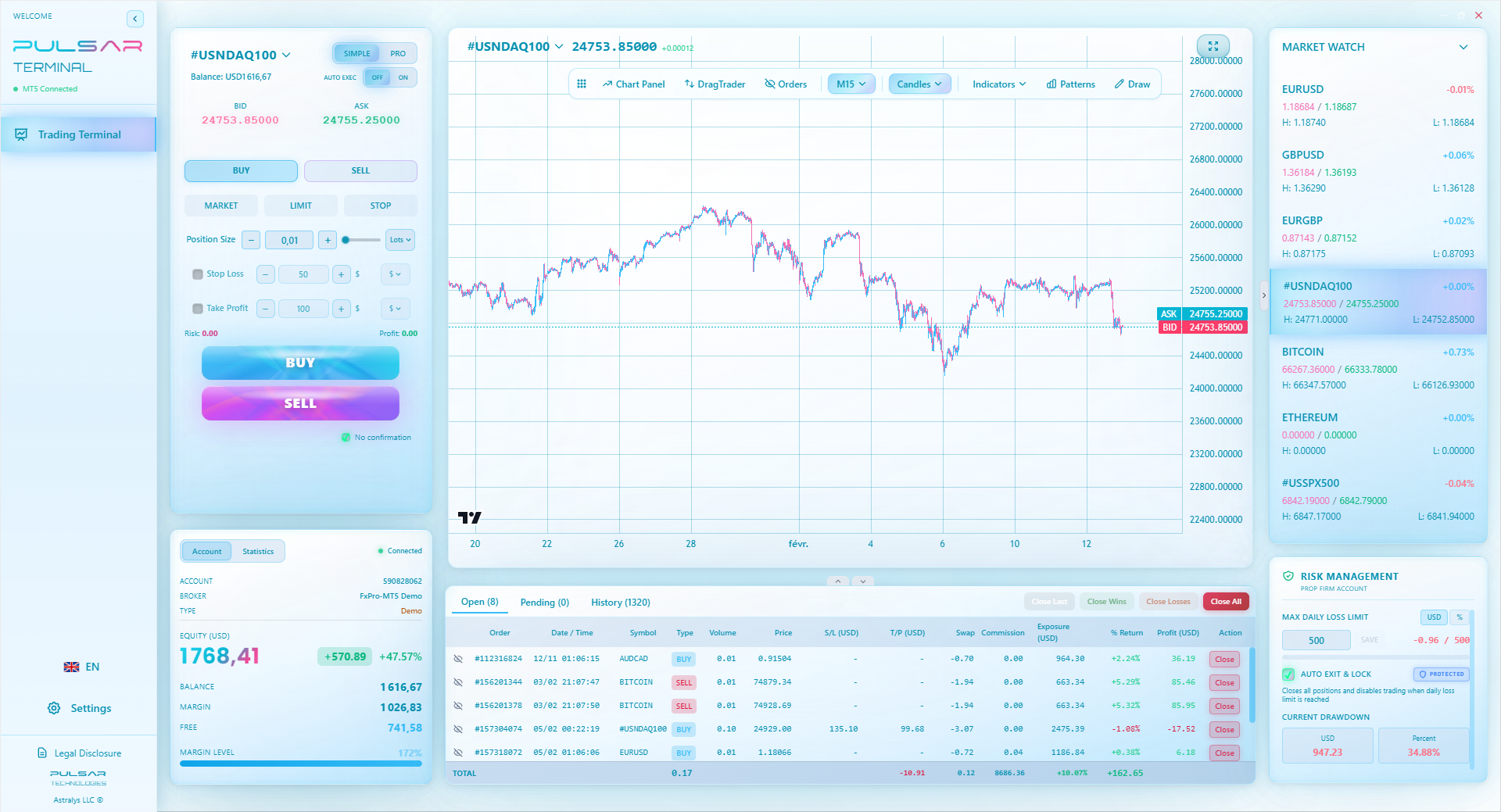
Managing multiple commodity swing trades with different stop and target levels is complex, but tools like Pulsar Terminal let you set and trail them all visually on your MT5 chart.
“use amplifies losses faster than gains. It's a multiplier for your mistakes.”
I've paid for these lessons, so you can learn for free.
- Trading Commodities Like Forex: My R8,400 gold loss story. Different volatility requires different risk management. Use a position size calculator and adjust your stop-loss for the asset's average true range, not a fixed pip amount.
- Ignoring Swap Fees on Commodities: That silver trade where fees ate 40% of my profit. Now, if I'm swing trading a commodity, I factor the potential swap cost into my minimum profit target. If the math doesn't work, I don't take the trade.
- Chasing USD/ZAR Because It's 'Local': It's a tempting pair, but the spreads are huge and it can be manipulated by local flows. It's a difficult market to trade technically. I lost more trying to be clever with the Rand than I ever made. I stick to the major forex pairs for liquidity.
- Using Maximum use on a 'Sure Thing': In 2020, I was convinced oil would rebound. I used near-max use on a long CFD position. It dropped another 15%, and the margin call forced me out at the worst possible time, right before it actually did rebound. use amplifies losses faster than gains.
- Not Having a Session-Specific Plan: Forex at 10 AM London time is a different animal to forex at 2 AM SA time. Commodities have their own active windows (often around US open). Trading during dead, low-liquidity hours is a great way to get stopped out by random spikes. Know when your chosen market is alive and trade then.
“If you need 500:1 use to make money, your strategy is the problem, not the use.”
If you're brand new to trading, start with forex. Specifically, start with one major pair like EUR/USD or GBP/USD on a demo account. The costs are lower, the educational material is vast, and the 24-hour liquidity is forgiving. You can practice swing trading or day trading without the explosive, account-killing volatility of commodities. Get your risk management rock solid here first. Learn how to use stops, calculate position size, and handle losing streaks.
Once you've traded consistently well in forex for at least 6 months, then consider allocating a portion of your capital to commodities. I'd suggest starting with gold (XAU/USD guide). It's the 'currency' of commodities and often behaves in ways that make sense to a forex trader (safe-haven flows, inverse relationship to the USD).
The biggest mistake is jumping between markets looking for the 'easy money.' There isn't any. Both markets are brutally efficient at transferring money from the impatient and undisciplined to the patient and disciplined. Pick one, learn its personality, and master it. In 2026, with the FSCA rules in place and SARS watching, discipline isn't just profitable, it's essential. Good luck, and trade safe.
FAQ
Q1Is it legal to trade forex and commodities in South Africa?
Yes, it's completely legal, but you must use a broker regulated by the Financial Sector Conduct Authority (FSCA). Trading through unregulated offshore brokers is risky and doesn't offer the same consumer protections. The FSCA ensures client funds are segregated and brokers operate fairly.
Q2Which is more profitable: forex or commodities?
Neither is inherently more profitable. It depends entirely on your skill and strategy. Forex offers more frequent, smaller opportunities ideal for day trading. Commodities offer stronger, longer trends suited for swing trading. Profitability comes from your edge and discipline, not the market itself. I know traders making a consistent living in both.
Q3What's the minimum amount needed to start trading commodities in SA?
While some brokers like XM let you start with $5, a realistic minimum for commodity trading is higher due to margin requirements. To trade one mini lot (0.1) of gold with sensible risk, you'd need at least R2,000-R3,000 in your account. Starting with too little forces you to use excessive use, which is a fast track to losing everything.
Q4How are my trading profits taxed by SARS?
SARS generally views frequent, short-term trading profits as income from a trade (not capital gains). This means your net profit is added to your other income (like your salary) and taxed at your marginal tax rate, which can be up to 45%. You must declare this income and keep detailed records of all trades, deposits, and withdrawals.
Q5Why is the use lower for commodities than for forex?
Regulators and brokers impose lower use on commodities because they are typically more volatile than major forex pairs. A $10 move in gold is common and would wipe out an account using 100:1 use very quickly. Lower use (like 10:1 or 20:1) acts as a built-in risk buffer against these larger price swings.
Q6Can I trade the South African Rand (USD/ZAR) as a beginner?
I don't recommend it. USD/ZAR is an exotic pair with wide spreads (often 80-150 pips), making transaction costs high. It's also susceptible to local political and economic shocks that are hard to predict. Beginners should stick to major pairs like EUR/USD where costs are lower and global analysis is more readily available.
Q7What's the single biggest risk when trading commodities?
Gap risk. Commodity markets can have formal closes (like the NYMEX close for oil). Major news (e.g., an OPEC emergency meeting, a major conflict) can break over the weekend, causing the price to open significantly higher or lower on Monday. Your stop-loss won't protect you; you'll be filled at the new price, potentially for a much larger loss than you planned.
Pelajaran Prof. Winston
:
- ✓Match your stop-loss to the asset's volatility, not a fixed number.
- ✓Commodity swap fees can silently consume 40% of your profits.
- ✓FSCA's 30:1 use cap is a protective gift for beginners.
- ✓USD/ZAR's wide spread makes it a poor choice for frequent trading.
Sejauh mana artikel ini berguna?
Klik bintang untuk menilai
Pandangan Dagangan Mingguan
Analisis & strategi mingguan percuma. Tiada spam.
Tentang Penulis
David van der Merwe
Pedagang Pasaran Membangun
Pedagang berpangkalan di Johannesburg dengan 11 tahun dalam mata wang pasaran membangun. Pakar dalam pasangan ZAR, dagangan terkawal FSCA, dan analisis pasaran Afrika Selatan.
Komen
Anda mungkin juga suka

Cara Trading Forex Sukses: 7 Prinsip dari Trader Profesional
Cara trading forex sukses dengan 7 prinsip trader pro: manajemen modal, disiplin, journal trading, backtest. Data nyata, bukan janji profit palsu.
Jam Trading Forex Terbaik untuk Trader Indonesia: Panduan Lengkap dengan Tabel Waktu
Panduan jam trading forex untuk trader Indonesia. Tabel 4 sesi dunia, jam emas 20:00-00:00, sesi mana yang harus dihindari. Data akurat + tips dari trader berpengalaman.
Top 5 Sàn Forex Uy Tín Nhất 2026: Review Jujur dari Trader Indonesia
Top 5 sàn forex uy tín 2026 untuk trader Indonesia. Review jujur: spread, deposit, withdraw, dukungan lokal. Exness, XM, IC Markets & lebih.
All these calculators are built into Pulsar Terminal with real-time data from your MT5 account. One-click position sizing, automatic risk management, and instant calculations.
