


Here's a hard truth most prop firms won't tell you: over 90% of their challenge fees are pure profit because traders fail.

James Mitchell
Penganalisis Dagangan Kanan
☕ 12 minit baca
Apa yang akan anda pelajari:
- 1What Exactly Is Upcomers? (It's Not a Broker)
- 2The Rules & Challenges: Where Most Traders Fail
- 3Costs, Fees, and Payouts: The Real Math
- 4What's the Word on Reddit? Community Sentiment
- 5The US Regulatory Cloud: What It Means for You
- 6Upcomers vs. The Competition: A Quick Comparison
- 7Final Verdict: Should You Try Upcomers?
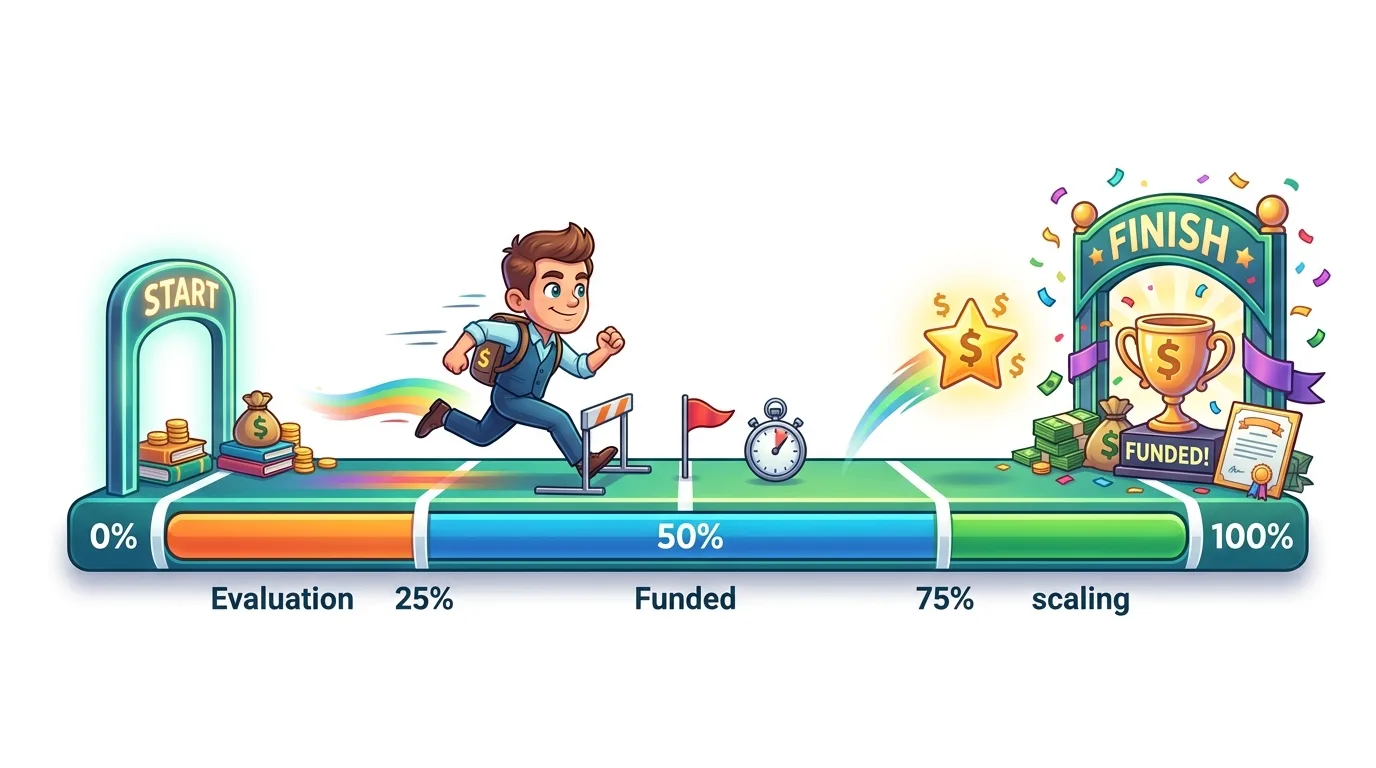
Here's a hard truth most prop firms won't tell you: over 90% of their challenge fees are pure profit because traders fail. Upcomers, like all the others, operates in that space. I've traded with half a dozen prop firms over the years, and the chatter on Reddit about 'newer' firms like Upcomers is always a mix of hope and skepticism. Let's cut through the marketing. This isn't a sponsored review. It's a look at Upcomers' real numbers, their rules, and whether the path to a 99% profit split is a golden road or a cleverly designed trap.
First thing to get straight: Upcomers is not your broker. You won't be sending your life savings to an Upcomers account. They're a proprietary trading firm, which means they run an evaluation service. You pay a fee to take a challenge on a simulated account. If you pass their rules, they grant you access to a larger pool of their capital to trade with, and you split the profits.
They're registered as Royal Flow - FZCO in Dubai and Upcomers Ltd. in Saint Lucia. This is a common setup for these firms. For you in the US, the critical point is they structure this as a simulated environment to navigate regulations. They don't hold client funds for trading, which keeps them outside the direct grip of the SEC or CFTC as a traditional broker. But that landscape is shifting, and we'll get to that.
Their model is straightforward: you buy a challenge, you trade a demo account under specific rules, you pass, you get a funded account. The allure is the capital size. Starting with a few hundred bucks, you can aim for a $50k, $100k, or even a $1.5 million account. It's use of a different kind.

Warning: Just because it's a "simulated environment" doesn't mean the psychology is simulated. The pressure is very real, and the rules are designed to make consistent profitability difficult. I've blown more challenge accounts than I care to admit, and the sting from losing that fee money is genuine.
“Over 90% of prop firm challenge fees are pure profit because the rules are designed for you to fail.”
This is the meat of it. The rules aren't just guidelines; they're the gatekeepers. Upcomers, like its competitors, uses these to manage their risk. You need to understand them like the back of your hand.
The Profit Targets
These vary by challenge. For their popular 1-step challenge on a $5k account, the profit target is 6%. That means you need to grow that $5,000 demo account to $5,300. Sounds simple on a good day, right? But it's not just about hitting a number.
Other challenges, like their multi-phase ones, have staged targets. An "Eon – 5 Step" challenge requires a 2% profit target per phase. An "Astral – 3 Step" requires 3%, 3%, and then 4%. The multi-phase ones often feel like a marathon with sprints in the middle.
The Drawdown Limits (The Silent Account Killer)
This is where I've seen countless traders, including a younger version of myself, get wrecked. There are two key limits:
- Maximum Daily Loss: For that same $5k 1-step challenge, it's 6% ($300). Hit that, and your challenge is over immediately. No warning, just a closed account.
- Maximum Total Drawdown: This is often a trailing limit from your starting balance or your highest equity. For the $5k challenge, it's also 6%. This one is sneaky. Let's say you start, make $200 (4% profit), and then have a bad trade that loses $250. Even though you're still above your starting balance, your drawdown from your peak equity of $5,200 might violate the rule if it's calculated a certain way. You must read their specific definition.

Example: You buy a $10,000 Phoenix challenge for $52. Your daily loss limit is 5% ($500). You have two losing trades totaling a $450 loss. You're now at $9,550. You cannot risk more than $50 on your next trade without breaching the daily limit. This forces micro-management and can lead to panic.
Time Limits and use
Most challenges have a time limit (30, 60, 90 days). Upcomers offers use up to 1:100. That's a double-edged sword. It can help you hit targets faster, but it absolutely magnifies your risk against those drawdown limits. Using high use without a precise position size calculator is a guaranteed way to fail.
The rules aren't necessarily unfair; they're just a different game. Your usual swing trading approach might not work here because of the daily loss limits. You need a strategy adapted to the prop firm model.

💡 Petua Winston
A prop firm challenge is a test of consistency, not brilliance. One amazing trade means nothing. Ten boring, rule-following trades mean everything.
“A 99% profit split means nothing if a 30% withdrawal fee takes a third of it off the top.”
Let's talk money, because the fees and splits are where you separate the good deals from the questionable ones.
Challenge Fees: Upcomers frequently runs discounts. A $5,000 1-step challenge might be listed at $39.75 (down from $159). A $5,000 2-step is around $42. These are relatively low entry points, which is attractive. The Thunderbolt and Phoenix challenges start at $39 and $52 respectively. Remember, this fee is usually non-refundable if you fail. It's their primary revenue stream.
The Famous Profit Split: They advertise up to 99%. That's top-tier on paper. But you only get that after passing the challenge and starting to earn on the funded account. Your first payout might be at 80% or 90%, scaling up with performance. Always read the fine print on how you climb to that 99%.
The Payout Catch (This is Critical): Here’s a real-world example from my research. Upcomers charges processing fees on withdrawals.
- Bank Transfer (IBAN): $19.9 + 2.49% of the withdrawal amount.
- Crypto Payout: $19.9 + a whopping 30% processing fee.
Let's do the math. If you earn a $1,000 payout and want it via crypto: $1,000 - $19.9 - ($1,000 * 0.30) = $1,000 - $19.9 - $300 = $680.10 in your pocket.
That 30% fee is a massive haircut. It makes crypto payouts almost nonsensical unless it's a tiny amount. The bank transfer fee is more industry-standard, but you still need to factor it in. This is why reading the payout terms is as important as reading the trading rules.
Payouts are "on-demand," which is good. But always calculate your net profit after all fees. A firm with an 80% split and low fees can sometimes net you more than a 90% split with high fees.

“A 99% profit split means nothing if a 30% withdrawal fee takes a third of it off the top.”
Scouring Reddit for an "upcomers prop firm review reddit" thread reveals the usual pattern for a newer firm. There's not a massive volume of threads, which tells you it's not yet a giant like FTMO was. The sentiment is mixed, which is actually normal.
The Positive Notes: Users sometimes mention the low entry cost for challenges as a plus. The 99% split is always a headline grabber in posts. Some commenters who claim to have passed say the verification and payout process was straightforward (using the bank transfer method, not crypto).
The Complaints and Warnings: This is where you need to pay attention. Common themes include:
- Confusion over Drawdown Rules: The number one complaint across all prop firm subreddits. Traders believe they were within limits but got failed. With Upcomers, specifically, ensure you know if their drawdown is static (from starting balance) or trailing (from peak equity). Don't assume.
- The Crypto Payout Fee: This gets flagged repeatedly. Many Redditors view the 30% fee as excessive and a red flag.
- Slippage & Spreads During News: Some unverified reports mention challenging conditions during high volatility. Since they use platforms like TradeLocker and Bybit, your experience may vary. It's less about "widened spreads" and more about whether their simulated environment accurately reflects liquidity.
My take? Reddit is a useful thermometer, not a definitive answer. Look for consistent patterns in complaints. A few isolated bad reviews are normal; a flood of people saying the same thing about payouts being denied is a major warning. For Upcomers, the fee structure seems to be the biggest recurring discussion point.

Pro Tip: When reading Reddit reviews, check the user's post history. Is this their only post, or are they an active member of trading communities? A one-post account trashing or glorifying a firm is less credible than someone with a long history of genuine discussion.
💡 Petua Winston
That 30% crypto fee isn't a charge; it's a sign. It tells you exactly what the firm thinks of that payment method. Listen to it.
“The prop firm path is a tough one. Your discipline is the only thing that can tilt the odds slightly back in your favor.”
This is the boring but vital section. The regulatory environment for prop firms in the US is in flux, and it directly impacts your security.
As of early 2026, the situation is clarifying but not settled. Here’s the layman's breakdown:
- The Good News for Firms (and Maybe You): In late 2024, a court pushed back against an SEC rule that would have forced many prop firms to register as strict broker-dealers. The SEC dropped its appeal in early 2025. This means the extreme regulatory crackdown some feared has been delayed, likely allowing the current model (simulated challenges) to continue for the near future.
- The Persistent Uncertainty: The CFTC (which oversees futures and commodities) is still eyeing this space. They might still decide that firms offering futures trading evaluations should be classified as Commodity Trading Advisors (CTAs), which comes with licensing and disclosure rules. The SEC hasn't fully gone away either.
What does this mean for you, the trader?
- Your Funds Are Not FDIC Insured: The challenge fee you pay is for a service, not an investment. If Upcomers shuts down, you have no recourse for that fee or any unpaid profits.
- Payouts Are a Business Agreement, Not a Regulatory Right: If they delay or deny a payout, your option is to argue based on their Terms of Service, not complain to a regulator like FINRA. This is why a firm's reputation for paying is everything.
- The Model Could Change: Stricter rules could come eventually. This might mean higher challenge fees (to cover compliance costs) or even firms pulling out of the US market.
The bottom line: trading with a globally registered prop firm carries an inherent risk that's different from trading with a regulated US broker. You're betting on the firm's solvency and integrity. This isn't to scare you off, but to make you trade with your eyes wide open. Never "invest" money into challenge fees that you can't afford to lose completely.
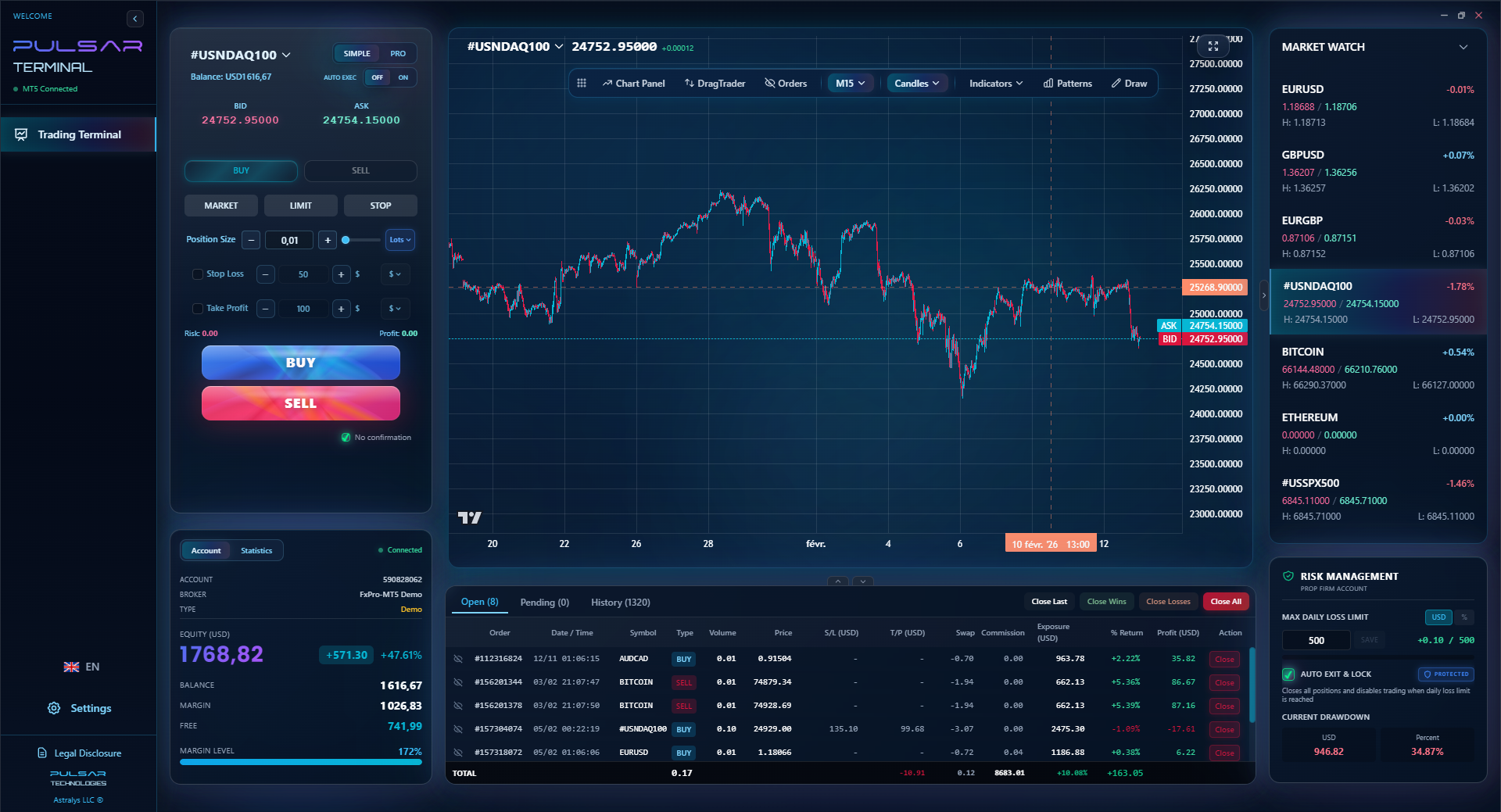
Managing a prop firm's strict daily loss limit is a constant manual headache, which is why tools like Pulsar Terminal automate it for you directly on MT5.
“The prop firm path is a tough one. Your discipline is the only thing that can tilt the odds slightly back in your favor.”
Is Upcomers the best choice? It depends on what you value. Let's stack it up loosely against some well-known names.
| Feature | Upcomers | Typical Established Firm (e.g., FTMO Legacy) | Notes |
|---|---|---|---|
| Entry Cost | Low (~$40 for $5k) | Moderate to High | Upcomers uses discounts aggressively. |
| Profit Split | Up to 99% | Usually up to 90% | Upcomers wins on paper, but check the fee clawback. |
| Payout Fees | High (30% for Crypto) | Typically Lower/Flat | This is a major disadvantage for Upcomers. |
| Rule Clarity | Standard | Standard | Both have complex drawdown rules. Always read. |
| Track Record | Shorter | Longer | Established firms have more years of payout history. |
| Platform | TradeLocker, Bybit | Often MT4/MT5 | Upcomers partners with newer platforms. If you love MT5 (like I do), this matters. |
Who might Upcomers be for?
- A trader on a very tight budget who wants a low-cost trial run of the prop firm model.
- Someone specifically interested in the platforms they offer (TradeLocker).
- A trader who is confident in passing quickly and doesn't mind the bank transfer payout fees.
Who should look elsewhere?
- Traders who prioritize low payout fees above all else.
- Those who want the perceived stability of a firm with a longer, more documented history.
- Anyone planning to withdraw profits via cryptocurrency regularly.
Remember, the best firm is the one whose rules best fit your trading style. A firm with a 5% daily loss limit might be better for a scalping strategy than one with a 3% limit.
💡 Petua Winston
Your first goal in any challenge isn't the profit target. It's surviving 10 trading days without touching the daily loss limit. Master that first.

“Never 'invest' money into challenge fees that you can't afford to lose completely.”
Alright, here's my straight take after living in this world for over a decade.
Upcomers is a legitimate player in the sense that they operate a common prop firm model. They're not a scam. But "legitimate" doesn't mean "the best choice for you."
The potential upside is real: low entry cost, high profit split on paper, and access to decent capital sizes. If you have a disciplined, rule-adapted strategy and treat the challenge fee as a cost of education, it could be a worthwhile gamble.
The downsides are significant: The crypto payout fee is borderline predatory. The relatively shorter track record compared to industry giants means they have more to prove regarding long-term payer reliability. And like all prop firms, the rules are designed for you to fail.
My personal approach now is different. After blowing a few hundred dollars on various challenges early on, I focused on building my own capital slowly. But I get the appeal. If you're going to try Upcomers, here's my battle plan:
- Treat the $40 fee as lost money the second you pay it. This removes emotional attachment.
- Choose the BANK TRANSFER payout method only. Forget crypto exists on their platform.
- Paper trade their rules first. Take your strategy and simulate it against their exact daily loss and max drawdown limits for a month. Use a position size calculator religiously.
- Start with the smallest, cheapest challenge. It's not about the capital size; it's about proving you can navigate their system.
- Document everything. Screenshot your trades, your balance, everything. If there's ever a dispute, you have evidence.
The prop firm path is a tough one. Upcomers offers a cheaper ticket to the game, but the house still has a massive edge. Your skill, discipline, and ability to manage risk under their constraints are the only things that can tilt the odds slightly back in your favor. Don't chase the 99% split dream. Chase a rule-set you can consistently beat. Everything else is just marketing.
FAQ
Q1Is Upcomers Prop Firm legit and trustworthy?
Based on their business model and available information, Upcomers operates a legitimate proprietary trading firm structure similar to others in the industry. They are a registered business. "Trustworthy" in this space often refers to payout reliability. While they don't have the multi-year history of some giants, there are no widespread, verified reports of them refusing to pay traders who followed the rules. The main trust issue is their high crypto payout fee, which you should avoid.
Q2What is the catch with Upcomers' 99% profit split?
The main catch is you only get that high split after becoming a profitable funded trader, and it may scale up from a lower starting percentage. More importantly, their processing fees on payouts can significantly eat into that split. A 30% fee on a crypto withdrawal turns a 99% gross split into a much lower net split. Always calculate your take-home profit after all fees.
Q3What are the most common reasons traders fail the Upcomers challenge?
Traders almost always fail for two reasons: violating the Maximum Daily Loss limit or the Maximum Total Drawdown limit. These rules are strict and often use a trailing calculation from your peak equity. A few bad trades in a row can hit the daily limit. A winning streak followed by a pullback can violate the total drawdown. Not understanding the exact definition of their drawdown is the #1 killer.
Q4Can I trade forex and gold (XAU/USD) with Upcomers?
Yes, as they offer forex and likely commodities through their partnered platforms (like TradeLocker). Since they offer use up to 1:100, instruments like XAU/USD can be traded, but you must be extremely careful with position sizing due to gold's volatility and the firm's strict drawdown limits.
Q5How long does it take to get a payout from Upcomers?
They advertise on-demand payouts, which typically means you can request a payout once you've reached the minimum threshold and your trading period (often a monthly minimum) is met. Processing time is usually stated as a few business days. However, always factor in the additional time for a bank wire (IBAN) to clear in your account, which can add several more days.
Q6Is Upcomers better than FTMO or The5ers?
"Better" is subjective. Upcomers often has lower entry fees and advertises a higher profit split. However, firms like FTMO and The5ers have longer, more established track records, which some traders value for peace of mind. Their payout fees are generally more favorable. Upcomers might be better for a low-cost trial; established firms might be better for traders prioritizing stability and lower withdrawal costs.
Q7What trading platforms does Upcomers support?
Upcomers partners with TradeLocker, Platform 5, and Bybit. They do not currently support the industry-standard MetaTrader 4 (MT4) or MetaTrader 5 (MT5) platforms directly. If you are accustomed to trading on MT5 with specific brokers like IC Markets or Pepperstone, you will need to adapt to Upcomers' offered platforms.
Pelajaran Prof. Winston
:
- ✓Drawdown rules, not profit targets, fail 80% of traders.
- ✓Always calculate net profit after ALL payout fees.
- ✓Start with the smallest challenge to learn the rules.
- ✓Prop firm trading is a business test, not market speculation.
Sejauh mana artikel ini berguna?
Klik bintang untuk menilai
Pandangan Dagangan Mingguan
Analisis & strategi mingguan percuma. Tiada spam.
Tentang Penulis
James Mitchell
Penganalisis Dagangan Kanan
Berpangkalan di New York dengan lebih 9 tahun pengalaman perdagangan. Fokus pada pasangan USD utama, cabaran prop firm, dan landskap peraturan AS.
Komen
Anda mungkin juga suka

Cara Trading Forex Sukses: 7 Prinsip dari Trader Profesional
Cara trading forex sukses dengan 7 prinsip trader pro: manajemen modal, disiplin, journal trading, backtest. Data nyata, bukan janji profit palsu.
Jam Trading Forex Terbaik untuk Trader Indonesia: Panduan Lengkap dengan Tabel Waktu
Panduan jam trading forex untuk trader Indonesia. Tabel 4 sesi dunia, jam emas 20:00-00:00, sesi mana yang harus dihindari. Data akurat + tips dari trader berpengalaman.
Top 5 Sàn Forex Uy Tín Nhất 2026: Review Jujur dari Trader Indonesia
Top 5 sàn forex uy tín 2026 untuk trader Indonesia. Review jujur: spread, deposit, withdraw, dukungan lokal. Exness, XM, IC Markets & lebih.
All these calculators are built into Pulsar Terminal with real-time data from your MT5 account. One-click position sizing, automatic risk management, and instant calculations.
