


Here's a fact that'll make you sit up: the USD/ZAR is, on average, over 50% more volatile than the EUR/USD.

David van der Merwe
Pedagang Pasaran Membangun ·  South Africa
☕ 11 minit baca
Apa yang akan anda pelajari:
- 1What Volatility Really Means (It's Not Just 'Big Moves')
- 2How to Measure Volatility on ZAR Pairs (The Tools You Need)
- 3Trading Strategies for High Volatility (ZAR Edition)
- 4What Actually Drives Volatility for a South African Trader?
- 5Non-Negotiable Risk Rules for Volatile Markets
- 6Choosing a Broker When Volatility is Your Neighbour
- 7The Mental Battle: Staying Sane in the Chaos
- 8Your Volatility Trading Checklist

Here's a fact that'll make you sit up: the USD/ZAR is, on average, over 50% more volatile than the EUR/USD. That's not a typo. While my mates in London are sipping tea and watching the Euro dance in a 50-pip range, we're down here in SA getting whipsawed for 100 pips before lunch. If you're trading with rands, understanding the volatility meaning in forex isn't academic. It's the difference between building wealth and getting your account shredded. I've seen both sides. Let's make sure you end up on the right one.
Most new traders think volatility just means price moves a lot. That's only half the story, and the half that gets you killed. The real volatility meaning in forex is about the rate and magnitude of price changes over a specific time. It's the market's heartbeat, and right now, ZAR pairs have the heart rate of a cheetah on espresso.
Think of it this way: a calm market (low volatility) moves predictably. A volatile market doesn't just move far, it moves fast and often without warning. The key metric we use is the Average True Range (ATR). It tells you, in pips, how much a pair typically moves in a day. For USD/ZAR, that ATR can easily sit between 250-400 pips. For EUR/USD? Maybe 70-100. That's the scale of the game we're playing.

Warning: High volatility doesn't mean 'more opportunity.' It means more risk. A 300-pip move against you on USD/ZAR will wipe out a much larger chunk of your capital than the same move on a major pair, thanks to the wider spread. Your first job is survival, not heroics.
I learned this the hard way in 2018. I treated USD/ZAR like it was GBP/USD, using the same stop-loss distances. The market blew through my stop like it wasn't there, turned around, and hit my profit target. I was right on direction, but my understanding of volatility was dead wrong. I lost the trade. That's when I started using a position size calculator religiously, inputting the current ATR to determine my stop distance first, then my position size.
You can't manage what you don't measure. Guessing volatility is a surefire path to the poorhouse. Here are the tools I have glued to my charts.
The ATR Gauge
The Average True Range indicator is your best friend. Set it to 14 periods on the daily chart. That number it spits out is your baseline for daily movement. Before any trade on USD/ZAR or EUR/ZAR, I check the 14-day ATR. If it's reading 350 pips, I know my stop-loss needs to be placed with that in mind. A 50-pip stop is just gambling.
Bollinger Bands Squeeze
Bollinger Bands are volatility bands placed above and below a moving average. When the bands squeeze tight, it signals low volatility and often precedes a big explosive move (a 'squeeze play'). When they expand, high volatility is present. On the 4-hour chart of USD/ZAR, a squeeze can be a powerful signal for a pending breakout.
Economic Calendar as a Volatility Predictor
This is the most important tool for a South African trader. The ZAR is a commodity currency, hypersensitive to local and global events. South African CPI data, SARB interest rate decisions, US Non-Farm Payrolls, and Chinese economic data are all guaranteed volatility injectors. I don't place new trades 30 minutes before or after these releases. Period. The spread widens, liquidity vanishes, and you can get filled at a disastrous price.

Example: Let's say USD/ZAD has an ATR of 320 pips. Your trading strategy requires a 1.5x ATR stop-loss for a swing trade. That means your stop needs to be at least 480 pips away from your entry. If your account risk is 1% ($100 on a $10k account), your position size must be small enough that a 480-pip loss equals $100. This math is non-negotiable.

💡 Petua Winston
Volatility isn't your enemy; mis-measured volatility is. Let the ATR dictate your stop, not your fear or greed.

“If you're trading with rands, understanding volatility isn't academic. It's the difference between building wealth and getting your account shredded.”
Trading the rand requires a specific mindset. The strategies that work on placid majors will fail here.
Swing Trading with Wide Stops
This is my bread and butter. You aim to catch the larger, multi-day trends driven by fundamental shifts (like changing interest rate differentials). Because volatility is high, you need wide stops to avoid being knocked out by noise. This means smaller position sizes. The profit potential, however, is massive. A good swing on USD/ZAR can net 800-1200 pips. I once caught a long swing on USD/ZAR from 14.80 to 16.20 over three weeks. The move was 1400 pips. My wide stop at 14.50 never got touched. The key is patience and letting the trade breathe. This aligns well with a swing trading philosophy.
Avoiding Scalping (Most of the Time)
Forget scalping USD/ZAR around major news. The spreads from most brokers will eat you alive. While a broker like IC Markets might offer decent raw spreads, the combination of spread cost and violent price spikes makes it a loser's game for most. I scalp only during the quiet London-New York overlap on less volatile crosses, never on pure ZAR pairs.
The Breakout Trap
High volatility makes fake breakouts more common. Price rockets through a key level, you jump in, and it reverses instantly. To filter these, I wait for a close above/below the level on the 4-hour chart, not just a spike. Even then, I enter with a partial position. A tool like the MACD indicator on a higher timeframe can help confirm if momentum supports the breakout.
Knowing the sources of the storm helps you prepare for it.
| Driver | Effect on ZAR | Why It Matters |
|---|---|---|
| SARB Repo Rate | Direct & Massive | This is the big one. A hike strengthens ZAR (in theory), a cut weakens it. The statement and tone are just as important as the number. |
| SA CPI & Budget Speech | Very High | Shows inflation and fiscal health. Bad numbers = ZAR sell-off. I mark these dates in red on my calendar. |
| US Dollar Strength | High | ZAR is a risk currency. When the USD rallies globally (safe-haven flow), ZAR often gets hammered. Watch EUR/USD as a gauge. |
| Commodity Prices (Platinum, Gold) | Moderate-High | SA is a major exporter. Rising gold prices can support the ZAR. I often keep a chart of XAU/USD open as a correlation guide. |
| Political & Local Factors | Unpredictable | Load-shedding stages, cabinet reshuffles, social unrest. These cause sudden, sharp spikes that technical analysis can't predict. Reduce use on days like these. |
The biggest mistake is trading ZAR pairs in a vacuum. You must have one eye on global risk sentiment and the other on local politics. It's exhausting, but that's the job.

“Your position size is determined by the distance to your stop-loss and your pre-defined risk percentage. Accept it.”
This is where careers are made or broken. Your strategy can be mediocre, but your risk management must be elite.
1. use is a Poisoned Chalice: With SA brokers offering use up to 1:500 (from firms like Exness or XM), it's a trap. On a volatile pair like USD/ZAR, I never use more than 1:20 effective use. That means if I have $10,000, my total position exposure is never above $200,000. Higher use turns a normal 300-pip move into a margin call.
2. Stop-Losses are Sacred, Not Suggestions: You must place a stop-loss on every trade, the moment you enter. And it must be based on the chart's volatility (ATR), not the arbitrary amount you're willing to lose. A stop that's too tight due to ego or fear is a guaranteed loss.
3. Position Sizing is Your Master Skill: This is the most important skill in trading, full stop. Your position size is determined by the distance to your stop-loss and your pre-defined risk percentage (I risk 0.5-1% per trade). If the volatile market demands a 400-pip stop, your position size will be small. Accept it. This is where that position size calculator saves your life.

Pro Tip: During extreme volatility (like a SARB announcement), consider using a Guaranteed Stop-Loss Order (GSLO) if your broker offers it. You'll pay a small premium, but it ensures you get out at your exact price, even if the market gaps. It's an insurance policy worth paying for on occasion.
💡 Petua Winston
The best trade during high volatility is often no trade at all. Preserving capital is a positive action.

Your broker can be an ally or your worst enemy when the ZAR starts jumping. Here’s what to look for:
Execution Speed & Slippage: During news events, does your broker's price feed freeze? Do you get horrific slippage? Test this with a demo account during SA CPI releases. Brokers with true ECN/STP models like Pepperstone or IC Markets typically handle volatility better than market makers.
Spreads on ZAR Pairs: The spread is your first cost. Compare the typical EUR/ZAR and USD/ZAD spreads across brokers. A difference of 5 pips might not matter on EUR/USD, but on a volatile pair, it adds up brutally. Some global brokers have shocking spreads on exotic pairs.
Regulation & Safety: The FSCA in South Africa is the local regulator. It's good practice. But also consider brokers with top-tier global regulation (like ASIC) for additional security. Know where your money is held.
Deposit/Withdrawal in ZAR: This is a practical must. You don't want to lose 3% on bank conversion fees every time you fund your account. Local EFT support is crucial.
My setup? I use a globally regulated ECN broker for execution quality, but I keep a separate account with a good local FSCA-regulated broker for easy ZAR deposits. I transfer between them only when necessary.
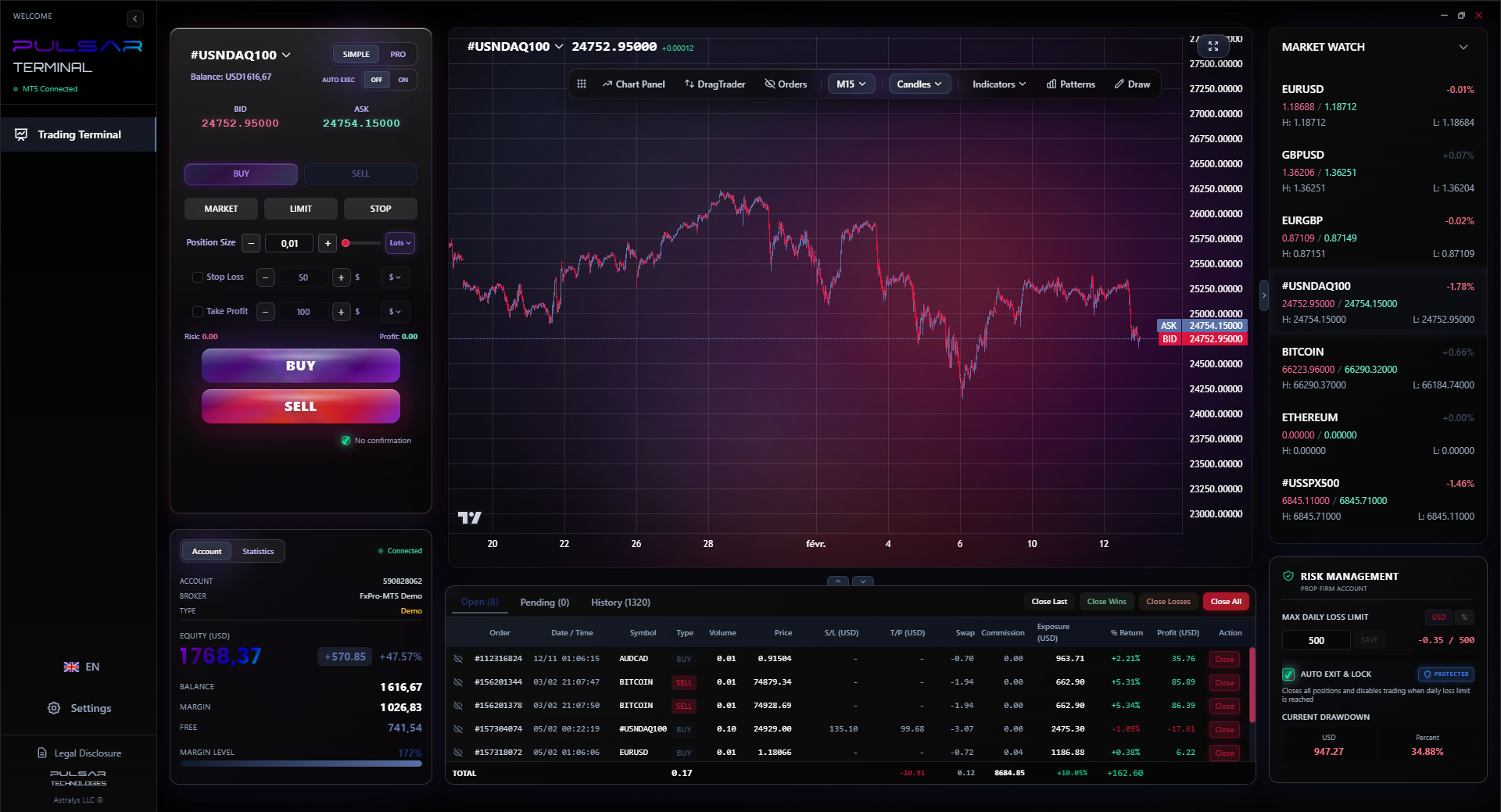
Managing multiple take-profit levels and trailing stops on volatile pairs is complex, but Pulsar Terminal automates it all directly within your MT5 platform.
“In a volatile market, you are a speck of dust. Accepting your insignificance is liberating.”
Volatility plays with your head. A 200-pip profit can vanish in 10 minutes. A 150-pip loss can turn into breakeven just as fast. This emotional whipsaw leads to revenge trading, overtrading, and abandoning your plan.
Detach from the P&L: Watch the chart, not the floating profit/loss in your MT5 terminal. That number will drive you insane. Focus on whether the price action is still validating your trade thesis.
Embrace Being Small: In a volatile market, you are a speck of dust. The market doesn't know you exist and doesn't care about your stop-loss. Accepting your insignificance is liberating. It removes ego from the equation.
Walk Away After a Big Win or Loss: After a huge winning trade on a ZAR pair, or a nasty stop-out, close the platform. Your judgment is impaired. Go for a braai, watch the rugby. Coming back with a clear head prevents you from giving back all your profits in one impulsive trade.
I've broken every one of these rules. The worst was in 2020. I had a great week, made 4%. I felt invincible. I jumped into a USD/ZAR trade just before a speech, size too big, stop too tight. Got stopped out, felt cheated, re-entered immediately. Lost the entire week's profit in an hour. The volatility didn't beat me. My own scrambled psychology did.

Before you click 'buy' or 'sell' on any ZAR pair, run down this list. Print it out. Stick it on your monitor.
- Check the ATR: What is the current 14-day daily ATR? Is my stop-loss distance at least 1x this value?
- Check the Calendar: Is there a major SA or global news event in the next 4-12 hours? If yes, do not enter a new trade.
- Calculate Position Size: Based on my stop-loss distance and my 1% risk rule, what is my exact lot size? Use the calculator.
- Set Stop & Take-Profit: Place them immediately as pending orders. Consider using a trailing stop or multiple take-profit levels to manage the ride.
- Assess use: What is my effective use after this trade? Is it below 1:20?
- Breathe: Once the trade is on, walk away for an hour. Let the market do its thing.
Understanding the volatility meaning in forex, especially in our backyard, transforms it from a threat into a measurable factor. You stop fearing the storm and start learning to sail in it. It won't make every trade a winner, but it will keep you in the game long enough for your edge to play out. And in this game, longevity is everything.

FAQ
Q1Is high volatility good or bad for forex trading?
It's neutral. It's a condition, not an advantage. High volatility offers larger profit potential but comes with exponentially larger risk. It's good for traders with strong risk management and wide stops; it's a death sentence for traders using tight stops and high use. The market doesn't care which one you are.
Q2What is the most volatile ZAR pair?
USD/ZAD is typically the most volatile major ZAR pair, as it's driven by both US and SA fundamentals. However, during specific risk-off events, exotic crosses like ZAR/JPY can see absolutely explosive and unpredictable moves. For most traders, sticking to USD/ZAD or EUR/ZAD is volatile enough.
Q3How can I protect my trades from news volatility?
The only surefire protection is to not be in the trade. Close positions before high-impact news, or don't open new ones. If you must hold, use a wider stop-loss than usual and consider a Guaranteed Stop-Loss. Remember, spreads widen massively, so even if price doesn't hit your stop, your entry/exit will be worse.
Q4What's a 'normal' daily range for USD/ZAD?
There's no 'normal,' but you can look at the Average True Range (ATR). An ATR between 250 and 400 pips on the daily chart is common. During periods of crisis or major policy shifts, it can easily spike above 500-600 pips in a single day.
Q5Can I use the same strategies on USD/ZAD as I do on EUR/USD?
Absolutely not. This is a critical error. Strategies must be adapted to volatility. A scalping strategy that works on EUR/USD will fail on USD/ZAD due to spreads and noise. A swing trading strategy needs its stop-loss parameters significantly widened. The core principles may be similar, but the numbers must be completely recalculated.
Q6Does the SARB intervene to control ZAR volatility?
The SARB's official stance is that it has a floating exchange rate and does not target a specific level for the rand. However, it has intervened in the past during periods of extreme disorderly market conditions. As traders, we should never trade based on hopes of intervention. Assume the market is free-floating.
Pelajaran Prof. Winston
:
- ✓USD/ZAD is 50%+ more volatile than EUR/USD on average.
- ✓Use the 14-period ATR to set scientifically wide stop-losses.
- ✓Never use >1:20 effective use on volatile ZAR pairs.
- ✓Never trade 30 mins before/after SA CPI or SARB rate decisions.
Sejauh mana artikel ini berguna?
Klik bintang untuk menilai
Pandangan Dagangan Mingguan
Analisis & strategi mingguan percuma. Tiada spam.
Tentang Penulis
David van der Merwe
Pedagang Pasaran Membangun
Pedagang berpangkalan di Johannesburg dengan 11 tahun dalam mata wang pasaran membangun. Pakar dalam pasangan ZAR, dagangan terkawal FSCA, dan analisis pasaran Afrika Selatan.
Komen
Anda mungkin juga suka

Cara Trading Forex Sukses: 7 Prinsip dari Trader Profesional
Cara trading forex sukses dengan 7 prinsip trader pro: manajemen modal, disiplin, journal trading, backtest. Data nyata, bukan janji profit palsu.
Jam Trading Forex Terbaik untuk Trader Indonesia: Panduan Lengkap dengan Tabel Waktu
Panduan jam trading forex untuk trader Indonesia. Tabel 4 sesi dunia, jam emas 20:00-00:00, sesi mana yang harus dihindari. Data akurat + tips dari trader berpengalaman.
Top 5 Sàn Forex Uy Tín Nhất 2026: Review Jujur dari Trader Indonesia
Top 5 sàn forex uy tín 2026 untuk trader Indonesia. Review jujur: spread, deposit, withdraw, dukungan lokal. Exness, XM, IC Markets & lebih.
All these calculators are built into Pulsar Terminal with real-time data from your MT5 account. One-click position sizing, automatic risk management, and instant calculations.
