


I was staring at my screen, coffee gone cold.

David van der Merwe
Pedagang Pasaran Membangun ·  South Africa
☕ 11 minit baca
Apa yang akan anda pelajari:
- 1Equity Defined: Your Live Financial Pulse
- 2Equity vs. Balance vs. Free Margin: The Holy Trinity
- 3How Equity Triggers a Margin Call: The SA Stop-Out
- 4The Silent Equity Killers: Spreads, Swaps & SA Fees
- 5Managing Your Equity: A Practical SA Strategy
- 6Equity, FSCA Regulation, and Your Safety
- 7Common Equity Mistakes I've Made (So You Don't Have To)
I was staring at my screen, coffee gone cold. It was March 2026, and the USD/ZAR had just spiked to 19.45 on some unexpected SARB commentary. My short position was deep in the red. My balance still showed my R20,000 deposit, but the number next to 'Equity' was flashing R15,240. That was the moment I truly understood what equity in forex trading is. It's not your starting cash. It's your current, breathing financial reality in the market, and in South Africa, ignoring it is a fast track to a margin call with your FSCA-regulated broker. Let's break down this fundamental concept, because your equity is the heartbeat of your trading account.
So, what is equity in forex? Forget the textbook definitions for a second. In plain English, your equity is the real-time, total value of your trading account right now. It's your starting balance plus or minus every single tick of profit or loss from all your open trades.
Think of it like this: Your Balance is the money you deposited. It only changes when you add funds, withdraw, or close a trade. Your Equity is your balance plus the live, unrealized P&L of everything you currently have running. If you have no open positions, your equity equals your balance. The second you click 'buy' or 'sell', they divorce.
Here’s the simple formula every South African trader needs to know: Equity = Account Balance + Floating Profit – Floating Loss

Example: You deposit R10,000 with an FSCA broker. Your balance is R10,000. You open a trade on Gold (XAU/USD) that immediately goes R500 into profit. Your equity is now R10,500. If that trade instead goes R500 against you, your equity is R9,500. Your balance remains R10,000 until you close the trade.
This number is dynamic. It updates with every market movement. It’s the most honest number on your platform, and it’s what your broker uses to decide if you’re still solvent enough to keep your positions open. Understanding this is non-negotiable, especially with the use commonly offered here. I learned this the hard way early on, focusing only on my balance and not realizing how close my equity was dragging me to a stop-out. For a deeper look at a popular instrument that can swing your equity wildly, check out our XAU/USD guide.

💡 Petua Winston
Your equity is your only truth in the market. A rising balance can lie to you about past wins, but your equity tells you exactly what you're worth right now. Trade that number.
This is where most new traders in SA get tripped up. Your trading platform shows you Balance, Equity, and Free Margin. They are related, but they tell you completely different stories. Mixing them up is a classic, and expensive, mistake.
Let’s clear the air with a local example. Say you fund your account with R15,000 via an EFT into your Exness or XM account.
| Term | What It Is | When It Changes |
|---|---|---|
| Balance | Your deposited cash + closed trade P&L. | When you deposit/withdraw, or when a trade closes. |
| Equity | Balance + current profit/loss on open trades. | With every price tick in your open positions. |
| Free Margin | Equity – Used Margin. Your "available credit" for new trades. | Changes with equity and as you open/close positions. |
A Real Trade Walkthrough
You have a R15,000 balance. You open a position on EUR/USD that requires R3,000 as margin (your broker's collateral).
- Used Margin: R3,000 (locked up).
- Equity: Starts at R15,000.
- Free Margin: R15,000 - R3,000 = R12,000.
Now, imagine your EUR/USD trade goes well and shows a R2,000 floating profit.
- Equity: R15,000 + R2,000 = R17,000.
- Free Margin: R17,000 - R3,000 = R14,000. Your buying power increased!
But what if it goes badly, showing a R4,000 loss?
- Equity: R15,000 - R4,000 = R11,000.
- Free Margin: R11,000 - R3,000 = R8,000. Your buffer is shrinking.
Your free margin is directly derived from your equity. If your equity falls too close to your used margin, you’ll get a margin call. This is why monitoring your equity is a core part of risk management. Never confuse a healthy balance with a healthy trading account. Your equity tells the true story. To manage this risk effectively, always use a position size calculator.
“Your equity is not your starting cash. It's your current, breathing financial reality in the market.”
This is the scary part, and where understanding what equity in forex is becomes a survival skill. South African brokers regulated by the FSCA are required to have clear stop-out levels to protect you (and them) from catastrophic loss.
A margin call isn't usually a phone call anymore. It's an automatic process. Here’s how it works:
- Margin Level Drops: Your Margin Level is (Equity / Used Margin) x 100%. It’s a percentage that shows how much buffer you have.
- Margin Call Warning: Most brokers will issue a warning (often at 100% Margin Level). This means your Equity equals your Used Margin. You have zero Free Margin. You can’t open new trades, and you should add funds or close positions.
- Stop-Out Level: If your equity keeps falling and hits a pre-defined percentage (often 50% or 20%), the broker will automatically start closing your losing positions, starting with the biggest loser, until your Margin Level is restored above this threshold.

Warning: I got stopped out on a volatile USD/ZAR trade in 2024. My equity hit the 50% level at 3 AM. By the time I woke up, my largest position was closed at a worst-price fill, crystallizing a loss that could have been managed if I’d set a proper stop-loss based on my equity. The system doesn't sleep.
Brokers like IC Markets and Pepperstone are transparent about their stop-out levels (often 50%). You must know yours. If your equity is falling, your margin level is falling. It’s a direct relationship. Keeping your equity healthy is the only way to avoid the forced liquidation of your trades. Learn more about the mechanics of a margin call.
Your equity isn't just chewed up by bad trades. It's nibbled away by costs, especially if you're a frequent trader or hold positions overnight. For us in South Africa, these costs have a local flavour.
Spreads: This is the cost of entering a trade. If the EUR/USD bid/ask is 1.0850/1.0852, the spread is 2 pips. Your trade starts 2 pips in the red. On a standard lot, that’s $20 gone from your equity the moment you click. Brokers like FP Markets might offer 1.3 pips on a standard account, while an ECN account at Tickmill might offer 0.1 pips plus a $5 commission. That spread is a direct, immediate deduction from your potential equity.
Overnight Financing (Swap Fees): This is huge for pairs like USD/ZAR or if you're trading commodities. If you hold a position past the broker's rollover time (usually 10 PM GMT), you pay or receive interest. For a long ZAR position, you might pay a hefty negative swap because of South Africa's interest rate differential. I once held a USD/ZAR short over a weekend, forgetting about swaps. Come Monday, my equity was R800 lower just from financing costs, not market movement.
Other Local Fees:
- Inactivity Fees: Some brokers charge if you don't trade for 30+ days. Markets South Africa charges $10/month; Alfa Financials can hit you with USD 100.
- Withdrawal Fees: While many FSCA brokers offer free EFTs, some international withdrawals can cost ~$25.
- Currency Conversion: If your account is in USD but you deposit in ZAR, a conversion fee (sometimes 1.2%) is baked in.
Every pip in spread, every day in swap, is a tiny drain on your equity. In a scalping strategy where you target 5-10 pips, a 2-pip spread is a massive 20-40% hurdle right out the gate. You need your trade to move just to get back to breakeven on your equity.
💡 Petua Winston
The fastest way to blow an account is to calculate risk based on your starting balance. After two losses, your equity is down. Risking the same Rand amount is now a much larger percentage bet. Always size for your current equity.
“A declining equity curve is the clearest sign your strategy isn't working, regardless of how good your last winning trade felt.”
Knowing what equity is isn't enough. You need a system to manage it. Here’s what I’ve settled on after years of trial and error.
The 2% Rule (Adjusted for Volatility): The old adage is to risk no more than 2% of your account per trade. But I don't use my balance for this calculation. I use my equity. Why? Because if I have a few losing trades in a row, my equity is down. Risking 2% of my original, higher balance would now be risking a much larger percentage of my actual, diminished capital. So, my position size is always based on my current equity. If my equity is R10,000, my max risk per trade is R200.
Equity-Based Stop-Losses: Your stop-loss should be placed at a level that, if hit, will lose you that predetermined amount (e.g., R200). This directly protects your equity from a large drawdown. Use the pip definition to calculate this precisely.
The Equity Curve Check: At the end of each week, I chart my equity. Not my balance, my equity. Is it making higher highs? Or is it in a steady downtrend? A declining equity curve is the clearest sign your strategy isn't working, regardless of how good your last winning trade felt. It forces objectivity.
Using Equity to Gauge Performance: A common mistake is to look at your balance after a big win and think you're a genius. But if that win came after three losses that tanked your equity first, your risk-adjusted performance might be poor. Focus on growing your equity steadily, not making hero trades to recover it.

Pro Tip: Most trading platforms let you add your Equity as a line on your chart. Do it. Seeing that line dip as your trade goes against you is a powerful psychological trigger to reassess, far more effective than just watching a P&L number.
Managing your equity in real-time requires precise order tools, and Pulsar Terminal's drag-and-drop orders and multi-TP/SL features on MT5 let you execute your equity-based risk plan without hesitation.
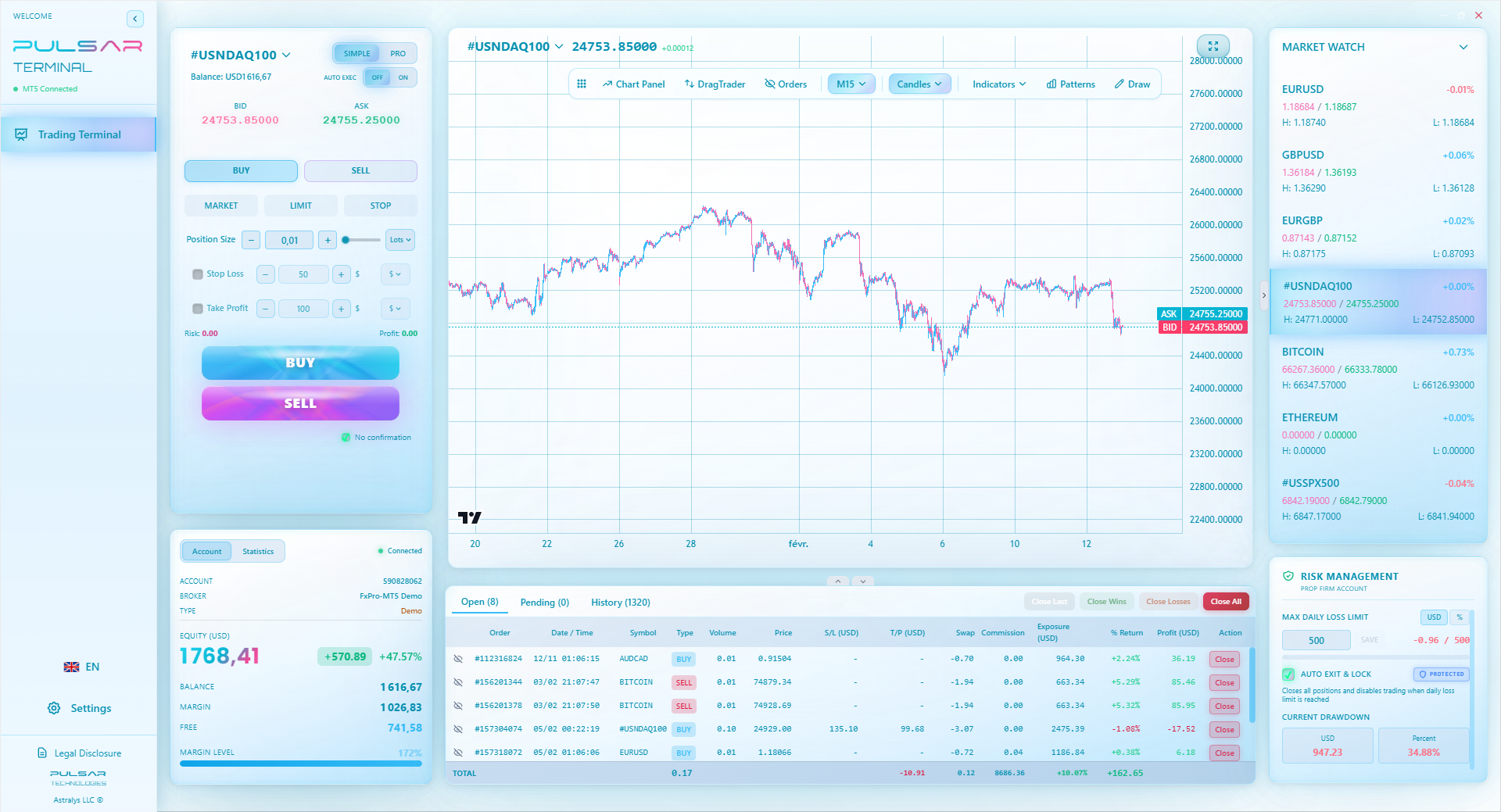
Trading with an FSCA-regulated broker adds a crucial layer of protection for your equity. Here’s why it matters for the number on your screen.
Client Money Segregation: This is the big one. By law, FSCA-licensed brokers (like IG, Plus500, AvaTrade) must keep your funds - your balance and thus the foundation of your equity - in separate bank accounts from the company's operational funds. If the broker goes bust (unlikely with Tier-1 firms, but possible), your money is ring-fenced and should be returned to you. It’s not theirs to use for office parties.
Transparency on Stop-Outs: FSCA rules demand clarity. The broker must clearly state their margin call and stop-out policies in their terms. You can’t be stopped out at some arbitrary, hidden level. You know the rules of the game (e.g., stop-out at 50% margin level).
Dispute Resolution: If there’s a technical error - a slippage event that unfairly decimates your equity, or a platform glitch - you have a formal recourse path through the FSCA’s complaints process. With an unregulated offshore broker, you might just be sending emails into a void.
While you can trade with international brokers, using a locally regulated one simplifies everything. Deposits and withdrawals in ZAR via EFT are seamless, you’re protected by local law, and you have peace of mind. That peace of mind lets you focus on managing your equity based on market dynamics, not broker risk. Always verify an FSCA license number on the regulator's website before you deposit a single cent.
“When you start arguing with your equity number, you're lost.”
Let’s get real. I’ve blown up an account. Most honest traders have. Here are the equity-specific blunders that cost me money.
Mistake 1: Adding to a Losing Position (Averaging Down) Without Checking Equity. This was my biggest. I was short EUR/USD at 1.0950. It went to 1.1000. I thought, "It’s a bargain, I’ll double my position." I did. It went to 1.1050. My floating loss was now massive, and my equity had plummeted. I was so focused on being "right" about the direction that I ignored what the equity number was screaming at me: I was over-exposed and wrong. The margin call came swiftly.
Mistake 2: Confusing a High Balance with a Strong Account. After a good run, my balance was at a record high. I got cocky. I started increasing my position sizes based on that inflated balance, not my current equity for the next trade. A normal 2% loss on the bigger size wiped out weeks of careful gains. Equity-based position sizing exists for a reason.
Mistake 3: Ignoring Swap Fees on a Swing Trade. As mentioned earlier, I entered a swing trading idea on Friday, aiming for a Monday move. The weekend swap on my USD/ZAR position was brutal. The market opened slightly in my favour on Monday, but my equity was already down significantly from the swaps. I ended up closing for a scratch, but the hidden cost had made the trade a net loser after costs.
The lesson? Your equity is your compass. When you start arguing with it, you’re lost. Use indicators like the RSI indicator or MACD indicator for entry signals, but use your equity to govern your survival.
💡 Petua Winston
If you can't look at your equity line during a drawdown without feeling panic, your position size is too large. Psychology is part of the system. Adjust until the number is just information, not emotion.
FAQ
Q1What is the difference between equity and balance in forex?
Your balance is your deposited cash plus the profit or loss from closed trades. It's static between trades. Your equity is your balance PLUS the current, live profit or loss from all your open positions. Equity changes with every market tick, while balance only changes when you deposit, withdraw, or close a trade.
Q2How is equity calculated in South African Rand (ZAR)?
The formula is the same in any currency: Equity = Balance + Floating Profit – Floating Loss. If your broker platform shows your account in ZAR, all values are converted and calculated in ZAR. For example, a R20,000 balance with a trade showing R1,500 floating profit gives you R21,500 equity. If that profit turns into a R1,500 loss, your equity becomes R18,500.
Q3Can my equity ever be higher than my balance?
Absolutely, and it's a great feeling. This happens when you have open trades that are in profit. Your balance remains at its last settled amount, but your equity adds that unrealized gain on top. Conversely, your equity is lower than your balance when you have losing open positions.
Q4Why does my equity matter more than my balance for margin calls?
Brokers calculate your margin level and free margin using your equity, not your balance. If your losing trades cause your equity to fall too close to your used margin, you'll get a margin warning and then a stop-out. A high balance is meaningless if your equity is low due to large floating losses.
Q5Do swap fees and spreads affect my equity?
Yes, directly and immediately. The spread is deducted from your potential equity the moment you open a trade (your trade starts slightly in the red). Swap fees (overnight financing) are deducted from or added to your equity daily at rollover. Both are silent killers of equity if not accounted for.
Q6Should I use balance or equity to calculate my position size?
Always use your current equity. Using your balance can lead to over-leveraging after a drawdown. If you risk 2% per trade, it should be 2% of your present, real account value (equity), not its historical value (balance). This is a core risk management principle.
Q7Are my equity and funds safe with an FSCA-regulated broker?
They are significantly safer. FSCA regulation mandates client fund segregation, meaning your money (the basis of your equity) is held separately from the broker's own funds. It also ensures transparent stop-out rules and provides a formal dispute resolution process if there's an issue affecting your equity.
Pelajaran Prof. Winston
:
- ✓Equity = Balance + Floating P&L. It's your live account value.
- ✓Brokers use Equity, not Balance, to calculate margin calls.
- ✓Always base your position size on your current Equity, not your starting Balance.
- ✓Spreads and swap fees are direct, silent deductions from your Equity.
- ✓A segregated client account with an FSCA broker protects the foundation of your Equity.
Sejauh mana artikel ini berguna?
Klik bintang untuk menilai
Pandangan Dagangan Mingguan
Analisis & strategi mingguan percuma. Tiada spam.
Tentang Penulis
David van der Merwe
Pedagang Pasaran Membangun
Pedagang berpangkalan di Johannesburg dengan 11 tahun dalam mata wang pasaran membangun. Pakar dalam pasangan ZAR, dagangan terkawal FSCA, dan analisis pasaran Afrika Selatan.
Komen
Anda mungkin juga suka

Cara Trading Forex Sukses: 7 Prinsip dari Trader Profesional
Cara trading forex sukses dengan 7 prinsip trader pro: manajemen modal, disiplin, journal trading, backtest. Data nyata, bukan janji profit palsu.
Jam Trading Forex Terbaik untuk Trader Indonesia: Panduan Lengkap dengan Tabel Waktu
Panduan jam trading forex untuk trader Indonesia. Tabel 4 sesi dunia, jam emas 20:00-00:00, sesi mana yang harus dihindari. Data akurat + tips dari trader berpengalaman.
Top 5 Sàn Forex Uy Tín Nhất 2026: Review Jujur dari Trader Indonesia
Top 5 sàn forex uy tín 2026 untuk trader Indonesia. Review jujur: spread, deposit, withdraw, dukungan lokal. Exness, XM, IC Markets & lebih.
All these calculators are built into Pulsar Terminal with real-time data from your MT5 account. One-click position sizing, automatic risk management, and instant calculations.
