


So you're in South Africa and you've heard you can trade currencies from your couch.

David van der Merwe
Pedagang Pasaran Membangun ·  South Africa
☕ 9 minit baca
Apa yang akan anda pelajari:
- 1Forex 101: It's Not Just Buying Dollars for Holiday
- 2The Rulebook: FSCA, Taxes, and Staying Legal
- 3How to Start Trading Forex in South Africa: A 5-Step Plan
- 4Trading the ZAR: Understanding Our Home Turf
- 5Pitfalls Every South African Trader Faces (I've Hit Them All)
- 6Brokers & Platforms: Where to Actually Place Your Trades
- 7The Final Question: Is This For You?

So you're in South Africa and you've heard you can trade currencies from your couch. Maybe a mate made a quick buck on the Rand, or you saw an ad promising the good life. But what is forex trading in South Africa, really? Is it just gambling with extra steps, or a legitimate way to build capital? I've traded here for over a decade, watched regulations evolve, and had my account blown up more than once learning the hard way. Let's cut through the hype and talk about what it actually means to trade forex when you're based in Mzansi.
When most South Africans think of forex, they think of the bureau de change at the airport. Trading is a different beast entirely. You're speculating on the price movement of one currency against another, using use. You don't own the physical currency; you own a contract for difference (CFD) on that price move. The goal is simple: buy a pair if you think the base currency will strengthen, sell it if you think it will weaken.
For us, the most important pair is USD/ZAR. It's our gateway to the world. When the Rand weakens (USD/ZAR goes up), your imported goods get more expensive. When it strengthens, you get more for your buck overseas. Trading it means you're taking a view on the health of the SA economy, politics, and global risk sentiment. It's volatile, which means opportunity and risk in equal, heart-pounding measure.

Warning: Trading CFDs with use is not 'investing'. It's a short-term speculation tool. You can lose your deposit very, very quickly. Never trade with money you can't afford to lose.
The other big one is EUR/ZAR. It's less manic than the dollar pair but still packs a punch. Then you have the majors like EUR/USD and GBP/USD, which are often cleaner to trade because they're less susceptible to local shocks. I made my first real profit on a short EUR/USD trade back in 2015, catching a 180-pip move over two days. I also lost it all three weeks later on a stubborn long USD/ZAR position that went against me. That's the game.

💡 Petua Winston
The Rand doesn't care about your opinion. Trade the price on the chart, not what you think 'should' happen based on the news.
This is the most critical part for any South African trader. You must know who's watching and what they expect.
The FSCA is Your New Best Friend (and Cop)
The Financial Sector Conduct Authority (FSCA) is the main regulator. They took over from the FSB. Any broker offering services to South Africans should be licensed by them. This isn't just bureaucracy; it's your first line of defence. An FSCA-licensed broker must adhere to strict conduct rules, keep client funds in segregated accounts, and provide a channel for dispute resolution. I only touch brokers with a solid FSCA license or a top-tier international license they hold openly.
What About International Brokers?
It's a grey area, but common. Many South Africans use international brokers like IC Markets or Pepperstone for their tighter spreads and better platforms. The key is they must still comply with local laws. The responsibility for declaring trading income and paying tax remains squarely on you, the trader.
Tax Man Cometh: SARS and Forex
Here's where I see guys get tripped up. In South Africa, forex trading profits are generally considered revenue from a business (if you trade regularly) or capital gains. The onus is on you to keep careful records of every trade: entry, exit, profit/loss. You declare this on your annual tax return. I use a simple spreadsheet and save monthly statements. SARS isn't kidding around. I know a trader in Cape Town who got a nasty audit because his trading profits didn't match his lifestyle. It wasn't pretty.

Pro Tip: Open a separate bank account just for trading. Feed it with your trading capital, and only withdraw profits to your main account. This makes tracking everything for SARS a million times easier. It also gives you psychological clarity - that account is for business, not for bills.
“Trading USD/ZAR isn't like trading EUR/USD. It's a different animal, driven by local and global factors.”
Forget the 'get rich quick' courses. Here's the boring, practical path that actually works.
- Education Before Deposit: Don't put a single cent in yet. Spend a month learning. Understand what a pip definition is, how use works, what a margin call feels like (it feels bad). Use free resources. Babypips.com is a global standard for a reason.
- Find a Reputable Broker: This is your most important decision. Look for FSCA regulation, low and transparent spreads on the pairs you want (check USD/ZAR especially), a reliable trading platform (MT4/MT5 is the norm), and good customer support in SA time zones. Do your due diligence. Our Exness review and IC Markets review cover two popular options with strong local presence.
- Open a Demo Account: Trade with virtual money for at least 2-3 months. Your goal isn't to make fake millions. Your goal is to develop a consistent strategy, get used to the platform's quirks, and experience losing streaks without real pain. I demo-traded for four months before going live, and it still wasn't enough.
- Develop a Simple Strategy: Pick one method. Maybe it's price action on the 4-hour chart, or combining RSI indicator with support/resistance. Master it. Don't jump from scalping strategy to swing trading in the same week. I started with a simple moving average crossover on EUR/USD. It was basic, but it taught me discipline.
- Go Live with Tiny Size: When you switch to real money, start with a micro or cent account. Your first goal is to preserve capital for 6 months, not to buy a Ferrari. Use a position size calculator religiously. Risk 1% or less of your account per trade. No exceptions.
Trading USD/ZAR isn't like trading EUR/USD. It's a different animal, driven by local and global factors.
What Moves the Rand?
- SA Political & Economic News: ANC policy announcements, budget speeches, Eskom load-shedding stages, corruption scandals. The Rand is a sentiment gauge for the country.
- Commodity Prices: We're a resource economy. Strong gold (XAU/USD guide), platinum, and coal prices often support the ZAR.
- Global Risk Sentiment: When global markets panic (like in 2020 or 2008), investors flee 'riskier' assets like emerging market currencies. The Rand gets sold off hard. It's a 'risk-on, risk-off' currency.
- US Dollar Strength: A strong dollar generally pressures all emerging markets, and ZAR is no exception.
Trading Tactics for ZAR Pairs: Because of the volatility, position sizing is even more critical. The spreads are wider, so short-term scalping is tougher. I find swing trading over several days works better, riding the broader waves of sentiment. Always be aware of major local event risk - trading around a Medium-Term Budget Policy Statement (MTBPS) is like playing with fire unless you're an expert.
My biggest ZAR win was shorting USD/ZAR at 18.95 in late 2022, riding it down to 17.20. My biggest loss was the reverse trade a few months prior. The lesson? The trend is your friend, until the SARB or a politician decides it isn't.
💡 Petua Winston
Your first R10,000 profit is the most dangerous. It convinces you you're a genius. That's when you'll take the stupid, oversized trade that wrecks you. Stay humble.

“The goal isn't to make a million on your first trade. The goal is to still be trading, and growing your account, one year from now.”
Let's be brutally honest about where you'll likely screw up.
Over-leveraging: This is the account killer. Just because your broker offers 500:1 use doesn't mean you should use it. On a R10,000 account, a 2% move against you with high use can wipe you out. I learned this with a 100:1 leveraged trade on GBP/JPY. A 150-pip spike against me triggered a margin call before I could even blink.
Trading Without a Stop-Loss: "It'll come back." Famous last words. The Rand can gap at market open due to offshore news. If you're not protected, you're gambling. Always use a stop-loss. No debate.
Chasing Losses: You lose R500 on a bad trade. Your next thought is, "I'll just double up on the next one to get it back." This is a direct path to blowing up your account. It's emotional, not strategic.
Ignoring the Total Cost: It's not just the spread. Consider the commission (if any), potential overnight financing charges (swap rates), and the spread widening during volatile news events. On USD/ZAR, that spread can balloon from 50 pips to 200 pips during a crisis. That's a huge hurdle to overcome just to break even.
Following the Herd: That WhatsApp group where 'Uncle John' shares his 'sure thing' tips? Run. You have no idea what his risk management or strategy is. You are responsible for your own trades.
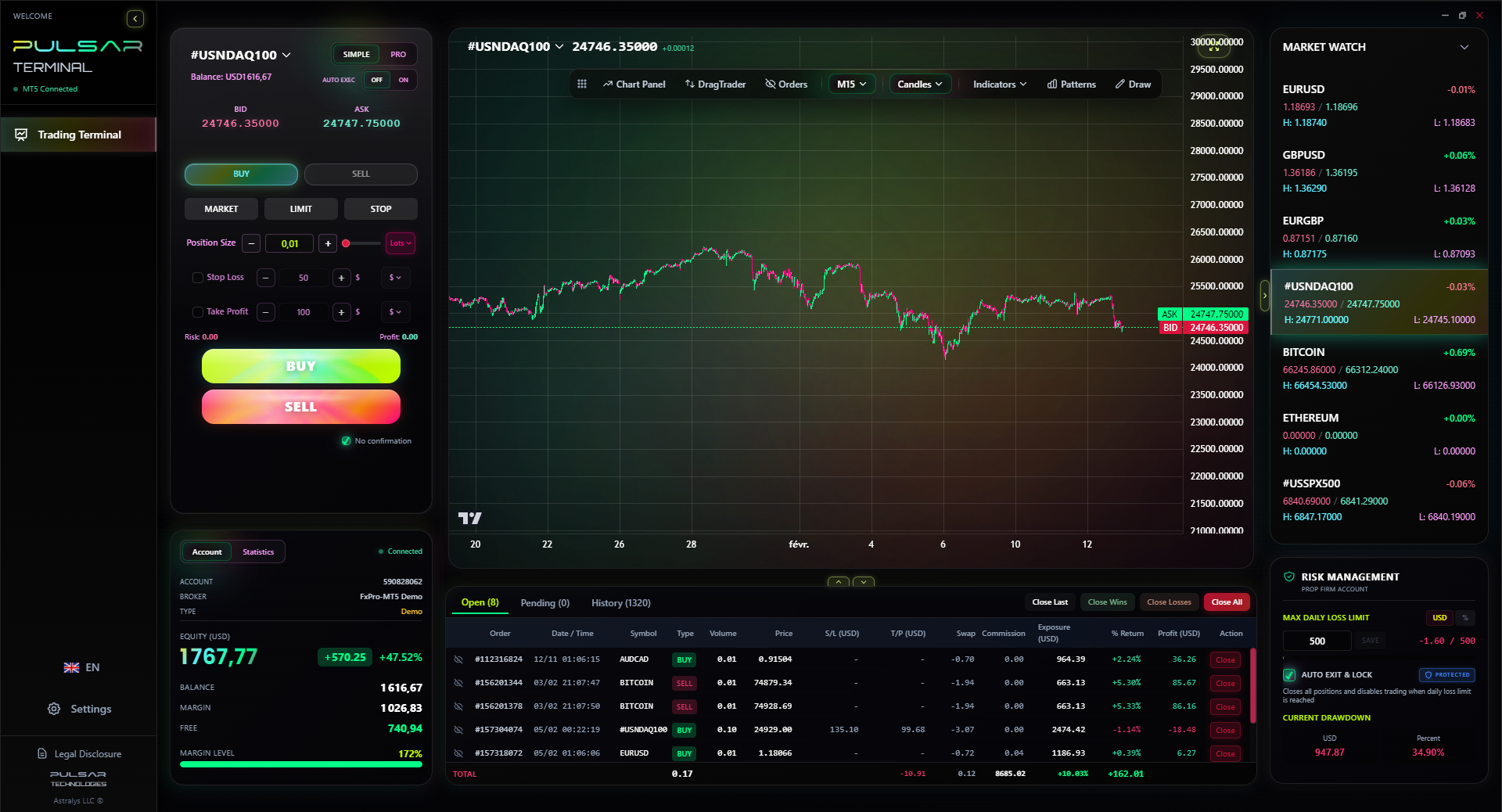
Managing multiple trades and their stop-losses on volatile pairs like USD/ZAR is a headache, which is why a tool like Pulsar Terminal that lets you set multi-level take-profits and trailing stops directly on your MT5 chart is a game-saver.
The South African market is served by a mix of local and international brokers.
Local Brokers (FSCA Licensed): Pros: Local support, easier deposits/withdrawals in ZAR via EFT, direct understanding of local market. Cons: Spreads on international pairs can be higher than global averages.
International Brokers (Popular in SA): Brokers like XM review, Pepperstone review, and IC Markets are huge here. They offer raw spreads, great platform access (MT4/MT5, cTrader), and often accept ZAR deposits. You must ensure they treat SA clients properly and that you understand the tax implications.
The Platform: MT4/MT5 is King MetaTrader 4 and 5 are the undisputed standard. They're stable, have countless indicators and Expert Advisors (EAs), and every broker supports them. Your skills on MT4 are transferable. Learn one platform inside out.
Deposits & Withdrawals: Most brokers offer instant EFTs (like Ozow, PayFast) or standard bank transfers. Withdrawals usually take 1-3 business days. Always check for fees on both ends - some brokers charge for withdrawals, and your bank might charge for receiving foreign currency.

Example: Let's say you deposit R10,000 with a broker. You might pay a 1% fee (R100) for an instant EFT. If you later withdraw $500 profit, the broker might charge a $30 withdrawal fee, and your bank might take another R50 for the currency conversion. That's R280+ gone in fees before you even started. Check the fee schedule!
💡 Petua Winston
If you can't explain your trade setup in one sentence ('I'm buying EUR/USD because it bounced off the daily support line'), you shouldn't be in the trade.
“Over-leveraging is the account killer. Just because your broker offers 500:1 use doesn't mean you should use it.”
Forex trading in South Africa is accessible, regulated, and offers real opportunity. But it's not for everyone. It's a skill, not a lottery ticket. It requires continuous learning, iron-clad discipline, and the emotional resilience to handle losses.
Ask yourself:
- Can I afford to lose the money I put in?
- Am I willing to study charts and economics for hours, not just watch numbers move?
- Can I follow my own rules even when I'm scared or greedy?
If you answered yes, then start with the education phase. Go slow. The market will be here tomorrow. The goal isn't to make a million on your first trade. The goal is to still be trading, and growing your account, one year from now. I've been at this for 12 years. The traders who lasted weren't the geniuses. They were the disciplined, patient, and risk-aware ones. You can be one of them. Just don't expect it to be easy.
FAQ
Q1Is forex trading legal in South Africa?
Yes, absolutely. It's regulated by the Financial Sector Conduct Authority (FSCA). You must trade with an FSCA-licensed broker or an international broker that complies with local laws. The legality is clear; the responsibility to trade wisely and pay tax is on you.
Q2How much money do I need to start forex trading in South Africa?
You can start with very little. Some brokers offer cent accounts where you can deposit as little as R500 or $50. However, I strongly advise starting with a minimum of R5,000-R10,000 in a live account. This allows for proper position sizing and risk management without being wiped out by a single, small loss. Your first investment should be in education, not capital.
Q3Which forex pair is best for South African beginners?
Start with major pairs that have low volatility and tight spreads, like EUR/USD. It's the most liquid market in the world. Avoid USD/ZAR initially. The wider spreads and extreme volatility driven by local politics make it a much harder environment to learn. Master the basics on a calm pair first.
Q4How are forex trading profits taxed in South Africa?
SARS typically views regular trading profits as revenue from a business, taxable as normal income. Infrequent, large gains might be considered capital gains. You must declare all profits and losses on your annual tax return. Keep detailed records of every single trade. Consult a tax professional who understands trading.
Q5Can I use international brokers like IG or Forex.com?
Many South Africans do. However, since 2021, some large international brokers have restricted services for SA residents due to regulatory complexities. Always check if the broker actively accepts clients from South Africa and what their specific terms are for deposits, withdrawals, and client fund protection. Your money's safety is paramount.
Q6What's the biggest mistake new South African traders make?
Using excessive use on volatile ZAR pairs. They see the big numbers USD/ZAR can move and think high use will magnify gains. It does, but it magnifies losses faster. Combine that with not using a stop-loss, and it's a guaranteed recipe for losing your entire deposit during a single bout of Rand volatility.
Pelajaran Prof. Winston
:
- ✓Start on majors like EUR/USD, not USD/ZAR
- ✓FSCA regulation is non-negotiable for safety
- ✓Risk a maximum of 1% of your account per trade
- ✓Demo trade for 3 months minimum before going live
- ✓SARS wants its share - keep impeccable records
Sejauh mana artikel ini berguna?
Klik bintang untuk menilai
Pandangan Dagangan Mingguan
Analisis & strategi mingguan percuma. Tiada spam.
Tentang Penulis
David van der Merwe
Pedagang Pasaran Membangun
Pedagang berpangkalan di Johannesburg dengan 11 tahun dalam mata wang pasaran membangun. Pakar dalam pasangan ZAR, dagangan terkawal FSCA, dan analisis pasaran Afrika Selatan.
Komen
Anda mungkin juga suka

Cara Trading Forex Sukses: 7 Prinsip dari Trader Profesional
Cara trading forex sukses dengan 7 prinsip trader pro: manajemen modal, disiplin, journal trading, backtest. Data nyata, bukan janji profit palsu.
Jam Trading Forex Terbaik untuk Trader Indonesia: Panduan Lengkap dengan Tabel Waktu
Panduan jam trading forex untuk trader Indonesia. Tabel 4 sesi dunia, jam emas 20:00-00:00, sesi mana yang harus dihindari. Data akurat + tips dari trader berpengalaman.
Top 5 Sàn Forex Uy Tín Nhất 2026: Review Jujur dari Trader Indonesia
Top 5 sàn forex uy tín 2026 untuk trader Indonesia. Review jujur: spread, deposit, withdraw, dukungan lokal. Exness, XM, IC Markets & lebih.
All these calculators are built into Pulsar Terminal with real-time data from your MT5 account. One-click position sizing, automatic risk management, and instant calculations.
