


Ask anyone on the street why people trade forex, and you'll hear the same fantasy: 'To get rich quick.' That's the marketing lie that fills broker accounts and empties them even faster.

Olumide Adeyemi
Perintis Dagangan Afrika Barat ·  Nigeria
☕ 8 minit baca
Apa yang akan anda pelajari:
Ask anyone on the street why people trade forex, and you'll hear the same fantasy: 'To get rich quick.' That's the marketing lie that fills broker accounts and empties them even faster. The real reasons Nigerians trade forex are darker, more practical, and tied directly to our economic reality. It's a survival tactic, a hedge against a system that feels rigged, and yes, a dream of escape. But understanding the 'why' is useless if you don't understand the 'how' - specifically, how the vast majority get it completely wrong. Let's set the record straight.
Forget the Lamborghini dreams for a second. The most powerful reason why do people trade forex in Nigeria is simple: self-preservation. When your local currency loses value faster than you can earn it, you look for a lifeboat. Trading forex, specifically earning in USD, is that lifeboat for hundreds of thousands.
I've had months where the profit from a single well-managed EUR/USD swing trade paid my annual rent in Naira. That wasn't genius. That was the Naira doing what it does. The numbers tell the story: Nigeria's FX market turnover hit $8.6 billion in 2025, up 56% from the year before. That's not just speculation; that's capital fleeing for stability.

Warning: This isn't a passive investment. Treating forex as a 'set-and-forget' dollar hedge is a sure way to lose the capital you're trying to protect. You're entering a live battlefield, not a savings account.
The dream is to insulate yourself from inflation and devaluation. The reality is that without strict risk management - using a tool like a position size calculator on every single trade - you'll incinerate your capital long before inflation gets a chance to.
Technology democratized access and broker marketing perfected the trap. You can fund an account with less than the cost of a decent dinner - Exness and HFM take as little as $1. Your phone is your broker. This low barrier is the #1 reason for the explosion in retail traders, with estimates around 300,000 Nigerians in the game.
The use Trap
Here's where the 'opportunity' turns dangerous. Brokers prominently offer use like 1:500 or even 1:2000. They frame it as 'amplifying your power.' I frame it as 'amplifying your funeral pyre.'
Let me give you a real, painful example from my early days. I deposited $200. With 1:500 use, I could control $100,000. I bought 1 standard lot of GBP/USD, a $100,000 position. The price moved 20 pips against me. A 20-pip move on a standard lot is a $200 loss. My entire account was gone in minutes. Poof. That's not trading; that's gambling with a financial grenade.

Example: A $500 account with 1:100 use controls $50,000. A 1% move against you (500 pips on most pairs) wipes 100% of your capital. Major currencies can move 1% in a single news event.
The 24/5 market and low costs are real benefits. But they're benefits for a disciplined strategist. For the unprepared, they're just more ways to lose money faster. If you're drawn by the accessibility, your first stop should be learning a disciplined approach like swing trading, not clicking the buy button.

💡 Petua Winston
Your first profitable trade is your most dangerous. It confirms your genius and invites overconfidence. The market humbles geniuses daily.
“The 'low cost' of entry is a myth. The real cost is a complex web of fees, taxes, and opportunity cost.”
Is forex trading legal in Nigeria? Yes. Is it well-regulated for the retail guy in his bedroom? Not even close. You're largely on your own.
The Central Bank of Nigeria (CBN) and the Securities and Exchange Commission (SEC) are the main players. The CBN's new Foreign Exchange Code (2024-2025) is a step forward, but it's focused on the wholesale market between banks. The SEC warns against unregulated platforms, aiming to stop Ponzi schemes. But for you, the individual trader, the message is clear: you are responsible for your own due diligence.
The CBN prohibits using unlicensed brokers, but the enforcement on individuals is a grey area. This pushes smart traders towards internationally regulated brokers like IC Markets or Pepperstone, who hold licenses from bodies like the FSCA (South Africa) or CySEC (Cyprus). You're not just choosing a platform; you're choosing whose rulebook protects your money.
Then there's the taxman. The FIRS wants 10% of your capital gains. If you're profitable, keep careful records. I learned this the hard way after a big quarter; sorting out the paperwork retroactively was a nightmare.
Brokers advertise 'low spreads' for a reason. It's the cost you see. The costs that bleed you dry are the ones you don't.
Let's break down a real trade from last month on XAU/USD (Gold):
- Entry: $2320.50
- Account: $2,000
- Position Size: 0.15 lots (controlled $15,000 worth of gold)
- Broker Spread: 0.35 pips ($3.50 cost on entry)
- Overnight Swap (held for 3 days): -$12.45 total
- Potential Profit: $150 (if target hit)
See that? The hidden financing cost (swap) was almost 10% of the potential profit. On a longer-term trade, swaps can turn a winning idea into a loser. You must factor this in.
Other silent killers:
- Slippage: During high volatility, your order fills at a worse price than expected. I've seen 5-10 pip slippages on NFP news, turning a calculated risk into a disaster.
- Withdrawal Fees: Some local payment processors charge 2-3%. Cashing out $1,000 profit? That's a $30 fee right there.
The 'low cost' of entry is a myth. The real cost is a complex web of fees, taxes, and opportunity cost. Your first profitable year might see 20-30% of gains eaten by these factors. Plan for it.
💡 Petua Winston
If you can't articulate your trade's thesis in one sentence - 'I'm buying because price rejected the weekly support level' - you're gambling, not trading.
“The traders who survive aren't the ones with the secret indicator. They're the ones who have learned to manage themselves.”
We've covered the 'why.' Now for the brutal truth: knowing why do people trade forex doesn't stop 9 out of 10 from blowing up their accounts. The failure isn't about intelligence; it's about psychology.
The market is designed to exploit every human weakness: greed, fear, hope, and ego. use feeds the greed. A losing trade triggers fear, which makes you close winners too early. Hope makes you hold a loser until you get a margin call. Ego makes you revenge trade.
I have a rule: if I have two losing days in a row, I stop for the week. In 2023, I broke it. After a $700 loss, I jumped back in on a 'hunch' in the EUR/USD, doubled my position size to 'make it back fast.' The trade went south. I lost another $1,200 in an hour. That $1,900 hole took me three disciplined weeks to climb out of. The loss wasn't in the charts; it was in my head.

Pro Tip: Your trading plan is worthless without an emotion plan. Write down your maximum daily loss (e.g., 2% of account) and stick to it with religious fervor. Use hard stop-losses on every trade, no exceptions.
The traders who survive aren't the ones with the secret indicator. They're the ones who have learned to manage themselves. They use tools to enforce discipline, because they know their own brain is their worst enemy.
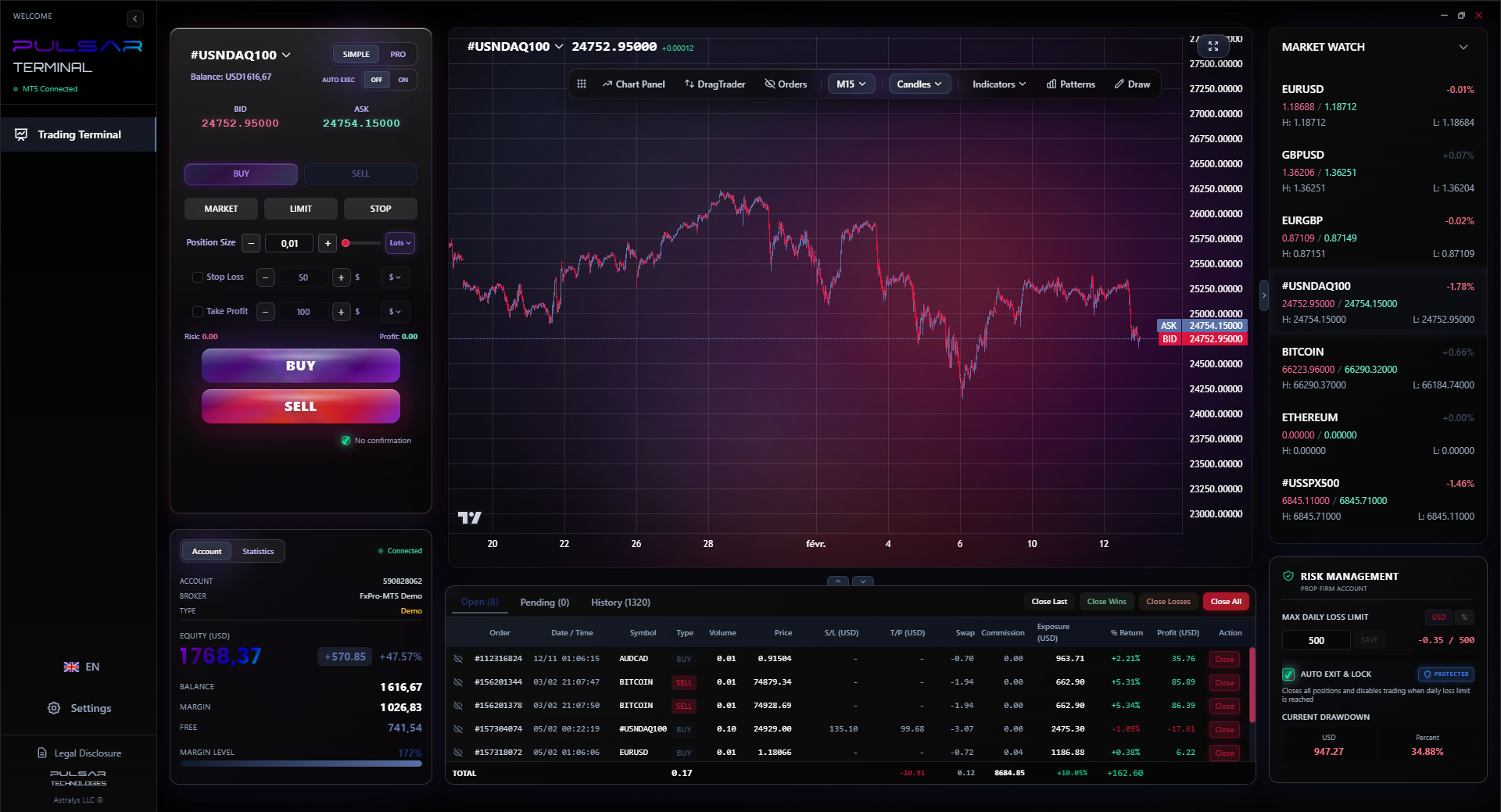
Managing the psychology gap requires tools that enforce your rules; Pulsar Terminal automates stop-loss, take-profit, and risk management directly on your MT5 charts, so your emotions can't interfere.
So, should you trade forex? It depends. If your 'why' is a desperate gamble to solve all your problems by Friday, run away. If your 'why' is a long-term commitment to learning a skill, with the full acceptance of risk, then you can begin.
Here’s a blunt, step-by-step path:
- Education with Skepticism: Ignore the 'secret wealth' courses costing millions of Naira. Learn the basics: what a pip is, how spread works, what the MACD or RSI actually shows. Free resources are plentiful.
- Choose a Broker Like a Bodyguard: Don't just pick the one with the highest use. Research their regulation, deposit/withdrawal process for Nigerians, and real customer reviews. XM and Exness are popular here for a reason - they understand the local funding hurdles.
- Start with a 'Pay-to-Learn' Account: Deposit the minimum you are 100% willing to lose. Not your rent money. Not your business capital. For most, that's between $100-$500, even though brokers allow less. This is your tuition fee.
- Develop a Mechanical Edge: Don't trade on feelings. Backtest a simple strategy. For example, a price action strategy on the H4 chart. See if it would have worked over the past year. Then practice it in a demo until it's boring.
- Scale with Paranoia: Your first goal is not to make money. It's to not lose money. Then, to be consistently profitable for 3 months. Only then should you consider adding more capital.
The forex market will always be here. Your capital won't be if you're in a hurry. The people who last are the ones who respect the grind, not just the glamour.
💡 Petua Winston
Track your trades in a journal. Not just wins and losses, but your emotional state. You'll find your worst losses happen when you're bored, angry, or trying to 'get back' at the market.
FAQ
Q1Is forex trading a good way to make money in Nigeria?
It can be a way to generate income, but it's a high-skill profession, not a lottery. The vast majority lose money. It's 'good' only if you treat it with the same seriousness as starting a business, complete with a business plan, capital for losses, and years of learning.
Q2What is the minimum amount I need to start forex trading in Nigeria?
Technically, you can start with as little as $1 with some brokers. Practically, this is a terrible idea. With such a small amount, proper risk management is impossible, and you'll be forced to use extreme use. A more realistic 'learning' amount is $200-$500, which allows for sensible position sizing on a cent or micro account.
Q3How do I avoid forex scams in Nigeria?
Avoid any 'investment scheme' promising guaranteed weekly returns or asking you to send money to a personal account. Only trade through well-known, internationally regulated brokers (check their license numbers on the regulator's website). Never give your trading account login details to a 'account manager.'
Q4Do I pay tax on forex trading profits in Nigeria?
Yes. Profits are considered capital gains and are subject to a 10% tax by the Federal Inland Revenue Service (FIRS). You are responsible for declaring this income.
Q5Which forex pairs are best for Nigerian beginners?
Start with major pairs like EUR/USD, GBP/USD, or USD/JPY. They have the lowest spreads (trading costs), the most available analysis, and are less prone to wild, unpredictable gaps than exotic pairs. They move enough to provide opportunity but are generally more stable.
Q6Can I trade forex with my Naira debit card?
It's possible for small amounts, but CBN restrictions often block larger international transactions. Most serious traders use domiciliary (USD) bank accounts or fund their broker accounts through e-wallets or direct bank transfers to the broker's international account.
Q7What's the biggest mistake new Nigerian traders make?
Using excessive use. They see 1:500 and think 'more profit.' Experienced traders see it and think 'more risk.' A 1% market move can wipe out a 1:100 leveraged account. Start with low use (1:10 or 1:20) to learn how price moves before even considering higher levels.
Pelajaran Prof. Winston
:
- ✓Forex is primarily a hedge against Naira volatility, not a get-rich-quick scheme.
- ✓use above 1:30 turns a business into a gamble for most beginners.
- ✓Hidden costs (swap, slippage, fees) can consume 20-30% of your annual profits.
- ✓90% fail due to psychological gaps, not a lack of strategy.
Sejauh mana artikel ini berguna?
Klik bintang untuk menilai
Pandangan Dagangan Mingguan
Analisis & strategi mingguan percuma. Tiada spam.
Tentang Penulis
Olumide Adeyemi
Perintis Dagangan Afrika Barat
Salah seorang pendidik dagangan forex paling aktif di Nigeria. 8 tahun pengalaman dagangan dari Lagos. Pakar dalam strategi modal rendah dan cabaran prop firm untuk pedagang Afrika.
Komen
Anda mungkin juga suka

Cara Trading Forex Sukses: 7 Prinsip dari Trader Profesional
Cara trading forex sukses dengan 7 prinsip trader pro: manajemen modal, disiplin, journal trading, backtest. Data nyata, bukan janji profit palsu.
Jam Trading Forex Terbaik untuk Trader Indonesia: Panduan Lengkap dengan Tabel Waktu
Panduan jam trading forex untuk trader Indonesia. Tabel 4 sesi dunia, jam emas 20:00-00:00, sesi mana yang harus dihindari. Data akurat + tips dari trader berpengalaman.
Top 5 Sàn Forex Uy Tín Nhất 2026: Review Jujur dari Trader Indonesia
Top 5 sàn forex uy tín 2026 untuk trader Indonesia. Review jujur: spread, deposit, withdraw, dukungan lokal. Exness, XM, IC Markets & lebih.
All these calculators are built into Pulsar Terminal with real-time data from your MT5 account. One-click position sizing, automatic risk management, and instant calculations.
