


Let's be brutally honest: a 100 USD no deposit bonus forex offer is a marketing gimmick designed to get you hooked, not to make you rich.

David van der Merwe
Trader Rynków Wschodzących ·  South Africa
☕ 9 min czytania
Czego się nauczysz:
- 1What Exactly Are You Getting? It's Not Cash.
- 2The Rules of the Game: FSCA Regulations & Your Safety
- 3The Real Offers on the Table (And Their Catches)
- 4A Trader's Blueprint: How to Use the Bonus Properly
- 5Why You'll Probably Blow It (And How Not To)
- 6The Endgame: Transitioning to Your Own Capital
- 7The Final Word: Is It Worth It?
Let's be brutally honest: a 100 USD no deposit bonus forex offer is a marketing gimmick designed to get you hooked, not to make you rich. Most traders treat it like free braai money and blow the account in two trades. I've done it myself. But if you understand the game being played - the strict FSCA rules, the insane withdrawal conditions, the psychological traps - you can use this 'free' capital to build a real trading skill set without risking your own rands. This guide will show you exactly how, by dissecting the real offers on the table for South Africans right now.
A no-deposit bonus is exactly what it sounds like: a broker gives you trading credit without you putting in a cent of your own money first. Sounds like a lekker deal, right? Here's the catch they don't put in the big, bold letters.
The bonus is not cash. You can't withdraw it. Think of it as a demo account with a potential cash prize. You get to trade with real market prices, but the bonus itself is just numbers on a screen. The only thing you can potentially withdraw are the profits you make from trading that bonus capital, and only after you've jumped through a series of hoops that would make an Olympic gymnast sweat.
Why do brokers do this? Simple. Customer acquisition cost. It's cheaper for them to give you $30 in virtual credit than to pay for online ads. They're betting that you'll get a taste, maybe make a few bucks, and then deposit your own money to keep going. It's a sample, not a handout.

Warning: The moment you accept a bonus, you agree to its Terms and Conditions (T&Cs). These documents are where brokers hide all the nasty bits. Ignoring them is the fastest way to see your profits vanish.

💡 Wskazówka Winstona
The bonus isn't a lottery ticket. It's a paid internship. Your salary is the experience. Don't get fired on the first day.
“The no-deposit bonus is a sample, not a handout.”
In South Africa, the Financial Sector Conduct Authority (FSCA) calls the shots. They're not messing around, and that's a good thing for you. Since 2021, retail use is capped at 30:1. This applies to bonus trading too. So forget those offshore brokers promising 1000:1 on your bonus - if they're offering that to South Africans, they're operating outside our regulations and you have zero protection.
The FSCA mandates that client funds are kept separate from the broker's own money. This means if the broker goes bust, your deposited capital should be safe. This rule also extends to bonus accounts in a way, as it forces a degree of operational integrity.
Most importantly, the FSCA requires all promotions to be clear and not misleading. Brokers can't promise guaranteed profits. This is why you'll see pages of small print for any 100 USD no deposit bonus forex offer. They have to disclose the catch. Your job is to read it.
Choosing a Broker: Local vs. Offshore
You can trade with an international broker, but I strongly advise using one licensed by the FSCA. If something goes wrong - withdrawals blocked, platform issues - you have a local authority to complain to. The FSCA can't help you if your money is with some unregulated outfit in the Caribbean. For a list of solid, regulated options, check our detailed XM review and Exness review.

Pro Tip: Always verify a broker's FSCA license number on the regulator's official website. Don't just trust the logo on the broker's site.
“Your goal isn't to get rich quick. Your goal is to practice real trading under real conditions.”
Let's cut through the hype and look at actual numbers for South African traders. That magic '100 USD' figure is more of a concept than a standard offer.
| Broker | No-Deposit Bonus Offer | Key Withdrawal Condition (The Catch) |
|---|---|---|
| FBS | $140 | Must trade a specific volume (lots) before profit withdrawal. |
| XM | $30 | Available after verification. Profits withdrawable after trading volume conditions met. |
| SuperForex | $88 (can become $99) | Bonus not withdrawable. Volume targets apply to profit withdrawals. |
| Tickmill | $30 Welcome Account | Serves as risk-free trading credit. Specific terms apply to any generated profits. |
| InstaForex | Up to $1000 | Extremely high trading volume requirements. Often considered nearly impossible for retail traders. |
Notice a pattern? The bonus isn't cash, and to get your profits out, you need to trade a certain volume. This is usually measured in lots. For example, a broker might require you to trade 3 standard lots (300,000 units of currency) for every $1 of bonus credit before you can touch your profits.
Let me give you a real example of how this works, and where I messed up. I once took a $50 bonus. I turned it into $300 profit trading gold (XAU/USD). I felt like a genius. Then I read the T&Cs: to withdraw, I needed to trade 20 standard lots. My total volume was 1.2 lots. I either had to deposit my own money and trade 18.8 more lots (risking my profits) or forfeit the $300. I forfeited it. Lesson learned the hard way.
Another common trick is a maximum withdrawal limit from bonus profits. RaiseFX, for instance, allows a max withdrawal of $100 from a $30 bonus profit, even if you make more. Always, always find this clause.
“Your goal isn't to get rich quick. Your goal is to practice real trading under real conditions.”
Stop thinking of the bonus as 'free money.' Start thinking of it as 'paid training capital.' Your goal isn't to get rich quick. Your goal is to practice real trading under real conditions, with the secondary goal of extracting some profit. Here's the blueprint.
Phase 1: The Survival Trade. Your first mission is not to lose the bonus. This sounds stupid, but most people do. Use a microscopic position size calculator. With a $30 bonus and 30:1 use, you could technically open a $900 position. Don't. That's a one-way ticket to a margin call. Start with a position size that risks no more than 5% of the bonus. For a $30 bonus, that's $1.50. Yes, it's tiny. That's the point. You're learning to handle real orders and emotion.
Phase 2: The Volume Grind (If You Want the Cash). If you want to attempt a withdrawal, you must understand the volume target. Let's say the terms are 'trade 3 lots to withdraw profits.'

Example: You take a $30 bonus. You aim for small, consistent wins on a scalping strategy. You trade 0.01 lots (a micro lot). One standard lot = 100 micro lots. To reach 3 standard lots, you need to open 300 separate 0.01-lot trades. This is a grind, not a gamble.
Phase 3: The Skill Transfer. This is the most important phase. Use the bonus to test one specific strategy. Maybe it's a simple RSI indicator divergence on the 1-hour chart. Document every trade. The bonus is funding your research and development. If you can consistently grow a $30 bonus to $50 under real market conditions, you've learned something valuable. That skill is worth more than the $20 profit.
💡 Wskazówka Winstona
Volume requirements are a math problem. Solve it before you accept the bonus, or you're just working for free.
“If you wouldn't take the trade with R1000 of your own money, don't take it with the bonus.”
I've mentored dozens of traders who started with these bonuses. 95% fail. Here’s the predictable script.
Mistake 1: The 'All-In' Mentality. "It's not my money, so let's yolo it on a GBP/JPY spike!" This is the fastest path to $0. The psychological barrier of real loss is removed, so you take risks you never would with your own rands. This teaches you nothing except how to lose.
Mistake 2: Ignoring the Real Cost – The Spread. You're trading tiny sizes to grind volume. The spread is your enemy. If you're trading 0.01 lots on EUR/USD with a 1.0 pip spread, each trade costs you $0.10. To make $10 profit, you need 100 pips of movement just to break even on the spread cost. On exotics like USD/ZAR, spreads are wider, killing your small account faster. Choose your pairs wisely.
Mistake 3: Chasing the Withdrawal. You become so obsessed with hitting the 3-lot volume target that you overtrade. You take low-probability setups just to 'get a trade on.' This destroys any discipline you're trying to build.
The antidote? Trade the bonus with the same solemnity you'd trade your grandmother's pension. Use a trading journal. Have a plan for every single trade. If you wouldn't take the trade with R1000 of your own money, don't take it with the bonus.
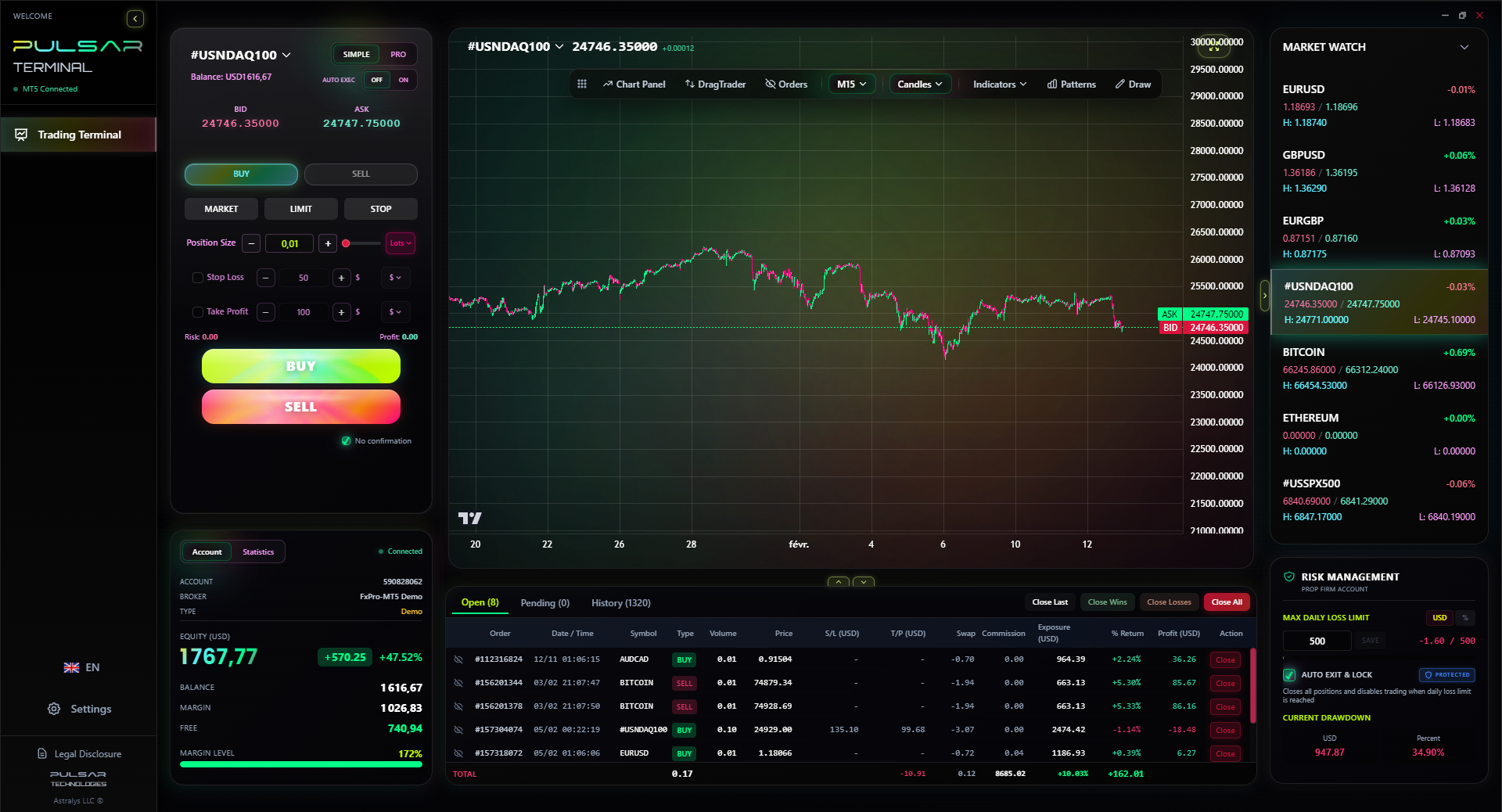
Managing multiple small trades for a volume target is chaotic in MT5, but Pulsar Terminal's drag-and-drop order grid lets you set and manage dozens of micro-lot positions with one click.
“If you wouldn't take the trade with R1000 of your own money, don't take it with the bonus.”
The true success metric of a no-deposit bonus isn't the withdrawal you might get. It's whether you're prepared to fund a live account. If you've followed the blueprint, you should have:
- A tested strategy with a documented win rate.
- A clear understanding of position sizing and risk.
- Emotional experience with real gains and losses.
Now, when you look at a broker's real account minimum - say, $100 at FP Markets or Pepperstone - you're not guessing. You know what you're doing.
Making Your First Real Deposit Start with the smallest amount the broker allows. Your goal for the first month is not profitability; it's consistency. Can you execute your plan when real rands are on the line? The pressure is different. This is where many falter, reverting to old, bad habits. Stick to the process you built with the bonus.
Remember, the regulated brokers offering these bonuses are hoping you'll become a long-term client. Use that to your advantage. Pick one with good educational resources, a reliable platform, and tight spreads on the pairs you want to trade for real. The bonus was just the introduction.
💡 Wskazówka Winstona
If you can't grow a $30 bonus to $35 with discipline, you have no business depositing R1000. Master the microscope before you look through the telescope.
“The true success metric of a no-deposit bonus isn't the withdrawal you might get. It's whether you're prepared to fund a live account.”
So, is chasing a 100 USD no deposit bonus forex offer worth your time? Yes, but only under these conditions:
- You treat it as a serious, funded training exercise.
- You pick a reputable, FSCA-regulated broker.
- You dissect the T&Cs like a detective.
- Your primary goal is education, not a cash payout.
If you just want to gamble for fun, rather use a demo account. It's less emotionally charged when you lose.
A Better Alternative? Frankly, if you have a small amount of risk capital (even R500), you might be better off opening a cent account or a nano lot account with a broker like XM or Exness. You trade with real money from the start, which instills the right psychology immediately, and there are no bonus strings attached. You keep 100% of your profits, no volume requirements. It’s cleaner.
The no-deposit bonus is a tool. A clever, slightly deceptive, but potentially useful tool. Don't let the tool use you. You use it to build the foundation of your trading career. Nothing more, nothing less.
FAQ
Q1Can I actually withdraw the 100 USD no deposit bonus itself?
No, absolutely not. The bonus credit itself is never withdrawable. You can only potentially withdraw the profits you generate from trading that bonus, and only after meeting strict trading volume conditions outlined in the Terms and Conditions.
Q2What is the best no deposit bonus for South African traders?
"Best" depends on your goal. For a low-pressure start, XM's $30 bonus is straightforward and from a well-established broker. If you want to practice on a larger virtual balance, FBS's $140 offer is notable. However, always compare the trading volume requirements for profit withdrawal - this is the most critical factor, not the bonus size.
Q3What are the typical trading volume requirements to withdraw profits?
Requirements vary wildly but are always high. A common structure is requiring you to trade 1 to 3 standard lots (100,000 to 300,000 currency units) for every $1 of bonus credit received. For a $30 bonus, you might need to trade 30 to 90 standard lots. This is a massive volume designed to encourage you to deposit your own money.
Q4Is it legal to use these bonuses in South Africa?
Yes, it is legal. However, you must use a broker that complies with South African Financial Sector Conduct Authority (FSCA) regulations. This means use will be capped at 30:1 for you as a retail client, and the broker's promotion must be clear and fair. Avoid unregulated offshore brokers offering insane use with bonuses.
Q5What happens if I lose the bonus money?
Nothing. The account typically goes to zero and may be closed. You do not owe the broker any money. This is why it's crucial to view it as a learning opportunity - you can't go into debt, but you can waste a valuable chance to practice risk-free.
Q6Should I use a bonus or just start with a demo account?
Start with a demo account to learn the platform. Then, use a no-deposit bonus. The psychological shift with a bonus is significant - it feels more 'real' than a demo with infinite virtual cash, which prepares you better for live trading. A demo account has no withdrawal conditions, so it's better for pure strategy testing.
Q7Can I use a bonus with a prop firm challenge?
No, these are completely separate. Prop firm challenges require you to pass specific profit targets and risk rules using the firm's capital. A broker's no-deposit bonus is a marketing product with its own restrictive rules. The discipline needed for a prop firm challenge is intense, and a bonus account won't prepare you for that level of scrutiny.
Lekcja Prof. Winstona
:
- ✓The bonus credit itself is never, ever withdrawable.
- ✓Profit withdrawal requires trading huge volume (often 1-3 lots per $1).
- ✓Trade micro lots (0.01) to survive and learn.
- ✓Use it to test one strategy with extreme discipline.
- ✓The real prize is the skill, not the cash.
Jak przydatny był ten artykuł?
Kliknij gwiazdkę, aby ocenić
Tygodniowe analizy tradingowe
Darmowe tygodniowe analizy i strategie. Bez spamu.
O autorze
David van der Merwe
Trader Rynków Wschodzących
Trader z Johannesburga z 11-letnim doświadczeniem w walutach rynków wschodzących. Specjalizuje się w parach ZAR, handlu regulowanym przez FSCA i analizie rynku południowoafrykańskiego.
Komentarze
Może Ci się też spodobać

Cara Trading Forex Sukses: 7 Prinsip dari Trader Profesional
Cara trading forex sukses dengan 7 prinsip trader pro: manajemen modal, disiplin, journal trading, backtest. Data nyata, bukan janji profit palsu.
Jam Trading Forex Terbaik untuk Trader Indonesia: Panduan Lengkap dengan Tabel Waktu
Panduan jam trading forex untuk trader Indonesia. Tabel 4 sesi dunia, jam emas 20:00-00:00, sesi mana yang harus dihindari. Data akurat + tips dari trader berpengalaman.
Top 5 Sàn Forex Uy Tín Nhất 2026: Review Jujur dari Trader Indonesia
Top 5 sàn forex uy tín 2026 untuk trader Indonesia. Review jujur: spread, deposit, withdraw, dukungan lokal. Exness, XM, IC Markets & lebih.
All these calculators are built into Pulsar Terminal with real-time data from your MT5 account. One-click position sizing, automatic risk management, and instant calculations.
