


Here's the biggest myth about prop firms: they're a golden ticket.

James Mitchell
Starszy Analityk Tradingowy
☕ 9 min czytania
Czego się nauczysz:
Here's the biggest myth about prop firms: they're a golden ticket. You pay a fee, pass a test, and suddenly you're trading millions. The reality is far messier, and The5ers is a perfect case study. I've seen too many traders blow their savings on challenge fees without understanding the game they're playing. Let's strip away the marketing and look at what this 5 ers prop firm actually offers, especially for traders in the US where the rules are getting tighter by the month.
The5ers is an Israeli-based proprietary trading firm founded in 2016. They're not a broker. Think of them as a talent scout with a bank account. You pay them to take a test (their "challenge"). If you pass, they give you simulated capital to trade. If you make profits, you get a cut. If you lose, they shut you down. It's that simple.
Their whole pitch is about scaling. Start small, prove yourself, and they'll increase your capital, sometimes up to $4 million. It sounds fantastic, but remember, you're never trading real market orders in the traditional sense. All trades are executed in a simulated environment. This is a crucial distinction that affects everything from execution speed to your legal rights.
For US traders, this simulation model is how they skate around heavy regulation. They're not managing your money as a client; they're charging you for an evaluation service using their capital. This keeps them outside the direct grip of the SEC or CFTC as a broker-dealer, for now. But the winds are changing. Recent moves by the SEC to narrow exemptions mean more scrutiny is coming. Don't assume the rules today will be the rules tomorrow.
“The static drawdown is the only reason I consider The5ers a viable option for disciplined traders.”
This is where dreams meet reality. The5ers has a menu of options, and the price tag directly correlates with how much rope they give you to hang yourself.
The Three Main Paths
You've got three routes: the Instant Funding, the Two-Step Evaluation (High Stakes), and the Bootcamp Challenge. The Instant Funding is the most expensive upfront but has no second phase. The Two-Step is the classic prop firm model. The Bootcamp is their newer, supposedly more "coaching" oriented program with stricter rules.
Let's talk real numbers. I paid $260 for a $10,000 Instant Funding account once, just to test the waters. The profit target was 10% ($1,000). Sounds easy, right? It's not. With a 3% daily and 6% max drawdown, two bad trades can end your whole challenge. That $260 is gone, poof.

Warning: The entry fee is a sunk cost. Mentally write it off the second you pay. If you're counting on making it back from your first payout, your risk management is already broken.
Here’s a quick comparison of the starter costs and key rules:
| Program | Example Account Size | Example Fee | Profit Target | Max Drawdown | Key Difference |
|---|---|---|---|---|---|
| Instant Funding | $10,000 | $260 | 10% | 6% (from initial balance) | No second phase, but higher cost. |
| High Stakes (Two-Step) | $20,000 | $345 | 8% (Phase 1), 5% (Phase 2) | 10% | Classic two-stage challenge. |
| Bootcamp | $20,000 | $95 + $145 on pass | 6% per stage | 5% (Static) | Lower use (1:10), emphasizes coaching. |
The profit split starts at 50% for most programs and can scale to 100%. The High Stakes program starts at a nicer 80%. But let's be blunt: getting to 100% requires consistently printing money for them. Very few ever see it.
The static drawdown is a point in their favor. Unlike firms that use a trailing drawdown based on your equity high, The5ers sets a fixed line in the sand (e.g., 6% down from your starting balance). It's clearer and less punishing for a swing trading style where you ride out drawdowns.

💡 Wskazówka Winstona
Your challenge fee is tuition, not an investment. If you learn what blows you up, it's money well spent. If you just get angry and try again with the same plan, you're donating.
“You're not buying capital; you're renting an audition with very strict directors.”
This is the engine room. Good rules are useless if the trading conditions are garbage.
The5ers provides access via MetaTrader 5. The spreads are tight, I'll give them that. On majors like EUR/USD, you're often looking at 0.1 to 0.5 pips. But remember, they add a commission. It's $4 per lot round turn for Forex and Metals. So, that "almost zero" spread isn't free. For a scalper, these costs add up fast and can kill a scalping strategy that relies on tiny moves.
use is a mixed bag and depends entirely on your program:
- Bootcamp: Max 1:10. Very restrictive.
- High Stakes: Up to 1:100. Now we're talking.
- Instant Funding: Up to 1:30.
This matters for your position size calculator settings. On a $20,000 High Stakes account with 1:100 use, you could theoretically control $2,000,000. That's insane power and danger. One wrong move on XAU/USD (gold) and you'll hit that max drawdown before you can blink.
Execution is a common gripe. Because it's a simulated environment, some traders report occasional slippage or requotes during news events that feel worse than with a raw IC Markets or Pepperstone account. I haven't found it to be predatory, but it's not institutional-grade either. It's fine for most retail strategies, but don't expect hedge fund fills.

Pro Tip: Their rules forbid hedging (opening opposite positions on the same instrument). If you're a trader who uses hedging as a risk management technique, this firm isn't for you. Full stop.
“You're not buying capital; you're renting an audition with very strict directors.”
This is the most important section for an American trader. The5ers, like most offshore prop firms, exists in a regulatory gray zone in the United States. They're legal because of how they structure the service: you pay for an evaluation, not for them to manage your securities.
However, "gray" doesn't mean "safe forever." The landscape is shifting. In early 2025, the SEC backed off on one rule but tightened another related to broker-dealer membership. The message is clear: regulators have prop firms on their radar. There's a growing push for lower use caps and clearer protection of trader profits.
What does this mean for you? Two things:
- Your profits aren't in an FDIC-insured account. If The5ers goes under or faces regulatory action, getting your money could be a long, international legal headache.
- The rules can change. They could suddenly lower use, change drawdown models, or even pause operations in the US while they adjust. You have zero control over this.
I'm not saying don't use them. I'm saying go in with your eyes open. This isn't like depositing with a well-regulated Exness or XM where the rules are long-established. You're participating in a newer, less-defined industry. Factor that risk into your decision.
💡 Wskazówka Winstona
The firms love traders who chase the scaling dream. It makes you take risks you shouldn't. Ignore the $4 million billboard. Your only target is the next payout.
“That challenge fee is a sunk cost. Mentally write it off the second you pay.”
I passed a $20,000 High Stakes challenge on my second try. The first time, I got cocky. I hit the 8% profit target in three days trading NAS100 with high size. Feeling invincible, I didn't bank the profit. A week later, a single losing trade took me past the 5% daily drawdown. Game over. $345 lesson learned.
The second time, I treated it like a job. My strategy?
- Instrument: Only EUR/USD. Less volatility, more predictable.
- Risk: 0.5% per trade. Max. I used a strict position size calculator.
- Target: 1-2% per week. Slow and boring.
- Indicator: I used the MACD indicator on the 4H chart for direction and the RSI indicator on the 1H for entry. No fancy stuff.
I passed the first phase in about a month. The second phase (5% target) took two weeks. My total profit was about $1,800. My split was 80%, so I got a $1,440 payout. After the $345 fee, my net was $1,095. Not life-changing, but it proved the model.
The key was ignoring the scaling dream initially. My only goal was to pass and secure the first payout. The psychology changes completely once you have their money in your account. I've seen more traders fail because they're daydreaming about the $4 million cap while ignoring the 10% drawdown line right in front of them.

Example: On a $20,000 account with a 10% max drawdown, your floor is $18,000. If you risk 1% ($200) per trade, you can only withstand 10 consecutive losses before a margin call (well, account termination). That's not a lot. At 0.5% risk, you get 20 trades. That's a much bigger buffer for error.
Managing multiple take-profit levels and a breakeven stop is critical in a prop challenge, and Pulsar Terminal lets you set it all up with one drag-and-drop order on your MT5 chart.
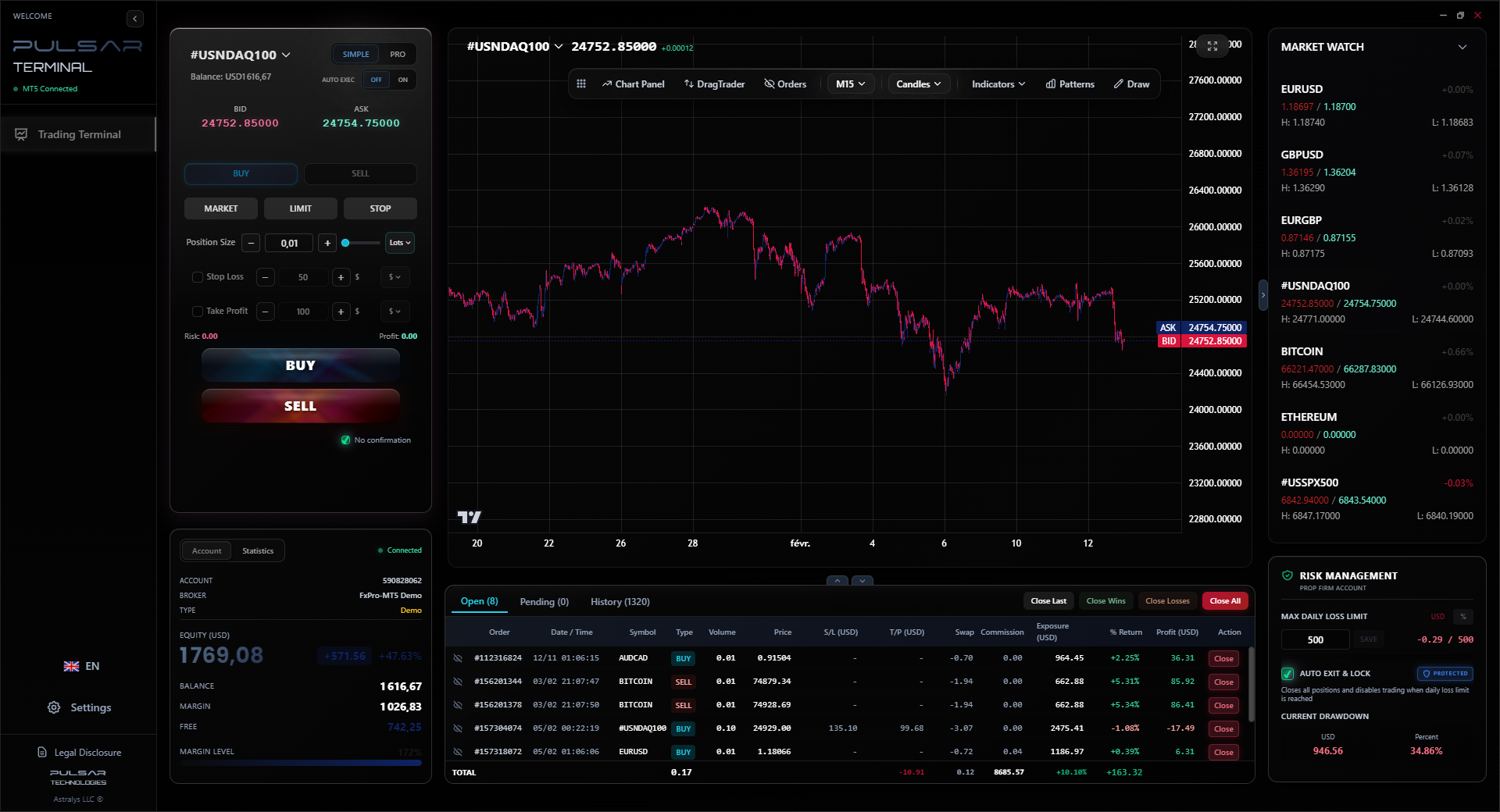
“That challenge fee is a sunk cost. Mentally write it off the second you pay.”
How does this 5 ers prop firm stack up? Let's be quick and dirty.
The5ers Advantages:
- Static Drawdown: Huge plus. Many firms use trailing drawdowns, which is like running on a treadmill that speeds up.
- Clear Scaling Plan: Their growth model is one of the better-defined ones.
- High use Options: In the High Stakes program, 1:100 is available.
The5ers Disadvantages:
- Fees: Their Instant Funding is pricey. That $260 for a $10k account is steep.
- Bootcamp use: 1:10 is laughably low for Forex.
- Commission: The $4/lot commission eats into scalping.
Compared to others:
- FTMO/MyForexFunds (pre-2024): Were the kings. Now, regulatory issues have changed everything. The5ers is more stable currently.
- FundedNext: Offers similar static drawdowns and often cheaper challenge fees. A very direct competitor.
- Apex Trader Funding: Favored by futures traders, different asset class.
The5ers sits in the middle. They're not the cheapest, not the most generous, but they're established and their static drawdown is a legitimate attraction for disciplined traders.
💡 Wskazówka Winstona
Static drawdown is a gift. It means you can bank a 5% profit and your loss limit doesn't climb to -5% from that new high. Use this to your advantage with partial closures.
“The 'scaling to millions' dream is a marketing hook that distracts from the 10% drawdown in front of you.”
Here's my blunt assessment.
The5ers is a legitimate firm. They pay out. Their conditions are transparent. The static drawdown is a pro-trader feature. If you are a consistently profitable, disciplined trader who needs capital to scale, and you understand the simulated/regulatory nuances, they are a solid option.
Who it's for: The disciplined swing or position trader. The person who risks 0.5-1%, targets 2-3% a month, and can grind systematically. The static drawdown rewards this patience.
Who it's NOT for:
- The desperate trader hoping for a miracle.
- The undercapitalized trader who can't afford to lose the challenge fee multiple times.
- The aggressive scalper who needs zero commissions.
- The trader terrified by regulatory uncertainty.
If you decide to go for it, start with the smallest, cheapest challenge you can. Prove your strategy there. Your goal isn't to get funded at $100k. Your goal is to pass a $5k or $10k challenge and get that first payout. Everything else is noise. Remember, the 5 ers prop firm, like all of them, is a business. You are the product. Make sure the economics work for you, not just for them.
FAQ
Q1Is The5ers prop firm legit and do they really pay?
Yes, based on widespread user reports and my own experience, The5ers is a legitimate firm that does pay out profits. They have a track record of processing withdrawals. However, 'legit' doesn't mean risk-free. You can still lose your challenge fee, and as an offshore firm, your capital doesn't have the same protections as with a US-regulated broker.
Q2What is the main advantage of The5ers over other prop firms?
The biggest advantage is their use of a static maximum drawdown. This means your loss limit is based on your initial account balance, not your highest equity. This is significantly more trader-friendly than the trailing drawdowns used by many competitors, as it doesn't punish you for taking profits.
Q3Can US traders use The5ers?
Yes, US traders can currently join and trade with The5ers. They operate under a service model that has, so far, allowed them to serve US clients. However, the regulatory environment for prop firms in the US is evolving, so this could change in the future. Always check their latest terms for country restrictions.
Q4What's the catch with The5ers?
The catches are standard for the industry: 1) You pay a non-refundable fee for a challenge you might fail. 2) You're trading simulated capital, not real market orders. 3) The profit targets and drawdown rules force a specific, conservative trading style. 4) There's regulatory uncertainty for US traders. The 'scaling to millions' dream is real for a tiny minority.
Q5Which The5ers program is best for beginners?
Beginners should avoid the Instant Funding (high cost) and Bootcamp (low use). The Two-Step Evaluation (High Stakes) with a small account size (e.g., $5k or $10k) is the best starting point. It has clearer stages, manageable targets (8% then 5%), and the static drawdown gives you room to breathe while you learn the rules.
Q6How long does it take to get funded with The5ers?
If you pass your challenge without violating rules, funding is typically quick - often within a few days. The time-consuming part is passing the challenge itself. A disciplined trader aiming for 1-2% per week might take 1-2 months to complete both phases of the Two-Step Evaluation. Rushing it is the fastest way to fail.
Lekcja Prof. Winstona
:
- ✓Treat the challenge fee as a one-time educational cost.
- ✓Static drawdowns reward patience over aggression.
- ✓Aim for the first payout, not the theoretical maximum capital.
- ✓US regulatory safety for prop firm profits is not guaranteed.
- ✓0.5% risk per trade turns 10 losses from a disaster into a setback.
Jak przydatny był ten artykuł?
Kliknij gwiazdkę, aby ocenić
Tygodniowe analizy tradingowe
Darmowe tygodniowe analizy i strategie. Bez spamu.
O autorze
James Mitchell
Starszy Analityk Tradingowy
Z siedzibą w Nowym Jorku, ponad 9 lat doświadczenia w tradingu. Koncentruje się na głównych parach USD, wyzwaniach prop firm i amerykańskim otoczeniu regulacyjnym.
Komentarze
Może Ci się też spodobać

Cara Trading Forex Sukses: 7 Prinsip dari Trader Profesional
Cara trading forex sukses dengan 7 prinsip trader pro: manajemen modal, disiplin, journal trading, backtest. Data nyata, bukan janji profit palsu.
Jam Trading Forex Terbaik untuk Trader Indonesia: Panduan Lengkap dengan Tabel Waktu
Panduan jam trading forex untuk trader Indonesia. Tabel 4 sesi dunia, jam emas 20:00-00:00, sesi mana yang harus dihindari. Data akurat + tips dari trader berpengalaman.
Top 5 Sàn Forex Uy Tín Nhất 2026: Review Jujur dari Trader Indonesia
Top 5 sàn forex uy tín 2026 untuk trader Indonesia. Review jujur: spread, deposit, withdraw, dukungan lokal. Exness, XM, IC Markets & lebih.
All these calculators are built into Pulsar Terminal with real-time data from your MT5 account. One-click position sizing, automatic risk management, and instant calculations.
