


You're searching for 'Australia's best forex broker' from Bangladesh, hoping to find a safe, regulated path to the markets.

Daniel Harrington
Szef Treści
☕ 8 min czytania
Czego się nauczysz:
You're searching for 'Australia's best forex broker' from Bangladesh, hoping to find a safe, regulated path to the markets. I get it. The promise of ASIC regulation sounds like a lifeline. But here's the brutal truth you need to hear before you deposit a single taka: this search is fundamentally flawed. The best Australian broker in the world is irrelevant to you, because what you're trying to do is illegal in Bangladesh. This isn't about spreads or platforms; it's about avoiding financial ruin and legal trouble. Let's talk about what's really happening.
Let's not sugarcoat this. Under the Foreign Exchange Regulation Act of 1947, which is still very much in force, you as a Bangladeshi resident are prohibited from trading forex with any entity not authorized by the Bangladesh Bank (BB).
I've spoken to traders in Dhaka and Chittagong who operate in a grey-area panic, constantly looking over their shoulder. They're not worried about a margin call; they're worried about a knock on the door. The BB isn't some passive observer. They issue regular, explicit warnings. Your dream of trading the EUR/USD with an Australian broker? In the eyes of your own government, it's an illegal foreign exchange transaction.
The risk isn't just theoretical. There is zero legal protection for you. If your broker, even a top-tier ASIC one, decides to freeze your account or you become a victim of outright fraud (which is rampant in spaces that exploit regulatory gaps), you have absolutely no recourse. You can't complain to the BB. You can't sue in a Bangladeshi court. Your money is just gone.

Warning: Using services like bKash, Nagad, or your local bank card to fund an international trading account is a direct violation. These transactions can be flagged, blocked, and even used as evidence of breaching exchange controls.

💡 Wskazówka Winstona
A demo account is a trader's gym. You don't get strong by watching workout videos. You get strong by lifting the weights, even if they're made of plastic. Trade it like it's real.
This is the critical misunderstanding. You think 'ASIC regulation' is a green light. For a legitimate broker, it's a massive red stop sign when it comes to clients from Bangladesh.
Genuine brokers like IC Markets or Pepperstone, who value their ASIC license, have strict compliance departments. Their job is to ensure the broker doesn't operate where it's not allowed. Onboarding a client from a jurisdiction where retail forex trading with international firms is illegal would put their precious license at risk. They will ask for your proof of residence during sign-up. A Bangladeshi address is an instant rejection.
So who does accept you? The answer should terrify you. It's the offshore, unregulated, or poorly regulated entities that don't care about compliance. They might have a fancy website and claim to be 'internationally regulated' by some obscure island authority. These are the operations that happily take your BDT deposits. They are also the ones most likely to manipulate prices, refuse withdrawals, or simply disappear. You're not finding Australia's best forex broker; you're finding the world's worst.
The Compliance Check You Can't Pass
When you click 'open account,' there's a legal process. A real broker must determine your country of tax residence and whether they can legally serve you. For Bangladesh, that answer is 'no.' Any site that skips this or lets you proceed is waving a giant red flag. I tried this myself out of curiosity last year. On a genuine ASIC broker site, selecting 'Bangladesh' as country of residence on the application form either greyed out the 'Next' button or displayed a message stating services were unavailable in my region.
“Your capital isn't at 'market risk.' It's at 'disappearance risk.'”
Forget the advertised 0.0 pip spreads. Your actual costs are catastrophic and measured in 100% losses, not fractions of a pip.
Let's talk numbers from my own painful early career mistakes, though in a different regulatory context. I once put $2,000 with a sketchy, unregulated firm promising 'the world's best conditions.' The spread on GBP/USD was a seemingly tight 1.2 pips. I made a $300 profit on my first trade. Fantastic, right? When I went to withdraw my $2,300, the 'compliance department' demanded a 30% 'verification tax' before processing. That was a $690 fee on money I already owned. I refused, and my account was locked. Total loss: 100% of my capital. That's the kind of 'cost' you're flirting with.
For you in Bangladesh, the cost structure looks like this:
| Cost Type | For a Legal Trader (e.g., in Australia) | For a Bangladeshi Trader (Unofficial) |
|---|---|---|
| Spread/Commission | 0.1 pips + $7 per lot, or 1.0 pip raw | Might be low, but likely manipulated. Irrelevant if you can't withdraw. |
| Platform Fee | $0 | $0 |
| Withdrawal Fee | $0-$20 | Potentially 100% of your balance. |
| Regulatory Protection | ASIC/SCB up to certain limits | $0. Absolutely none. |
| Legal Risk Cost | $0 | Potentially unlimited fines/penalties from Bangladesh Bank. |
Your capital isn't at 'market risk.' It's at 'disappearance risk.' No position size calculator can manage that.
💡 Wskazówka Winstona
The most expensive lesson is learning that your broker was the risk all along. Regulatory jurisdiction isn't a feature; it's the foundation. Build on sand, and everything collapses.

I'm not here to just crush dreams. I'm here to steer your energy toward something that won't get you into trouble. The trading instinct is good. The target is wrong.
The Bangladesh Securities and Exchange Commission (BSEC) regulates the local stock market. This is your legal playground. Instead of EUR/USD, you can trade shares of listed Bangladeshi companies. The platforms are local, regulated, and your funds are within the domestic financial system. The volatility might be different, but the principles of analysis, risk management, and discipline are identical. Learning to read price action on a DSE chart is the same skill as reading it on a forex chart.
Another avenue is mutual funds. It's less hands-on, but it's a legitimate way to gain exposure to portfolios that might include international assets, managed by professionals operating within the law.
If your heart is set on global markets, the indirect route is through instruments that might be offered legally. This requires serious research and likely professional financial advice within Bangladesh. Some structured products or funds approved by the BSEC might have international exposure. It's not the same as clicking buy/sell on XAU/USD at 2 AM, but it's the only way to do it without breaking the law.

Pro Tip: Master the craft on a demo account. Use a platform like MetaTrader 5 with pretend money. Hone a scalping strategy or perfect your swing trading discipline. The skills are 100% transferable. When or if the regulatory environment ever changes, you'll be a technically proficient trader ready to go with real capital.
“The trading instinct is good. The target is wrong.”
Since legitimate doors are closed, predators fill the void. Here’s how to identify them instantly.
- They actively advertise to you. You see ads in Bengali on social media, promising easy money with 'ASIC-regulated' trading. A real ASIC broker does not need to run targeted ads in Bangladesh; it's illegal for them to seek you out.
- They accept BDT deposits directly. They'll have integrations with bKash or offer 'local bank transfer' to a Bangladeshi account. This is a major red flag. It's a middleman operation collecting your money.
- They have 'account managers' who call you. A person from a 'wealth department' calls you unsolicited, pushing you to deposit more. This is a boiler-room tactic. I fell for this once early on. The 'manager' pressured me into adding $500 more to 'recover losses,' which of course, I then lost completely.
- Their regulation is vague. They'll say 'internationally regulated' or show logos of regulators from Mauritius, the Caribbean, or obscure European jurisdictions with weak oversight. Check any claimed license number on the actual regulator's website. Often, it's fake.
- Withdrawal stories are horror shows. Search online for '[Broker Name] + withdrawal problem'. If you find multiple complaints from Bangladeshis or others about stalled withdrawals, fees, or closed accounts, run. I remember a trader showing me his chat log with support; they kept asking for more 'verification documents' every week for two months until he gave up.
These operations are not brokers. They are scams designed to eventually take all your money. Your first withdrawal request is the moment their true nature is revealed.
💡 Wskazówka Winstona
Your first, most important trade is choosing where to place your capital. If that choice is illegal, you've already lost, regardless of the chart.

Use this time productively. The market isn't going anywhere. If you build a solid foundation now, you'll be ahead of 90% of newcomers whenever you can trade legally, whether that's in Bangladesh years from now or if your personal circumstances change.
Focus on education, not execution. Learn technical analysis inside out. Understand what the RSI indicator really tells you about momentum, not just overbought/oversold lines. Study how the MACD indicator can signal trend changes. Paper trade religiously. Keep a journal. Treat your demo $50,000 as if it were real 500,000 BDT.
Develop a system. Most traders fail because they jump from idea to idea. Pick one approach - price action, supply/demand, indicators - and test it for 100 trades on demo. Record every entry, exit, and your reasoning. This process is boring but it's what separates pros from gamblers.
Also, understand global macro. Why does the US dollar move? What drives gold prices? This knowledge is timeless and doesn't require a live account. When you finally have access, you won't be just clicking buttons; you'll be making informed decisions. That's how you survive and thrive in this game.
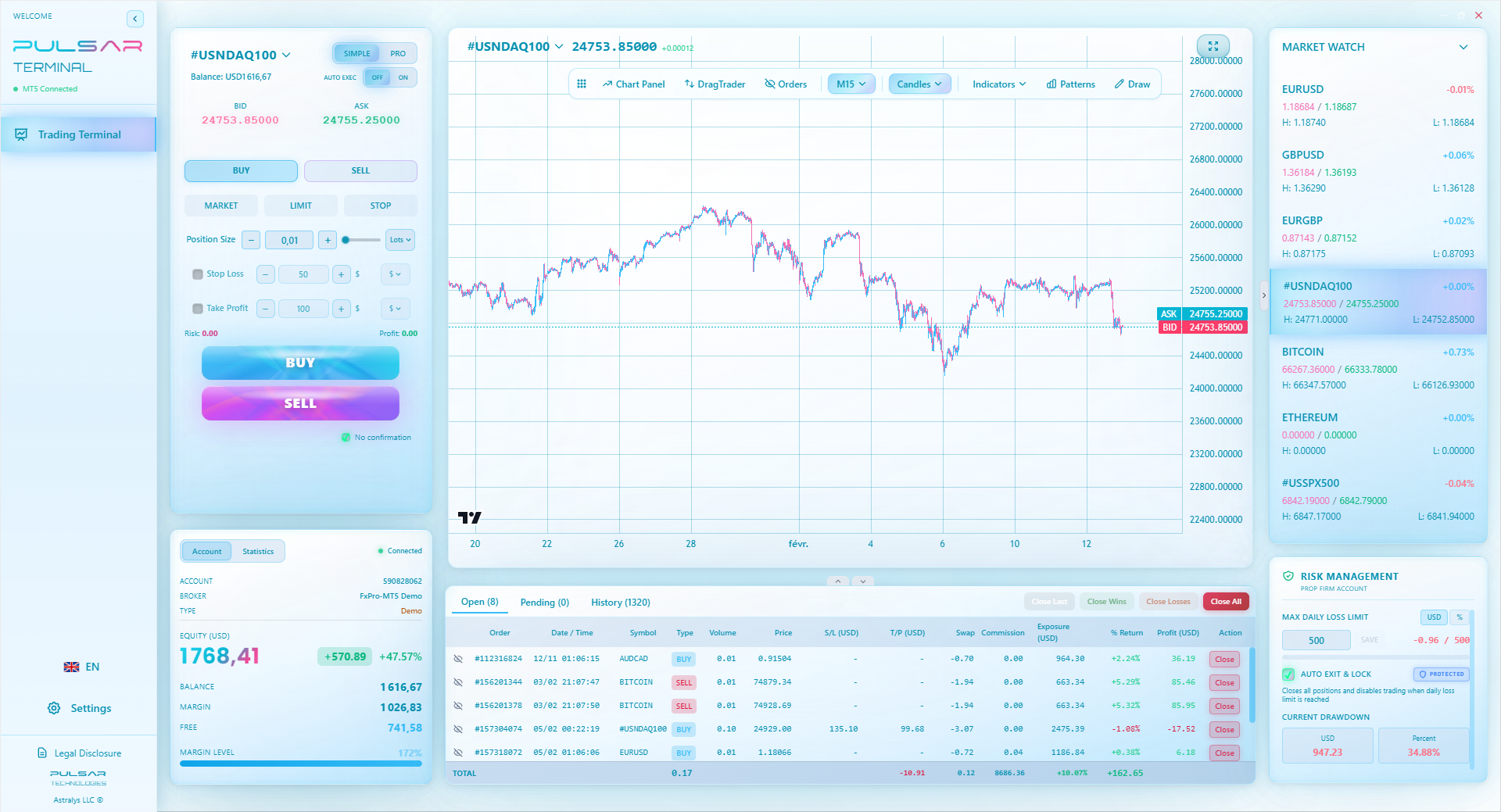
When you can trade legally, tools like Pulsar Terminal that offer advanced order management and charting will let you focus on your strategy, not manual calculations.
FAQ
Q1Can I use a VPN to open an account with an Australian broker?
Technically, you could try. Practically, it's a terrible idea. You'll be lying on a legal application (fraud). When it comes time to verify your identity (KYC), you'll need to provide proof of address, which will be Bangladeshi, leading to account closure. Withdrawals will be impossible as the bank account name must match your verified ID. You'll lose your money during this 'compliance' freeze.
Q2What happens if Bangladesh Bank catches me trading forex?
The Bangladesh Bank has the authority to take legal action under the Foreign Exchange Regulation Act. This can lead to fines, seizure of funds, and potentially more severe penalties. They monitor financial flows. While not every trader is caught, the risk is a permanent, looming threat that can materialize at any time.
Q3Are there any ASIC brokers that accept Bangladeshi clients?
No legitimate, reputable ASIC broker will knowingly onboard a client residing in Bangladesh for retail forex trading, as it violates both Bangladeshi law and their own compliance obligations. Any entity claiming to be ASIC-regulated and actively accepting Bangladeshis is almost certainly misrepresenting its regulatory status or operating a separate, unregulated brand.
Q4I see influencers in Bangladesh trading forex. How are they doing it?
They are taking the same illegal risks you are. Some may be trading with unregulated offshore brokers. Others might be trading demo accounts while showing old, fake 'live' statements. Don't use social media proof as evidence of safety or legality. Many of these influencers are paid to promote the very scam brokers you must avoid.
Q5What is the minimum deposit for these offshore brokers targeting Bangladesh?
They often set it very low, like $10 or 1000 BDT, to make it seem easy and risk-free. This is a classic scam tactic called 'low-barrier entry.' The goal is to get you hooked, then pressure you into depositing more and more. The initial low amount is just bait.
Q6Will forex trading ever be legalized in Bangladesh?
There is no indication from the Bangladesh Bank or government as of 2026 that they are considering legalizing retail forex trading with international brokers. Their focus remains on stabilizing the local currency and preventing capital flight. It's not a priority, and change, if it ever comes, is likely many years away.
Q7Can I trade the Bangladeshi Taka (BDT) as a currency pair?
Lekcja Prof. Winstona
:
- ✓Forex trading with int'l brokers is illegal for Bangladeshi residents.
- ✓Real ASIC brokers will reject your application due to compliance.
- ✓Your biggest risk is broker fraud, not market loss.
- ✓Focus on legal avenues like the DSE or demo trading.
- ✓Skills learned on demo are 100% transferable for the future.
Jak przydatny był ten artykuł?
Kliknij gwiazdkę, aby ocenić
Tygodniowe analizy tradingowe
Darmowe tygodniowe analizy i strategie. Bez spamu.
O autorze
Daniel Harrington
Szef Treści
Szef działu treści w The Trading Mentor. Doświadczony trader z pasją do upraszczania złożonych koncepcji handlowych. Obejmuje tematy globalne, strategie i przewodniki po platformach.
Komentarze
Może Ci się też spodobać

Cara Trading Forex Sukses: 7 Prinsip dari Trader Profesional
Cara trading forex sukses dengan 7 prinsip trader pro: manajemen modal, disiplin, journal trading, backtest. Data nyata, bukan janji profit palsu.
Jam Trading Forex Terbaik untuk Trader Indonesia: Panduan Lengkap dengan Tabel Waktu
Panduan jam trading forex untuk trader Indonesia. Tabel 4 sesi dunia, jam emas 20:00-00:00, sesi mana yang harus dihindari. Data akurat + tips dari trader berpengalaman.
Top 5 Sàn Forex Uy Tín Nhất 2026: Review Jujur dari Trader Indonesia
Top 5 sàn forex uy tín 2026 untuk trader Indonesia. Review jujur: spread, deposit, withdraw, dukungan lokal. Exness, XM, IC Markets & lebih.
All these calculators are built into Pulsar Terminal with real-time data from your MT5 account. One-click position sizing, automatic risk management, and instant calculations.
