


I remember staring at my screen in late 2023, watching the USD/ZAR climb through R18.80.

David van der Merwe
Trader Rynków Wschodzących ·  South Africa
☕ 11 min czytania
Czego się nauczysz:
- 1The Salary Myth: Retail vs. Institutional
- 2What Retail Traders Really Make (The Ugly Truth)
- 3The Institutional Desk: A Real Salary, Different Stress
- 4The Silent Killers: Costs, Taxes & FSCA Rules
- 5How to Actually Build a Trading Income
- 6Your Broker Choice Directly Impacts Your Earnings
- 7The Final Verdict: Is It Worth It?
I remember staring at my screen in late 2023, watching the USD/ZAR climb through R18.80. My position was up R4,200 in a single afternoon - more than some people make in a week. Then the SARB made an unexpected comment about inflation, and I watched R3,800 of that vanish in 90 seconds. That's the reality of trading here. There's no 'average forex trader salary' in the traditional sense. What you earn depends entirely on whether you're a retail trader gambling with your own money or a professional sitting at a bank desk. Let me walk you through what both worlds actually pay, and more importantly, what it takes to get there.
First, let's kill this misconception right now. If you're trading from your bedroom in Sandton or your flat in Cape Town, you don't have a salary. You have P&L. You have good months and brutal months. Calling it a salary gives it a false sense of security it doesn't deserve.
An institutional foreign-exchange dealer at a bank like Standard Bank or Investec? That's different. They get a real paycheck. According to the latest 2026 data, the average gross salary for that job is about R812,377 per year, plus a bonus that averages R185,059. An entry-level dealer with a couple years' experience pulls in around R570,990. A senior guy with 8+ years? Close to R935,000.
Now, compare that to the retail side. A beginner trader with a R10,000 account isn't earning a salary. They're statistically likely to be losing money while they learn. The 'average' monthly figures you see floating around - R1,000 to R5,000 for beginners, R10k to R50k for intermediates - are mostly hopeful estimates from trading educators, not hard data. I've seen guys with R50k accounts blow up in a week trying to chase a 'monthly salary'.

Warning: Any website promising you a fixed monthly income from forex is selling you a dream, not a strategy. Your earnings are a direct function of your skill, your capital, and market volatility. Period.
The only way a retail trader approaches a 'salary' is through extreme consistency. A professional retail trader with R100,000+ in capital, solid risk management, and a proven swing trading system might average 3-8% per month. That's R3,000 to R8,000. On a great day, they might bank R10,000. On a bad week, they might lose R5,000. It's not linear, and it's never guaranteed.

💡 Wskazówka Winstona
Stop asking 'What's the average salary?' and start asking 'What's the average drawdown?' The traders who survive are obsessed with managing losses, not fantasizing about profits.
“Your forex 'salary' is what's left after spreads, commissions, and SARS take their bite.”
Let's get specific with real numbers from my own circle and what I've seen over 12 years. Forget the guru nonsense.
The Beginner Phase (First 1-2 Years): Earnings: Typically negative. If you start with R5,000, the goal isn't to make money. It's to not lose it all. I funded my first live account with R8,000 in 2014. I was down to R4,200 within three months. My 'salary' was negative R1,266 per month. The successful beginners I mentor are thrilled if they can be flat (break even) after a year. Any profit is a bonus. The idea of a R5,000 monthly salary from a small account is a fast track to a margin call.
The Intermediate Grind (Years 2-4): This is where you might start seeing consistent small profits. Let's say you've grown your capital to R25,000 through added deposits and small wins. A good target is 5% a month. That's R1,250. Not a salary, but a decent side hustle. The problem? Life gets in the way. You have a bad trade, revenge trade, and give back two months' profits in a day. I did this in 2019. Made R14,000 over two months scalping EUR/JPY, then lost R11,000 in one overtraded session on USD/ZAR after missing my sleep. Net 'salary' over three months: R1,000 per month. Pathetic.
The Professional Retailer (5+ Years, Serious Capital): This is the 1%. They treat it like a business. Capital: R100,000 minimum, often R250,000+. They use a strict position size calculator for every trade. Their goal is 3-8% monthly. On R250k, that's R7,500 to R20,000 per month. One of the most disciplined traders I know averages about R15,000 per month on a R200k account. But he has had three months in the last two years where he was negative. His 'annual salary' equivalent is around R180,000, but it's not deposited on the 25th. It's withdrawn quarterly after setting aside a big chunk for tax.

Example: Let's break down a realistic month for an intermediate trader.
- Account: R40,000
- Monthly Target: 4% = R1,600
- Trades 8 times, wins on 5.
- Average win: R500. Average loss: R300.
- Gross Profit: (5 x R500) = R2,500
- Gross Loss: (3 x R300) = R900
- Net Profit: R1,600
- Broker Costs (Spreads): ~R200
- Net for the month: R1,400 That's the reality. It's a grind.
“A beginner's goal isn't profit; it's not losing more than 2% on any single trade.”
Want a guaranteed forex salary? Get a job. The path is usually a finance degree, an internship, and starting as a junior analyst or dealer at a bank, asset manager, or corporate treasury.
The money is real, but so is the pressure. You're not trading your view; you're executing client orders, managing the bank's risk, and hitting quarterly P&L targets. That R185k average bonus? It's tied directly to your performance and the bank's profits. A bad year in the markets, and that bonus can be zero.
I have a friend who's a senior dealer at a JSE-listed bank. His base is around R850k. His bonus last year was R220k. But he also has to be at his desk at 6:45 AM for the London open and can't just decide to take a Wednesday off. He deals in millions of dollars, but a single fat-finger error could cost him his job. The stress is constant, just of a different flavor.
The skills, however, are transferable. The understanding of order flow, macroeconomics, and risk you gain on a desk is unparalleled. Many successful independent traders I know are ex-desk guys. They left for the freedom, accepting the trade-off of no guaranteed paycheck.
“A beginner's goal isn't profit; it's not losing more than 2% on any single trade.”
Your 'salary' is what's left after the sharks take their bite. In South Africa, the sharks have names: Spreads, Commissions, and SARS.
Trading Costs Slice Your Pie
You're not trading against a charity. Your broker makes money on the spread. If you're trading EUR/USD with a 0.8 pip spread on a standard lot, that's $8 gone before you even start. On a R20,000 account trading mini lots, that adds up fast. A broker like IC Markets might offer raw spreads near 0.0 pips, but then you pay a commission. You need to factor this into every single trade. High-frequency scalping with wide spreads is a surefire way to turn a winning strategy into a loser.
The SARS Reality Check
This is non-negotiable. SARS does not view your retail forex trading as a hobby. It's income. You pay your marginal income tax rate on your net profits (profits minus losses minus allowable expenses). In 2026, they are more connected than ever. They can see your bank deposits.
You need records of every trade, every deposit, every withdrawal. I use a simple spreadsheet: Date, Pair, Entry, Exit, P/L (ZAR), Running Total. At tax time, I give it to my accountant. If you make R100,000 net profit in a year and you're in the 36% tax bracket, you owe SARS R36,000. Suddenly that 'R8,333 monthly salary' is more like R5,333. Plan for it.
FSCA Rules: The 30:1 Cage
Since 2021, the FSCA has capped use at 30:1 for retail clients. This is a good thing for beginners - it stops you from blowing up an account in minutes. But it also limits potential returns on small accounts. You can't just throw R5,000 at a trade with 100:1 use anymore. This rule alone has flattened the hypothetical 'salary' of many aggressive small-account traders. It forces proper capital growth. Also, remember you can't speculate directly against the ZAR with an FSCA-regulated broker. You trade majors like EUR/USD or XAU/USD.
💡 Wskazówka Winstona
Your first R100,000 in profits will be the hardest. Most of it will go right back to the market and SARS. Consider it tuition. Your real earning potential begins after you've paid that bill.
“The 30:1 use cap isn't a limit on your earnings; it's a guardrail against your own stupidity.”
Forget the salary mindset. Think like a business owner. Here's the blueprint, learned from expensive mistakes.
Step 1: Get Your Capital Right. Starting with less than R10,000 is a steep hill. R5,000 is a practice account. R10,000-R25,000 lets you breathe. Your first goal isn't profit; it's not losing more than 2% on any single trade. On a R10k account, that's R200. That feels tiny, but it keeps you in the game. Use a broker with a low barrier like XM or Exness to start small, but plan to move to a more strong platform as you grow.
Step 2: Master One Strategy, Not Ten. I made more money when I stopped jumping between the MACD indicator, Bollinger Bands, and fancy harmonic patterns. I focused purely on price action support/resistance and the RSI indicator for divergence. One setup. One time frame (the 4-hour chart). Repetition builds competence, competence builds consistency.
Step 3: Ruthless Risk Management. This is your paycheck protection plan. 1% risk per trade is the gold standard for growing accounts. On a R50k account, you're risking R500 per trade. If your stop loss is 50 pips away, your position size is automatically calculated. This discipline turns gambling into a business.
Step 4: Track Everything & Pay Yourself. Don't let profits sit and burn a hole in your account. Set a monthly or quarterly withdrawal rule. If you're up R6,000 in a quarter, withdraw R2,000 for yourself, leave R4,000 to compound your capital. This psychologically reinforces the income and stops you from overtrading your 'winnings'.

Pro Tip: Your most important tool isn't an indicator; it's your trading journal. Every night, review your trades. Why did you enter? Did you follow your plan? What was the outcome? This feedback loop is worth more than any premium course. I've kept one for 10 years, and it's the reason I stopped repeating the same stupid mistakes.
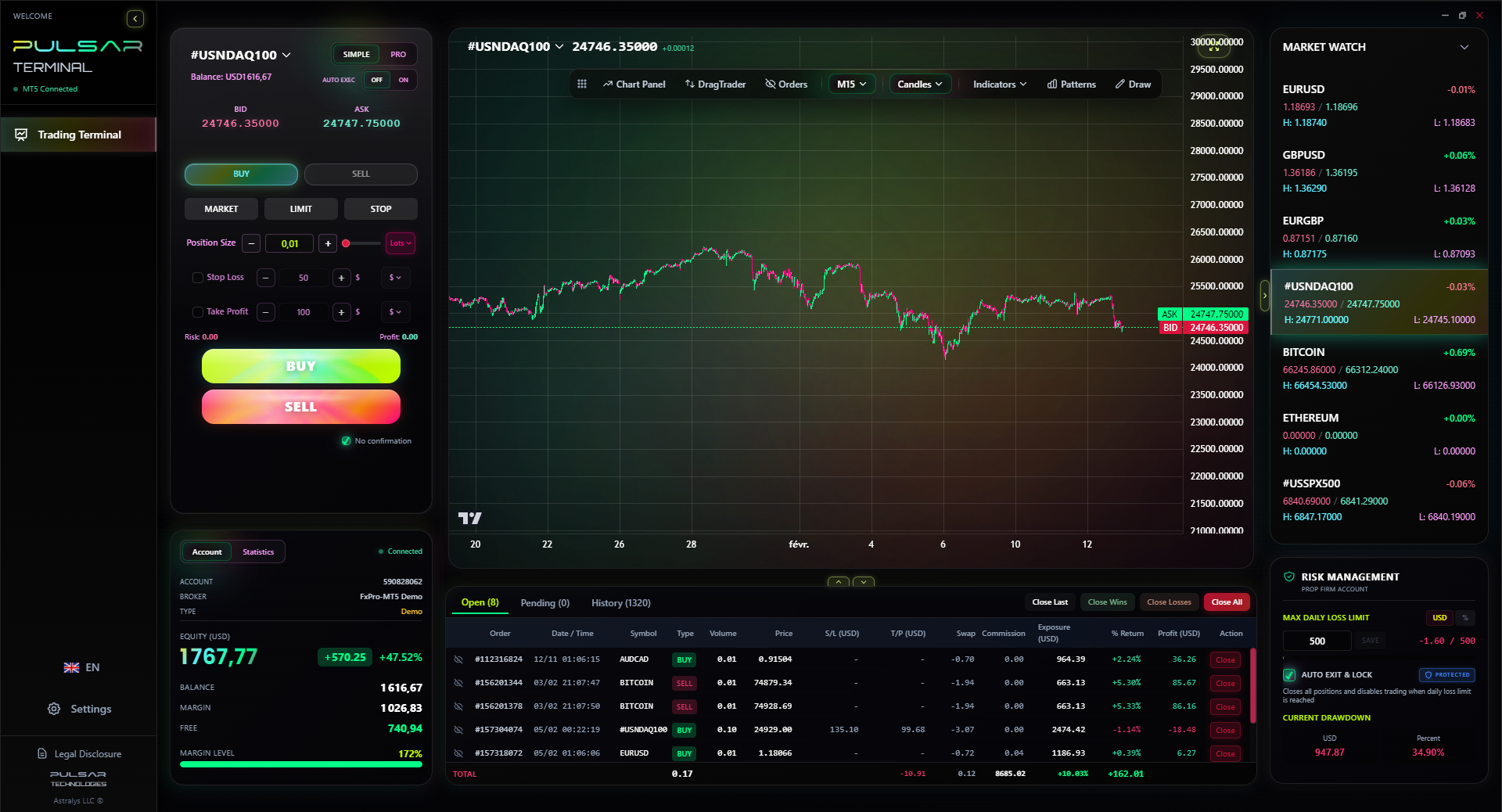
When building a real trading income, precise order management is non-negotiable, which is why tools like Pulsar Terminal that add drag-and-drop orders and multi-take-profit levels directly to MT5 are game-changers for serious traders.
“The 30:1 use cap isn't a limit on your earnings; it's a guardrail against your own stupidity.”
Picking the wrong broker is like choosing a job with a 20% pay cut. The spread is your silent partner, and they always get paid first.
In South Africa, you must use an FSCA-regulated broker for peace of mind (client fund segregation is critical). But within that group, costs vary wildly. Look at this comparison for trading 1 standard lot of EUR/USD:
| Broker | Account Type | Avg. Spread (pips) | Commission | Total Cost per Round Turn |
|---|---|---|---|---|
| Tickmill | Raw | 0.11 | $4 per lot | ~$8.20 (Spread + Commission) |
| IC Markets | Raw Spread | 0.0 | $7 per lot | $7.00 |
| XM | Standard | 0.8 | None | $8.00 |
| AvaTrade | Standard | 0.9 | None | $9.00 |
Costs converted at ~R18.50/$ for illustration. 1 pip = $10 on a standard lot.
See the difference? If you take 20 trades a month, the broker at the top of that list costs you about $164, while the one at the bottom costs $180. That's a R300 difference monthly - that's real money coming out of your potential 'salary.'
Also, look for ZAR-denominated accounts to avoid conversion fees on deposits and withdrawals. Brokers like Pepperstone and others offer this. It simplifies your life and your tax calculations. Don't just go for the flashy bonus offers. Go for tight spreads, reliable execution, and a platform you trust (MT4/MT5 are still kings here).
“Focus on the process, and the money becomes a byproduct, not a promise.”
Chasing an 'average forex trader salary' as a retail trader is a fool's errand. You will have months where you 'earn' R20,000 and months where you 'earn' negative R5,000. The institutional path offers a real salary but demands a corporate career and comes with its own shackles.
The real question is: Do you want to build a skill that can generate independent income on your own terms? It's a marathon that takes years, thousands of rands in 'tuition' (lost trades), and immense psychological fortitude.
For 95% of people, it's not worth it. The draw of quick money evaporates in the face of charts that don't care about your rent. But for the 5% who are analytical, disciplined, and patient, it can provide a freedom that no salaried job can match. Not a steady paycheck, but the potential for significant income without asking a boss for permission.
My advice? Keep your day job. Start with a R10,000 account you can afford to lose. Practice for two years. If you can consistently be profitable for 6 months straight, then consider scaling up. Your forex 'salary' will be the last number you should worry about. Focus on the process, and the money becomes a byproduct, not a promise.
FAQ
Q1What is the average monthly salary for a forex trader in South Africa?
For retail traders, there's no average monthly salary - earnings are highly variable. Beginners often make little or lose money. Skilled retail traders with R100k+ capital might average R10,000 to R50,000 per month, but it's not consistent. For institutional foreign-exchange dealers employed by banks, the average monthly salary is around R27,306 (before bonuses), according to 2026 data.
Q2Do you need a license to forex trade in South Africa?
No, individual retail traders do not need a personal license. However, you must use a broker that is licensed by the Financial Sector Conduct Authority (FSCA). This regulation protects you by ensuring client funds are segregated and the broker operates within set rules, like the 30:1 use cap.
Q3How much do forex traders pay in tax in South Africa?
SARS treats frequent forex trading as income, not capital gains. You pay your marginal income tax rate on your net annual profit (total profits minus total losses and allowable trading expenses). If your net profit is R150,000 and you're in the 36% tax bracket, you'll owe SARS roughly R54,000. Detailed record-keeping is essential.
Q4What is a good monthly return for a forex trader?
A consistently good monthly return for a professional retail trader is between 3% and 8% on their trading capital. Aiming for more than that usually involves excessive risk that leads to blow-ups. For example, 5% monthly on a R200,000 account is R10,000. This is a realistic target for experienced traders, not a guaranteed salary.
Q5Can I start forex trading with R1000 in South Africa?
Technically, yes. Some brokers like XM allow deposits as low as $5 (approx. R90). But practically, it's very difficult. With R1000 and 30:1 use, your buying power is R30,000, but the required risk management (e.g., not risking more than 2%) means your position sizes will be tiny. The transaction costs (spreads) will eat a large percentage of any potential profit. R5,000-R10,000 is a more realistic starting point to learn properly.
Q6What is the best forex broker for South Africans?
The 'best' depends on your needs. For low costs, look at FSCA-regulated brokers like Tickmill or IC Markets. For beginner-friendly features and low minimum deposits, XM is popular. For a wide range of assets, consider Pepperstone or FP Markets. Always verify the broker's FSP number on the FSCA website first.
Lekcja Prof. Winstona
:
- ✓Retail traders have P&L, not a salary. Institutional dealers earn ~R812k/year.
- ✓Skilled retail pros target 3-8% monthly returns on their capital.
- ✓SARS taxes forex profits as income at your marginal rate.
- ✓FSCA rules cap use at 30:1 for retail protection.
- ✓Broker spreads are a direct tax on your potential earnings.
Jak przydatny był ten artykuł?
Kliknij gwiazdkę, aby ocenić
Tygodniowe analizy tradingowe
Darmowe tygodniowe analizy i strategie. Bez spamu.
O autorze
David van der Merwe
Trader Rynków Wschodzących
Trader z Johannesburga z 11-letnim doświadczeniem w walutach rynków wschodzących. Specjalizuje się w parach ZAR, handlu regulowanym przez FSCA i analizie rynku południowoafrykańskiego.
Komentarze
Może Ci się też spodobać

Cara Trading Forex Sukses: 7 Prinsip dari Trader Profesional
Cara trading forex sukses dengan 7 prinsip trader pro: manajemen modal, disiplin, journal trading, backtest. Data nyata, bukan janji profit palsu.
Jam Trading Forex Terbaik untuk Trader Indonesia: Panduan Lengkap dengan Tabel Waktu
Panduan jam trading forex untuk trader Indonesia. Tabel 4 sesi dunia, jam emas 20:00-00:00, sesi mana yang harus dihindari. Data akurat + tips dari trader berpengalaman.
Top 5 Sàn Forex Uy Tín Nhất 2026: Review Jujur dari Trader Indonesia
Top 5 sàn forex uy tín 2026 untuk trader Indonesia. Review jujur: spread, deposit, withdraw, dukungan lokal. Exness, XM, IC Markets & lebih.
All these calculators are built into Pulsar Terminal with real-time data from your MT5 account. One-click position sizing, automatic risk management, and instant calculations.
