


I remember staring at my screen at 9:15 AM SAST, watching the USD/ZAR spike from R14.80 to R15.20 in what felt like seconds.

David van der Merwe
Trader Rynków Wschodzących ·  South Africa
☕ 10 min czytania
Czego się nauczysz:
- 1You Can Actually Start (Like, for Real)
- 2The Market Never Sleeps (And That's Good for Us)
- 3Trading in Rands and Playing by the Rules
- 4Trade Your View, Any Direction
- 5use: The Ultimate Power Tool (That Can Burn Your House Down)
- 6The Flip Side: What They Don't Put in the Brochure
- 7Making It Work for You: A South African Blueprint
I remember staring at my screen at 9:15 AM SAST, watching the USD/ZAR spike from R14.80 to R15.20 in what felt like seconds. It was March 2020, and the pandemic panic was hitting the rand. My hands were sweating, but my trade plan was clear. I'd been waiting for a break of that R15.00 psychological level. That single morning move, perfectly timed with our local market open overlapping with London, netted me over R8,000 on a carefully sized position. It wasn't luck. It was the unique structure of the forex market - its 24/5 access, insane liquidity, and our perfect time zone - giving me a shot. That's the real deal about the benefits of forex trading here. It's not about getting rich quick. It's about having a global financial tool that works on South African time.
One of the biggest myths is that you need thousands to trade. In South Africa, that's just not true anymore. I opened my first live account with R500. Seriously. It was with a broker that offered a ZAR-denominated account, so I didn't even get hammered by conversion fees off the bat.
Now, trading with R500 is a learning exercise, not a wealth-building strategy. The point is the barrier to entry is shockingly low. You can find brokers with minimum deposits of $10 (about R185) or even $0. This low threshold is a double-edged sword, though. It makes forex one of the most accessible financial markets, but it also lets people jump in without proper respect for risk.

Warning: Just because you can start with R500 doesn't mean you should trade your full account on one idea. That R500 account is for practicing execution, getting used to the platform, and learning emotional control with real, but very small, money. Use a position size calculator religiously, even for tiny amounts.
The real benefit here is the ability to learn with real capital without risking your rent. I made every mistake in the book with that first R500: overtrading, ignoring stops, revenge trading after a loss. Losing R50 felt terrible, but it taught me lessons that saved me thousands later. That practical, low-stakes education is useful.

💡 Wskazówka Winstona
Your first R10,000 in profits isn't money. It's a receipt proving your process works. Reinvest it in your education and risk capital, not a lifestyle.
“The real benefit of regulated use is that it allows for efficient use of capital, not a license to gamble.”
This is the core structural benefit. The forex market runs 24 hours a day, five days a week. From Monday morning in Wellington to Friday evening in New York, someone, somewhere, is trading currencies.
Our Secret Weapon: The SA Time Zone
Our geographic location is a hidden advantage. The most liquid sessions are the London session (10:00 AM - 7:00 PM SAST) and the overlapping London/New York session (3:00 PM - 7:00 PM SAST). Guess what? That's smack in the middle of our working day. You don't have to wake up at 3 AM to catch the best moves. I've placed most of my profitable trades between lunchtime and the end of the SA business day. This accessibility means you can be a part-time trader with a full-time job without destroying your sleep schedule.
Liquidity Means You Get In and Out
Daily turnover is over $6 trillion. That liquidity means tight spreads (the difference between buy and sell prices) and instant order execution during major sessions. On a major pair like EUR/USD, spreads can be as low as 0.1 pips with a good broker. Compare that to trying to buy or sell a small-cap JSE share where the bid-ask spread can wipe out your potential profit. This liquidity is why scalping strategies are even possible.

Example: On a quiet day, the spread on EUR/USD might be 0.8 pips. On a $10,000 (1 mini lot) position, that transaction cost is about $8. On a volatile JSE share, the spread percentage can often be much higher, costing you more before the price even moves.
“Our geographic location is a hidden advantage. The most liquid sessions are smack in the middle of our working day.”
This is a uniquely South African benefit that many overlook until they get a nasty surprise on their bank statement.
Many international brokers, and most local ones, offer ZAR-based trading accounts. You deposit rands, your profit and loss is displayed in rands, and you withdraw rands. This eliminates the hidden cost of currency conversion on every deposit and withdrawal. I learned this the hard way early on. I deposited $100, paid my bank's forex fee, traded, withdrew $110, and paid another fee. I barely broke even after the bank was done with me.
The FSCA: Your Safety Net
Forex trading is legal and regulated here by the Financial Sector Conduct Authority (FSCA). This isn't some wild west. An FSCA license means the broker must adhere to strict rules.
- Client Money Segregation: Your funds are held in separate bank accounts from the broker's operating money. If the broker goes under (it happens), your money isn't part of their assets to be claimed by creditors. This is non-negotiable.
- use Caps: Since 2021, retail use is capped at 30:1 for major pairs. This is a good thing. It forces discipline. In the old days, seeing 500:1 use was a temptation to blow up an account fast. Now, the maximum loss is more controlled. Yes, professionals can apply for higher use, but for 99% of us, 30:1 is more than enough to make mistakes with.
Brokers like Exness and XM offer ZAR accounts and are popular here, but always check their FSCA status on the regulator's website. Don't just take their word for it.
“Our geographic location is a hidden advantage. The most liquid sessions are smack in the middle of our working day.”
The JSE having a bad year? The ALSI down 10%? In forex, that doesn't matter. You can make money in rising, falling, or sideways markets.
This bidirectional nature is a profound benefit. If you believe the US economy will strengthen against the Eurozone, you buy USD/CHF or sell EUR/USD. If you think the rand will weaken due to local political uncertainty, you can buy USD/ZAR. Your profit potential isn't tied to a bull market. Some of my best trades have been short positions during clear downtrends.
Diversification Away from SA Assets
Most South Africans' wealth is tied to the rand: property, JSE shares, retirement annuities. Forex offers genuine diversification. You're taking a view on global macroeconomic forces - interest rate differentials, geopolitical stability, commodity prices. Trading XAU/USD (gold) is a classic hedge against uncertainty. When global risk aversion hits, gold often goes up, which can offset losses in a risk-on portfolio.
It also lets you indirectly invest in economies you believe in without buying foreign stocks. Believing in the UK's recovery? Maybe GBP/USD is your play. It's a pure currency play, uncluttered by company-specific news.
I once had a quarter where my local equity portfolio was flat, but my forex trades on a weakening euro (short EUR/GBP) kept my overall P&L positive. That's the power of non-correlated assets.
💡 Wskazówka Winstona
The market's 24/5 nature is a test of your patience, not an invitation to trade. The most powerful position is often a well-funded one waiting for the right setup.
“use amplifies everything - your gains, your losses, and most dangerously, your emotions.”
This is the benefit everyone talks about and the one most people completely misuse. use of 30:1 means with R10,000 in your account, you can control a position worth R300,000.
Here's the raw truth from my experience: use amplifies everything - your gains, your losses, and most dangerously, your emotions. My single biggest loss, a R15,000 hole in one afternoon, came from using excessive use on a USD/ZAR trade that went 30 pips against me. I hadn't placed a stop-loss because I was 'sure' it would come back. It didn't. The loss was magnified 30 times over my initial risk.

Pro Tip: Don't think of use as "how much can I control." Think of it as "how little margin do I need to post to take this trade with proper risk?" Use the use cap to allow smaller, smarter margin requirements, not to max out your buying power on one hunch. A good rule is to never use more than 5-10% of your available use on a single trade.
The real benefit of regulated use is that it allows for efficient use of capital. You can run multiple swing trading ideas with a modest account without having all your capital tied up as margin. But you must have iron-clad risk management. Knowing what a margin call is before it happens is crucial. It's the broker automatically closing your losing positions because your losses have eaten up your usable margin. It's not a suggestion; it's a forced exit at the worst possible price.
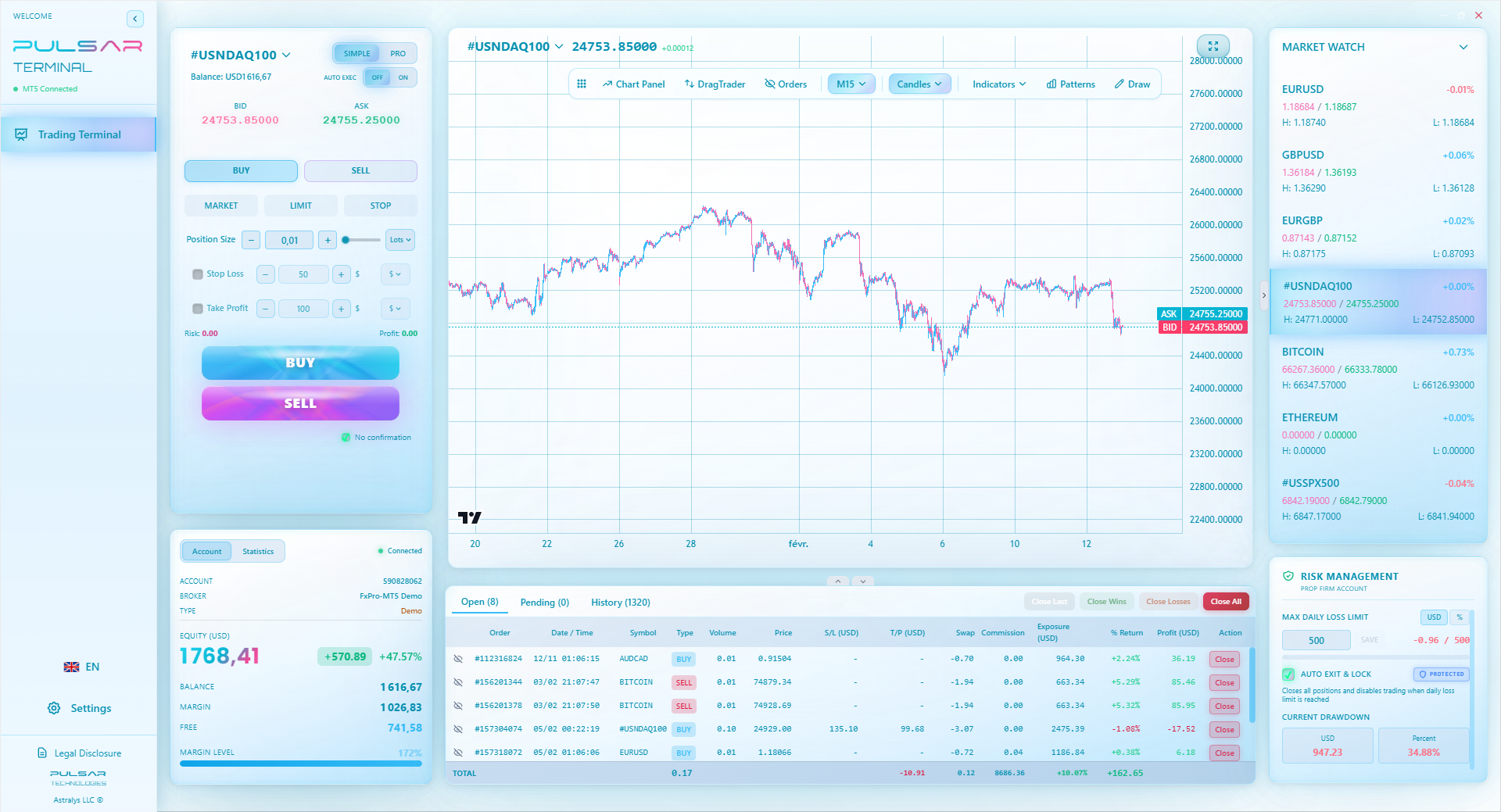
Managing multiple trades and their exits under pressure is where most fail; a tool like Pulsar Terminal lets you set complex multi-TP/SL and trailing stop orders on MT5 with one click, so your plan executes automatically.
“use amplifies everything - your gains, your losses, and most dangerously, your emotions.”
Let's be brutally honest. The benefits come with massive caveats.
The Learning Curve is a Cliff. Understanding a pip, spread, rollover, and correlation isn't enough. You need a grasp of global macroeconomics, central bank policy, and market sentiment. I spent my first year consistently losing because I was just chasing patterns without understanding why the market moved.
Emotional Tax is High. Watching real money fluctuate second-by-second triggers greed and fear like nothing else. The flexibility of 24/5 trading can become a curse, tempting you to monitor positions obsessively or revenge trade after hours.
Costs Add Up. Even with low spreads, there are costs. Swap fees (interest for holding overnight) can eat into longer-term trades. Poor internet can lead to slippage on entries and exits. And if you're not using a ZAR account, those bank fees are a silent killer.
It's a Zero-Sum Game. For you to win R100, someone else has to lose R100 (minus the broker's spread). You're not investing in a growing company; you're competing against banks, hedge funds, and algos with far more resources. Your edge has to come from discipline, psychology, and a strong process, not just a fancy indicator like the MACD or RSI.
“The ultimate benefit isn't a Lamborghini. It's the development of discipline, analytical skill, and a global perspective.”
So how do you capture the benefits without being destroyed by the risks? You need a localised plan.
- Start with a Regulated, ZAR-Account Broker. This is non-negotiable for beginners. Research IC Markets, Pepperstone, or other FSCA-licensed entities. Demo trade for at least 3 months, then fund a live account with money you can afford to lose completely.
- Specialise in Sessions That Fit Your Life. Are you a 9-to-5 worker? Focus on the London open (10 AM SAST) or the New York open (3:30 PM SAST). Don't try to trade the Asian session unless you're a night owl. Master the rhythm of one session first.
- Focus on a Handful of Pairs. Don't jump from USD/ZAR to EUR/JPY to AUD/CAD. Start with one major pair like EUR/USD or GBP/USD. They have the tightest spreads and most predictable behavior during our daytime. Add USD/ZAR later if you want to trade your local view.
- Risk Management is Your Primary Strategy. Decide before you enter what you will risk (e.g., 1% of your account) and where your stop-loss and take-profit levels are. Write it down. A trading journal is your best teacher. My biggest turning point was reviewing a month of trades and seeing that my winners were, on average, smaller than my losers. I fixed my risk-reward ratio, and everything changed.
- Continuous Education, Not Just Trading. The market evolves. Central bank policies change. Dedicate time each week to learning, not just staring at charts. Understand why the South African Reserve Bank (SARB) is hiking or cutting rates, and how that affects USD/ZAR.
The ultimate benefit of forex trading in South Africa isn't a Lamborghini. It's the development of discipline, analytical skill, and a global perspective, all while using a market that's open and liquid during our convenient hours. It's a marathon of self-improvement, with the potential for financial rewards if you run it wisely.
FAQ
Q1Is forex trading legal and safe in South Africa?
Yes, it's legal. Its safety depends entirely on using a broker licensed by the Financial Sector Conduct Authority (FSCA). These brokers must segregate client funds, which protects your money if the broker faces financial trouble. Always verify the FSP number on the FSCA's official website before depositing any money.
Q2How much money do I need to start forex trading in South Africa?
You can technically start with as little as R500 with some brokers. However, this should be viewed as tuition fees for learning with real money, not a serious trading capital. A more practical starting point for applying basic risk management is between R5,000 and R10,000. The key is that the amount should be capital you can afford to lose without impacting your lifestyle.
Q3What is the maximum use I can use?
For retail traders in South Africa, the FSCA has capped use at 30:1 for major currency pairs. This means with R1,000 of your own capital (margin), you can control a position worth R30,000. This cap is designed to protect traders from catastrophic losses. Only clients classified as 'professional' investors can access higher use.
Q4What are the tax implications for forex trading profits in SA?
The South African Revenue Service (SARS) views forex trading as speculative, meaning profits are not classified as capital gains. Your net profit (total profits minus total losses and allowable expenses) is considered income and is added to your other taxable income for the year. You must declare it on your annual tax return. It's highly recommended to keep detailed records of all trades and consult with a tax professional.
Q5Should I trade USD/ZAR or major pairs like EUR/USD?
Beginners should almost always start with major pairs like EUR/USD or GBP/USD. They have much higher liquidity, which means tighter, more predictable spreads and less chance of sudden, wild price gaps. USD/ZAR can be more volatile and have wider spreads, making it trickier to manage risk when you're new. Learn the basics on the majors first.
Q6What's the best time of day to trade forex in South Africa?
The most active and liquid times are during the London session (10:00 AM to 7:00 PM SAST) and the overlap with the New York session (3:00 PM to 7:00 PM SAST). This is when the highest volume trades, leading to better order execution and clearer trends. This works perfectly for South Africans as it falls within normal daytime hours.
Lekcja Prof. Winstona
:
- ✓Start with a ZAR account to kill hidden bank forex fees.
- ✓Use the FSCA's 30:1 use cap as a risk governor, not a target.
- ✓Trade the London/New York overlap (3-7 PM SAST) for maximum liquidity.
- ✓Risk a maximum of 1-2% of your capital on any single trade.
- ✓Your first year's goal is to preserve capital, not generate profit.
Jak przydatny był ten artykuł?
Kliknij gwiazdkę, aby ocenić
Tygodniowe analizy tradingowe
Darmowe tygodniowe analizy i strategie. Bez spamu.
O autorze
David van der Merwe
Trader Rynków Wschodzących
Trader z Johannesburga z 11-letnim doświadczeniem w walutach rynków wschodzących. Specjalizuje się w parach ZAR, handlu regulowanym przez FSCA i analizie rynku południowoafrykańskiego.
Komentarze
Może Ci się też spodobać

Cara Trading Forex Sukses: 7 Prinsip dari Trader Profesional
Cara trading forex sukses dengan 7 prinsip trader pro: manajemen modal, disiplin, journal trading, backtest. Data nyata, bukan janji profit palsu.
Jam Trading Forex Terbaik untuk Trader Indonesia: Panduan Lengkap dengan Tabel Waktu
Panduan jam trading forex untuk trader Indonesia. Tabel 4 sesi dunia, jam emas 20:00-00:00, sesi mana yang harus dihindari. Data akurat + tips dari trader berpengalaman.
Top 5 Sàn Forex Uy Tín Nhất 2026: Review Jujur dari Trader Indonesia
Top 5 sàn forex uy tín 2026 untuk trader Indonesia. Review jujur: spread, deposit, withdraw, dukungan lokal. Exness, XM, IC Markets & lebih.
All these calculators are built into Pulsar Terminal with real-time data from your MT5 account. One-click position sizing, automatic risk management, and instant calculations.
