


Most traders think finding the 'best forex news sites' is about getting the fastest alerts.

Olumide Adeyemi
Pionier Tradingu w Afryce Zachodniej ·  Nigeria
☕ 10 min czytania
Czego się nauczysz:
- 1Why News Trading is a Minefield (Especially in Nigeria)
- 2Tier 1 Sources: The Non-Negotiables
- 3Tier 2: Analysis and Context
- 4What to Avoid (The Nigerian Context)
- 5Building Your Personal News Routine
- 6Trading the News: A Practical Framework
- 7Managing Emotions and Expectations
- 8Final Thoughts: Where Your Real Edge Is
Most traders think finding the 'best forex news sites' is about getting the fastest alerts. They're wrong. The real problem isn't a lack of information, it's drowning in it. I've seen more accounts blown by traders reacting to every headline than by missing one. This guide cuts through the noise. I'll show you the sites that matter, how to read them like a pro, and the exact filters you need to avoid getting whipsawed by every piece of 'breaking news'.
Let's be blunt: news trading is one of the fastest ways to lose money if you don't have a system. The moment a high-impact news event hits, spreads widen, liquidity dries up, and your stop-loss becomes a suggestion, not a guarantee. I learned this the hard way during a US Non-Farm Payrolls (NFP) release in 2015. I was long EUR/USD, the number missed expectations, and the pair tanked. My stop at 1.1050? It got filled at 1.1025. That's a 25-pip slippage on a single trade. In Naira terms, on a standard lot, that was an extra ₦10,000 loss I hadn't planned for.
The Nigerian context adds another layer. Our internet isn't always the most reliable. If you're trying to compete with algorithmic traders in London or New York on speed, you will lose. Your edge isn't being first. Your edge is being smarter. It's about understanding the why behind the move, not just reacting to the headline. The best forex news sites won't save you if you're using them to chase volatility.

Warning: Trading the initial spike after news is pure gambling. The market often reverses as liquidity returns. I've been caught in that 'fakeout' more times than I care to admit.

💡 Wskazówka Winstona
The news headline is the bait. The market's sustained reaction 45 minutes later is the real meal. Trade the digestion, not the swallow.
These are the primary sources. You don't get your news from someone commenting on these, you go straight to the source. Think of them as the CBN website for Nigerian monetary policy.
The Economic Calendar: Your Trading Roadmap
Every week starts here. You're not looking for every event, just the high-impact ones (usually marked red). For a Nigerian trader, focus on:
- US Data: NFP, CPI, Federal Reserve decisions (FOMC). The Dollar is the world's reserve currency.
- EU Data: ECB decisions, Eurozone CPI. Major for EUR pairs.
- UK Data: Bank of England (BoE) decisions, UK CPI. Major for GBP pairs.
- Oil Data: OPEC meetings, US Crude Inventories. Critical because oil directly impacts the Naira.
I use the calendar on Forex Factory. It's free, simple, and the community commentary (which you should mostly ignore) can sometimes highlight consensus expectations.
The Central Bankers' Mouthpieces
When a central bank speaks, the market listens. Don't read summaries. Read or watch the actual statements.
- Federal Reserve: The FOMC Statement and, crucially, the Dot Plot. The press conference 30 minutes later is where the real moves happen.
- European Central Bank (ECB) & Bank of England (BoE): Same principle.
- Central Bank of Nigeria (CBN): For Naira pairs and understanding local liquidity. Their Monetary Policy Committee (MPC) statements are key.
A personal rule: I don't enter any new trades 1 hour before a major central bank event. The risk of a random headline tweet is too high.

Example: In June 2022, the Fed hiked rates by 0.75%. The news was already priced in. The market then rallied because Powell's tone in the press conference was less hawkish than feared. The trade wasn't in the rate decision, it was in the nuance of his words.
“The trap with Tier 2 is analysis paralysis. You'll find five analysts with five different opinions.”
Once you know the facts from Tier 1, you need interpretation. These sites help you understand market sentiment and positioning.
Reuters & Bloomberg: The gold standard. You want to understand how a news event is being framed. Are they calling inflation 'sticky' or 'transitory'? The language matters. Full terminals are expensive, but their free websites and apps offer plenty.
TradingView 'Ideas' & Charts: This is a double-edged sword. I don't go here for news, I go to see how the retail crowd is positioned. If I see 85% of traders are long on USD/NGN, that's a serious contrarian signal. It helps me gauge sentiment extremes. Their charting tools are also essential for planning your swing trading entries around news levels.
DailyFX (by IG): Their market analysis is generally solid. I find their 'Sentiment' widget useful. They also provide good pre- and post-event analysis that explains the market reaction, which is more valuable than the prediction.
The trap with Tier 2 is analysis paralysis. You'll find five analysts with five different opinions. Pick one or two whose reasoning you consistently understand and ignore the rest. My XM review notes they offer decent market analysis, but I always cross-reference.
Our market has specific pitfalls. Steer clear of these:
Telegram/Signal Groups Promising 'News Alerts': 99% are scams. By the time a 'hot tip' reaches a free Telegram group, the move is over. They often use fake screenshots (PipsPics) to lure you in. I've had clients lose millions of Naira following these.
Social Media 'Gurus' on X (Twitter): Be extremely selective. Many are just reposting headlines from Bloomberg with their own bullish/bearish spin. Verify their track record over years, not days. Look for analysts who discuss risk and show losses, not just wins.
Local Blogs with Poor Sourcing: Many Nigerian finance blogs just copy-paste from international sites, often with errors. If they're not directly quoting Reuters, Bloomberg, or the CBN, be skeptical.
Broker 'News' Feeds: The news feed inside your Exness or IC Markets platform is convenient, but it's often a low-tier aggregator with delays. Use it for convenience, not as your primary source. Always check the timestamp.
Your greatest tool is skepticism. If a piece of news would make you 'get rich quick,' it's probably designed to make someone else rich at your expense.
💡 Wskazówka Winstona
If you can't explain in one sentence why a news event should move a currency pair, you don't have a trade. You have a guess.
“If a piece of news would make you 'get rich quick,' it's probably designed to make someone else rich at your expense.”
Consistency beats speed. Here's the 20-minute daily routine I've used for a decade:
- Morning (Before 8 AM WAT): Open the Forex Factory calendar. Identify any high-impact events for the next 24 hours. I mark them on my trading plan. No trading until I've done this.
- Pre-Event (1 Hour Before): I'm in preparation mode, not execution. I check Reuters/Bloomberg for any last-minute leaks or updates to forecasts. I set price alerts on key levels, but I don't have an open trade.
- Post-Event (30-60 Minutes After): This is the sweet spot. The initial panic is over, the spread has normalized, and the chart is showing its true reaction. This is where I look for MACD indicator or RSI indicator confirmation on the 15-minute or 1-hour chart. The trend post-news is often more reliable than the initial spike.
- Weekly Review: Every Sunday, I look at the week ahead. I identify the 2-3 biggest events and decide which, if any, I will trade. For the others, I will simply stay out of the market.
This routine removes emotion. You're not chasing; you're observing and then acting with discipline. It's the difference between a gambler and a trader. For managing the trades you do take, a tool like our position size calculator is non-negotiable, especially around volatile news.
Let's get specific. Here's a simple, risk-managed way to approach a high-impact event like US CPI.
Step 1: The Setup (Before the News)
- Know the consensus forecast (e.g., CPI expected at 3.1%).
- Identify key technical levels on the EUR/USD guide chart - support and resistance from the previous day/week.
- Place buy-stop and sell-stop orders 20 pips above and below the current range. Do NOT enter a market order.
- Set tight stops (15-20 pips) on these pending orders. The goal is to catch the initial breakout, not ride a reversal.
Step 2: The Reaction
- The news hits. One of your pending orders will trigger.
- Immediately cancel the other pending order.
- Here's the key part: set a breakeven stop as soon as the trade is 15 pips in profit. News trades are fickle; protect your capital first.
Step 3: The Management
- If the trend continues, consider a trailing stop. Don't get greedy. A 30-50 pip gain on a news event is a great success.
- If you get stopped at breakeven, fine. You risked nothing. The worst outcome is a small loss if you get slippage.
I used this exact framework on a GBP/USD trade after a BoE meeting last year. Entry via sell-stop at 1.2650, moved to breakeven at 1.2635, and trailed it down to 1.2580 for a 70-pip gain. The market later reversed, but I was already out. Greedy traders who held gave back all their profits.

Pro Tip: For a volatile instrument like XAU/USD guide (Gold), double your normal stop distance around news. Gold can jump $20 in a blink, and a tight stop will just get hunted.
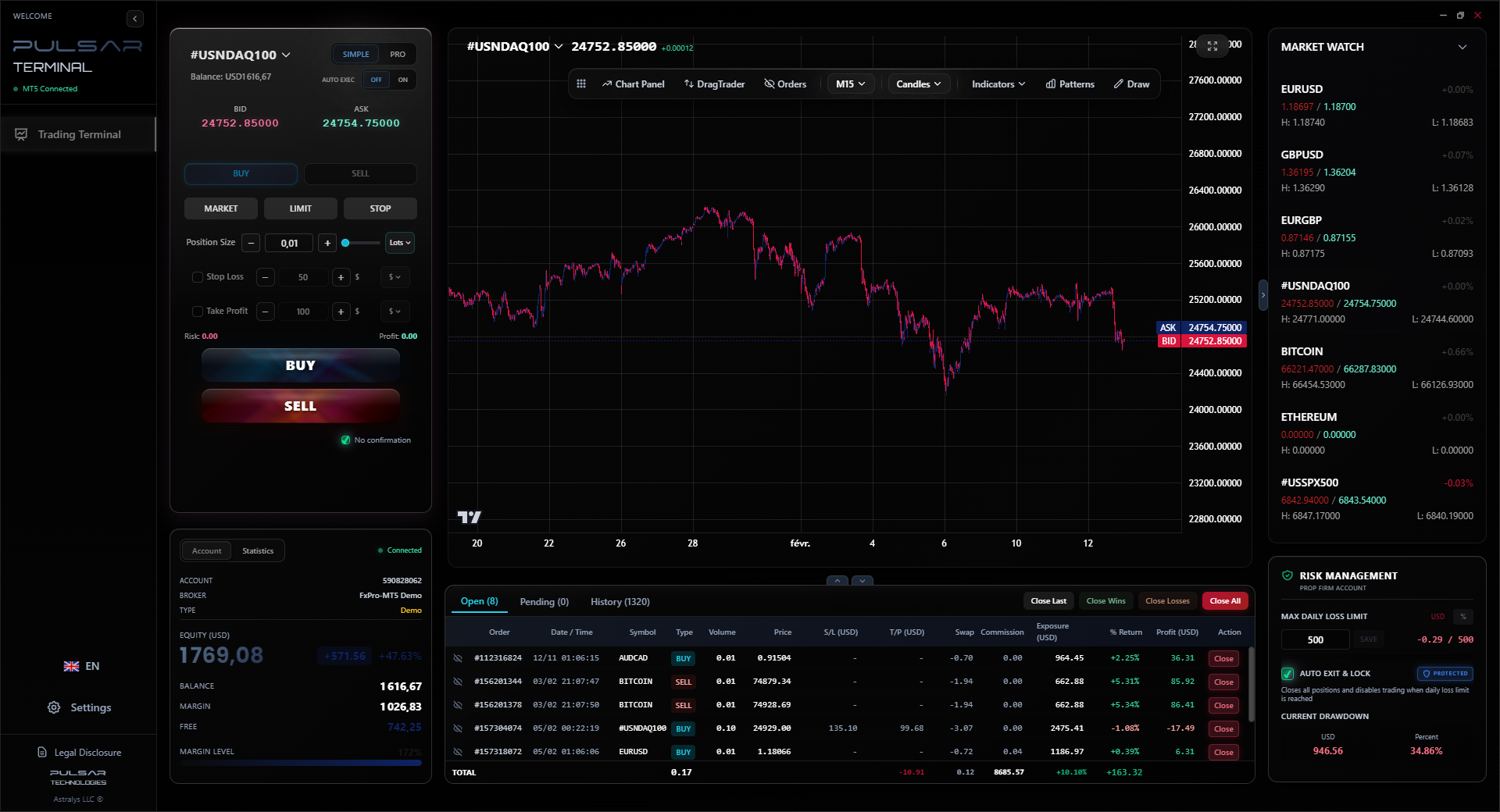
Managing multiple take-profit levels and moving stops to breakeven during volatile news trades is stressful; Pulsar Terminal automates this with its multi-TP/SL and breakeven functions directly on your MT5 chart.
“Your edge as a Nigerian trader isn't in getting news faster. It's in processing it better and managing risk more ruthlessly.”
The data on your screen is neutral. Your interpretation is emotional. The biggest mistake is attaching your self-worth to being 'right' about a news outcome.
I remember trading a Fed decision where I was convinced Powell would be dovish. He wasn't. My analysis was wrong. Instead of accepting the loss on my small speculative position, I doubled down as the USD rallied, trying to prove the market wrong. That second, emotional trade lost 3x more than the first. It was a classic margin call in the making.
You must separate your ego from your P&L. The best forex news sites give you information, not certainty. The market's reaction is the only truth that matters. If you find yourself yelling at the screen because the market 'shouldn't' be moving a certain way, walk away. You've lost objectivity.
Set a hard rule: one trade per news event. Win or lose, you're done. No revenge trading. The market will be there tomorrow. Your account might not be if you break this rule.
💡 Wskazówka Winstona
Your pre-news analysis is a hypothesis. The price chart post-news is the experimental result. Believe the result, not your hypothesis.
Your edge as a Nigerian trader isn't in getting news faster. It's in processing it better and managing risk more ruthlessly.
Think about it. The big banks have news feeds that are microseconds faster than yours. They have algorithms that trade before you can even click. You can't win that race.
You win by:
- Preparation: Knowing the event is coming and having a plan.
- Patience: Waiting for the chaotic first 30 minutes to pass.
- Position Sizing: Never risking more than 1-2% of your account on any single news trade. Use the calculator.
- Psychology: Accepting that most news events are not tradeable opportunities. It's okay to sit on your hands.
The goal is to use the best forex news sites to inform your broader market view, not to trigger knee-jerk trades. Let the impatient retail traders blow themselves up on the initial volatility. You wait, you assess, and you take the cleaner, smarter trade that comes after the storm. That's how you survive and compound gains in this business. For those who master this, techniques like scalping strategy become more effective because you're trading in the direction of the post-news momentum, not against it.
FAQ
Q1Is it worth paying for a premium news service like Bloomberg Terminal?
For 99.9% of retail traders in Nigeria, no. The cost (thousands of dollars per month) is astronomically higher than any potential edge it might give you. The free tiers of Reuters, Bloomberg online, and Forex Factory provide more than enough information if you know how to interpret it. Your money is better spent on education and strong risk management tools.
Q2How do I know if news is already 'priced in' to the market?
You look at the price action before the event. If the EUR/USD has been rallying for a week in expectation of a hawkish ECB, the actual announcement might cause a 'sell the news' drop even if the news is good. Watch the market's reaction to the news versus the forecast. If the number is slightly better than expected but price falls, it was priced in. The immediate move after the release tells you the truth.
Q3What's the most important news for trading the Naira?
Domestically, the Central Bank of Nigeria's (CBN) Monetary Policy Committee (MPC) decisions and any official statements on foreign exchange management are paramount. Internationally, US Federal Reserve policy and global oil prices (especially Brent Crude) are the two biggest external drivers of USD/NGN. A Fed hike or a drop in oil prices typically strengthens the dollar against the Naira.
Q4Can I trade forex news with a small account?
It's incredibly risky. News volatility leads to wider spreads and slippage, which can eat a disproportionate chunk of a small account. If you must, trade the smallest possible position size (e.g., micro lots) and only after the initial spike, when spreads have normalized. Consider that the required stop-loss might be 20-30 pips, which could be a large percentage of a small account.
Q5What time of day is best for news trading in Nigeria?
The most volatile overlaps are during European and US sessions. 2:00 PM - 5:00 PM WAT (when London and New York are active) is often when major data drops. This is good for opportunity but bad for sleep if you're in Nigeria. Asian session news (around 4 AM WAT) is usually lower impact. Trade when you are alert and can monitor the market, not when you're forcing it.
Q6Should I use an EA (Expert Advisor) to trade news automatically?
I strongly advise against it for retail traders. News environments are disorderly. EAs rely on stable spreads and instant order execution, which vanish during news. The EA will fail exactly when you need it most, likely resulting in a massive slippage loss. Human discretion in managing the trade post-news is far superior.
Lekcja Prof. Winstona
:
- ✓Trade the 45-minute post-news trend, not the 45-second spike.
- ✓One trade per news event. Win or lose, walk away.
- ✓Always set a breakeven stop after 15 pips profit on news trades.
- ✓Wider spreads during news mean you need wider stops (20-30 pips).
Jak przydatny był ten artykuł?
Kliknij gwiazdkę, aby ocenić
Tygodniowe analizy tradingowe
Darmowe tygodniowe analizy i strategie. Bez spamu.
O autorze
Olumide Adeyemi
Pionier Tradingu w Afryce Zachodniej
Jeden z najaktywniejszych edukatorów tradingu forex w Nigerii. 8 lat doświadczenia tradingowego z Lagos. Specjalizuje się w strategiach niskiego kapitału i wyzwaniach prop firm dla afrykańskich traderów.
Komentarze
Może Ci się też spodobać

Cara Trading Forex Sukses: 7 Prinsip dari Trader Profesional
Cara trading forex sukses dengan 7 prinsip trader pro: manajemen modal, disiplin, journal trading, backtest. Data nyata, bukan janji profit palsu.
Jam Trading Forex Terbaik untuk Trader Indonesia: Panduan Lengkap dengan Tabel Waktu
Panduan jam trading forex untuk trader Indonesia. Tabel 4 sesi dunia, jam emas 20:00-00:00, sesi mana yang harus dihindari. Data akurat + tips dari trader berpengalaman.
Top 5 Sàn Forex Uy Tín Nhất 2026: Review Jujur dari Trader Indonesia
Top 5 sàn forex uy tín 2026 untuk trader Indonesia. Review jujur: spread, deposit, withdraw, dukungan lokal. Exness, XM, IC Markets & lebih.
All these calculators are built into Pulsar Terminal with real-time data from your MT5 account. One-click position sizing, automatic risk management, and instant calculations.
