


Thinking about trading futures with a prop firm's capital? Blusky Prop Firm (or BluSky Trading Company) keeps popping up with its 90% profit split and 'no hidden fees' pitch.

James Mitchell
Starszy Analityk Tradingowy
☕ 10 min czytania
Czego się nauczysz:
- 1What Is Blusky Prop Firm, Really?
- 2The Rules: Breaking Down the Blusky Challenge
- 3Costs, Fees, and The Famous 90% Split
- 4Straight Talk: The Pros and Cons of Blusky
- 5How Does Blusky Stack Up Against The Competition?
- 6Who Is Blusky Actually Good For? (And Who Should Run)
- 7Final Verdict & The Non-Negotiable Risk Warning
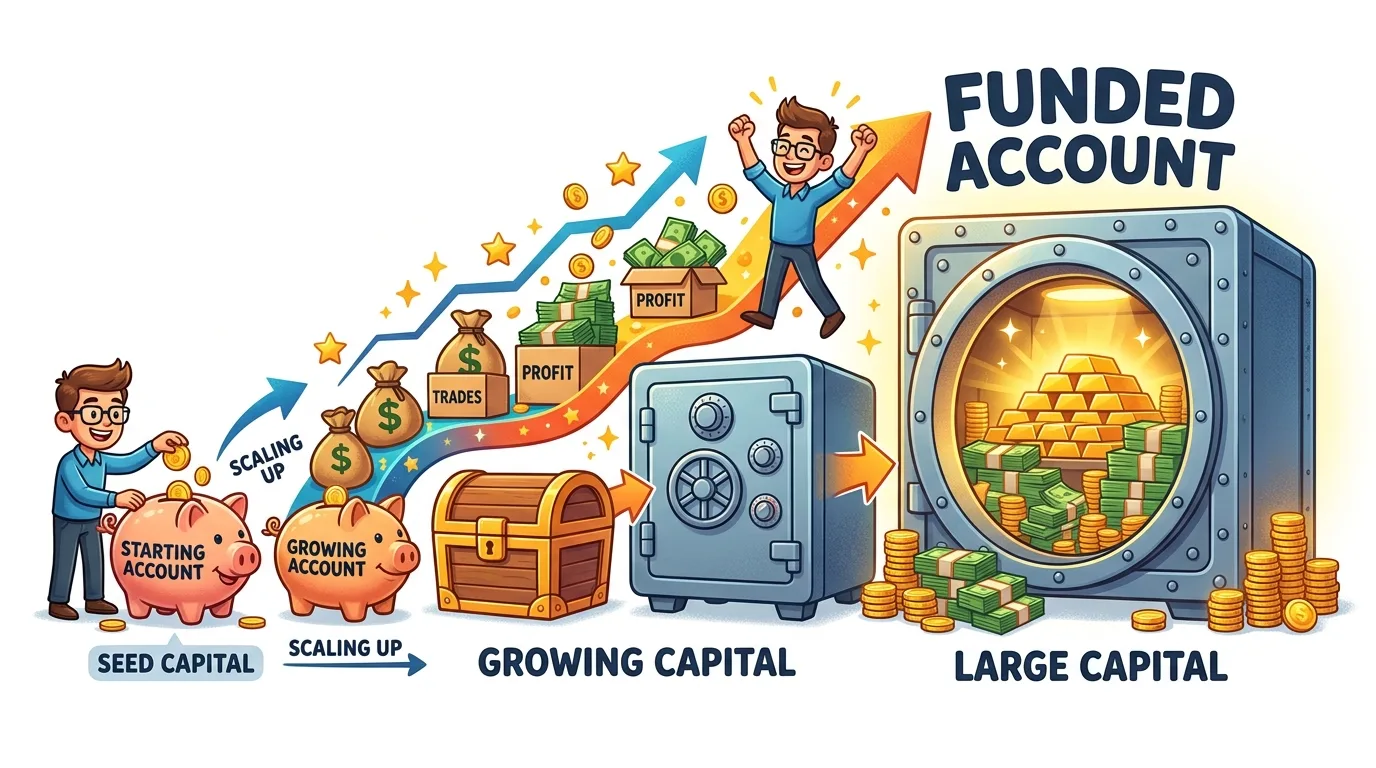
Thinking about trading futures with a prop firm's capital? Blusky Prop Firm (or BluSky Trading Company) keeps popping up with its 90% profit split and 'no hidden fees' pitch. Sounds great on paper, right? But as someone who's blown up a few prop accounts in my time, I know the devil is always in the details. Let's cut through the marketing and see if this US-based outfit is a legitimate path to funding or just another expensive lesson.
BluSky is a US-based proprietary trading firm that popped up around 2022/2023. They focus exclusively on futures trading. Their whole angle is transparency and a simple model: you pay a monthly fee to take their evaluation challenge, and if you pass, you trade their capital and keep up to 90% of the profits.
Here's the critical bit most new traders miss: prop firms like Blusky aren't regulated like your standard broker. They don't need SEC or CFTC approval because they're not handling your money for investment. You're paying for an evaluation service to prove you can trade. All the trading is done with their proprietary capital. This legal gray area is why their terms of service are your bible. Forget them at your peril.
They operate out of the US, which means everything is in USD and they cater to US payment methods like ACH. Their supported platforms are the usual suspects for futures traders: NinjaTrader (they give you a free license), Tradovate, TradingView, and a few other professional ones like Sierra Chart.

Warning: Don't confuse a prop firm with a broker. You're not getting FDIC insurance or SIPC protection here. You're entering a performance-based contract. Your only asset is your skill and your right to a profit split if you succeed.
This is where you make or lose your subscription fee. Blusky offers a few different evaluation plans (Premium, Launch, Static Growth), but the core mechanics are similar. Let's use their popular Premium Evaluation as an example.
Profit Targets & Drawdowns
You need to hit a specific profit target without violating a maximum loss rule (drawdown). For a $25,000 account, the target is $1,500. The trailing drawdown is $1,200. That means your starting loss limit is $25,000 - $1,200 = $23,800. But here's the kicker: it's trailing. Once you make a profit, your high-water mark rises, and the drawdown level trails it, locking in some of your gains as a buffer.
For a $100k account, the target is $6,000 with a $3,500 trailing drawdown. The targets are aggressive but standard for the industry. You can't just yolo one big win and coast.
The Consistency Rule & Minimum Days
Blusky has a "consistency rule." No single day can account for more than 30% of your total profit target. So, on that $25k account, you can't make more than $450 in one day and call it done. If you do, your target just increases by the excess. It's a softer penalty than an instant fail, which I actually appreciate. It forces you to trade like a professional, not a gambler.
You also need a minimum of 8 trading days. No passing in 48 hours. This rule exists to stop pure luck from getting through.
The Realistic Pass Rate
Blusky themselves reported a candidate pass rate of 16.9% over an 8-month period in 2023. Let that sink in. About 1 in 6. That's not a scam; that's just math. Most people fail. The challenge is designed to find traders who can manage risk consistently. Before you even think about using a position size calculator, you need a strategy strong enough to pass this gate.
I once took a similar challenge with another firm. I was up 8% in three days, got cocky, broke my own rules on a NQ scalp, and gave it all back plus the drawdown in one ugly session. The consistency rule would have saved me from myself.

💡 Wskazówka Winstona
A 90% split of zero is still zero. Focus on building a strategy that can consistently pass the evaluation's risk rules first. The split is a reward for execution, not a strategy in itself.
“The prop firm business model is built on the failure of the majority. You are not the customer; you are the product being tested.”
Alright, let's talk money. The 90/10 profit split is Blusky's headline act. It's excellent. Most firms start you at 70/30 or 80/20. Starting at 90% is a major perk if you can get funded.
But first, you have to pay to play. Evaluation fees are monthly subscriptions:
- $25K Premium Account: ~$151/month
- $50K Launch Plan: $49/month
- $200K Static Growth: $69/month
If you blow the account, a reset costs $65. However, they offer a free reset if you renew your monthly subscription after a fail. That's a decent policy.

Example: Let's say you buy the $151, 30-day challenge for the $25k account. You pass in 15 days. You get funded. In your first month live, you make a clean $2,000 profit. Your payout is $2,000 * 0.90 = $1,800. Minus your initial $151 fee, your net is $1,649. Not bad. But if you fail and need a $65 reset, your sunk cost before even getting funded is $216.
Now, the good news: No activation fee. Some firms hit you with a $200+ "activation" charge once you pass. Blusky doesn't. That's a genuine point in their favor.
The less-good news for live traders: Once funded, you're registered as a "pro trader" with the broker. That means you might be on the hook for exchange data fees - about $140 per month, per exchange. Blusky covers the first month, but after that, it's yours. Commissions are $2 per side for micros, which is fair.
Payouts are via the Deel platform. ACH transfers (for US traders) are free and fast if you request before 11 AM EST. PayPal, crypto, and wire transfers are also options, with varying fees and speeds. Minimum withdrawal is $250, no max.
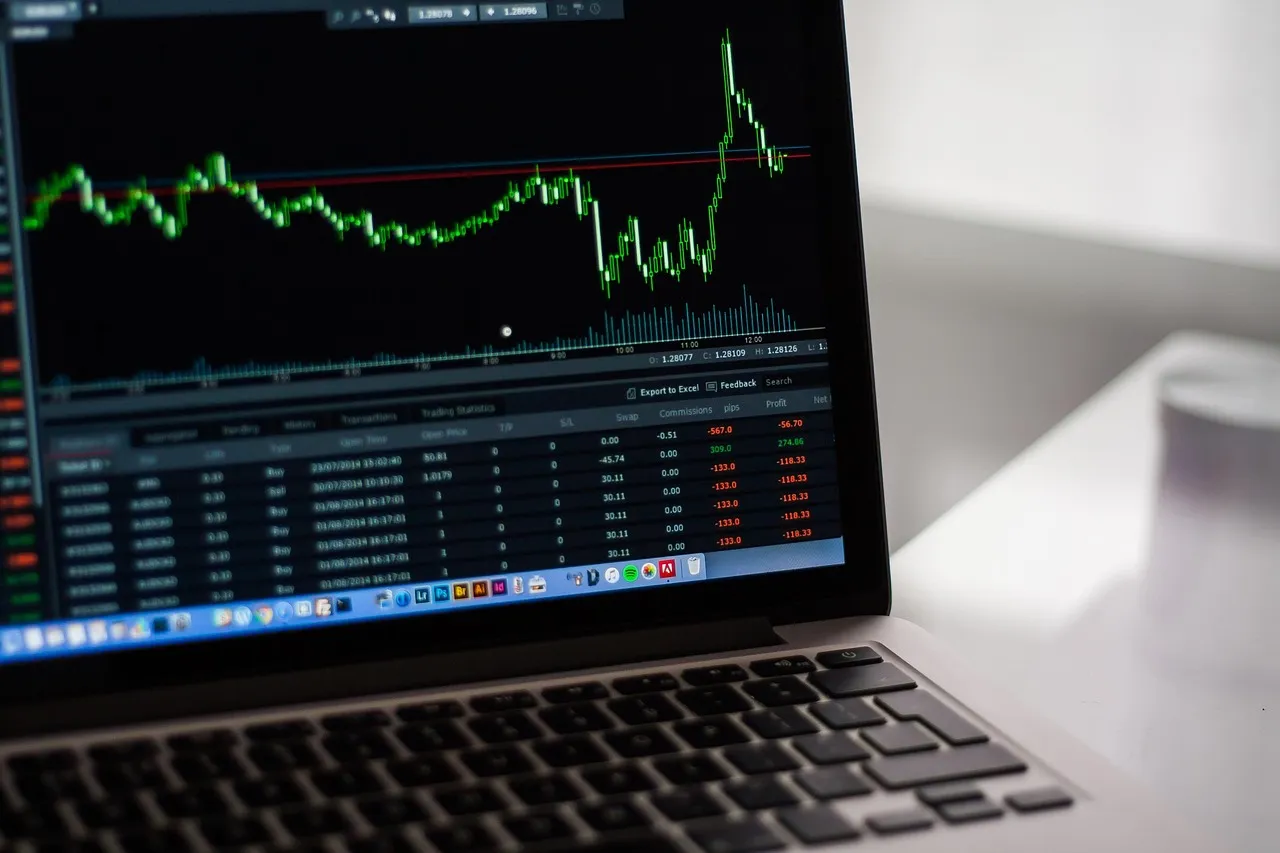
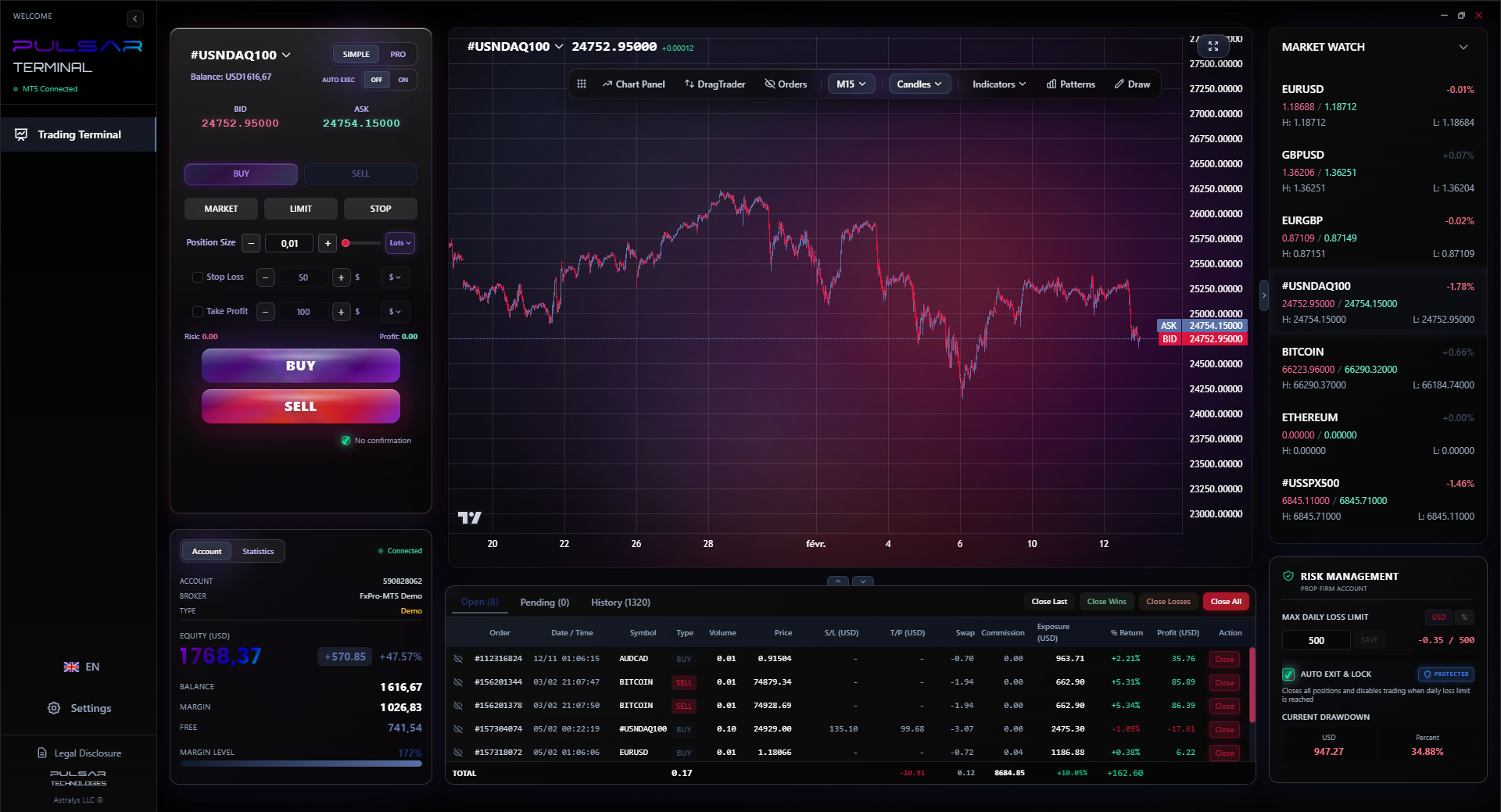
Managing a prop firm challenge requires iron-clad discipline on daily profit and loss limits, which is exactly the kind of rule-based automation Pulsar Terminal provides directly on your trading platform.
Based on their structure and my experience with similar firms, here's the unfiltered breakdown.
Pros:
- 90% Profit Split From Day One: Industry-leading. This is the big one.
- No Hidden Activation Fee: A huge plus that saves you hundreds.
- Reasonable Consistency Rule: The 30% daily rule adjusts your target instead of failing you. It's tough but fair.
- Good Platform Support: NinjaTrader, Tradovate, and TradingView integration covers most futures traders.
- Transparent US Business: Operating in USD with clear terms is better than some offshore mystery box.
Cons:
- You Pay Data Fees Live: That $140/month/exchange bill can eat into profits, especially for smaller accounts. Factor this into your scalping strategy P&L.
- Aggressive Profit Targets: Hitting $1,500 on a $25k account (6%) in 30 days while managing a tight drawdown is not easy. It encourages overtrading.
- The 16.9% Pass Rate: It's a hard challenge. Most will lose their subscription fee. That's the business model.
- Futures Only: If you're a forex or stock trader, look elsewhere.
My take? The pros are significant for a disciplined futures trader. The cons are mostly about the inherent difficulty of prop challenges and the real costs of professional trading. The lack of an activation fee shows they might be more aligned with trader success than some competitors.
💡 Wskazówka Winstona
That $140 monthly data fee is your new reality as a pro. If your average monthly profit can't comfortably cover that fee plus commissions, your account size is too small. Scale up or refine your edge.

“90% of zero is still zero. The split is a reward for execution, not a strategy.”
Let's put Blusky in the ring with the general US prop firm landscape. It's not apples-to-apples, as some firms trade different instruments, but the principle is the same.
| Feature | Blusky Prop Firm | Typical US Futures Prop Competitor | Typical Forex/Stock Prop Firm |
|---|---|---|---|
| Core Market | Futures Only | Futures Only | Forex, CFDs, Stocks |
| Profit Split | 90/10 from start | Often 80/20, scaling to 90% | Usually 70/30 to 80/20 |
| Key Fee | Monthly Data Fees (~$140) | Often Higher Activation Fee ($200+) | High Reset/Evaluation Fees |
| Challenge Rule | 30% Daily Consistency Rule | Often Stricter Max Daily Loss Rule | Often Time Limits & Strict Drawdowns |
| Payout Speed | Fast ACH (Same Day) | Varies, often weekly/monthly | Varies, often slower |
Blusky's edge is clear: the best-in-class profit split and no activation fee. Their weakness is the future data cost, which is a standard professional expense but a shock to retail traders.
Compared to a firm like Topstep (a major futures prop name), Blusky's rules can be slightly more forgiving on the daily consistency front, but the data fee issue is similar. Where Blusky competes hard is on the payout percentage right out of the gate.
For a forex trader used to platforms like Exness or IC Markets, moving to a futures prop model is a different world. The contracts are standardized, the use is exchange-defined, and the costs are more transparent (commissions + data). It's a more professional environment, for better or worse.
The bottom line? If you're a serious futures trader who can handle the evaluation, Blusky's structure is financially attractive. If you're a casual trader or can't stomach the idea of monthly data fees, this isn't for you.
After dissecting this, Blusky isn't for everyone. It's a specific tool for a specific trader.
Consider Blusky if you:
- Are already a disciplined futures trader with a proven, rule-based strategy.
- Understand and can afford the real costs of professional trading (data, commissions).
- Have a strategy that can generate steady, consistent gains (not home runs) to meet their profit target without hitting the daily consistency rule.
- Value a high profit split over everything else and are confident in your ability to pass a tough eval.
- Want to trade with a US-based firm for simpler tax reporting and USD payments.
Avoid Blusky like the plague if you:
- Are new to trading or futures. You will donate your subscription fee. Go practice on a sim first.
- Have a "get rich quick" or high-risk scalping strategy that relies on huge, infrequent wins.
- Can't commit to the minimum trading days. This requires active management.
- Are scared of technical platforms like NinjaTrader. Stick with MT5 if that's your home.
- Don't have a firm grasp on drawdown and margin call principles in futures.
I made the mistake early on of jumping into a prop challenge because I had a few good months on my personal account. I didn't respect the different psychology of trading someone else's rules. I broke the max daily loss rule on the third day. It was a cheap, valuable lesson. Don't be me.

Pro Tip: Before you give Blusky a dime, take your strategy and trade it in a NinjaTrader simulation account for at least two months. Impose their rules on yourself: a 4.8% trailing drawdown ($1,200 on $25k) and a 30% max daily profit rule. If you can't be profitable with those constraints in a sim, you won't be in the eval.
💡 Wskazówka Winstona
The 30% daily rule is a gift, not a burden. It forces you to quit while you're ahead on great days, locking in profits and preventing the classic trader's mistake of giving it all back. Use it as a mandatory stop-win.

“Treat the evaluation fee as tuition. If you pass, it's the best investment you'll ever make. If you fail, it was a lesson you needed.”
So, is Blusky Prop Firm legit? Yes. It's a real US business with a transparent, if challenging, model. Is it a good deal? For the right trader, absolutely. The 90/10 split with no activation fee is one of the best funding deals in the US prop space right now.
But here's the final, brutal truth: The prop firm business model is built on the failure of the majority. That 16.9% pass rate isn't an accident. The monthly subscription fees from the 83.1% who fail pay the bills and the payouts to the successful few. You are not the customer; you are the product being tested.
Your mission, should you choose to accept it, is to be in that 16.9%. That requires more than just trading skill. It requires the discipline of a monk, a rock-solid strategy, and the emotional fortitude to trade under pressure.
If you're going to try, treat the evaluation fee as the cost of education. If you pass, it's the best investment you'll ever make. If you fail, it was tuition for a lesson in risk management you desperately needed. Either way, never risk money on a prop challenge that you can't afford to lose 100% of.
Blusky offers a fantastic opportunity, but it's a narrow gate. Don't walk through it unprepared.
FAQ
Q1Is Blusky Prop Firm regulated by the SEC or CFTC?
No. Like most proprietary trading firms, Blusky operates as an evaluation service business, not a broker or investment manager. They use their own capital. They are not regulated by the SEC or CFTC, but they must comply with standard US business laws (AML/KYC). Always read their Terms of Service thoroughly.
Q2What's the catch with the 90% profit split?
The "catch" is the difficulty of passing the evaluation and the ongoing costs. You have to hit a challenging profit target under strict drawdown and consistency rules. Once funded, you're also responsible for professional data feed fees (around $140/month/exchange), which can significantly impact net profits on smaller accounts.
Q3How long do Blusky payouts take?
For US traders using ACH bank transfer, payouts are free and can be processed the same day if requested before 11:00 AM EST. Other methods like PayPal, crypto, or international wire take 1-5 business days and may have fees. The minimum withdrawal is $250.
Q4Can I trade forex or stocks with Blusky?
No. Blusky is a futures-only proprietary firm. You will be trading products like the E-mini S&P 500 (ES), Nasdaq (NQ), crude oil (CL), gold (GC), and Treasury notes on exchanges like the CME. If you want to trade forex, you'd need to look at other prop firms or brokers like Pepperstone.
Q5What happens if I exceed the 30% daily profit rule?
Your account is not instantly failed. Instead, your total profit target is increased by the amount you exceeded the 30% limit. For example, on a $25k account (target $1,500), if you make $600 in one day (40% of target), your new target becomes $1,500 + $150 = $1,650. It's a penalty designed to encourage consistency, not a game-ender.
Q6Is the Blusky challenge harder than other prop firms?
It's competitive. The 16.9% pass rate indicates it's difficult, which is standard. The rules (trailing drawdown, consistency rule, minimum days) are common. The profit targets are aggressive but not uniquely so. The main differentiator is the softer penalty on the daily rule compared to firms that use an instant-fail max daily loss.
Q7Do I need to know how to use NinjaTrader?
It's highly recommended. Blusky provides a free NinjaTrader license and connects via Rithmic. While they support other platforms like Tradovate and TradingView, NinjaTrader is a core platform for serious futures traders. If you're not familiar with it, plan on a significant learning curve before attempting the evaluation.
Lekcja Prof. Winstona
:
- ✓Prop firm passes require consistency, not just one big win.
- ✓Always factor in all fees: data, commissions, and resets.
- ✓A 90% profit split is meaningless if you can't get funded.
- ✓Simulate the challenge rules first. Never pay to learn.
Jak przydatny był ten artykuł?
Kliknij gwiazdkę, aby ocenić
Tygodniowe analizy tradingowe
Darmowe tygodniowe analizy i strategie. Bez spamu.
O autorze
James Mitchell
Starszy Analityk Tradingowy
Z siedzibą w Nowym Jorku, ponad 9 lat doświadczenia w tradingu. Koncentruje się na głównych parach USD, wyzwaniach prop firm i amerykańskim otoczeniu regulacyjnym.
Komentarze
Może Ci się też spodobać

Cara Trading Forex Sukses: 7 Prinsip dari Trader Profesional
Cara trading forex sukses dengan 7 prinsip trader pro: manajemen modal, disiplin, journal trading, backtest. Data nyata, bukan janji profit palsu.
Jam Trading Forex Terbaik untuk Trader Indonesia: Panduan Lengkap dengan Tabel Waktu
Panduan jam trading forex untuk trader Indonesia. Tabel 4 sesi dunia, jam emas 20:00-00:00, sesi mana yang harus dihindari. Data akurat + tips dari trader berpengalaman.
Top 5 Sàn Forex Uy Tín Nhất 2026: Review Jujur dari Trader Indonesia
Top 5 sàn forex uy tín 2026 untuk trader Indonesia. Review jujur: spread, deposit, withdraw, dukungan lokal. Exness, XM, IC Markets & lebih.
All these calculators are built into Pulsar Terminal with real-time data from your MT5 account. One-click position sizing, automatic risk management, and instant calculations.
