


Ever feel like you're trading in the dark, guessing what the big players are doing? You're watching the USD/ZAR chart, trying to figure out if the rand's strength is real or just a head-fake.

David van der Merwe
Trader Rynków Wschodzących ·  South Africa
☕ 10 min czytania
Czego się nauczysz:
Ever feel like you're trading in the dark, guessing what the big players are doing? You're watching the USD/ZAR chart, trying to figure out if the rand's strength is real or just a head-fake. What if you had a weekly report that showed you exactly what the smart money - the commercial hedgers, the big speculators - is actually doing? That's the Commitment of Traders Report for forex. It's not a crystal ball, but for a trader in Johannesburg or Cape Town, it's the closest thing to getting a peek at the other side's playbook. I've used it for years, and honestly, it's saved me from some truly terrible trades.
Right, let's break this down without the finance jargon. The Commitment of Traders (COT) report is a weekly snapshot published every Friday by the U.S. Commodity Futures Trading Commission (CFTC). It tells you who's holding what in the futures markets, including major currency pairs. Think of the JSE's equity disclosures, but for global forex futures.
The report splits traders into three main groups, and this is the key to using it:
| Group | Who They Are | What They Usually Do |
|---|---|---|
| Commercial Traders | Big institutions (banks, multinationals). Think Absa or a mining giant hedging USD exposure. | They're considered the 'smart money'. They hedge real business risk, not speculate for fun. |
| Non-Commercial Traders | Large speculators (hedge funds, big money managers). | They're the trend followers and momentum players, often holding large directional bets. |
| Non-Reportable Positions | Small speculators (that's us, the retail crowd). | Historically, this group is wrong at major market extremes. Ouch. |
The raw data shows long and short positions for each group. But staring at the numbers is pointless. The magic is in the changes and the extremes. You're looking for moments when one group is positioned more extremely than they've been in months or years. When the 'dumb money' (non-reportables) is overwhelmingly long, it's often a good contrarian signal that a move is exhausted. I learned this the hard way back in 2018, piling into a long EUR/USD trade alongside a record retail long position. The reversal wiped out two weeks of profits in a day. A quick check of a position size calculator after that fiasco showed me how over-leveraged I was.

Warning: The COT data is for futures, not the spot forex market you're trading. But the big players use futures, so their positioning heavily influences spot prices. It's a leading indicator, not a lagging one.
“The Commitment of Traders report is the closest thing to getting a peek at the other side's playbook.”
Good question. We're trading from SA, often focusing on USD/ZAR or using the dollar as a base for pairs like EUR/USD. The COT report gives you context you just can't get from your normal charts.
First, it helps with the USD/ZAR puzzle. The rand is a wild animal, driven by local politics, commodity prices, and global dollar strength. The COT report cuts through the noise on that last part. If the report shows commercial traders are building their biggest short USD positions in years against a basket of currencies, it tells you the underlying structural demand for dollars might be weakening. That doesn't mean the ZAR will automatically rally (we have our own issues), but it tells you a major headwind for riskier currencies like ours could be fading.
Second, it protects you from chasing ghosts. Technical analysis on your EUR/USD guide chart might show a beautiful breakout. But if the COT data reveals speculators are already record-long euros, that breakout is sitting on a shaky foundation. It's crowded. I use it as a filter: no new long positions if the 'non-commercial' crowd is at a 90th percentile extreme. This simple rule stopped me from buying into a false GBP/USD breakout last quarter.
Finally, it teaches patience. The COT report moves slowly. Extreme positions can get more extreme before they reverse. It's not a timing tool. But when you see a setup forming on your charts and the COT aligns (e.g., commercials start buying while speculators are panicking), your conviction goes way up. You're not just trading a candlestick pattern, you're trading a fundamental shift in who owns the market.

💡 Wskazówka Winstona
The market's greatest fools are revealed not by a single week's COT data, but by a trend of conviction that grows as the price move matures. Peak positioning often coincides with peak narrative.
“When the 'dumb money' is overwhelmingly long, it's often a good contrarian signal that a move is exhausted.”
Don't go to the CFTC website and get lost in a spreadsheet. You'll go cross-eyed. Use free sites that visualize the data, like TradingView's COT indicators or dedicated financial blogs that plot the net positions.
Look for Net Positioning
You're not interested in absolute numbers. You want the net position (longs minus shorts) for each group. A commercial net long position of 50,000 contracts means they are, on balance, betting on the currency's rise.
Focus on Rate of Change and Extremes
A single week's number is noise. You want to see the trend over 8-12 weeks. Is the commercial net position steadily increasing while the price is falling? That's classic smart money accumulation. Also, look for extremes. When the non-commercial (speculator) net position hits a level that's only been seen 5% of the time in the last 5 years, pay attention. The market is stretched.
The COT Index & Sentiment
Many analysts create a "COT Index" that scales the current net position between 0 and 100. A reading above 90 is considered extreme bullish for that group, below 10 extreme bearish. This is a quick, clean way to gauge sentiment.

Example: Let's say the COT Index for Non-Commercial traders in Euro futures hits 93. This means their net long position is larger than it has been 93% of the time in the look-back period. It's a warning sign of excessive bullishness, not a signal to short immediately, but a reason to be cautious on new longs.
Combine this with your own chart analysis. If you're a swing trading fan, a bearish divergence on the RSI indicator paired with a COT extreme is a powerful combo. It's about layering your evidence.
“When the 'dumb money' is overwhelmingly long, it's often a good contrarian signal that a move is exhausted.”
Okay, enough theory. How do you actually trade this thing? Here are two approaches I've used with real money.
1. The Contrarian Fade (My Go-To): This works best at clear extremes. Wait for the Non-Commercial (speculator) COT Index to push above 90 or below 10. Then, look for a technical trigger on the chart in the opposite direction. For instance, if specs are record-long USD/JPY and the price breaks below a key weekly support level, that's your signal. I did this with gold (XAU/USD) in early 2023. Specs were near-record long, the XAU/USD guide chart showed a parabolic rise, and then a key daily level broke. Shorting there was one of my best trades of the year.
2. The Smart Money Follow: This is trickier but can catch big trends early. Look for a sustained, multi-week shift in Commercial positioning against the prevailing price trend. If EUR/USD is falling but commercials are consistently adding to their net long position, they're buying the dip. Don't jump in immediately. Wait for price to confirm with a reversal pattern and a break of a minor downtrend line. This requires more patience.
A crucial note on brokers and execution: When you act on a COT-based idea, you need clean execution. A wide spread definition can kill a contrarian fade entry. I've found brokers like IC Markets review and Pepperstone review offer consistently tight spreads on majors, which is vital. Also, because COT signals aren't precise, use a wider stop-loss. This isn't a scalping strategy.

Pro Tip: Don't trade the COT report in isolation. I always wait for my chart to agree. The report tells you why you might look for a setup, but the chart tells you when to pull the trigger.
💡 Wskazówka Winstona
If you cannot explain in one sentence what the current COT extreme is telling you, you do not understand the setup. Complexity is the enemy of execution.
“The COT report tells you *why* you might look for a setup, but the chart tells you *when* to pull the trigger.”
I've made most of these, so learn from my wasted margin.
Mistake 1: Treating it as a timing signal. This is the biggest one. The COT report is released Friday, but it's data from Tuesday. The market has moved since then. An extreme can stay extreme for weeks. Jumping in the second you see the number is a sure way to get stopped out. Use it for context, not entry.
Mistake 2: Ignoring your own charts. I once shorted AUD/USD solely because spec positioning was extreme, ignoring a massive bullish weekly candle closing. The market didn't care about my clever COT analysis and rallied another 200 pips. The chart is the truth of price action. The COT is a background story.
Mistake 3: Focusing on the wrong group. For trend reversals, the Non-Commercial (speculator) extremes are most useful. For confirming a trend's underlying strength, watch the Commercials. Mixing them up leads to confusion.
Mistake 4: Not adjusting for volatility. A "record" position in a quiet market is different from one in a volatile one. Some advanced COT metrics adjust for open interest, which helps. If you're just starting, keep it simple: look for levels not seen in several years.
Finally, remember this is just one piece of the puzzle. A margin call doesn't care how smart your COT analysis was if your position size is reckless. Always, always link your thesis back to your risk management.
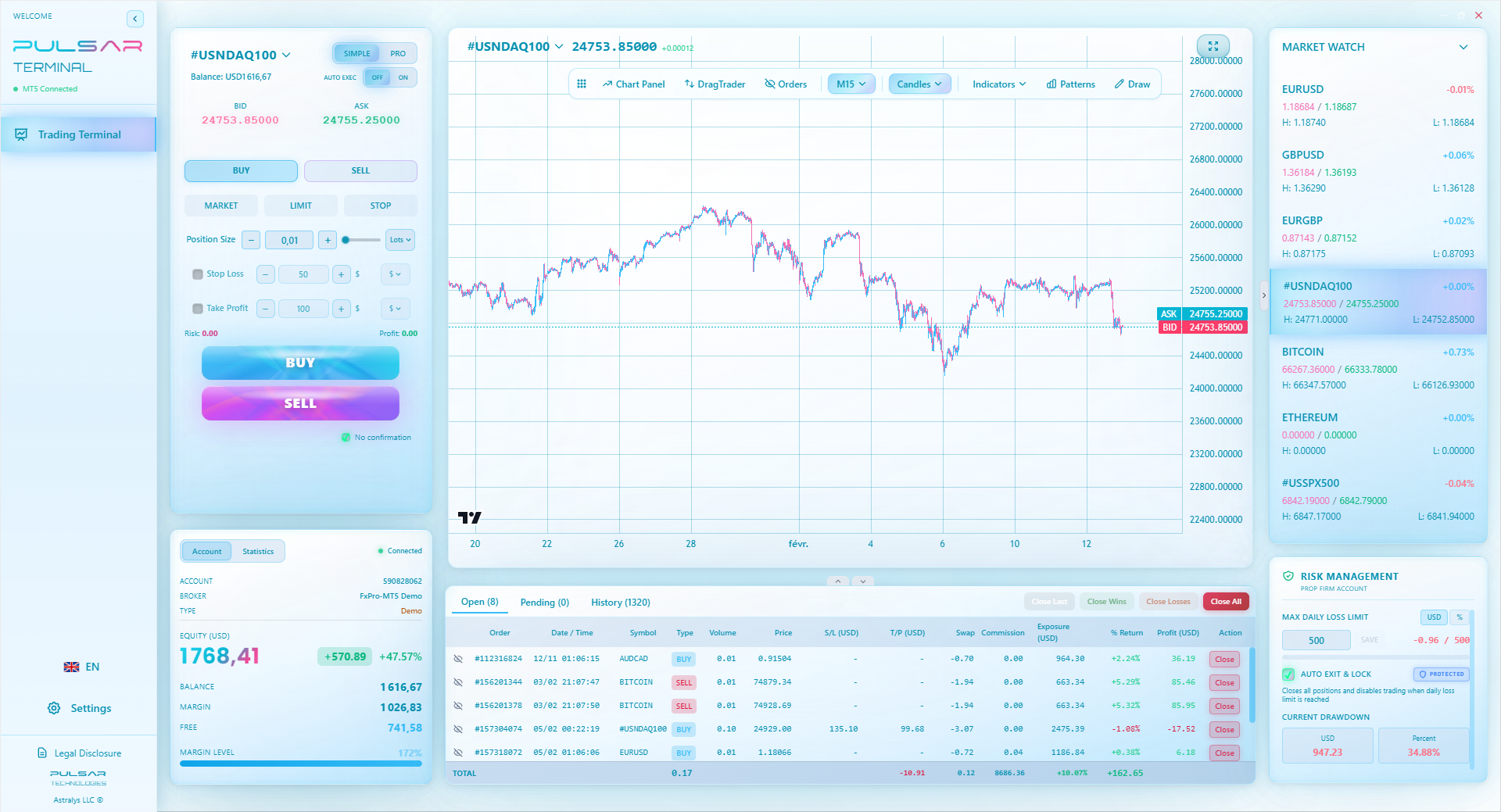
Managing the wider stops required for COT-based swing trades is easier with tools that let you drag and modify orders directly on your chart, like Pulsar Terminal does on MT5.
“The COT report tells you *why* you might look for a setup, but the chart tells you *when* to pull the trigger.”
Now, the million-rand question: can you get a COT report for USD/ZAR? Not directly. The CFTC report covers major currency futures: Euro, Yen, Pound, etc. There's no official futures market for the rand big enough to be reported.
So, how do we use it? You trade the ZAR indirectly.
1. Use the Dollar Index (DXY) COT. The ZAR is heavily influenced by global dollar sentiment. If the COT report shows an extreme positioning in the dollar against the majors (Euro, Yen), it gives you a strong clue about broader USD momentum. A massively long-speculative dollar position suggests global USD strength, which is usually a headwind for EM currencies like the ZAR.
2. Watch the 'Risk-On/Off' Pairs. The AUD and CAD are commodity currencies, somewhat like the ZAR. Their COT data can give you insight into how the 'smart money' is positioning in commodity-linked FX. If commercials are piling into long AUD positions, it might reflect a bullish view on global growth/commodities, which could indirectly support the ZAR.
3. Combine with Local Data. The COT tells you the global picture. You then layer on local factors: SARB decisions, Eskom news, political stability. If the global COT picture is dollar-negative (supportive for ZAR) but local politics are in chaos, the local noise might win in the short term. The COT helps you understand which way the tidal current is flowing, even if local winds are creating choppy waves.
It's about building a more complete picture. You're not using the Commitment of Traders report for forex to predict the ZAR's next move, but to understand the powerful global undercurrents it's swimming against.
💡 Wskazówka Winstona
A wise trader once told me, 'The commercials are paid to be right. The specs are hoping to be right.' Your job is to figure out who is writing the cheques at that moment.
“Used well, the COT can be the thing that turns you from a reactive trader into a proactive one.”
Feeling overwhelmed? Don't be. Start simple.
- Find a Source: Bookmark the 'COT Charts' section on a site like TradingView or a reliable financial blog. Don't start with raw data.
- Pick One Pair: Start with EUR/USD. It's the most liquid, and the COT data is most relevant. Ignore everything else for now.
- Observe for a Month: Don't trade it. Just check the net position chart every Friday. Note where price is when positions are extreme. Build a feel for it.
- Add One Indicator: Look up the "COT Index" for Non-Commercial traders on EUR. Just watch it. See what happens when it goes above 80 or below 20.
- Paper Trade: After a month of observation, try a simple contrarian fade on a demo account. Wait for an extreme, wait for a chart confirmation, then enter. Track your results.
The goal is to integrate it slowly into your process. It's a powerful lens, but it's not your only pair of glasses. Used well alongside your technical and fundamental analysis, the Commitment of Traders report for forex can be the thing that turns you from a reactive trader into a proactive one. It helps you see the traps before you fall into them. And in this game, staying out of trouble is half the battle.
FAQ
Q1When is the COT report released, and where can I find it?
The CFTC publishes the report every Friday at 3:30 PM US Eastern Time (that's late Friday night or very early Saturday morning SA time). Don't go to the CFTC website directly. Use free charting platforms like TradingView, which have built-in COT indicators, or financial data websites that visualize the trends for you.
Q2Can I use the COT report for scalping or day trading?
Absolutely not. The COT report is a slow-moving, macro-level sentiment indicator. It's useless for timeframes under a day. It's best suited for swing traders and position traders looking to hold for days to weeks. If you're a scalping enthusiast, this isn't the tool for you.
Q3Why are commercial traders considered the 'smart money'?
Commercials are in the market out of necessity, not speculation. A European manufacturer needs to hedge USD payments, or an oil company needs to lock in exchange rates. They have access to superior fundamental research and are often positioned early against the herd. While not infallible, their collective actions tend to be more predictive at major turning points than the speculative crowd.
Q4Is there a lag in the COT data?
Yes, and it's critical to remember. The report released on Friday contains data as of the preceding Tuesday. So there's a 3-day lag. The market can move significantly in that time. This is another reason why you never trade the report on its own - you need current price action to confirm any thesis.
Q5How does the COT report differ from normal volume data on my MT5 platform?
Your MT5 shows trading volume for your specific broker's clients on the spot market. The COT report shows the open interest (total outstanding contracts) and the identity of the holders (commercial vs. speculator) in the centralized futures market. It's a much broader and more institutional picture of who is committed to a position.
Q6As a South African, should I be looking at a different report for the Rand?
There's no equivalent official report for USD/ZAR. The JSE doesn't publish this kind of data for forex. Your best bet is to use the COT for the US Dollar Index (DXY) and major pairs to gauge global USD sentiment, which is a primary driver of the ZAR's value, and then combine that with local news and analysis.
Lekcja Prof. Winstona
:
- ✓Trade with the Commercials, fade the Non-Commercials at extremes.
- ✓A COT Index above 90 or below 10 is a warning light, not a signal.
- ✓Always wait for price action confirmation - the 3-day lag is deadly.
- ✓Use it for swing trades, never for scalping or day trades.
Jak przydatny był ten artykuł?
Kliknij gwiazdkę, aby ocenić
Tygodniowe analizy tradingowe
Darmowe tygodniowe analizy i strategie. Bez spamu.
O autorze
David van der Merwe
Trader Rynków Wschodzących
Trader z Johannesburga z 11-letnim doświadczeniem w walutach rynków wschodzących. Specjalizuje się w parach ZAR, handlu regulowanym przez FSCA i analizie rynku południowoafrykańskiego.
Komentarze
Może Ci się też spodobać

Cara Trading Forex Sukses: 7 Prinsip dari Trader Profesional
Cara trading forex sukses dengan 7 prinsip trader pro: manajemen modal, disiplin, journal trading, backtest. Data nyata, bukan janji profit palsu.
Jam Trading Forex Terbaik untuk Trader Indonesia: Panduan Lengkap dengan Tabel Waktu
Panduan jam trading forex untuk trader Indonesia. Tabel 4 sesi dunia, jam emas 20:00-00:00, sesi mana yang harus dihindari. Data akurat + tips dari trader berpengalaman.
Top 5 Sàn Forex Uy Tín Nhất 2026: Review Jujur dari Trader Indonesia
Top 5 sàn forex uy tín 2026 untuk trader Indonesia. Review jujur: spread, deposit, withdraw, dukungan lokal. Exness, XM, IC Markets & lebih.
All these calculators are built into Pulsar Terminal with real-time data from your MT5 account. One-click position sizing, automatic risk management, and instant calculations.
