


Here's the uncomfortable truth: 90% of South African traders who create a forex demo account treat it like a video game and learn absolutely nothing.

David van der Merwe
Trader Rynków Wschodzących ·  South Africa
☕ 10 min czytania
Czego się nauczysz:
- 1Why a Demo Account is Your Most Important Trade (Especially in SA)
- 2Step-by-Step: How to Create Your SA Forex Demo Account
- 3Configuring Your Demo: Don't Skip This Setup
- 4The 5 Deadly Demo Account Mistakes (I Made #3)
- 5The Scary Jump: Moving from Demo to Live with Real ZAR
- 6South African Demo Account FAQ
- 7Your Demo Account is a Mirror
Here's the uncomfortable truth: 90% of South African traders who create a forex demo account treat it like a video game and learn absolutely nothing. They rack up fake millions with reckless trades, develop terrible habits, and then blow their real Rands in weeks. I know because I was one of them. This guide isn't just about clicking 'open account.' It's about using that demo period to build a real, profitable trading foundation that works with our volatile ZAR pairs and local brokers. I'll show you exactly what to do, what to avoid, and how to make those virtual ZAR 100,000 teach you something valuable.
Let's get this straight right away. A demo account isn't 'practice.' It's your trading laboratory. In South Africa, with the FSCA capping use at 30:1 and our beloved ZAR swinging like crazy, you need to understand price action without the heart attack. That USD/ZAR move during a SARB announcement? You want to have felt that in a demo first.
I remember my first 'demo' phase back in 2012. I turned ZAR 50,000 into ZAR 450,000 in two weeks trading GBP/JPY with insane use. I felt like a genius. Then I deposited R5,000 of real money. Gone in three days. The psychology was completely different when it was my grocery money. The demo had taught me nothing except how to be overconfident.
The real value? Testing your emotional responses. Can you hold a winning USD/ZAR trade through a retracement? Can you cut a losing EUR/ZAR position immediately? A demo lets you answer these questions without financial ruin. It also lets you test brokers. That low spread advertised by your chosen Exness review or IC Markets review? See if it holds during London open on your demo. Check execution speeds. This is due diligence, not playtime.

Warning: A demo account with unlimited virtual money and no consequences can build a gambling mentality. You must impose your own strict rules from day one.

💡 Wskazówka Winstona
When you create your demo, immediately place a trade with a stop-loss and take-profit. Then, do not touch it. Let it hit either target. This first act of discipline sets the tone.
“A demo account isn't 'practice.' It's your trading laboratory.”
The process is simple, but the choices you make here matter. Don't just pick the first broker Google shows you.
1. Choosing a Regulated Broker
This is non-negotiable. You must use an FSCA-regulated broker for your demo if you plan to trade live in South Africa. Why? Because the trading conditions - spreads, use (capped at 30:1), execution - will mirror what you'll actually get. Practicing on an unregulated broker's demo with 500:1 use and zero spreads is a fantasy that will set you up for failure. Check the FSCA's website for the broker's license number. Reputable options include the brokers mentioned in our XM review and Pepperstone review, provided they hold local regulation.
2. The Registration Process
Go to the broker's South African website. Look for 'Open Demo Account' or 'Try Free Demo.' You'll need to provide:
- Your full name
- Email address
- Phone number (South African)
- Sometimes a password
You usually won't need to verify your ID for a demo, but you might need to select your country as South Africa. This is crucial to get ZAR as your account currency and the correct use settings.
3. Platform Download & Setup
Most brokers offer MetaTrader 4 or 5 (MT4/MT5). Download it directly from your broker's website after you create the demo account. They'll provide demo server login details (login, password, server name). Log in, and you'll see your virtual balance - often ZAR 100,000 or USD 10,000.

Pro Tip: Immediately change your demo balance to match what you plan to really start with. If you have R10,000 to trade, set your demo balance to R10,000. This makes your position size calculator results realistic from the start.
“I blew my first demo account in a week. My reaction? 'This broker's demo is crap.' I was the problem.”
This is where most people fail. They log in and start slinging orders. Stop. Configure it like it's real.
1. Set Realistic Capital: As mentioned, if you're a beginner with R5,000, start with R5,000 virtual. Trading a ZAR 100,000 demo teaches you nothing about proper risk management for a small account.
2. Replicate Live Conditions:
- use: Set it to 30:1 or lower. Don't use 1:500 because you can't live with it.
- Spread: Be aware that some demo servers have artificially tight spreads. Compare the EUR/USD spread on your demo to the live spread listed on the broker's website. If it's way off, your demo results will be misleading.
- Slippage: Demos often have perfect order execution. In live markets, especially on volatile pairs like USD/ZAR, you can get slippage. Mentally account for this.
3. Trade Your Plan, Not Your Mood: Before you place a single demo trade, write down a simple rule. Example: "I will only risk 1% of my demo balance per trade. I will use a stop-loss on every order." Then follow it. Religiously. Use the demo to practice using tools like the RSI indicator or MACD indicator within a strategy, not just randomly.
4. Focus on ZAR Pairs: You're in South Africa. Pay attention to USD/ZAR, EUR/ZAR, GBP/ZAR. Learn their typical daily ranges (use the ATR indicator). Notice when they're most active (European overlap with SA afternoon). Your XAU/USD guide is useful, but gold in ZAR (XAU/ZAR) behaves differently. Practice with the instruments you'll actually trade.
“I blew my first demo account in a week. My reaction? 'This broker's demo is crap.' I was the problem.”
Let me save you some pain by listing exactly what not to do.
1. The 'Monopoly Money' Mentality: This is the big one. That ZAR 50,000 on screen isn't real, so you take wild risks. You'd never risk R5,000 on a single trade in real life, but in a demo? Why not! This builds no useful skill.
2. No Record Keeping: If you're not journaling your demo trades, you're just playing. Write down every trade: entry, exit, why you took it, your emotional state. Review it weekly. The pattern of mistakes will become glaringly obvious.
3. Switching Demos After a Blow-Up: I blew my first demo account in a week. My reaction? "This broker's demo is crap." I opened another with a different firm, got another ZAR 100,000, and blew that too. I repeated this four times before realizing I was the problem. The demo did its job - it showed me I was a terrible trader. I just refused to listen.
4. Ignoring the Calendar: South African traders need to watch the SARB interest rate decisions, budget speeches, and local CPI data. If you demo trade USD/ZAR without knowing when these events are, you're missing a key lesson. News volatility is a major factor.
5. The Infinite Demo Trap: Some brokers offer unlimited demo access. This can become a crutch. You need a deadline. Give yourself 2-3 months of serious, disciplined demo trading. Then, transition to a very small live account. Perpetual demo trading is just avoidance.

Example: In my final, serious demo phase, I tracked 47 trades over two months. My win rate was 38%, but my average winner was R420 and my average loser was R150. The demo showed me my strategy had a positive expectancy, even with a low win rate. That was a priceless lesson no book could teach.
💡 Wskazówka Winstona
Your demo trade journal is more important than your demo balance. If you're not writing down the 'why' behind every trade, you're just pushing buttons.
“The goal of your first live account is NOT to make money. The goal is to survive.”
This is the moment of truth. You've had a profitable, disciplined demo run for a few months. Now what?
Start Absurdly Small. Your first live deposit should be money you can afford to lose completely without affecting your life. For many South Africans, that's R1,000 or R2,000. The goal of your first live account is NOT to make money. The goal is to survive and learn to handle the psychology. The spread definition and pip definition are the same, but the sweat on your brow is different.
Keep Your Demo Open. Don't close it. Use it to test new ideas or strategies. Saw a new scalping strategy online? Test it on the demo for a week before risking a cent of real money.
Expect a Performance Dip. It's normal. Your execution might hesitate. You might move stops too early. This is why starting small is critical. The pressure is real now. I funded my first serious live account with R2,500. My hands shook placing my first order. I made R150 that day, and it felt better than any demo 'million.'
Manage the Logistics. Funding your account. Most SA brokers accept EFT (Electronic Funds Transfer) directly from your bank. Withdrawals are usually back to your SA bank account. Do a test withdrawal with a small amount first to ensure the process works smoothly. Understand the tax implications: SARS wants a share of your net profits.
This is also where tools that manage risk become vital. Manually moving stops to breakeven or setting a trailing stop can be stressful and slow.
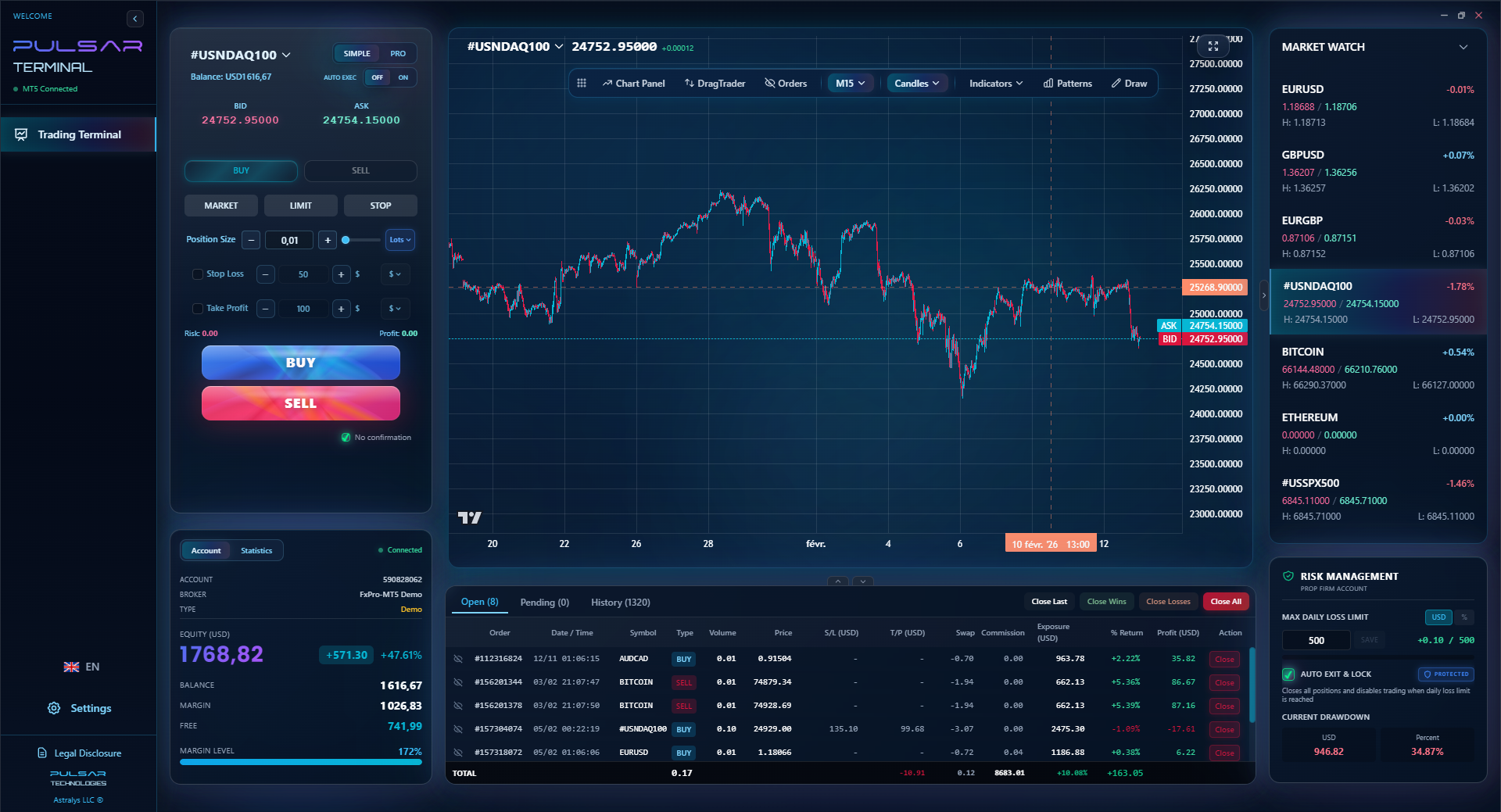
Managing multiple take-profit levels and moving stops to breakeven manually is stressful; Pulsar Terminal automates these advanced order types directly on your MT5 platform.
“The goal of your first live account is NOT to make money. The goal is to survive.”
Are forex demo accounts really free?
Yes, 100%. Any reputable FSCA-regulated broker will offer a demo account completely free of charge. If someone asks you to pay for a demo, run.
How long does a demo account last?
It varies. Some brokers (like HFM, IG) offer unlimited demos. Others (like IC Markets, Pepperstone) might have a 30-day limit, but you can usually just create a new one when it expires.
Can I test ZAR pairs on a demo?
Absolutely. When you create your account and select South Africa as your country, you should be able to trade USD/ZAR, EUR/ZAR, etc., on the demo. If you can't, you configured it wrong or the broker doesn't properly support SA clients.
Is demo trading the same as live trading?
Almost, but not quite. The prices and charts are real. The key differences are: 1) No emotional pressure, 2) Demos often have perfect, instant execution (no slippage), and 3) Sometimes spreads are slightly tighter on the demo server. Mentally adjust for these.
Do I need to verify my FICA for a demo account?
Generally, no. Verification (ID, proof of address) is only required when you want to deposit real money and open a live account.
Can I use a demo to pass a prop firm challenge?
You can use it to practice the strategy and discipline needed, yes. But remember, prop firm challenges are on live accounts with real, albeit the firm's, capital. The pressure is different. The strict drawdown rules of a prop challenge make tools for automatic risk management essential to avoid a margin call.
“Creating a forex demo account is the easiest technical part of this journey. The hard part is looking in the mirror it provides.”
Creating a forex demo account is the easiest technical part of this journey. The hard part is looking in the mirror it provides and accepting what you see.
It will show you that you're impatient. It will show you that you overtrade. It will show you that you let losses run and cut profits short. My demo showed me all of this, and I ignored it for years. I paid for that ignorance with real rands.
This time, do it differently. Create your demo with intention. Use it as a surgical tool to dissect your own psychology and refine a simple, repeatable process. Start with a ZAR balance that reflects your reality. Trade the pairs you will actually trade. Keep a brutal journal.
When you finally make that first small live deposit, you won't be a 'new' trader. You'll be a trader who has already made - and learned from - hundreds of trades in a controlled environment. The platform will be familiar. Your strategy will be documented. Your worst habits will be identified. That's the true power of a demo account done right. It's not a game. It's your first, and most important, trading capital.
Now, go create that account. But this time, take it seriously.
FAQ
Q1What's the best forex demo account in South Africa?
There's no single 'best.' The best demo account is from an FSCA-regulated broker that you might actually fund a live account with later. Look for one that offers ZAR as the demo currency, has realistic spreads on USD/ZAR, and provides the trading platform (like MT5) you want to use. Brokers like Exness, XM, and Pepperstone (all FSCA-regulated) are solid starting points for a demo.
Q2Can I lose money on a forex demo account?
No, you cannot lose real money. You can lose the virtual, pretend money allocated to the demo. That's the whole point: to experience drawdowns and losing streaks without financial harm. However, if you treat it carelessly, you can 'lose' the useful learning opportunity it provides.
Q3How much virtual money do I get in a demo account?
It varies by broker. Common amounts are ZAR 100,000, USD 10,000, or USD 50,000 in virtual funds. Remember, you can often adjust this amount down to a more realistic figure. If you plan to start live with R5,000, set your demo to R5,000 to practice proper position sizing.
Q4Is forex demo trading good for beginners?
It's essential for beginners. It's the only way to learn how a trading platform works, what a pip movement looks like, and how to place orders without risking a cent. The key is to transition from 'beginner' to 'disciplined practitioner' on the demo before going live.
Q5Can I use a demo account on my phone?
Yes, almost all brokers offer mobile versions of their platforms (like MT4/5 mobile). You can download the app and log in with your demo account details. It's great for checking trades, but I recommend doing your main analysis and planning on a desktop computer.
Q6Do professional traders use demo accounts?
Yes, but not for 'practice' in the beginner sense. Pros use demo accounts to backtest new trading algorithms, test a broker's execution quality before depositing large amounts, or experiment with a new strategy in real-time market conditions without risk.
Lekcja Prof. Winstona
:
- ✓Set your demo balance to match your real starting capital (e.g., R5,000, not ZAR 100,000).
- ✓Impose a strict 1-2% risk rule on every demo trade from day one.
- ✓Journal every demo trade: entry, exit, reason, and emotion.
- ✓Give your demo practice a 3-month deadline to avoid the perpetual trap.
- ✓Trade ZAR pairs (USD/ZAR) to learn local market volatility.
Jak przydatny był ten artykuł?
Kliknij gwiazdkę, aby ocenić
Tygodniowe analizy tradingowe
Darmowe tygodniowe analizy i strategie. Bez spamu.
O autorze
David van der Merwe
Trader Rynków Wschodzących
Trader z Johannesburga z 11-letnim doświadczeniem w walutach rynków wschodzących. Specjalizuje się w parach ZAR, handlu regulowanym przez FSCA i analizie rynku południowoafrykańskiego.
Komentarze
Może Ci się też spodobać

Cara Trading Forex Sukses: 7 Prinsip dari Trader Profesional
Cara trading forex sukses dengan 7 prinsip trader pro: manajemen modal, disiplin, journal trading, backtest. Data nyata, bukan janji profit palsu.
Jam Trading Forex Terbaik untuk Trader Indonesia: Panduan Lengkap dengan Tabel Waktu
Panduan jam trading forex untuk trader Indonesia. Tabel 4 sesi dunia, jam emas 20:00-00:00, sesi mana yang harus dihindari. Data akurat + tips dari trader berpengalaman.
Top 5 Sàn Forex Uy Tín Nhất 2026: Review Jujur dari Trader Indonesia
Top 5 sàn forex uy tín 2026 untuk trader Indonesia. Review jujur: spread, deposit, withdraw, dukungan lokal. Exness, XM, IC Markets & lebih.
All these calculators are built into Pulsar Terminal with real-time data from your MT5 account. One-click position sizing, automatic risk management, and instant calculations.
