


Let's get one thing straight: there's no such thing as a regulated 'crypto forex trade' product in Nigeria.

Olumide Adeyemi
Pionier Tradingu w Afryce Zachodniej ·  Nigeria
☕ 12 min czytania
Czego się nauczysz:
Let's get one thing straight: there's no such thing as a regulated 'crypto forex trade' product in Nigeria. Anyone selling you that exact phrase is either confused or trying to sell you something. What we do have is a brand new, complex, and expensive regulatory playground for digital assets that completely changes how you can trade. I've been trading through Nigeria's regulatory whiplash since the 2017 CBN warnings, and the game has fundamentally changed. This guide will cut through the noise, show you what's actually legal now, and explain how a savvy trader can operate within - and sometimes around - these new rules.
When Nigerians search for 'crypto forex trade,' they're usually imagining one of two things. First, trading cryptocurrency pairs (like BTC/USD) on a platform that feels like a forex broker. Second, and more commonly, they want to use crypto as a gateway to access foreign currency or trade forex pairs indirectly. I get it. With Naira volatility, who wouldn't?
The brutal truth? No licensed Nigerian broker offers direct crypto-to-forex conversion as a single, seamless product. The CBN's December 2023 guidelines let banks work with licensed crypto firms, but banks themselves are still banned from touching crypto. So you have two separate worlds: regulated Virtual Asset Service Providers (VASPs) for crypto, and traditional forex brokers for currency pairs. The 'trade' happens in your strategy, not on a single platform.
Here's how it often works in practice: You use a licensed Nigerian crypto exchange (a VASP) to buy USDT with Naira. You then send that USDT to an international forex broker that accepts crypto deposits. Finally, you trade forex pairs on that broker's platform. It's a three-step process, not one. Understanding this separation is your first lesson in navigating this space safely.

Warning: Any platform claiming to be a Nigerian-regulated broker offering direct crypto-funded forex trading is likely operating in a gray area at best. Always verify their SEC VASP license status first.
The volume is insane, which is why the government finally stepped in. The SEC DG said Nigeria saw about $96 billion in crypto and virtual asset transactions. That's not small change; it's a whole economy they couldn't ignore anymore, leading directly to the Investments and Securities Act 2025.
“No licensed Nigerian broker offers direct crypto-to-forex conversion as a single, seamless product.”
Forget the old days of P2P free-for-alls. The Investments and Securities Act 2025 changed everything. Crypto assets are now officially recognized as securities. The SEC is the boss. This is good for long-term legitimacy but a headache for casual traders.
The License Shake-Up
In January 2026, the SEC dropped a bombshell circular that priced out the small players. To operate legally now, a Digital Assets Exchange (what you'd call a crypto exchange) needs a minimum paid-up capital of ₦2 billion. That's about $1.4 million. The previous requirement was ₦500 million. They quadrupled it overnight.
What does this mean for you? The platforms that survive will be well-funded, but they'll also pass those compliance costs onto you through fees. Expect more thorough KYC (Know Your Customer) checks. They'll need your BVN, a valid ID, and proof of address. They're required to monitor your transactions for tax purposes. Your anonymity is gone.
What You Can and Can't Do
You CAN:
- Buy and sell cryptocurrencies on a licensed Nigerian VASP.
- Use your bank account to fund and withdraw from that VASP (thanks to the 2023 CBN reversal).
- Get some level of investor protection under the SEC.
You CANNOT:
- Expect your local bank to buy crypto for you.
- Trade on an unlicensed international platform and easily cash out to your Nigerian bank account without flags being raised.
- Avoid tax implications. The system is watching.
I learned this the hard way last year. I made a decent profit on a scalping strategy using an offshore platform, but when I tried to bring ₦8 million back through a domiciliary account, the bank asked for a mountain of paperwork proving the source of funds. It took three weeks to unlock. Now, I only use licensed on-ramps for initial deposits.

💡 Wskazówka Winstona
The spread is the tax you pay for using any financial bridge. In Nigeria, you pay it twice: Naira to crypto, and crypto to forex. Factor in a 1.5-2% total cost before you even see a pip of profit. If your strategy can't overcome that, it's not a strategy.
“Your anonymity is gone. The system is watching, and that's the price of legitimacy.”
This is the core of your operational setup. You need two main pieces: a Nigerian on-ramp/off-ramp (a VASP) and an international trading platform.
Your Nigerian VASP (The Gateway)
Think of this as your regulated gateway between Naira and the crypto world. Startups like Busha and Quidax have provisional SEC licenses through a special sandbox program (the ARIP). They're your safest bet for converting Naira to USDT or other stablecoins. Their spreads and fees will be higher than unregulated P2P, but you get clarity and banking access.
Your due diligence checklist:
- Check the SEC website for their current license status (provisional or full).
- Compare deposit/withdrawal fees. They're not always obvious.
- Look at their liquidity. Can they handle you selling ₦5 million worth of USDT quickly?
Your International Trading Platform
This is where the actual 'forex trade' part happens. You'll send your crypto (like USDT) from your Nigerian VASP to one of these. I've tested many over the years.
For a balance of crypto deposits and good forex conditions, I like IC Markets and Pepperstone. Both accept crypto funding (you'll send to a specific wallet address they provide) and offer raw spreads on major forex pairs. I've used IC Markets' crypto deposit for three years. The transfer from my Nigerian exchange to their ETH address usually confirms in under 15 minutes. Just remember, you're now trading under that broker's jurisdiction (often Australia or the Seychelles), not Nigeria's.
A crucial note on use: These international brokers might offer you 500:1 use on forex. That's a tool, not a target. With the volatility in crypto-funded accounts, I never use more than 20:1. A margin call can hit you twice as fast when your deposit method is also swinging 5% daily.
| Platform Type | Example | Role | Key Consideration |
|---|---|---|---|
| Licensed Nigerian VASP | Busha, Quidax | Naira ↔ Crypto Gateway | SEC license status, Naira deposit/withdrawal speed |
| Int'l Broker (Accepts Crypto) | IC Markets, Pepperstone | Crypto → Forex Trade Execution | Spreads on EUR/USD, crypto deposit processing time |
| Crypto Exchange | Binance, Bybit | Crypto-to-Crypto Trading | Not for Naira deposits; use only if you already hold crypto |

Pro Tip: Before you deposit a large amount, do a test withdrawal. Send a small amount of crypto (like $50 USDT) from your trading broker back to your licensed Nigerian VASP, then convert to Naira and withdraw to your bank. Time the whole process. This 'dry run' will show you the real cost and speed of getting your money back home.
“Your anonymity is gone. The system is watching, and that's the price of legitimacy.”
Trading with crypto as your base currency adds a unique layer of risk. You're not just trading the EUR/USD pair; you're also exposed to Bitcoin or Ethereum's volatility unless you use a stablecoin. Your entire account balance in USD terms can change before you even place a trade.
The Stablecoin Anchor
This is non-negotiable. Use USDT or USDC as your funding and base currency on the international broker. It pegs your capital to the dollar, isolating your trading P&L from crypto swings. I made the mistake of funding with Bitcoin in early 2023. I gained 12% on a forex swing trade, but BTC dropped 18% in the same week. I ended up with less dollar value than I started with, despite a winning trade. Painful lesson.
Position Sizing with a Double Buffer
Your position size calculator needs an extra input. Normally, you'd risk 1% of your account. With a crypto-funded account, I add a 'volatility buffer.'
Here's my method:
- Let's say my trading account has $10,000 in USDT.
- I consider the potential volatility of USDT itself (it can depeg slightly, say 1%).
- I also consider the volatility of the Naira when I eventually convert profits back.
- Instead of risking 1% ($100), I risk 0.7% ($70). That extra 0.3% is my buffer for external currency/crypto noise.
Tax and Record-Keeping
Keep a spreadsheet. Every. Single. Transaction.
- Naira to USDT on Busha: Date, Naira amount, USDT received, fee.
- USDT sent to IC Markets: Date, amount, transaction hash (TXID).
- Trades on IC Markets: Screenshots or statements.
- Withdrawal back to Busha: Date, amount, TXID.
- USDT to Naira: Date, rate, Naira received.
The SEC-regulated VASPs are reporting to the authorities. Your records must match theirs. I use a simple Google Sheet with a tab for each step. It saved me hours of stress when my accountant needed the data last tax season.
💡 Wskazówka Winstona
Your most important tool isn't an indicator; it's a spreadsheet. Log every Naira in, every Naira out, every TXID. When the bank or SEC asks, a clean logbook is your best defense. Confusion looks like guilt.
“I gained 12% on a forex swing trade, but BTC dropped 18% in the same week. I ended up with less dollar value than I started with.”
Beyond normal trading risks, this path has unique Nigerian pitfalls.
The Regulatory Pivot Risk: Nigerian finance policy can change overnight. Remember the 2021 ban? While the 2025 Act provides a framework, the CBN could issue a new circular tomorrow that makes it harder for banks to process VASP transactions. Your funds could get stuck in the system. Never keep all your capital in the crypto layer. Always bring profits back to Naira regularly.
The Liquidity Squeeze: Licensed Nigerian VASPs have high capital requirements, but that doesn't guarantee deep liquidity for large orders. If you need to convert ₦20 million in USDT back to Naira during a market panic, you might get a terrible rate or find the order book empty. Scale in and out.
The 'KYC Re-verification' Freeze: This happened to a friend. He deposited ₦15 million, traded successfully, and tried to withdraw ₦25 million. The VASP flagged it for 'enhanced due diligence' and froze his account for 21 working days while they 'verified the source of wealth.' His money was in limbo. Large withdrawals can trigger automatic compliance reviews.
Technical Bridge Risk: You're relying on the blockchain to move funds between your VASP and your broker. Network congestion (like high Ethereum gas fees) or a broker delaying the confirmation of your deposit can leave you unable to enter a trade you spotted. Always factor in a 30-minute buffer for fund movement.
My worst moment was in 2024. I had a perfect setup on XAU/USD. I sent USDT from my wallet to my broker, but the network was slow. By the time the deposit cleared 45 minutes later, gold had already moved 80 pips in the direction I wanted to trade. I missed the entire move. Now, I keep a small float of USDT sitting in my trading account at all times to cover immediate opportunities, even though it's not capital-efficient.
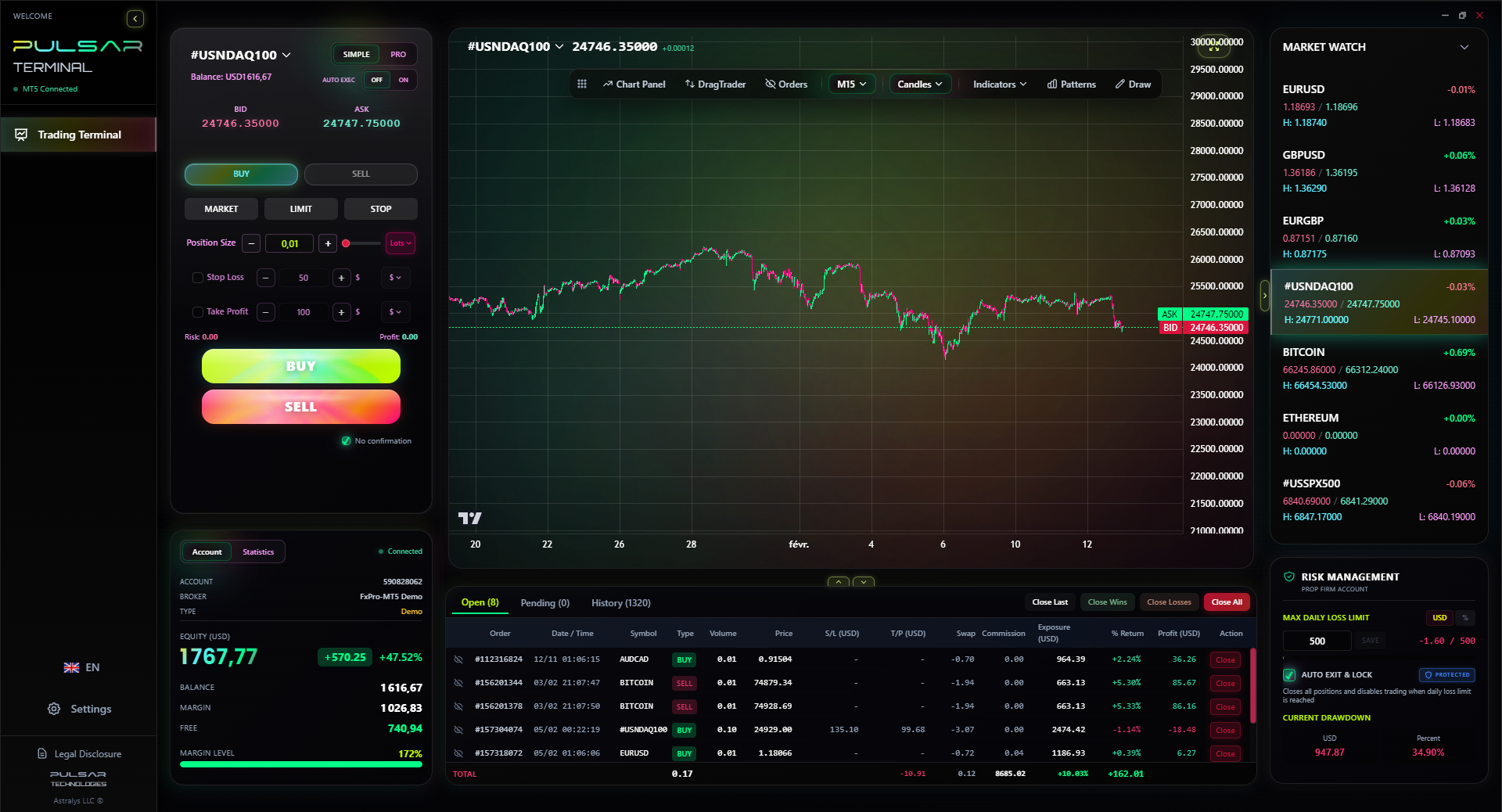
Managing complex trades across multiple assets and currencies requires precise tools, and Pulsar Terminal's drag-and-drop orders and multi-TP/SL features let you execute your hybrid strategy cleanly on MT5.
“I gained 12% on a forex swing trade, but BTC dropped 18% in the same week. I ended up with less dollar value than I started with.”
Let's make this concrete. Here's exactly how I'd execute a trade today, with real numbers from a recent setup.
Goal: Short EUR/USD based on a MACD indicator divergence on the 4-hour chart.
Step 1: Fund the VASP. I transfer ₦1,000,000 from my Zenith Bank account to my licensed Nigerian exchange (Busha, for this example). It arrives in 5 minutes. I buy USDT at a rate of ₦1,520/$1. After their 0.8% fee, I receive $655 USDT.
Step 2: Move to Trading Account. I initiate a withdrawal from Busha to my pre-whitelisted Ethereum address at IC Markets. I pay a network fee of $2. About 12 minutes later, $653 USDT lands in my IC Markets crypto account and is auto-converted to USD.
Step 3: Execute the Trade. EUR/USD is at 1.0850. My analysis says it's heading to 1.0750. I use my position size calculator. Account balance: $653. I'll risk 0.7% ($4.57). With a stop loss at 1.0880 (30 pips risk), my position size is 0.15 lots.
I sell 0.15 lots EUR/USD at 1.0850. Stop Loss: 1.0880. Take Profit: 1.0750.
Step 4: Manage and Exit. The trade goes my way. I use a trailing stop of 20 pips once it's 50 pips in profit. It gets stopped out at 1.0770, for an 80-pip gain.
Profit: 0.15 lots * 80 pips = $120 profit. New balance: ~$773.
Step 5: Repatriate Profits. I withdraw $700 from IC Markets back to my Busha USDT wallet (cost: $2 network fee). I sell $698 USDT on Busha at ₦1,515/$1. After their 0.8% sell fee, I receive approximately ₦1,048,000.
I withdraw ₦1,048,000 to my bank account. The whole cycle, from initial Naira deposit to final Naira profit in my bank, took about 48 hours, with about ₦48,000 eaten by various fees and spreads. The net profit was ₦48,000 on a ₦1m stake. That's 4.8% return, but the forex trade itself returned over 18% on the risked capital. The difference is your operational cost of doing business this way.
💡 Wskazówka Winstona
Liquidity in emerging markets is a mirage. Just because you can buy ₦10m of USDT at 2 pm doesn't mean you can sell it at 10 pm. Test the exit before you commit the army. Do a small sell order first.
“The hybrid model - Nigerian VASP + international broker - is the only viable path for serious traders who want to be compliant.”
Where is this all heading? The SEC's aggressive capital requirements tell a story. They want fewer, bigger, more controllable players. The wild west of P2P is being funneled into regulated channels. I predict within 2-3 years, we'll see the first licensed Nigerian VASPs applying for hybrid licenses that allow them to offer derivative products (like CFDs) on the crypto assets they custody. That would be the first true 'crypto forex' product on Nigerian soil.
For now, the hybrid model - Nigerian VASP + international broker - is the only viable path for serious traders who want to be compliant. It's clunky and expensive, but it's legal. The ₦2 billion capital floor means the exchanges that survive will likely partner with or be acquired by traditional finance institutions.
Your job as a trader is to stay agile. Keep your records impeccable. Build relationships with your VASP's compliance team (sounds boring, but it helps). And always, always have an exit plan that doesn't depend on a single platform or a single currency. The Naira will fluctuate. Crypto will be volatile. Regulations will shift. Your edge isn't just in your MACD or RSI signals; it's in your ability to navigate this incredibly complex financial maze better than the next person.
Pro Tip: Follow the SEC's circulars directly. Don't rely on news summaries. When they issue a new guideline (like the Jan 2026 capital rules), it often gives a 3-6 month compliance window. That's your heads-up to adjust your strategy or move funds before the platforms themselves scramble to adapt.
FAQ
Q1Is it legal to trade forex using crypto in Nigeria?
It's a layered answer. It is legal to buy crypto on a licensed Nigerian VASP (like Busha). It is legal to send that crypto to an international broker that accepts it. It is legal to trade forex on that international broker. However, there is no single, Nigerian-regulated entity that offers 'crypto-funded forex trading' as one product. The legality depends on you using licensed channels for the on-ramp/off-ramp.
Q2What's the cheapest way to fund a forex account from Nigeria?
Honestly, if you have a domiciliary account, a direct wire transfer to a broker like XM or Exness is often cheaper in pure fee terms. The crypto method (Naira -> VASP -> USDT -> Broker) involves two spreads (NGN/USDT, USDT/USD) and network fees. The crypto method's advantage isn't cost; it's often speed and avoiding direct CBN scrutiny on international wire transfers for trading.
Q3Can I use Binance P2P to fund my trading?
You can, but it's riskier from a compliance standpoint. Binance P2P is not a licensed Nigerian VASP. If you receive a large Naira payment from an unknown party for your USDT, your bank account could be flagged for suspicious activity. For consistent, large-volume trading, the licensed VASP route provides a clearer audit trail and reduces your personal banking risk.
Q4How are my trading profits taxed?
This is evolving. The SEC framework and the 2025 Act imply that capital gains are taxable. Your licensed Nigerian VASP is required to report your transaction volumes. While a clear, enforced crypto tax code is still developing, you must keep detailed records. When you convert crypto profits to Naira on a licensed platform, that is a taxable event. Consult a Nigerian accountant familiar with digital assets.
Q5What happens if my international broker goes bankrupt?
Your funds are likely gone. Nigerian regulations and investor protections do not extend to offshore brokers. This is a major risk of this model. Always use well-established, globally regulated brokers (like ASIC-regulated ones) and never keep more capital there than you are actively trading. Withdraw profits back to your Nigerian VASP regularly.
Q6Will Nigerian brokers ever offer direct crypto deposits?
Not under the current rules. Nigerian brokers are regulated for securities and forex. Crypto asset custody and exchange require a separate SEC VASP license. A single company would need two massively capitalized licenses. It's more likely we'll see partnerships, where a broker's client can fund via a button that connects to a licensed VASP's API.
Lekcja Prof. Winstona
:
- ✓The operational cost of a crypto-forex trade is at least 1.5%.
- ✓Always use stablecoins (USDT/USDC) as your funding bridge.
- ✓Risk 0.7%, not 1%, to buffer crypto/Naira volatility.
- ✓Withdraw profits to Naira monthly; don't let capital stagnate.
- ✓The TXID is your receipt. Keep it forever.
Jak przydatny był ten artykuł?
Kliknij gwiazdkę, aby ocenić
Tygodniowe analizy tradingowe
Darmowe tygodniowe analizy i strategie. Bez spamu.
O autorze
Olumide Adeyemi
Pionier Tradingu w Afryce Zachodniej
Jeden z najaktywniejszych edukatorów tradingu forex w Nigerii. 8 lat doświadczenia tradingowego z Lagos. Specjalizuje się w strategiach niskiego kapitału i wyzwaniach prop firm dla afrykańskich traderów.
Komentarze
Może Ci się też spodobać

Cara Trading Forex Sukses: 7 Prinsip dari Trader Profesional
Cara trading forex sukses dengan 7 prinsip trader pro: manajemen modal, disiplin, journal trading, backtest. Data nyata, bukan janji profit palsu.
Jam Trading Forex Terbaik untuk Trader Indonesia: Panduan Lengkap dengan Tabel Waktu
Panduan jam trading forex untuk trader Indonesia. Tabel 4 sesi dunia, jam emas 20:00-00:00, sesi mana yang harus dihindari. Data akurat + tips dari trader berpengalaman.
Top 5 Sàn Forex Uy Tín Nhất 2026: Review Jujur dari Trader Indonesia
Top 5 sàn forex uy tín 2026 untuk trader Indonesia. Review jujur: spread, deposit, withdraw, dukungan lokal. Exness, XM, IC Markets & lebih.
All these calculators are built into Pulsar Terminal with real-time data from your MT5 account. One-click position sizing, automatic risk management, and instant calculations.
