


Let's cut through the noise right now.

David van der Merwe
Trader Rynków Wschodzących ·  South Africa
☕ 10 min czytania
Czego się nauczysz:
- 1What FNB Forex Sandton City Actually Is (And Isn't)
- 2Key Services, Limits, and The Fine Print
- 3The Real Cost: Fees and Hidden Spreads
- 4Why Serious Traders in Sandton Look Elsewhere
- 5Practical Alternatives for South African Traders
- 6The Right Reasons to Use FNB Forex Sandton City
- 7Step-by-Step: What to Expect If You Do Go
- 8Final Verdict for Aspiring Traders
Let's cut through the noise right now. If you're walking into FNB Sandton City thinking you're about to open a high-powered forex trading account with tight spreads and use to match, you're in for a rude awakening. I've had more than one student come to me confused, cash in hand, after a trip to that branch. They mistake a bank's foreign exchange service for a live trading platform. This guide is here to set the record straight on what FNB Forex actually offers, who it's for, and why you, as an aspiring trader, will almost certainly need to look beyond their counters.
First, let's kill the biggest myth. The FNB Forex bureau at Sandton City, or any FNB branch for that matter, is not a retail forex broker. You cannot download MetaTrader 4 or 5 from them, you cannot scalp the EUR/USD with 500:1 use, and you won't be setting stop-loss orders on their terminals.
What it is, is a foreign exchange service for physical currency and international transfers. It's for you to buy US Dollars for your overseas holiday, send Rands to a family member in the UK, or receive Euros from a client abroad. They deal in spot transactions for physical cash and electronic transfers, not in contracts for difference (CFDs) on margin. The spread you pay is the difference between their buy and sell rate for physical notes, which is typically massive compared to the 0.1 pip spreads you might see with a real broker like IC Markets.
I remember a client years ago who insisted on using his bank for 'safety.' He exchanged R100,000 for USD for a 'trade.' The spread cost him over R2,500 before he even left the building. On a proper platform, that cost would have been under R100. That's the difference between a service and a trading venue.
So, what can you do there? Knowing the limits stops you from wasting your time.
Travel Forex
This is their main gig. You can order foreign cash (USD, GBP, EUR, etc.) for collection. You need to be an FNB account holder. Limits depend on your profile and SARS regulations. For individuals, the single discretionary allowance is R1 million per calendar year, but you must be tax compliant. The practical amount you can walk out with in cash is much lower, often around a few thousand dollars equivalent without prior arrangement.
International Transfers
They help SWIFT transfers. It's a process: you go in, fill forms, pay their fees (which include a wire fee and their margin on the exchange rate), and wait 2-5 business days. It's not for moving money quickly to seize a market opportunity.
Forex Cards
They offer prepaid travel cards loaded with foreign currency. Handy for travel, useless for trading.

Warning: The exchange rate you see on Google or Reuters is not the rate you'll get. Banks add a significant margin. Always ask for the 'all-in rate' – the total amount in ZAR you will pay for your foreign currency, including all commissions. That's the only number that matters.
The process is bureaucratic by design. It's about compliance, not speed. If your plan involves reacting to news or a specific price level, this is the wrong tool.
“FNB Forex is a utility, not a weapon. It's part of your infrastructure, not your strategy.”
This is where banks make their money, and it's the single biggest reason traders avoid them. The cost is baked into the exchange rate spread.
Let's break it down with a real example from a few months back. The interbank mid-rate for USD/ZAR was 18.50.
- FNB's quoted 'buy' rate for USD (you buying USD): Maybe 19.00.
- Their 'sell' rate (you selling USD back): Maybe 18.00.
That's a 100 cent (or ~5.4%) spread right there. If you bought $1,000, you'd pay R19,000. If you immediately sold it back (a pointless but illustrative move), you'd get only R18,000 back. You just lost R1,000 to the spread.
Compare that to a real forex broker:
- Broker's spread on USD/ZAR: 1.5 pips (0.015). At 18.50, that's a spread of about R0.28.
- Cost on a $1,000 (R18,500) position: Roughly R28.
| Cost Factor | FNB Forex (Physical Cash) | Online Forex Broker (CFD) |
|---|---|---|
| Typical Spread on USD/ZAR | 400-600 pips (R4-R6) | 1.5 - 3.0 pips (R0.28-R0.56) |
| Commission | Often built into spread | Sometimes separate, e.g., $3.50 per lot |
| Speed of Execution | Next day (for cash) | Milliseconds |
| Suitable for | Travel, Physical Currency | Live Trading, Speculation |
On top of the spread, there may be a commission fee for transfers. It's a costly way to move money if your goal is generating returns. For travel, it's a convenience tax. For trading, it's a profit killer. Always use a position size calculator to understand your true costs, but with bank spreads, the math never works in your favor for short-term moves.

💡 Wskazówka Winstona
A bank's forex spread isn't a fee, it's a wall. You need a monumental move just to climb over it before you see a cent of profit. Trade where the walls are low.
Walk around Sandton City and you'll see suits on phones watching charts. They're not calling FNB Forex. They're using international brokers. Here’s why.
use: FNB offers zero use for currency speculation. You put up R100,000, you control R100,000. End of story. A regulated international broker offers use (capped at 30:1 for retail clients in SA under FSCA rules, but often higher with global entities). This allows for proper capital efficiency and risk management when used responsibly.
Platforms: Trading requires advanced platforms: MetaTrader 4/5, cTrader, or proprietary systems. These offer live charts, one-click trading, automated scripts, and sophisticated order types. FNB's online banking platform is none of those things.
Market Access: Through a broker, you're not just buying USD for your holiday. You're trading the EUR/USD, the XAU/USD, indices, commodities, and cryptocurrencies (via CFDs). It's a global marketplace. FNB offers a handful of major physical currencies.
Speed: In scalping, a 2-second delay can mean the difference between profit and loss. Bank processes that take days are irrelevant.
My own turning point was years ago trying to 'arbitrage' a currency move using my bank's transfer system. By the time the funds landed, the opportunity was gone, and the fees ate any theoretical profit. I learned the hard way that the tool must match the task.
“The spread at a bank isn't a cost of trading; it's the price of using the wrong tool entirely.”
So where does a Sandton-based trader go? You have two real paths.
1. International Brokers with Local Presence
These are your best bet. They offer the global platforms, tight spreads, and use, but often have South African support, ZAR-based accounts, and local deposit methods. Do your due diligence.
- Exness: Popular for its variety of account types and acceptance of SA clients.
- IC Markets: Known for raw spreads and excellent execution, a favorite for serious volume.
- Pepperstone: Strong reputation, good research tools.
- XM: Offers extensive educational resources, which beginners might find useful.
You fund these via electronic funds transfer (EFT) from your South African bank account (FNB included) into the broker's locally held ZAR account. It usually clears in a few hours.
2. SARB-Approved Local CFD Providers
A few providers are licensed by the South African Financial Sector Conduct Authority (FSCA) to offer CFD trading. They operate under stricter use caps (30:1 on major forex) but offer the comfort of local regulation. Their spreads might be slightly wider than the top internationals, but they are a legitimate, regulated option.

Pro Tip: Before funding any broker, do a small test withdrawal. The easiest way to check a broker's operational integrity is to see if you can get your money back without drama. Start with R1,000. If it lands back in your FNB account smoothly, you're likely dealing with a professional operation.
The choice between an international or local regulated broker depends on your need for higher use versus regulatory comfort. Most of my successful students use the first category, managing their risk diligently to avoid a margin call.
💡 Wskazówka Winstona
Your bank is for custody and transfers. Your broker is for execution. Confuse the two, and you'll pay for the lesson in lost opportunity and excessive cost.
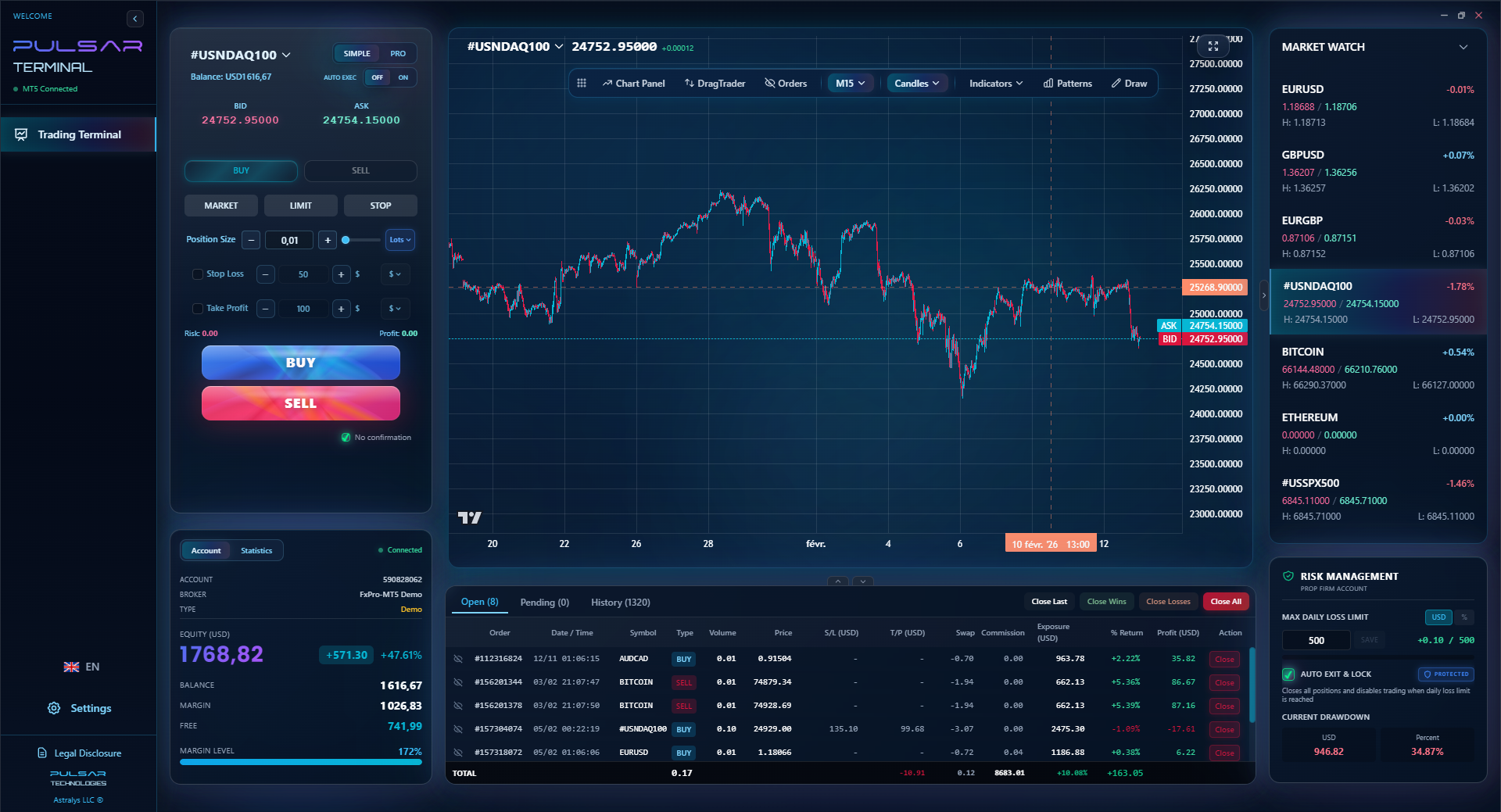
Once you're trading with a real broker, managing complex orders and risk on MT5 is key, which is where a tool like Pulsar Terminal transforms your workflow.
I'm not saying never walk in there. I use them myself for specific, non-trading purposes. Here’s when it makes sense:
- You Need Physical Foreign Cash for Travel: This is their specialty. Order online and collect at Sandton City. Convenient.
- You're Making a Legitimate International Payment: Paying for imports, university fees abroad, or a property installment. The paperwork and compliance they handle is valuable for large, legitimate transfers.
- You're Withdrawing Profits from Trading and Want ZAR in Hand: This is a key one. You've made money on your IC Markets account, withdrawn USD to your FNB foreign currency account, and now you want to convert a portion to physical Rands. Walking into Sandton City to do that final conversion is perfectly logical.
Think of FNB Forex as the beginning and end point of your trading capital's journey, not the highway it travels on. It's the on-ramp (depositing ZAR) and the off-ramp (cashing out profits), not the high-speed trading platform itself.
“Mistaking a bank's forex desk for a trading hub is a classic, and expensive, beginner error.”
Alright, you've decided you need their services for a valid reason. Here’s how not to look like a rookie.
- Check Rates Online First: Use the FNB website or app to check their live 'travel' exchange rates. Don't rely on the interbank rate.
- Order Ahead: For cash, always order online for branch collection. It guarantees availability and sometimes a slightly better rate.
- Documents: Take your FNB card, your SA ID, and proof of residence. For larger amounts, take your tax compliance status confirmation from SARS. They will ask.
- Know Your Limits: Be clear on how much you need. If it's over your discretionary allowance, you'll need supporting documents (invoices, acceptance letters).
- Ask for the All-In Rate: When at the counter, confirm the final rate including all charges before you approve the transaction.
- Count Your Cash: Do it discreetly but do it, before you leave the counter.
It's a straightforward process if you're prepared. The staff there are processing hundreds of these transactions; they're efficient if you have your docs in order.
💡 Wskazówka Winstona
Always do a test withdrawal first. A broker that makes it easy to get your money out is a broker you can trust to put your money in.
Here’s the blunt truth from the trading floor: FNB Forex Sandton City is a utility, not a weapon. It's part of your financial infrastructure, like your internet connection. You need it to be stable and reliable for funding and withdrawing, but you don't expect your ISP to tell you when to buy Tesla stock.
Your journey should look like this:
- Open an account with a reputable international broker.
- Use your FNB online banking to EFT ZAR to fund it.
- Trade on the broker's advanced platform using defined strategies, perhaps incorporating tools like the RSI indicator or MACD indicator for your analysis.
- Withdraw profits back to your FNB account.
- If you need physical cash, then and only then, visit FNB Forex Sandton City.
Mistaking the bank's forex desk for a trading hub is a classic beginner error. It confuses a high-margin, compliance-heavy retail service with a low-margin, high-speed speculative market. Now you know the difference. Don't make the expensive mistake my old client did. Use the right tool for the job.
FAQ
Q1Can I trade forex live at the FNB Sandton City branch?
No, absolutely not. They provide currency exchange and international transfer services. You cannot execute live CFD or margin trades on financial markets from their bureau. For that, you need an account with a dedicated online forex broker.
Q2What is the maximum amount of forex I can buy at FNB?
For individuals, the single discretionary allowance is R1 million per calendar year, provided you are tax compliant. However, the amount you can get in physical cash without prior notice is much lower, often a few thousand dollars. Larger amounts require advance ordering and, above your allowance, supporting documentation for SARS.
Q3Are FNB's forex rates good for trading?
They are among the worst possible rates for trading purposes. The spreads (difference between buy and sell rates) are typically hundreds of times wider than those offered by online brokers. Using FNB's rates would require a market move of several percentage points just to break even, which is unsustainable for active trading.
Q4How do I fund an international trading account from South Africa?
The most common method is via EFT (Electronic Funds Transfer) in ZAR. Most major international brokers have local South African bank accounts. You log into your FNB online banking, make a payment to the broker's provided bank details, and the ZAR is converted by the broker at interbank rates. The funds usually appear in your trading account within a few hours to a day.
Q5Is it safe to use international brokers instead of my bank?
Safety depends on the broker's regulation, reputation, and operational history. Reputable brokers like those mentioned are regulated by top-tier authorities (ASIC, CySEC, FCA). They segregate client funds and offer greater protection for trading activities than a bank's forex service does for speculation. Always verify regulation and read independent reviews like our Exness review before depositing.
Q6Can I use my FNB Forex Card for online trading?
No. Forex cards are pre-paid debit cards for spending abroad. They cannot be used to fund margin trading accounts with brokers. Brokers require bank transfers, credit/debit cards (though these are declining), or e-wallet payments.
Q7What should I do if I need to make a large international payment for a business reason?
Then FNB Forex is a appropriate channel. For large, legitimate transfers (e.g., importing goods, paying for services), the bank's compliance framework and documentation are necessary. Use their international wire transfer service, but be sure to understand all fees and the final exchange rate applied before authorizing.
Lekcja Prof. Winstona
:
- ✓Bank forex spreads are 400-600 pips vs. 1.5 pips at a broker.
- ✓Use FNB for physical cash & transfers, not live market execution.
- ✓Fund trading accounts via EFT to international brokers' local ZAR accounts.
- ✓Always ask for the 'all-in rate' at a bank, never the headline rate.
- ✓Do a small test withdrawal to verify any broker's reliability.
Jak przydatny był ten artykuł?
Kliknij gwiazdkę, aby ocenić
Tygodniowe analizy tradingowe
Darmowe tygodniowe analizy i strategie. Bez spamu.
O autorze
David van der Merwe
Trader Rynków Wschodzących
Trader z Johannesburga z 11-letnim doświadczeniem w walutach rynków wschodzących. Specjalizuje się w parach ZAR, handlu regulowanym przez FSCA i analizie rynku południowoafrykańskiego.
Komentarze
Może Ci się też spodobać

Cara Trading Forex Sukses: 7 Prinsip dari Trader Profesional
Cara trading forex sukses dengan 7 prinsip trader pro: manajemen modal, disiplin, journal trading, backtest. Data nyata, bukan janji profit palsu.
Jam Trading Forex Terbaik untuk Trader Indonesia: Panduan Lengkap dengan Tabel Waktu
Panduan jam trading forex untuk trader Indonesia. Tabel 4 sesi dunia, jam emas 20:00-00:00, sesi mana yang harus dihindari. Data akurat + tips dari trader berpengalaman.
Top 5 Sàn Forex Uy Tín Nhất 2026: Review Jujur dari Trader Indonesia
Top 5 sàn forex uy tín 2026 untuk trader Indonesia. Review jujur: spread, deposit, withdraw, dukungan lokal. Exness, XM, IC Markets & lebih.
All these calculators are built into Pulsar Terminal with real-time data from your MT5 account. One-click position sizing, automatic risk management, and instant calculations.
