


I remember the first time I tried to trade the 'Beast' – GBP/JPY – based on a flashy signal from a popular indicator.

David van der Merwe
Trader Rynków Wschodzących ·  South Africa
☕ 10 min czytania
Czego się nauczysz:
I remember the first time I tried to trade the 'Beast' – GBP/JPY – based on a flashy signal from a popular indicator. I saw a perfect 'buy' arrow pop up on my screen, loaded up a 2-lot position, and watched my screen turn red as price immediately reversed. I lost R4,200 in about 90 seconds. That's the thing about chasing the 'forex beast' – whether it's a tool, a pair, or the dream of easy money – it can bite back hard if you don't understand what you're really dealing with. In South Africa, with our volatile rand and unique market access, you need a local's perspective to separate the useful tools from the hype.
Alright, let's clear this up first. When guys in the trading groups talk about the 'forex beast,' they usually mean one of three things, and mixing them up is a recipe for confusion.
First, there's the Forex Beast Indicator. This is a paid tool for MT4 that paints arrows and zones on your chart. It combines stuff like moving averages and support/resistance into one dashboard. I bought it back in 2021 for about $65 (roughly R1,200 at the time). It's okay for getting a second opinion, but it's not a magic bullet. The sellers will tell you it's a 'beast' of a system, but honestly, no indicator works 100% of the time. I've had trades where it nailed a 150-pip move on USD/ZAR, and others where it gave three false signals in a row on EUR/USD.
Second, and this is the one real pros talk about, is The Beast: GBP/JPY. This pair earns its nickname. The volatility is insane. A normal day can see 150-200 pips of movement without breaking a sweat. Why? You're trading the British Pound against the Japanese Yen, which means you're exposed to wild swings in global risk sentiment. When traders are feeling brave, they buy it. When panic hits, they sell. It's a pure sentiment gauge.
Third, you might hear about 'BeastFX' or similar branded courses or 'prop firm challenges.' Be careful here. Some are legit educators, but many are just selling a dream. In our market, you want tools and education that account for ZAR liquidity and local broker conditions.

Warning: Any product or person promising to turn you into an overnight 'forex beast' with guaranteed returns is almost certainly a scam. The FSCA regularly warns against these. Real trading is a grind, not a glory run.

💡 Wskazówka Winstona
The 'Beast' isn't the pair or the indicator. It's the gap between your discipline and your ambition. Close that gap first.
“The 'forex beast' isn't an indicator or a pair. It's the disciplined, patient, and resilient trader you can become.”
If you want to trade the actual Beast pair (GBP/JPY), you can't just wing it. You need a plan that respects its personality. Here’s a framework I’ve used, adapted for our timezone and common broker offerings like those from IC Markets or Pepperstone.
Understanding Its Rhythm
GBP/JPY is most active during the London session (10:00-19:00 SAST) and when London overlaps with New York. That’s your prime time. Our early mornings (Asian session) are often quieter, marked by tighter ranges. I learned this the hard way by trying to scalping strategy it at 5 AM SAST, only to get chopped up by 10-pip whipsaws.
A Simple, High-Probability Approach
Forget complicated systems. This pair responds well to clean price action.
- Find the Daily Trend: Always start on the daily chart. Is price making higher highs and higher lows? That's your trend direction. Only take trades in line with this trend about 70% of the time. The other 30% can be for sharp counter-trend reversals at clear levels.
- Drop to the 4-Hour for Structure: Look for key support and resistance. The Beast loves to test and reject these areas. A pin bar or a strong engulfing candle at these levels is your signal.
- Entry on the 1-Hour: Use the 1-hour chart for your precise entry. I wait for a pullback to a smaller Fibonacci level (like the 50% or 61.8% retrace) within the larger trend, then look for a price action confirmation.
Managing the Madness
This is where you survive. Your stop-loss must be placed beyond the recent swing high/low. On GBP/JPY, that often means a 40-60 pip stop. Don't try to make it tighter; the noise will stop you out. Your profit target should be at least 1.5 times your risk. I use a 2:1 reward-to-risk ratio as a minimum.

Example: Long entry at 185.00. Stop loss at 184.40 (60 pips risk). Take profit at 186.20 (120 pips reward). That's a clean 2:1 trade. If you're trading a standard lot, that 60-pip stop is $600 risk. Always use a position size calculator so you don't bet the farm.
This pair is perfect for swing trading over a few days. Don't get greedy, and never, ever add to a losing position thinking 'it has to turn.' It doesn't.
“I lost R4,200 in about 90 seconds. That's the thing about chasing the 'forex beast' – it can bite back hard.”
Trading from South Africa isn't the same as trading from London or New York. We have our own set of rules, costs, and advantages.
The FSCA is Your Friend The Financial Sector Conduct Authority (FSCA) regulates our market. Only use brokers licensed by them. It’s your first line of defence against shady operations. Brokers like XM and Exness have local FSCA licensing, which matters for dispute resolution.
The Real Cost of Trading in Rands This is the boring stuff that kills profits. When you deposit Rands, your broker converts them to USD, EUR, or another account currency. That conversion has a fee, often around 1-2%. If your broker offers a ZAR-denominated account, use it to avoid this.
Then you have the spreads and commissions. Let's break down a typical R10,000 trade on EUR/USD:
| Cost Type | Typical Charge | Impact on R10,000 Trade |
|---|---|---|
| Spread (1.2 pips) | Rendered in pips | ~R16 cost on entry & exit |
| Commission (if applicable) | $7 per lot | ~R130 per round turn |
| Overnight Swap | Variable | Can cost or earn you Rands daily |
| Bank Fee (Deposit/Withdrawal) | R250 - R350 | A flat fee that hurts small accounts |
See how it adds up? If you're trading small, those bank fees are a massive percentage. I use brokers with free local deposits for this reason.
USD/ZAR: Our Home-Grown Beast Don't overlook your own backyard. USD/ZAR is hugely liquid and can offer fantastic trends driven by commodity prices (gold, platinum) and local politics. It’s less manic than GBP/JPY but can still move 500-1000 pips in a major trend. Understanding SA fundamentals is an edge you have over traders in other countries.
“Real trading is a grind, not a glory run.”
Here's the truth nobody selling a $65 indicator will tell you: becoming a consistently profitable trader – a true 'forex beast' – has almost nothing to do with the tools and everything to do with your mindset and routine.
Your Daily Trading Checklist (Non-Negotiable)
- Economic Calendar: Check it. Every morning. Know when SARB announcements, US CPI, or local budget speeches are. I got caught in a GBP/JPY trade during a surprise BOJ intervention announcement once. Lost a month's profits in minutes. Now I know when to reduce size or stay out.
- Weekly Market Review: Every Sunday night, I look at the weekly charts of my 3-4 favorite pairs. I mark key levels. This 30-minute task gives direction to my whole week.
- Journal Every Trade: Not just 'bought EUR/USD, won.' I record the chart time, my rationale, my emotional state ('felt FOMO after missing earlier move'), and the outcome. Reviewing this weekly is how you improve.
Risk Management is Your Superpower This is the only 'secret' you need. Never risk more than 1-2% of your account on a single trade. For a R20,000 account, that's R200-R400 max risk per trade. Use stop-losses without exception. I've broken this rule, thinking I could 'nurse' a trade back. It's how I turned a R1,500 loss into a R8,000 loss. A margin call is a brutal teacher.
Tools That Actually Help Indicators should support your analysis, not lead it. I use two:
- The RSI indicator to spot potential overbought/oversold conditions within a trend.
- The MACD indicator on the 1-hour chart to gauge momentum shifts. That's it. Clean charts are better than cluttered ones. The 'Forex Beast Indicator' can be one more data point, but don't let it make your decisions for you.
💡 Wskazówka Winstona
Your most important indicator is your trade journal. A pattern of small, disciplined losses teaches you more than one lucky, reckless win.
“Real trading is a grind, not a glory run.”
We have unique traps here. Let me save you some money and heartache.
Chasing 'Prop Firm' Dreams Without a Plan Passing a prop firm challenge is trendy. They give you a simulated account, you hit a target, and you get a funded account. Sounds great. But the rules are brutal – strict daily loss limits (like 5%) and drawdown rules. You need a rock-solid, disciplined strategy just to pass. Jumping in with the 'Forex Beast Indicator' and hoping for the best will blow your challenge fee (often $100-$500) in days. You need to treat the challenge like real money, with strict risk parameters.
Ignoring Swap Rates on ZAR Pairs When you trade USD/ZAR, you're dealing with a massive interest rate differential. Holding a long USD/ZAR position (buying USD, selling ZAR) often pays you a positive swap because US rates are typically higher. Holding the opposite (short USD/ZAR) can cost you. These swaps are calculated daily and can significantly add to or eat your profits over time. Check your broker's swap sheet!
Underestimating Liquidity Gaps Our market closes Friday night and opens Sunday night. Major news happens over weekends. The 'Sunday open gap' on pairs like GBP/JPY can be enormous. If you're holding a position over the weekend, you're accepting that risk. I only do it if I have a very large profit buffer.
Using Unregulated 'Investment Schemes' If someone on WhatsApp or Facebook offers you 'managed forex accounts' with guaranteed 10% monthly returns, run. These are Ponzi schemes targeting our community. The FSCA publishes a warning list of these entities. Stick to regulated brokers and your own educated trading.
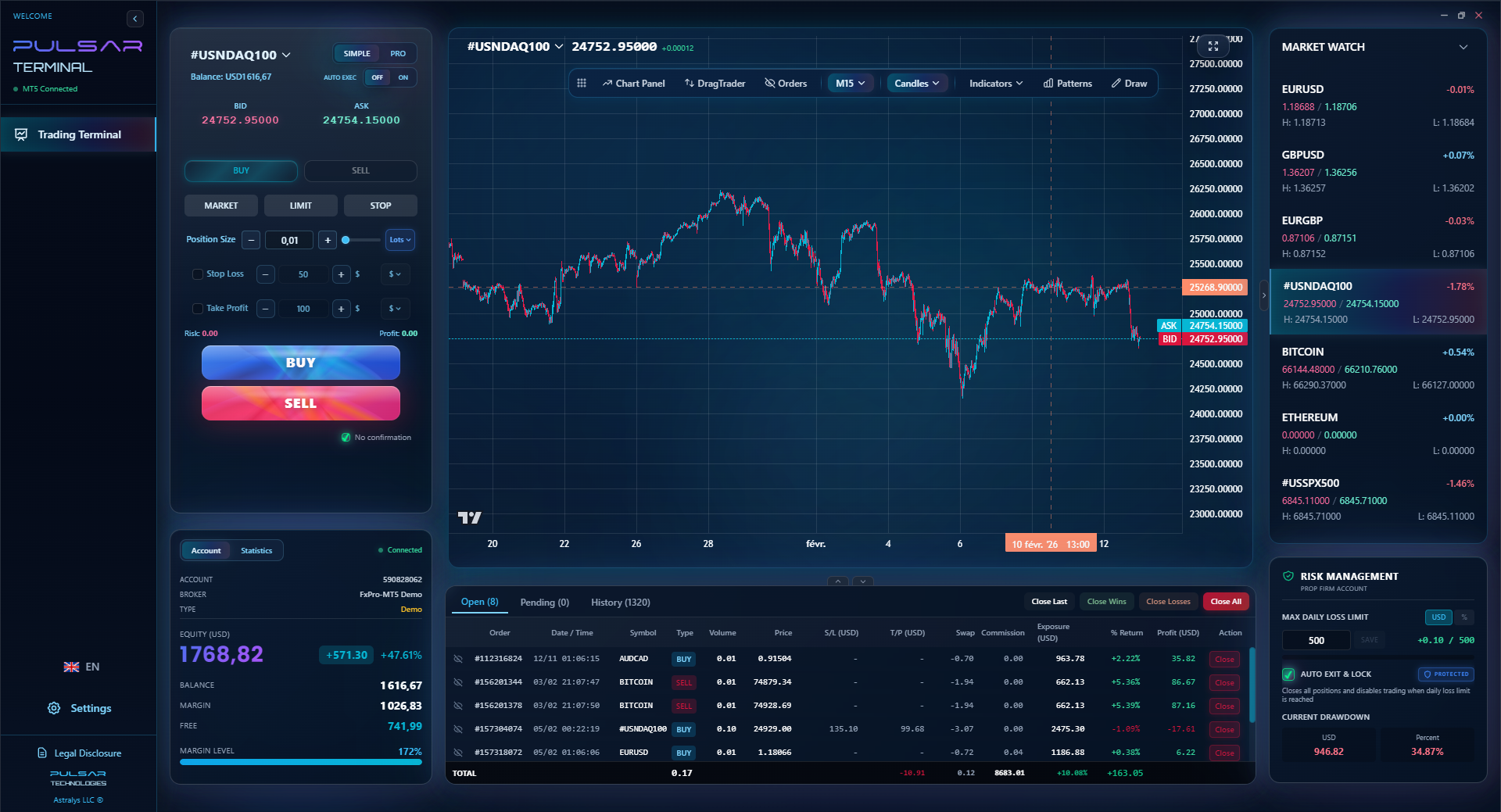
Managing the strict daily loss limits of a prop firm challenge is incredibly stressful, but tools like Pulsar Terminal can automate this protection directly on your MT5 platform, so you never accidentally breach a rule.
“A 50-pip win on a well-planned trade is a bigger victory than a 200-pip win on a reckless gamble.”
So, how do you actually start this journey without blowing up your account? Follow this phased approach.
Phase 1: The Demo Grind (Minimum 3 Months) Open a demo account with an FSCA broker. Don't just play around. Treat it like real money. Practice the GBP/JPY strategy I outlined. Practice trading USD/ZAR. Get used to calculating your position size for a 1% risk. Your goal here isn't to make fake money, it's to build a habit of following your plan. Log 100 trades in your journal.
Phase 2: The Live Micro-Account Deposit the smallest amount you can – maybe R2,000. The goal is to feel real emotion (fear, greed) while the financial stakes are low. Your focus is on preserving capital and hitting a consistent risk-reward ratio, not getting rich. This is where you learn about slippage, emotional discipline, and those hidden fees for real.
Phase 3: Scaling With Profits Only add more capital to your account from your trading profits. If you can grow a R2,000 account to R2,500 by following your rules, you've earned the right to trade a bit more. This is the ultimate test of your system.
Final Thought The 'forex beast' isn't an indicator or a pair. It's the disciplined, patient, and resilient trader you can become. It's about understanding that a 50-pip win on a well-planned trade is a bigger victory than a 200-pip win on a reckless gamble. The market will always be here. Your job is to make sure your account is too. Focus on the process, protect your capital, and the results will follow over time. Now, go review those weekly charts.
FAQ
Q1Is the Forex Beast Indicator worth buying for a South African trader?
It can be a useful secondary tool if you understand its signals are suggestions, not commands. However, for the cost (around $65+, over R1,200), you might be better off investing that money into your live micro-account or a solid trading course. No indicator accounts for ZAR-specific factors like liquidity or local news.
Q2What's the minimum amount I need to start trading GBP/JPY from South Africa?
Technically, some brokers like XM let you start with $5 (around R90). But realistically, to trade a volatile pair like GBP/JPY with proper risk management, you need enough capital to withstand its swings. I wouldn't recommend trading it live with less than $500 (roughly R9,000). This allows you to use sensible lot sizes (like 0.01 lots) and place stops wide enough (40-60 pips) without risking a huge percentage of your account on one trade.
Q3Can I trade forex legally in South Africa, and how do I check if a broker is legit?
Yes, forex trading is completely legal. The key is to use a broker regulated by the Financial Sector Conduct Authority (FSCA). Go to the FSCA's official website and use their 'Search for an authorised financial services provider' tool. Type in the broker's name or license number. If they're not on the FSCA list, avoid them, no matter how good their offers sound.
Q4Why is USD/ZAR so volatile, and what moves it?
USD/ZAR is an emerging market currency pair, which makes it sensitive to global risk appetite. Key drivers include: 1) Commodity prices (gold, platinum, palladium), as SA is a major exporter. 2) US Dollar strength. 3) Local political and economic stability (think Eskom, budget deficits). 4) Interest rate differentials between the US Fed and the South African Reserve Bank (SARB). It's less 'noisy' than GBP/JPY but can trend powerfully for months.
Q5What's the biggest mistake new SA forex traders make?
Two tied for first place: 1) Using way too much use because their broker offers 1:500 or more. This turns small market movements into account-destroying losses. 2) Not accounting for all the costs - bank fees for international deposits, currency conversion fees, and swap rates. They see a 50-pip win but don't realize fees ate half of it, turning a winning trade into a net loser.
Q6Is it better to have a USD or ZAR trading account?
For most South African traders, a ZAR-denominated account is simpler and cheaper. It eliminates the currency conversion fee your broker charges when you deposit Rands into a USD account (often 1-2%). Your profits and losses are in Rands, so you know exactly where you stand. The only reason to use a USD account is if you frequently deposit foreign currency.
Lekcja Prof. Winstona
:
- ✓GBP/JPY needs a 40-60 pip stop minimum.
- ✓Never risk more than 2% per trade.
- ✓FSCA regulation is non-negotiable.
- ✓Swap rates matter on USD/ZAR.
Jak przydatny był ten artykuł?
Kliknij gwiazdkę, aby ocenić
Tygodniowe analizy tradingowe
Darmowe tygodniowe analizy i strategie. Bez spamu.
O autorze
David van der Merwe
Trader Rynków Wschodzących
Trader z Johannesburga z 11-letnim doświadczeniem w walutach rynków wschodzących. Specjalizuje się w parach ZAR, handlu regulowanym przez FSCA i analizie rynku południowoafrykańskiego.
Komentarze
Może Ci się też spodobać

Cara Trading Forex Sukses: 7 Prinsip dari Trader Profesional
Cara trading forex sukses dengan 7 prinsip trader pro: manajemen modal, disiplin, journal trading, backtest. Data nyata, bukan janji profit palsu.
Jam Trading Forex Terbaik untuk Trader Indonesia: Panduan Lengkap dengan Tabel Waktu
Panduan jam trading forex untuk trader Indonesia. Tabel 4 sesi dunia, jam emas 20:00-00:00, sesi mana yang harus dihindari. Data akurat + tips dari trader berpengalaman.
Top 5 Sàn Forex Uy Tín Nhất 2026: Review Jujur dari Trader Indonesia
Top 5 sàn forex uy tín 2026 untuk trader Indonesia. Review jujur: spread, deposit, withdraw, dukungan lokal. Exness, XM, IC Markets & lebih.
All these calculators are built into Pulsar Terminal with real-time data from your MT5 account. One-click position sizing, automatic risk management, and instant calculations.
