


Here's a statistic that should make you pause: over 95% of traders who sign up for a 'free' no deposit bonus never withdraw a single cent of profit.

David van der Merwe
Trader Rynków Wschodzących ·  South Africa
☕ 11 min czytania
Czego się nauczysz:
- 1What Exactly Is a No Deposit Bonus? (It's Not Free Money)
- 2The FSCA Rulebook: What's Allowed in South Africa
- 3Broker Breakdown: Who Offers What (And Their Catch)
- 4A Realistic Strategy to Withdraw Bonus Profits
- 5The Hidden Costs & Classic Pitfalls
- 6Honest Alternatives: Better Ways to Start
- 7The Final Verdict: Should You Bother?
Here's a statistic that should make you pause: over 95% of traders who sign up for a 'free' no deposit bonus never withdraw a single cent of profit. The broker isn't being generous; they're running a sophisticated acquisition funnel. In South Africa, where the FSCA keeps a watchful eye, these offers exist in a grey area between clever marketing and potential pitfalls. I've taken these bonuses for a spin more times than I can count, and I'll tell you exactly which ones are worth your time and which are designed to make you fail.
Let's cut through the marketing fluff. A no deposit welcome bonus is a small amount of trading credit - usually between $10 and $100 - that a broker gives you after you open and verify an account. You don't need to deposit your own money first. Sounds great, right? Here's the catch: the bonus money itself is almost never withdrawable. You can only withdraw the profits you make from trading with it, and only after jumping through a series of hoops that are deliberately difficult.
Think of it as a demo account with real money stakes. The broker is betting that you'll either blow the account quickly (costing them nothing) or that you'll get a taste of winning and deposit your own cash. It's a classic 'freemium' model. The key is understanding that this is a marketing tool, not a charitable donation. Your goal isn't to get rich off $30; it's to test the broker's execution, platform, and support in a live environment without risking your capital. I once turned a $50 no-deposit bonus from a now-defunct broker into $212, only to discover the withdrawal required a trading volume equivalent to 50 standard lots. I gave up. The broker won.

Warning: If a broker promises you can withdraw the bonus amount itself, run. That's almost certainly a scam or a firm operating outside FSCA guidelines. Legitimate brokers only let you withdraw profits, and only after meeting specific conditions.

💡 Wskazówka Winstona
The bonus's real value is as a 'live demo.' Use it to test slippage on news events and withdrawal processing times. That intel is worth more than the credit.
“The broker isn't being generous; they're running a sophisticated acquisition funnel.”
South Africa's financial watchdog, the Financial Sector Conduct Authority (FSCA), is no joke. They took over from the FSB in 2018 and have been tightening the screws ever since. For you, the trader, this is mostly a good thing - it means there's a local authority you can complain to if things go sideways.
Licensing is Non-Negotiable
Any broker offering services to South Africans should hold an FSP license from the FSCA. You can and should check this on the FSCA's public register. If they're not listed, you have zero local recourse. Many international brokers get licensed here because the market is valuable; it's a sign of credibility.
The 30:1 use Cap
This is a big one. Since 2021, retail traders like you and me are capped at 30:1 use. That means with a $100 position, you can control $3,000 worth of currency. Some brokers might whisper about 'professional' status for higher use, but the criteria are strict. This cap directly affects how you trade a no-deposit bonus. With a typical $30 bonus, your maximum exposure is $900. It forces more sensible position sizing, which isn't a bad thing.
Bonus Transparency is Enforced
The FSCA hates misleading ads. Brokers must clearly state all terms and conditions: the trading volume required to withdraw profits, the time limits, and the fact that the bonus capital isn't yours. They can't promise 'guaranteed profits.' This is why you'll see pages of fine print - the FSCA makes them put it there. A broker hiding its terms is a major red flag.
Client Funds Are Segregated
This is critical. FSCA-licensed brokers must keep your money in separate bank accounts from their own operating funds. So, if the broker goes bankrupt (it happens), your deposit should be safe. This applies to your real deposits, not the bonus phantom money.
“Over 95% of traders who sign up for a 'free' no deposit bonus never withdraw a single cent of profit.”
Based on the current landscape (late 2024 into 2026), here are the main players. I'm listing the bonus, but more importantly, the real cost of doing business with them.
| Broker | No-Deposit Bonus | The Key Withdrawal Condition (The Catch) | FSCA Licensed? | Real Account Min. Deposit |
|---|---|---|---|---|
| XM | $30 | Trade 10 standard lots (1,000,000 units per lot) | Yes | $5 |
| Tickmill | $30 Welcome Account | Trade 5 lots to withdraw profits between $30-$100 | Yes | $100 |
| FBS | Up to $140 | Extremely high trading volume required | No (Int'l) | $5 |
| InstaForex | Up to $1,000 | 3 lots of volume for every $1 of profit you want to withdraw | No (Int'l) | $1 |
| RaiseFX | $30 | 3 standard lots to withdraw up to $100 profit | Yes | Not Specified |
My Take:
- XM and Tickmill are your safest bets from a regulatory standpoint. Their terms are tough but transparent. Tickmill's post-bonus offering is particularly strong for serious traders due to their tight spreads.
- FBS and InstaForex offer bigger numbers, but the volume requirements are often ludicrous. I tried the InstaForex $1k bonus years ago. To withdraw $200 in profit, I needed 600 lots of volume. That's a $6 million trade size. It's mathematically designed for failure. They are not FSCA-licensed, so you're dealing with their international entity.
- RaiseFX is a smaller, local player with FSCA backing. Their terms are relatively straightforward.

Pro Tip: Always open the bonus terms PDF before you sign up. Search for phrases like 'trading volume,' 'withdrawal condition,' and 'lot requirement.' If it takes you more than 2 minutes to find the key number, walk away.
Remember, the bonus is a gateway. Check what the broker is like after. What are their EUR/USD spreads? Do they offer MT5? What's their customer service like? I use my no-deposit phase to test everything - from placing a scalping trade to asking a dumb question via live chat.
“Over 95% of traders who sign up for a 'free' no deposit bonus never withdraw a single cent of profit.”
Forget getting the Lamborghini. The goal is to make a small, withdrawable profit and prove you can do it. Here's a step-by-step plan that might actually work.
1. Treat It Like Real Money (Because It Is) That $30 is your entire trading capital. This means your position size must be microscopic. We're talking 0.01 lots (a micro lot). With 30:1 use, a 0.01 lot on EUR/USD uses about $30 of margin. This is your one bullet. Don't fire it wildly.
2. Target a Single, High-Probability Setup Don't trade for the sake of it. Wait for a setup on a major pair like EUR/USD that aligns with your strategy. Maybe it's a bounce off a key support level confirmed by the RSI indicator. Enter with your 0.01 lot, set a tight stop-loss (15-20 pips), and aim for a 2:1 risk/reward. A 40-pip win on a 0.01 lot is $4. It's not glamorous, but it's progress.
3. The Volume Grind is a Marathon This is the brutal part. Let's say you need to trade 5 lots to withdraw. With 0.01 lots, that's 500 trades. You cannot do this quickly without blowing up. Incorporate it into your normal swing trading routine. If you hold a 0.01 lot position for a week, that's one trade toward your goal. It's a slow, mechanical process.
4. Withdraw at the First Opportunity If the terms say you can withdraw after $100 profit on 3 lots, the second you hit that, initiate the withdrawal. Don't get greedy and try to run it up. The objective is to successfully navigate their system once. I managed this with a $50 bonus from a broker similar to XM. I made $107 profit over 4 months of grinding micro-lots, withdrew the $107, and closed the account. It was a moral victory more than a financial one.
5. Document Everything Take screenshots of your trades, the bonus terms, and all communication. If there's a dispute during withdrawal, you'll need this paper trail. The FSCA will ask for evidence if you lodge a complaint.
💡 Wskazówka Winstona
If the volume requirement is 'X lots,' calculate how many 0.01 lot trades that is. Write that number on a sticky note. It will cure any urge to overtrade.
“Your goal isn't to get rich off $30; it's to test the broker's execution without risking your capital.”
The bonus is free, but the environment isn't. Here's what they don't put in the shiny ad.
Wider Spreads on Bonus Accounts: Some brokers quietly widen the spread on accounts using bonus funds. That 2-pip spread on EUR/USD might be 3 pips for you, eating into your microscopic profits. Always check the execution during your first few trades.
Inactivity Fees: You're grinding out 0.01 lot trades over months. If you go 30 days without a trade, some brokers hit you with a $10 monthly inactivity fee. If your account only has the $30 bonus, they'll just close it and you lose everything. Read the account terms.
Currency Conversion Fees: Your bonus is in USD, but your bank account is in ZAR. When you finally withdraw that $100 profit, the broker or payment processor might slap on a 1.5% conversion fee. Suddenly it's R1800 instead of R1850. It's a small thing, but it adds up.
The Psychological Trap: This is the biggest cost. You make R1500 from a bonus and feel like a genius. The broker then emails you a '100% deposit match' offer. You deposit R10,000 of your hard-earned money, your psychology shifts, you overtrade, and you lose it in a week. I've seen it happen a dozen times. The bonus is designed to trigger this exact sequence.
Prop Firm Parallel: The volume requirement is similar to a prop firm challenge, but without the upside. At least with a prop firm, passing gives you large capital. Here, passing might give you $100. The discipline needed, however, is identical. Using a tool that helps manage risk automatically, like setting a strict daily loss limit, is just as crucial here. It's practice for the big leagues.
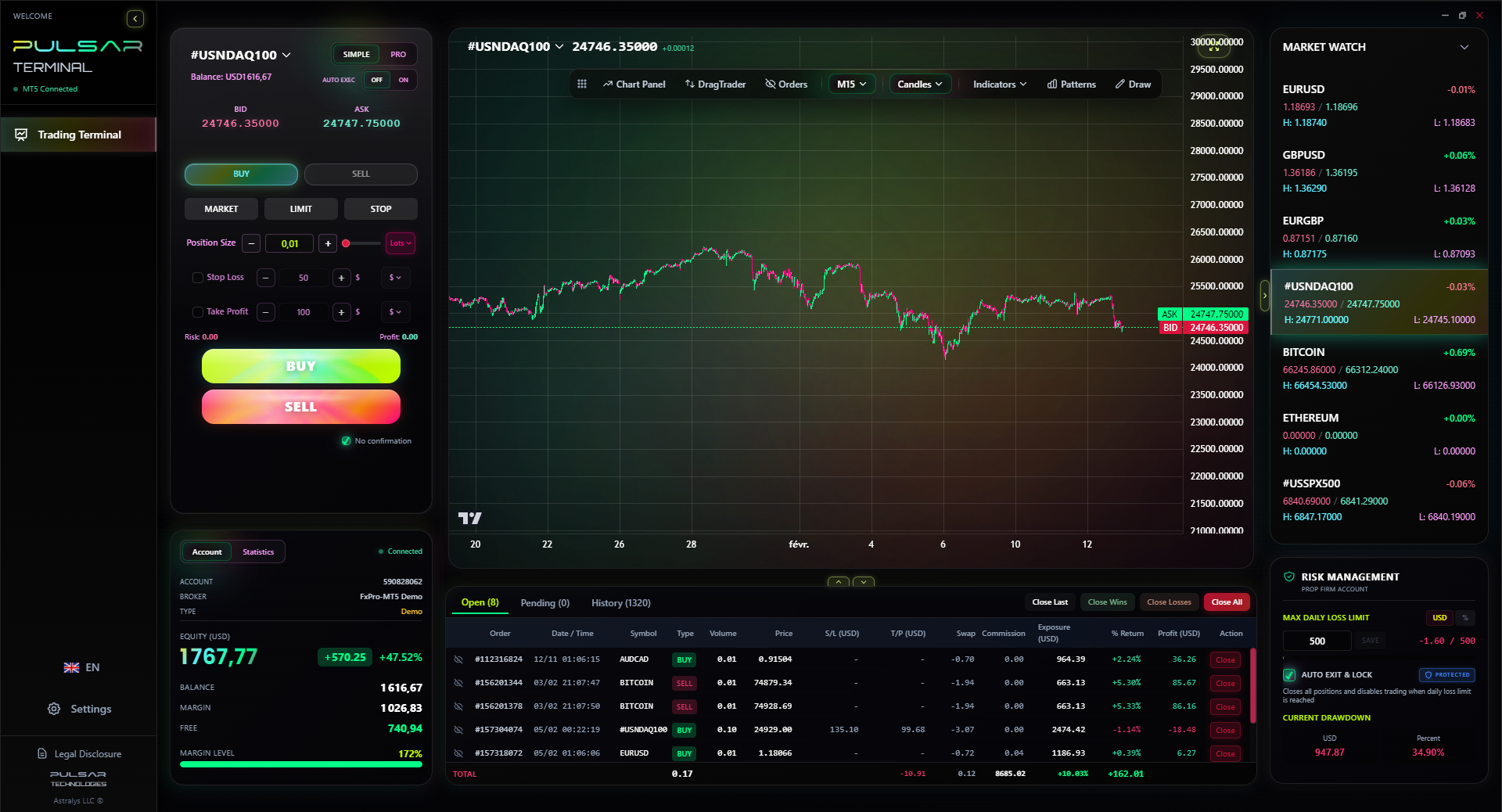
Managing the tedious volume grind for a bonus withdrawal requires strict, automated trade management, which is exactly what Pulsar Terminal's one-click order and risk tools are built for on MT5.
“Your goal isn't to get rich off $30; it's to test the broker's execution without risking your capital.”
If your goal is to learn or test a broker, consider these often-better paths.
1. A Proper Demo Account: Unlimited virtual money, no time limits (usually), and no toxic withdrawal conditions. This is where you should live for your first 3-6 months. Anyone skipping this step is donating money to the market.
2. A Broker with a Tiny Minimum Deposit: Many brokers, like some accounts at XM or IC Markets, let you open a live account for $5 or $10. Deposit R200. Trade 0.01 lots. The psychological impact of losing real money, even a tiny amount, is a more valuable teacher than any bonus. You'll learn about margin calls and slippage in a low-stakes environment.
3. Focus on Education, Not Free Cash: Spend the time you'd waste grinding bonus volume on mastering one strategy. Learn how to read the MACD indicator properly. Backtest. The market will always be here. A solid foundation is worth infinitely more than a contested $50 withdrawal.
4. Use the Bonus as a Pure Platform Test: This is the only smart use. Sign up for the bonus at a broker you're curious about (like Pepperstone). Don't even try to meet the volume. Just test their order execution speed, their mobile app, their charting tools, and their customer support response. Then move on. Consider the bonus a paid research fee from the broker to you.
“The path to consistency is never built on free lunches.”
For the complete beginner? No. You'll learn bad habits trying to game the volume requirements. The demo account is your best friend.
For an experienced trader looking to test a new broker's raw infrastructure? Yes, but with zero expectations of withdrawing profit. It's a paid tech demo.
For the disciplined, patient trader who sees it as a challenging side quest? Maybe. If you pick an FSCA-licensed broker with clear terms (XM or Tickmill are frontrunners), and you approach it with a robotic, micro-lot volume-grind mindset, you can extract a small amount of value. Just know the hourly rate for your effort will be pitiful.
The South African market is strong, with strong local regulation. That's your biggest advantage. Focus on finding a well-regulated broker with tight spreads and a platform you like - whether they offer a gimmicky bonus or not. Your long-term success depends on your skill and psychology, not on a one-time $30 hand-out that comes with a ball and chain attached.
In the end, the market doesn't care about your bonus. A pip is still a pip. A loss still hurts. Use these offers wisely, or don't use them at all. The path to consistency is never built on free lunches.
FAQ
Q1Can I actually make money from a no deposit bonus in South Africa?
Technically yes, but practically, it's very difficult for most. You can withdraw profits, not the bonus itself, but only after meeting high trading volume targets. The amount of time and disciplined micro-trading required often makes the 'profit' negligible for the effort. View it as a platform testing tool, not an income source.
Q2Is it legal for forex brokers to offer these bonuses in South Africa?
Yes, it is legal, but it's heavily regulated by the FSCA. Brokers must be transparent about all terms and conditions, cannot promise guaranteed profits, and must be licensed. Always verify the broker's FSP number on the FSCA register before signing up.
Q3What's the typical trading volume required to withdraw profits?
It's brutal. It's usually measured in standard lots (100,000 units). Common requirements are 3 to 10 lots for every $50-$100 of profit you wish to withdraw. With a typical $30 bonus, you'd be trading 0.01 micro-lots, meaning you'd need hundreds of trades to reach the target.
Q4Which South African regulated brokers offer the best no-deposit bonus terms?
Based on transparency and regulatory standing, XM (FSCA licensed) and Tickmill (FSCA licensed) are among the better options. Their terms, while still challenging, are clear and they are reputable international brokers with good post-bonus trading conditions.
Q5What happens if I lose the bonus money?
Nothing. The account is simply closed. You don't owe the broker anything. This is why they cap the bonus amount - it's a calculated marketing cost for them. You can usually open a regular account with your own money afterward if you choose.
Q6Are there any taxes on profits from a no-deposit bonus in South Africa?
Yes. According to SARS, all income from trading, regardless of the source of the initial capital, is subject to tax. If you successfully withdraw profits, those profits form part of your taxable income. Keep clear records.
Q7Can I use a no-deposit bonus with a prop firm challenge?
Almost never. Prop firms have strict rules against using external capital or bonuses to fund their evaluation challenges. Using a bonus would violate their terms and result in instant failure. Keep these two worlds separate.
Lekcja Prof. Winstona
:
- ✓No-deposit bonuses are marketing, not philanthropy.
- ✓Always verify FSCA licensing first.
- ✓The trading volume required is designed to be a barrier.
- ✓Withdraw at the first opportunity; don't get greedy.
- ✓A real $10 deposit teaches more than a phantom $100 bonus.
Jak przydatny był ten artykuł?
Kliknij gwiazdkę, aby ocenić
Tygodniowe analizy tradingowe
Darmowe tygodniowe analizy i strategie. Bez spamu.
O autorze
David van der Merwe
Trader Rynków Wschodzących
Trader z Johannesburga z 11-letnim doświadczeniem w walutach rynków wschodzących. Specjalizuje się w parach ZAR, handlu regulowanym przez FSCA i analizie rynku południowoafrykańskiego.
Komentarze
Może Ci się też spodobać

Cara Trading Forex Sukses: 7 Prinsip dari Trader Profesional
Cara trading forex sukses dengan 7 prinsip trader pro: manajemen modal, disiplin, journal trading, backtest. Data nyata, bukan janji profit palsu.
Jam Trading Forex Terbaik untuk Trader Indonesia: Panduan Lengkap dengan Tabel Waktu
Panduan jam trading forex untuk trader Indonesia. Tabel 4 sesi dunia, jam emas 20:00-00:00, sesi mana yang harus dihindari. Data akurat + tips dari trader berpengalaman.
Top 5 Sàn Forex Uy Tín Nhất 2026: Review Jujur dari Trader Indonesia
Top 5 sàn forex uy tín 2026 untuk trader Indonesia. Review jujur: spread, deposit, withdraw, dukungan lokal. Exness, XM, IC Markets & lebih.
All these calculators are built into Pulsar Terminal with real-time data from your MT5 account. One-click position sizing, automatic risk management, and instant calculations.
