


Here's a brutal truth most Nigerian trading 'gurus' won't tell you: over 80% of new traders lose money, and a huge chunk of that failure starts with misreading a simple chart.

Olumide Adeyemi
Pionier Tradingu w Afryce Zachodniej ·  Nigeria
☕ 13 min czytania
Czego się nauczysz:
- 1Why Charts Matter (Especially in Nigeria's Volatile Market)
- 2The Three Main Chart Types: Which One Actually Works?
- 3Choosing Your Timeframe: Align It With Your Life, Not Your Greed
- 4The 5 Chart Concepts That Separate Profits From Losses
- 5Platforms & Tools: What Works on Nigerian Internet?
- 6The 5 Most Common Nigerian Chart Reading Mistakes (And How to Fix Them)
- 7Putting It All Together: A Real Trade Example
Here's a brutal truth most Nigerian trading 'gurus' won't tell you: over 80% of new traders lose money, and a huge chunk of that failure starts with misreading a simple chart. You're staring at the same candlesticks as everyone in London or New York, but your context - Naira volatility, local broker spreads, and even your trading hours - changes everything. This isn't about fancy indicators. It's about learning to see what the chart is actually telling you, not what you hope it says.
Let's cut through the noise. A forex chart isn't just a pretty picture; it's a direct feed of global fear and greed, priced in real-time. For us in Nigeria, that price action has extra layers. When the CBN makes a policy announcement, you don't just read the news - you watch it explode on the USD/NGN pair. The 40.9% depreciation of the Naira in 2024? That wasn't an abstract statistic. It was a thousand-pip move on a chart that wiped out poorly positioned accounts and made fortunes for others who saw it coming.
Your job is to decode that action. The chart shows you where the big money is placing its bets. Are buyers stepping in aggressively at a certain price? That's support. Are sellers overwhelming every rally? That's resistance. In a market as sentiment-driven as Nigeria's, where foreign investor inflows can swing wildly, these levels on a chart are your only objective truth amidst the rumors on WhatsApp and Twitter.
I learned this the hard way in early 2024. I was bullish on the Naira based on 'expert' commentary, ignoring the clear breakdown structure on the USD/NGN weekly chart. I fought the trend and lost 15% of my account in two weeks. The chart was screaming sell, and I was deaf to it. Never again.

Example: The CBN's rate hike to 27.5% in late 2024. On the USD/NGN chart, you didn't just see a spike down (Naira strengthening). You saw a failure to break a key low, followed by a rapid reversal. That told a smarter story: the market doubted the policy's long-term efficacy. The chart gave the real verdict before the analysts did.

💡 Wskazówka Winstona
A clean chart is a smart chart. If you can't see the price action clearly because of 10 indicators, you're not analyzing, you're decorating. Strip it back.
“Over 80% of new traders lose money, and a huge chunk of that failure starts with misreading a simple chart.”
You'll see three types of charts everywhere. Most traders waste time on the wrong ones. Here’s the blunt breakdown.
Line Charts: For CEOs, Not Traders
A line chart connects closing prices. It's clean, simple, and utterly useless for active trading. It smooths out all the important noise - the intraday battles between buyers and sellers. You might use it for a quick glance at the long-term trend, but for making entry and exit decisions? Forget it. It's like trying to drive a car while only looking in the rearview mirror once a minute.
Bar Charts: The Overlooked Middle Child
A bar chart shows the open, high, low, and close (OHLC) for each period. It's more informative than a line chart. The top of the vertical bar is the high, the bottom is the low, the little notch on the left is the open, and the notch on the right is the close. You can see the range and the direction. It's good, but it's not the best. Why? Because visually processing a series of these bars to gauge momentum is slower. In fast markets, speed of recognition is key.
Candlestick Charts: Your Primary Weapon
This is it. The standard for a reason. A candlestick gives you the same OHLC data as a bar chart, but in a visually intuitive format. The 'body' shows the range between open and close. If the close is above the open, the body is often green or white (bullish). If the close is below the open, it's red or black (bearish). The 'wicks' or 'shadows' show the high and low.
The power is in pattern recognition. A long bullish candle with a small wick shows strong, sustained buying pressure. A small body with long wicks (a spinning top) shows indecision. After a strong trend, that spinning top can signal a potential reversal. You can see this story unfold at a glance. For Nigerian traders dealing with volatile pairs like GBP/NGN or during Lagos-London session overlap, this immediate visual cue is priceless.

Warning: Don't get lost hunting for exotic candlestick patterns like 'Three Black Crows' or 'Abandoned Baby'. The basics - engulfing patterns, hammers, shooting stars - combined with key support/resistance levels, will serve you far better. I spent months back-testing complex patterns only to find a simple bullish engulfment at a major weekly support level had a higher win rate.
“The chart was screaming sell, and I was deaf to it. Never again.”
This is where most Nigerian traders blow up their accounts. They see a signal on a 1-minute chart and treat it like gospel, ignoring the hurricane on the daily chart. You must trade in multiple timeframes. Think of it like a map: the weekly gives you the continent, the daily gives you the country, and the 1-hour or 15-minute shows you the street you're on.
The Multi-Timeframe Analysis Rule:
- Start with the Higher TF: Always check the weekly and daily chart first. What's the major trend? Where are the big support and resistance zones? If the daily chart is screaming bearish, why are you looking for buy signals on the 5-minute chart? You're just catching a falling knife.
- Use the Middle TF for Context: The 4-hour or 1-hour chart is your primary battle plan. This is where you find your trade setup - your entry zone, based on the trend from the higher TF.
- Use the Lower TF for Precision: The 15-minute or 5-minute chart is for fine-tuning your entry. Wait for price to come into your zone on the 1-hour, then use the lower TF to find a confirming candlestick pattern or a break of a minor trendline to pull the trigger.
Nigerian Reality Check: The so-called 'best' time to trade is 1-6 PM WAT (London-NY overlap). If you're a banker in Lagos or a student with classes, you might not be at your screen then. So don't try to be a scalper using 1-minute charts. Be a swing trader using the 4-hour and daily charts. Set your alerts and check a few times a day. I know a pharmacist in Abuja who only trades the daily chart, holds positions for weeks, and outperforms 90% of the 'screen-glued' traders. Match the timeframe to your lifestyle.
A practical example from my trading: I wanted to short EUR/USD in Q1 2025. The weekly chart showed a clear rejection from a multi-year resistance zone. The daily chart was forming lower highs. I waited for the 4-hour chart to show a break below a rising trendline. My actual entry order was placed just below a minor 1-hour support level. The weekly told me what to do (sell), the daily and 4-hour told me why now, and the 1-hour told me exactly where.
“The chart was screaming sell, and I was deaf to it. Never again.”
Forget the 50 indicators. Master these five concepts on your bare price chart first.
-
Support & Resistance: This is non-negotiable. Support is a price level where buying interest is strong enough to overcome selling pressure. Resistance is the opposite. These aren't thin lines; think of them as zones. The more times price tests and respects a zone, the more significant it is. When a resistance zone is finally broken, it often becomes new support (and vice versa). This is where you place your stop-losses (just beyond the zone) and take-profits (at the next zone).
-
Trend: Is the market making higher highs and higher lows (uptrend), or lower highs and lower lows (downtrend)? Or is it moving sideways (range)? Use simple trendlines connecting these highs and lows. The biggest mistake is forcing a trend where there isn't one. In a raging uptrend, don't try to pick the top. In a tight range, buy support and sell resistance until it breaks.
-
Price Patterns: These are shapes formed by price action that suggest what might come next. The two main categories are continuation patterns (like flags and triangles, suggesting the trend will resume) and reversal patterns (like head and shoulders or double tops/bottoms). A double top at a key resistance on the USD/NGN chart after a CBN announcement is a powerful signal.
-
Candlestick Patterns: As discussed, these are your entry and exit triggers. A bullish engulfing pattern at a major support zone is a high-probability buy signal. A shooting star after a long rally at resistance is a warning sign.
-
Volume (or Tick Volume): On forex, we don't have centralized volume, but most platforms show 'tick volume' (number of price changes). It's a proxy. Generally, a price move with high volume is more significant. A breakout from a resistance zone on high volume is more likely to be real than a low-volume wiggle.

Pro Tip: Before you even think about an indicator like the RSI indicator or MACD indicator, draw your support/resistance zones and trendlines on the daily chart. I guarantee your trading will improve overnight. Indicators just derivative of price; start with price itself.
💡 Wskazówka Winstona
“Match your trading timeframe to your lifestyle, not your greed.”
You need a platform that's reliable, has good charting, and doesn't freeze when your network dips. Here’s the real talk on what Nigerian traders use.
MetaTrader 4 (MT4): The undisputed king. It's lightweight, stable, and every broker supports it. The charting is excellent for basic to intermediate analysis. You can draw trendlines, channels, Fibonacci retracements, and add dozens of indicators. For 95% of Nigerian traders starting out, MT4 is all you need. Its scalping strategy execution is generally solid with a good broker.
MetaTrader 5 (MT5): The newer version. It has more timeframes, more indicators, and a built-in economic calendar. The charting is superior. However, it's a bit heavier, and not all brokers offer it. If your broker has MT5 and your PC or phone can handle it, use it. The depth of market feature (when available) is a game-changer for seeing order flow.
TradingView: This is a charting powerhouse. Its social features and idea-sharing are popular, but be wary - for every good idea, there are ten terrible ones. Use TradingView for your primary analysis and idea generation because its drawing tools and chart responsiveness are top-tier. Then, execute the trade on your broker's MT4/5 platform. This is my personal workflow.
Broker-Specific Platforms: Brokers like XM review, Exness review, and IC Markets review have their own web and mobile platforms. They're usually user-friendly but can be limited. Use them for quick checks and managing open trades, but do your serious analysis on MT or TradingView.
Critical Consideration – Data Costs: Streaming real-time charts uses data. If you're on a limited plan, configure your platform to update less frequently when you're not actively trading, or use the mobile app only on WiFi for deep analysis. A frozen chart during a volatile Naira move is a direct path to a margin call.
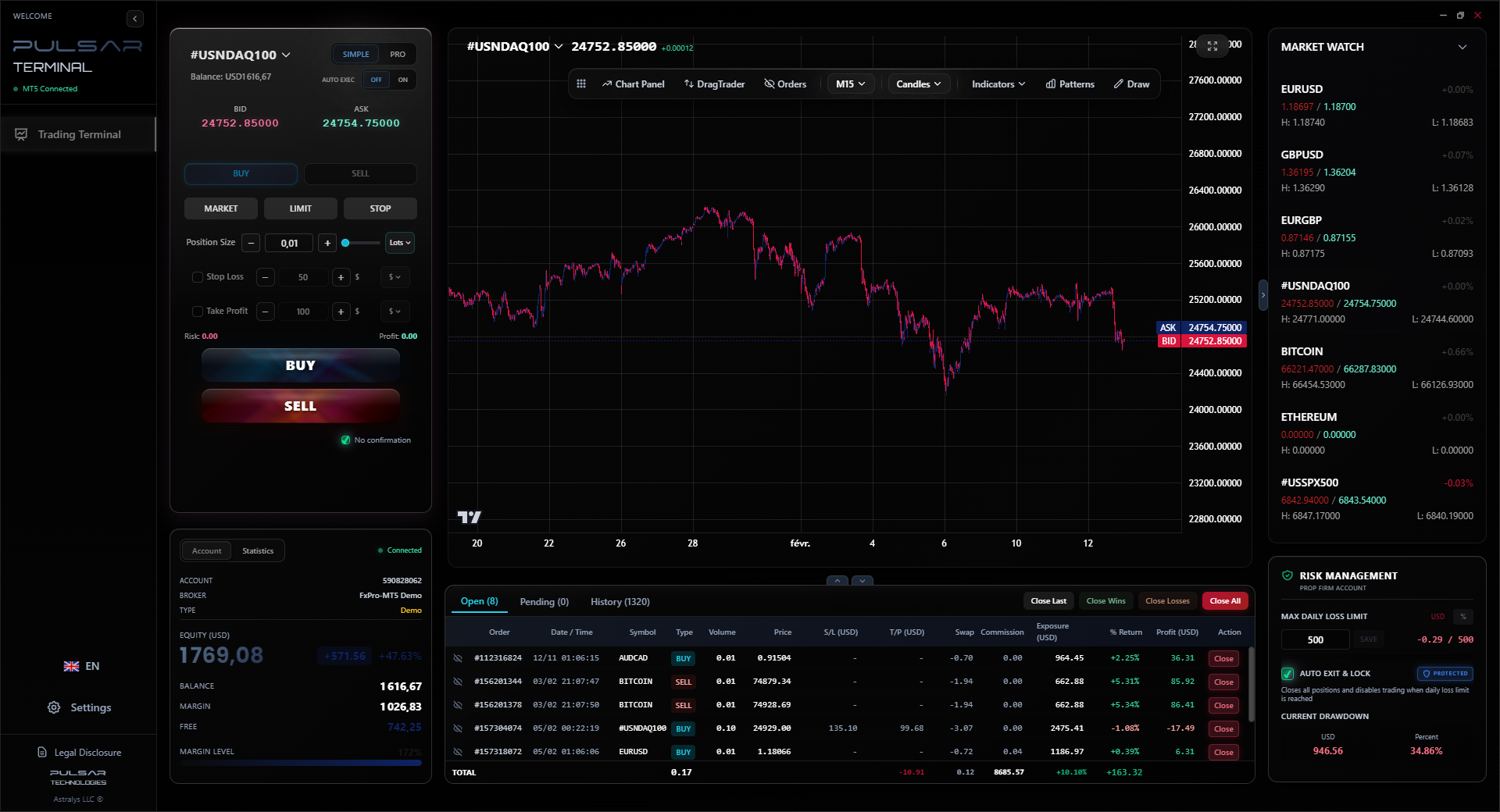
Manually drawing every trendline and order level is slow; Pulsar Terminal integrates directly with MT5 to let you drag, drop, and manage complex orders and analyses right on your chart.
“Match your trading timeframe to your lifestyle, not your greed.”
I've made these. My students make these. Let's kill these habits now.
-
Overcomplicating the Chart: You have 12 moving averages, Bollinger Bands, RSI, MACD, and Stochastic on one screen. The price is buried. This is noise, not analysis. Fix: Start with a clean chart. Price, one or two key support/resistance zones, and maybe one trend indicator (like a 20-period EMA) and one momentum oscillator (like RSI). That's it.
-
Ignoring Higher Timeframes: You see a perfect buy signal on the 15-minute chart and jump in, only to get crushed because the daily trend is violently bearish. Fix: Make it a rule. No entry without checking the daily chart trend. Period.
-
Drawing S/R as Pinpoint Lines: You draw a thin line at a price and get stopped out when price taps it and reverses 0.3 pips above it. Fix: Draw zones, not lines. Use the high/low of the candlestick wicks that formed the level. A zone gives the market room to breathe.
-
Chasing Price: You see a massive green candle and FOMO kicks in. You buy at the top, just as the move exhausts. Fix: Have a plan. Wait for price to come back to a tested support zone or a moving average in an uptrend. Be patient. The market will give you another chance. It always does.
-
Not Understanding the Spread: You place a buy order based on a breakout shown on your chart, but your fill is 1.5 pips higher because of the spread definition. Your perfect trade is now underwater from the start. Fix: Know your broker's average spread for your pair, especially during off-hours. Factor it into your entry and stop-loss calculations. Use a position size calculator that includes spread in the risk calculation. This is crucial for pairs involving Naira or exotic crosses where spreads can be wide.
💡 Wskazówka Winstona
Your first job is to protect your capital, not to be right. A well-placed stop-loss based on a chart level is the best insurance policy you'll ever buy.
“Your edge comes from disciplined application, not a secret indicator.”
Let's walk through a simplified example using Gold (XAU/USD), a popular asset in Nigeria, and concepts you can apply to any pair.
Step 1: The Higher Timeframe Story (Weekly/Daily) I look at the XAU/USD guide daily chart. I see Gold has been in a steady uptrend, making higher highs and higher lows. It has recently pulled back and is approaching a previous resistance zone (around $2150) that, if the trend is strong, should now act as support. The overall trend is UP.
Step 2: The Setup Timeframe (4-Hour) Zooming to the 4-hour chart, I see the pullback is slowing down. Price is coiling near that $2150 support zone. The selling candles are getting smaller (losing momentum). I draw a descending trendline connecting the recent lower highs of the pullback.
Step 3: The Trigger (1-Hour) I switch to the 1-hour chart and wait. I want to see price either bounce cleanly off the $2150 zone, or, better yet, break upwards through that descending trendline. A few sessions later, a strong bullish engulfing candle breaks the trendline. This is my trigger.
Step 4: Trade Execution
- Entry: I buy at the close of that bullish candle: $2155.
- Stop-Loss: I place my stop-loss just below the key support zone, at $2147. This risks 8 pips or $80 on a standard lot (1 pip = $10).
- Take-Profit: I look for the next major resistance zone on the daily chart, which is near the previous high at $2190. That's a 35-pip target.
- Risk/Reward: I'm risking $80 to make $350. A 1:4.3 ratio. This is a swing trading mindset.
The Outcome: The trade played out over three days. Price tested $2150 once more after my entry (normal), then rallied to hit my $2190 target. I banked the profit. The chart told the whole story: trend context, key level, momentum shift, clear trigger. No guesswork.
This process works on EUR/USD guide, GBP/JPY, or any market. The principles are universal. Your edge comes from disciplined application, not a secret indicator.
FAQ
Q1What is the best type of forex chart for beginners in Nigeria?
Candlestick charts, 100%. They give you the most information (open, high, low, close) in the most visual, intuitive format. Start on the daily and 4-hour timeframes to avoid noise. Ignore line and bar charts for active trading.
Q2How do I know if a support or resistance level is strong?
Look for two things: 1) Multiple Touches: The more times price has reacted to a level (e.g., bounced off it 3+ times), the stronger it is. 2) Timeframe Significance: A level that appears on the weekly or daily chart is far more important than one on the 15-minute chart. A strong level has a history.
Q3What timeframes should a Nigerian swing trader use?
Use the daily chart to define the primary trend and major support/resistance. Use the 4-hour chart to find your entry setups. Use the 1-hour chart for your precise entry trigger. This aligns perfectly with checking your trades a few times a day around your work schedule.
Q4Why does my chart look different from my friend's chart?
Three main reasons: 1) Broker Data Feed: Different brokers can have slightly different price quotes, especially on exotics. 2) Chart Settings: You might be on 'Bid' price while they're on 'Ask', or you have different session break times set. 3) Time Zone: Ensure your platform is set to GMT or your broker's time, not your local WAT, for consistency.
Q5Is TradingView better than MetaTrader for charting?
For pure charting analysis and drawing tools, TradingView is superior - it's faster, more intuitive, and has better social features. However, MetaTrader (MT4/5) is integrated directly with your broker for seamless trading. The best combo is to do your analysis on TradingView and execute on MetaTrader.
Q6How do I factor the spread into my chart analysis?
You don't analyze based on spread, but you must account for it in execution. When you identify a breakout level on your chart, add your broker's typical spread to the level to get your actual entry price if buying. Always calculate your position size and stop-loss based on the real fill price, not the chart price. A good position size calculator will help.
Q7Can I make money just by reading price charts without indicators?
Absolutely. In fact, many professional traders rely primarily on price action (support/resistance, trends, candlestick patterns). Indicators like RSI or MACD are just derivatives of price; they lag. Learning to read the raw price chart is the most fundamental skill you can develop. Master price first, then add an indicator or two for confirmation if needed.
Lekcja Prof. Winstona
:
- ✓Candlestick charts are your primary weapon; master them first.
- ✓Always analyze from higher timeframes down (Weekly -> Daily -> 4H).
- ✓Draw support/resistance as zones, not thin lines.
- ✓Factor in your broker's spread before you click 'buy' or 'sell'.
- ✓A clean chart with price and key levels beats a cluttered one every time.
Jak przydatny był ten artykuł?
Kliknij gwiazdkę, aby ocenić
Tygodniowe analizy tradingowe
Darmowe tygodniowe analizy i strategie. Bez spamu.
O autorze
Olumide Adeyemi
Pionier Tradingu w Afryce Zachodniej
Jeden z najaktywniejszych edukatorów tradingu forex w Nigerii. 8 lat doświadczenia tradingowego z Lagos. Specjalizuje się w strategiach niskiego kapitału i wyzwaniach prop firm dla afrykańskich traderów.
Komentarze
Może Ci się też spodobać

Cara Trading Forex Sukses: 7 Prinsip dari Trader Profesional
Cara trading forex sukses dengan 7 prinsip trader pro: manajemen modal, disiplin, journal trading, backtest. Data nyata, bukan janji profit palsu.
Jam Trading Forex Terbaik untuk Trader Indonesia: Panduan Lengkap dengan Tabel Waktu
Panduan jam trading forex untuk trader Indonesia. Tabel 4 sesi dunia, jam emas 20:00-00:00, sesi mana yang harus dihindari. Data akurat + tips dari trader berpengalaman.
Top 5 Sàn Forex Uy Tín Nhất 2026: Review Jujur dari Trader Indonesia
Top 5 sàn forex uy tín 2026 untuk trader Indonesia. Review jujur: spread, deposit, withdraw, dukungan lokal. Exness, XM, IC Markets & lebih.
All these calculators are built into Pulsar Terminal with real-time data from your MT5 account. One-click position sizing, automatic risk management, and instant calculations.
