


Over 70% of retail traders lose money.

David van der Merwe
Trader Rynków Wschodzących ·  South Africa
☕ 9 min czytania
Czego się nauczysz:
Over 70% of retail traders lose money. That's not just a scary statistic, it's the single most important number for understanding forex client sentiment. If the majority is usually wrong, their collective positioning becomes a powerful map of where not to be. I spent years ignoring this data, convinced my own analysis was superior. I was wrong. Learning to read the crowd's fear and greed - and then confidently betting against it - changed my trading completely. This guide is about turning that overwhelming 70% failure rate into your edge.
Forex client sentiment data shows the percentage of retail traders holding long or short positions in a specific currency pair, in real-time. Brokers like Exness review, IC Markets review, and XM review often publish this data for their own client base. It's a snapshot of what the 'little guys' are doing.
Crucially, it's not a predictor of what will happen. It's a gauge of what has already happened - where the retail money is parked. When you see 80% of traders are long EUR/USD, it doesn't mean the price will go up. It means a huge pile of retail buy orders is already in the market. There's often no one left to buy, only a crowd that might need to sell in a panic.

Warning: This data almost exclusively tracks retail traders. It doesn't show what hedge funds, banks, or large institutions are doing. You're seeing one side of the market, but it's the side that tends to be wrong at extremes.
The logic is brutally simple. Retail traders are often driven by emotion - chasing breakouts, buying highs out of FOMO, or selling lows in a panic. They are typically undercapitalised, over-leveraged, and slow to react. The professional money waits for these emotional extremes to build and then takes the other side.
Think of it like a crowded trade. If everyone is already in, who's left to push it further? The move becomes fragile. A small shift can trigger a cascade of stop-losses from the overcrowded side, accelerating the move in the opposite direction. Your job is to identify when the crowd is at an extreme and position yourself for that potential reversal.
A Real Trade That Hurt
I learned this the hard way with GBP/ZAR a few years back. The pair was in a strong uptrend, and sentiment showed 85% of clients were long. 'Great,' I thought, 'the trend is strong, everyone agrees.' I joined the long side. What I missed was that the trend was exhausted. All that bullishness was already priced in. When a minor piece of UK data disappointed, the sell-off was vicious. My stop was hit, and the pair fell another 400 pips. I was part of the panicking crowd. That loss taught me more about forex client sentiment than any winning trade ever could.

Pro Tip: Don't just look at the percentage. Look at the change. A jump from 60% to 75% long is more significant than a steady reading of 70%. It shows a rush of new, likely emotional, money entering the trade.

💡 Wskazówka Winstona
A sentiment extreme is a warning light, not a green light. The trade only starts when price action flips the switch.
“Forex client sentiment data shows you where the emotional money is parked, and emotional money usually gets towed.”
You don't need a fancy terminal. Many major brokers provide this for free.
- MT4/MT5 Platforms: Some brokers bake it into their trading platform as an indicator.
- Broker Websites: Check the 'Market Analysis' or 'Trading Tools' section of your broker's site.
- Dedicated Sentiment Websites: Independent sites aggregate data from multiple brokers, giving a broader view.
Here’s a quick guide to interpreting the numbers:
| Client Sentiment Reading | Implied Bias | Typical Trader Action | Contrarian Stance |
|---|---|---|---|
| > 70% Long | Overwhelmingly Bullish | Chasing the trend, buying highs | Look for short signals. Price may be topping. |
| > 70% Short | Overwhelmingly Bearish | Panic selling, giving up on rallies | Look for long signals. Price may be bottoming. |
| 55% - 70% Long/Short | Moderate Bias | Trend-following, but not extreme | Neutral/Confirm with other analysis. |
| ~50% | Balanced/Uncertain | Indecision, ranging markets | Sentiment is not a useful signal here. |
Remember, these are guidelines, not holy rules. A 75% long reading in a genuinely powerful, news-driven bull market might just keep going. That's why you never trade on sentiment alone. It's a filter, not a strategy. You must combine it with your own technical or fundamental analysis from your swing trading or scalping strategy toolkit.

Sentiment shouldn't tell you when to enter. It should tell you which direction to look for entries. Here’s how I weave it into my process.
Step 1: The Sentiment Check. Before I even draw a trendline, I check the sentiment for my chosen pair. If it shows 78% long, my immediate bias is to look for short setups. It frames my entire analysis.
Step 2: Find Confluence. I won't short just because sentiment is extreme. I need price to agree. I look for:
- Price at a key resistance level (like a previous swing high or a Fibonacci level).
- Bearish reversal patterns (like a double top or a bearish engulfing candle).
- Divergence on an oscillator like the RSI indicator or MACD indicator.
Step 3: Execute with Discipline. My entry is based on my technical trigger, not the sentiment number. But that sentiment reading directly affects my risk management. In a high-conviction contrarian trade, I might use a slightly wider stop, knowing the initial move might go against me as the crowd tries to push it one last time.
A Trade That Worked: USD/ZAR In early 2023, USD/ZAR was near 17.50. Sentiment data showed 82% of retail clients were short, betting on Rand strength. The crowd was overwhelmingly bearish on the dollar. Price, however, was bouncing off a major multi-month support zone and showing a bullish MACD indicator divergence on the daily chart. The confluence was perfect. I went long at 17.55, with a stop at 17.30. The trade went against me briefly, dipping to 17.45, but then reversed sharply. I took partial profits at 18.00 and let the rest run as the crowd's short positions got squeezed. That one trade netted over 500 pips. The sentiment told me what to do; the charts told me when.
💡 Wskazówka Winstona

“I don't use sentiment to find trades. I use it to filter out the bad ones.”
This tool is deceptively simple. Here's where I've blown up.
Pitfall 1: Fading Every Extreme. Just because sentiment hits 70% doesn't mean a reversal is due. In a parabolic trend, it can stay at 80%+ for weeks. I once tried to short a raging XAU/USD guide bull run because sentiment was at 88% long. I got run over. The lesson? Wait for price action confirmation. Don't just jump in front of the train.
Pitfall 2: Ignoring the Underlying Trend. Contrarian signals work best at potential trend exhaustion points. Using a bearish sentiment extreme to go short in a strong, established downtrend is often a mistake. You're being contrarian to the retail crowd, but you might be aligning with the professional trend. Context is everything.
Pitfall 3: Poor Position Sizing. Contrarian trades can be early. The crowd can get even more extreme before it breaks. If you size too big, a final push against you can trigger your stop or cause emotional distress. Always use a position size calculator. No matter how strong the sentiment signal, never risk more than 1-2% of your capital.
Pitfall 4: Data Lag. The data is real-time for open positions, but it doesn't show pending orders. A sudden shift can happen fast. Don't treat the number as static gospel; it's a fluid picture.
Warning: Sentiment is a secondary indicator. Never let it override clear stop-loss levels from your primary strategy. A margin call doesn't care if you were being cleverly contrarian.
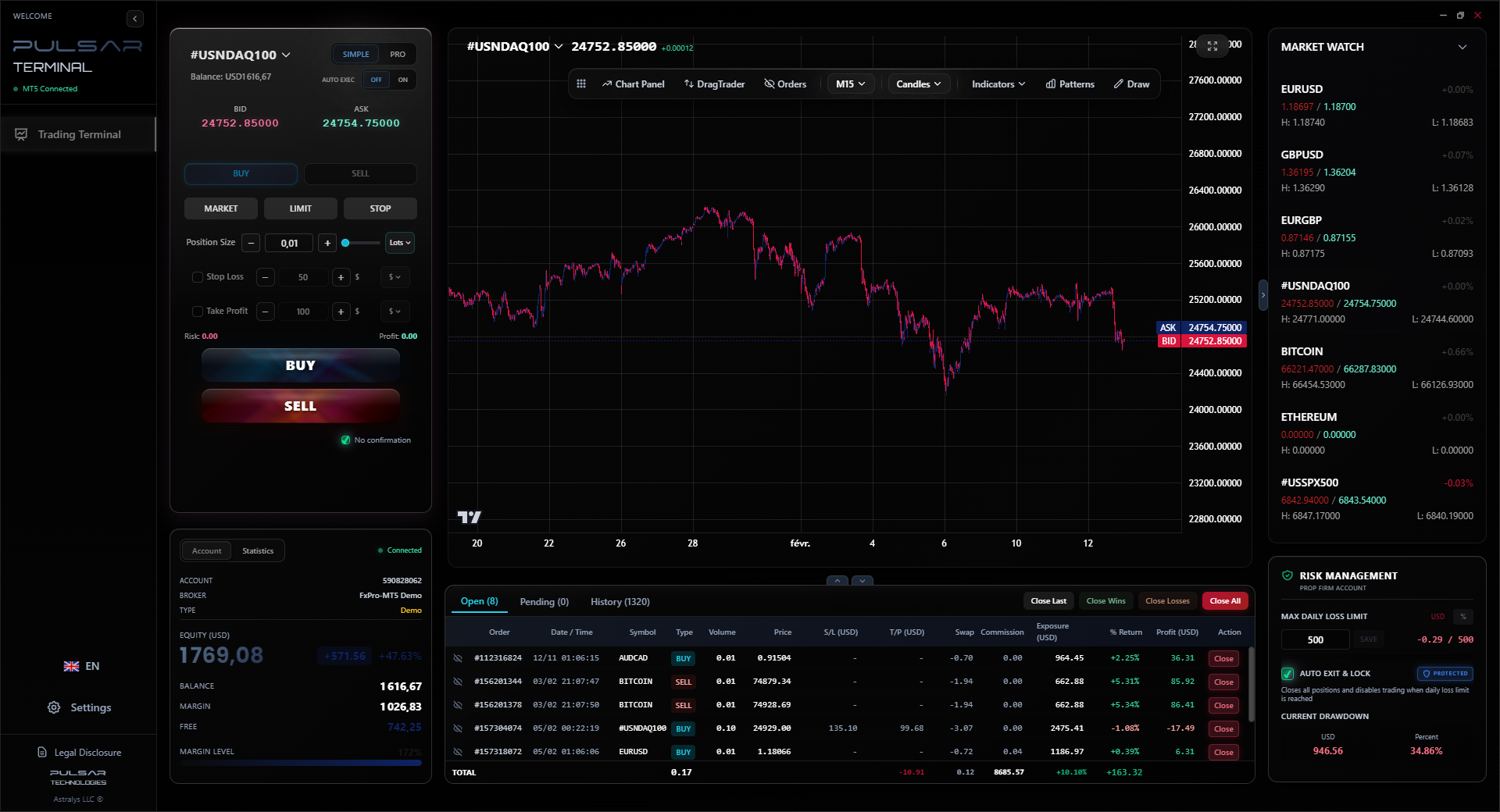
Managing contrarian trades often requires precise, multi-level exits to secure profit as the crowd panics, a process Pulsar Terminal's multi-TP/SL with partial closures automates perfectly on your MT5 chart.
Trading USD/ZAR, EUR/ZAR, or GBP/ZAR with sentiment adds another layer. The 'client' data is often global. You're seeing what a German trader in Frankfurt and a Japanese trader in Tokyo think about the Rand. This can be incredibly useful.
South African retail traders can be overly pessimistic or optimistic about their own currency based on local headlines (load-shedding, politics). Global retail sentiment often amplifies these moves at extremes. When global retail is massively short ZAR (long USD/ZAR) during a local crisis, it can signal a sentiment capitulation low is near.
However, remember the Rand is a high-volatility, liquidity-sensitive currency. Sentiment extremes can last longer during genuine risk-off events. Combine global retail sentiment with a check of SA-specific bond yields or commodity prices for a fuller picture. I find sentiment works brilliantly on EUR/USD guide due to its liquidity, but on ZAR pairs, you need to be more patient and use wider stops.
💡 Wskazówka Winstona
Backtest this: look for times sentiment was >75%. See what price did over the next 5-10 candles. Your own charts are the best teacher.
“Your edge isn't in predicting the crowd's next move, but in recognising when it has finally run out of room.”
Here's the process I follow now, born from years of trial and error.
- Identify the Extreme: Is client sentiment above 70% or below 30% on a major pair? If not, shelf it as a tool for this trade.
- Check for Confluence: Is price at a clear technical level (support/resistance, trendline)? Is there a reversal pattern or oscillator divergence? If yes, proceed. If no, wait.
- Define the Trade: Plan your entry, stop-loss, and take-profit levels based on your technical setup, NOT the sentiment number. Use your position size calculator.
- Manage the Trade: Be prepared for volatility. The crowd may fight the reversal initially. Don't move your stop unless your original technical reason is invalidated.
- Review: After the trade, win or lose, go back. Did the sentiment extreme mark a turning point? How did price behave? This review loop is how you build intuition.
Forex client sentiment won't give you a magic 'buy here' signal. What it gives you is context. It tells you whether you're about to swim with a panicking school of fish or if you're quietly positioning yourself where the smart money will soon feed. In a game where most lose, that's an edge worth having.
FAQ
Q1Is forex client sentiment a leading or lagging indicator?
It's a bit of both, but mostly a contemporaneous lagging indicator. It shows positions already taken (lagging), but because those positions are often wrong at extremes, it can be a leading indicator of a potential reversal. The key is the extreme reading itself is the signal to watch for a change in price direction.
Q2Can I use sentiment for scalping?
It's less reliable for very short timeframes like scalping. Sentiment shifts more slowly than a 1-minute chart. It's more powerful for swing trading and daily analysis, where crowd psychology has time to build and exhaust itself.
Q3Why do brokers give this data away for free?
Because it's a valuable educational and analytical tool that attracts clients. Also, a more informed client (who manages risk better) is a more sustainable client for the broker in the long run, even if they are trading against the broker's other clients.
Q4Does high short interest mean the price must go up?
No, it never 'must' do anything. It means conditions are ripe for a short squeeze if the price starts to rise. But if fundamental news is overwhelmingly negative, price can continue down despite high short interest. Always wait for price confirmation.
Q5How is this different from the Commitment of Traders (COT) report?
The COT report shows positions of large institutional players (commercials, speculators) and is released weekly by exchanges. Forex client sentiment shows real-time retail trader positions from specific brokers. They are opposite ends of the spectrum: COT shows the 'smart money,' sentiment often shows the 'dumb money.'
Q6As a South African, should I focus on ZAR pair sentiment?
You should monitor it, but don't ignore majors like EUR/USD. Sentiment often creates cleaner, less noisy signals in highly liquid markets. Use ZAR pair sentiment with extra caution, given the Rand's volatility and sensitivity to local and global risk flows.
Lekcja Prof. Winstona
:
- ✓Trade against sentiment extremes above 70% or below 30%.
- ✓Never enter without price action confirmation.
- ✓Wider stops help survive the crowd's final push.
- ✓Sentiment on EUR/USD is cleaner than on volatile ZAR pairs.
- ✓Review every extreme: did it mark a high or low?
Jak przydatny był ten artykuł?
Kliknij gwiazdkę, aby ocenić
Tygodniowe analizy tradingowe
Darmowe tygodniowe analizy i strategie. Bez spamu.
O autorze
David van der Merwe
Trader Rynków Wschodzących
Trader z Johannesburga z 11-letnim doświadczeniem w walutach rynków wschodzących. Specjalizuje się w parach ZAR, handlu regulowanym przez FSCA i analizie rynku południowoafrykańskiego.
Komentarze
Może Ci się też spodobać

Cara Trading Forex Sukses: 7 Prinsip dari Trader Profesional
Cara trading forex sukses dengan 7 prinsip trader pro: manajemen modal, disiplin, journal trading, backtest. Data nyata, bukan janji profit palsu.
Jam Trading Forex Terbaik untuk Trader Indonesia: Panduan Lengkap dengan Tabel Waktu
Panduan jam trading forex untuk trader Indonesia. Tabel 4 sesi dunia, jam emas 20:00-00:00, sesi mana yang harus dihindari. Data akurat + tips dari trader berpengalaman.
Top 5 Sàn Forex Uy Tín Nhất 2026: Review Jujur dari Trader Indonesia
Top 5 sàn forex uy tín 2026 untuk trader Indonesia. Review jujur: spread, deposit, withdraw, dukungan lokal. Exness, XM, IC Markets & lebih.
All these calculators are built into Pulsar Terminal with real-time data from your MT5 account. One-click position sizing, automatic risk management, and instant calculations.
