


If you're searching for 'forex contact' hoping to find a customer service number to call when your trade goes south, you've already lost.

David van der Merwe
Trader Rynków Wschodzących ·  South Africa
☕ 7 min czytania
Czego się nauczysz:
- 1What 'Forex Contact' Really Means (Spoiler: It's Painful)
- 2Your Real Points of Contact (The Only Ones That Matter)
- 3Building Contact Through Screen Time (Not Overtrading)
- 4The Tech That Facilitates Real Contact (Your Trading Desk)
- 5When Contact Breaks: Loss Management & The Prop Firm Reality
- 6From Contact to Consistency: The Boring Truth
If you're searching for 'forex contact' hoping to find a customer service number to call when your trade goes south, you've already lost. That's the harsh truth. In this game, 'contact' isn't about phoning a help desk. It's the brutal, intimate connection between your money and the ever-shifting sentiment of millions of other traders. I'll show you what real market contact looks like, why most South Africans get it wrong, and how to build the only connection that matters: the one that makes you money.
Let's clear this up right now. You won't find a useful 'forex contact' number for the market itself. The market doesn't have a complaints department. When traders, especially new ones here in SA, talk about needing contact, they're often secretly looking for someone to blame or a shortcut to understanding. Real forex contact is the visceral feel of the market's pulse. It's reading the order flow on the EUR/USD as London opens, sensing the hesitation before a major ZAR pair news drop, or feeling the sheer weight of a stop-loss hunt. It's not a passive thing you look up. It's an active, often uncomfortable, skill you build through screen time and repeated failure.
I learned this the hard way. Early on, I blew a R5,000 account on USD/ZAR because I was 'in contact' with my gut feeling, not the market's reality. I ignored the clear rejection at R18.40, thinking I knew better. The market swiftly corrected my ignorance. That loss was my first real, expensive point of contact.

Warning: Searching for an external 'forex contact' is a coping mechanism for a lack of strategy. The only contact details you need are your entry price, your stop loss, and your take profit levels.

💡 Wskazówka Winstona
Your first 'contact' with a new trade should be your stop-loss order. Place it before you even think about your entry. If you can't find a sensible stop, you have no business being in the market.
“Searching for an external 'forex contact' is a coping mechanism for a lack of strategy.”
Forget phone numbers. Your trading survival depends on maintaining clear, disciplined contact with these three entities. Screw this up, and you're just donating money.
1. Contact with Price Action
This is non-negotiable. It means learning to read what price is telling you, not what you hope it will do. It's spotting a fakeout above a key resistance level on the XAU/USD (gold) chart, or recognizing a genuine breakout with volume. This isn't about fancy indicators, though tools like the RSI indicator or MACD indicator can help confirm what you see. It's about understanding structure: where are the highs, lows, and consolidation zones? This is your primary line of communication.
2. Contact with Your Broker
Okay, fine, here's an actual contact point. But it's not for trade advice. It's for infrastructure. You need to know their spread patterns during SA market open (often wider on ZAR pairs), their policy on slippage during SARB announcements, and how fast they execute orders. Is your spread definition a fixed 1.5 pips or a variable monster that jumps to 10? Test this. I use Exness review and IC Markets review for their raw spreads, but you must do your own checks. A failed order during a volatile move is a catastrophic loss of contact.
3. Contact with Your Own Psychology
This is the hardest one. It's the internal dialogue when a trade moves against you. Do you panic and move your stop loss? Do you double down out of pride? Maintaining contact here means having a pre-written plan and the discipline to follow it, even when every fiber of your being is screaming to do the opposite. Your trading journal is your contact log for this. Write down every emotional impulse you ignored (or foolishly followed).
“Your soul is a terrible trader. Your discipline is what makes money.”
There's a massive difference between watching the market and actively engaging with it. Putting in screen time doesn't mean placing 50 trades a day. That's a surefire way to get chopped up. It means observing.
Spend a week just watching the USD/ZAR pair from 9 AM to 11 AM SAST. Note where it finds buyers and sellers. Watch how it reacts to the JSE opening. Do this without placing a single trade. You're building a mental map, a sense of its rhythm. This is how you develop an edge. Later, when you see a similar setup, you'll have a deeper, more intuitive contact point than any news headline can provide.

Pro Tip: Don't watch every pair. Pick two or three. Master them. For most South Africans, focusing on USD/ZAR, EUR/USD, and maybe XAU/USD gives you enough scope without drowning in data. Deep contact with one pair is better than superficial awareness of ten.
This process is boring. It's tedious. It feels like you're not 'doing' anything. But this is the grunt work that separates punters from traders. It's how you learn that EUR/USD often has a false move at the New York open, or that gold (XAU/USD) can be eerily quiet before a big US data release. This knowledge comes from contact, not from a textbook.
💡 Wskazówka Winstona
If you feel the need to 'contact' your broker to complain about a trade outcome, you've already failed. The trade was wrong before you even entered. Your journal, not their support desk, holds the answer.
“A dropped connection during a trade is the ultimate betrayal; you're blind.”
Your tools are your mediators for market contact. A slow platform, unreliable internet, or a broker with constant requotes breaks that contact. For active styles like scalping strategy, this is fatal. You need a setup that disappears, letting you focus purely on price.
- Trading Platform: MT4/MT5 is the standard for a reason. It's stable and ubiquitous. But the real contact is built on top of it. This is where a tool like Pulsar Terminal shines - it doesn't replace MT5, it supercharges your interaction with it.
- Internet: Get a fibre line. Don't trade on mobile data during load-shedding if you can avoid it. A dropped connection during a trade is the ultimate betrayal; you're blind.
- Hardware: At least two monitors. One for your main chart, one for your economic calendar, trade journal, and maybe a longer time frame. Squinting at a single laptop screen destroys your situational awareness.
I learned this after a costly mistake. I was in a good short on GBP/ZAR, my internet blinked during a scheduled outage, and by the time I reconnected, I was stopped out and the trade had reversed perfectly without me. The market didn't care about my load-shedding. My lack of a proper backup plan (a UPS) broke the contact, and I paid for it.
“A dropped connection during a trade is the ultimate betrayal; you're blind.”
You will lose contact with the market. It happens to everyone. A news event comes out of nowhere, your analysis was just wrong, or you simply freeze. This is when your pre-established rules take over. This is your emergency contact procedure.
Your stop loss is your single most important point of contact in these moments. It's a direct line that says, "You are wrong here. Exit." Moving it is like ignoring a fire alarm. I once watched a R15,000 drawdown turn into a R40,000 disaster on a single EUR/JPY trade because I kept 'staying in contact' with the hope of a reversal. I was just staying in contact with my own stupidity.
This is brutally relevant for the prop firm scene in SA. These firms don't care about your story. They have one point of contact with you: your daily and overall loss limits. Blow through that, and you're out. It's automated, emotionless, and final. Tools that can automate this protection are not a luxury; they're a necessity for surviving the evaluation. Managing this risk is the ultimate discipline, and frankly, most people fail at it. Understanding a margin call is theoretical until you get one that liquidates half your account.
💡 Wskazówka Winstona
The most valuable contact you'll make is with other disciplined traders. Find one or two, share your trade logs brutally honestly, and let them tear your mistakes apart. Ego has no place here.
When your discipline is your only real edge, tools like Pulsar Terminal automate your risk rules—like prop firm loss limits—directly on MT5, so you can't break contact with your own plan.
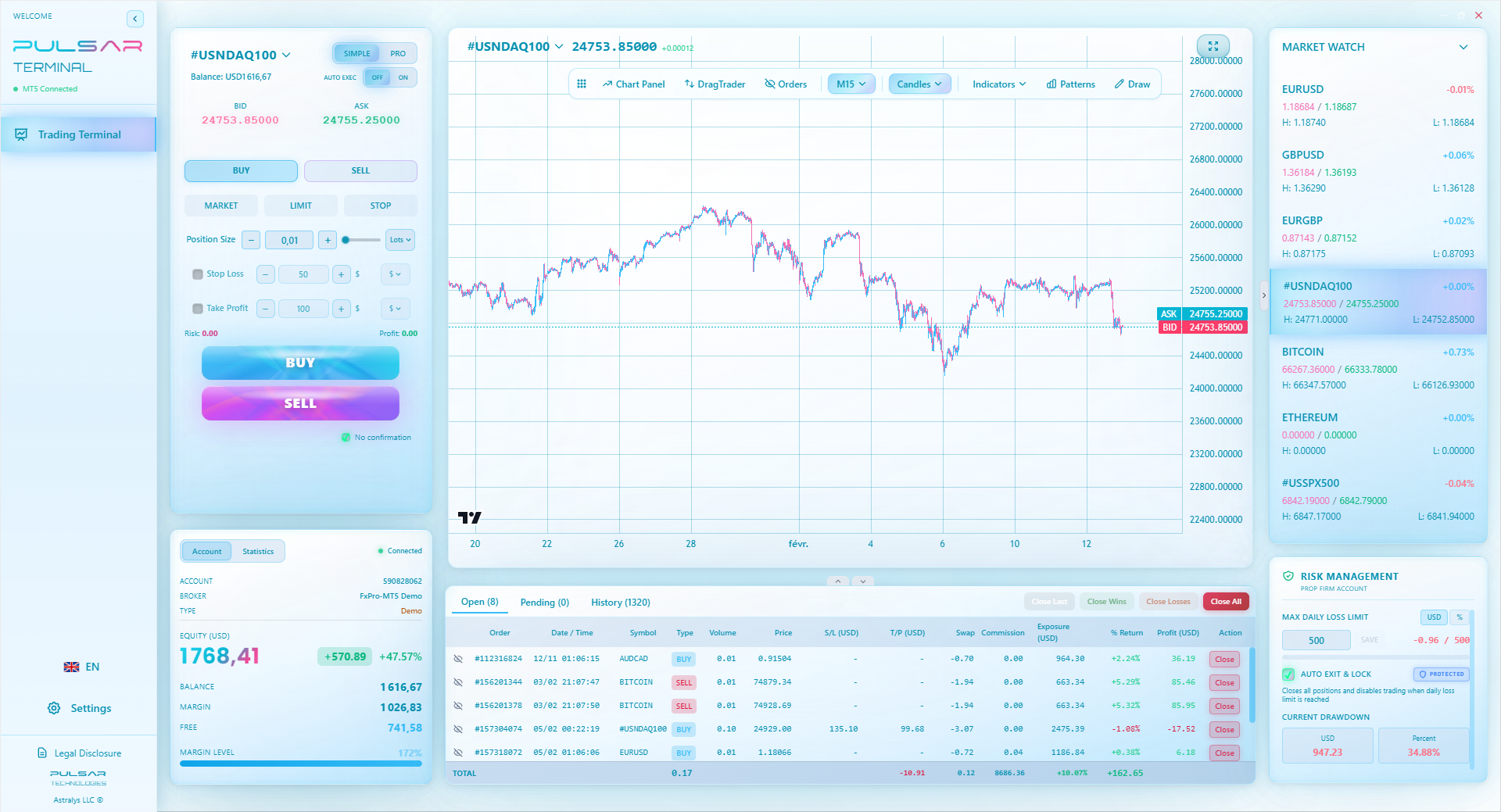
“Moving your stop loss is like ignoring a fire alarm.”
Sustainable trading isn't about the euphoria of a perfect call. It's about the boring, repetitive maintenance of contact with your process. It's checking your charts at the same time each day, reviewing your journal every Friday, and calculating your position size with a position size calculator for every single trade, no matter how 'sure' you are.
Consistency comes from turning those points of contact into unbreakable rituals.
- Pre-Market Ritual: Scan news, check for major support/resistance.
- Trade Execution Ritual: Set entry, stop, take profit. Then press buy/sell.
- Post-Trade Ritual: Record the trade, note the emotional state, move on.
This robotic approach feels like it lacks the 'soul' of trading. Good. Your soul is a terrible trader. Your discipline is what makes money. When you've built this, you'll find you need to search for 'forex contact' less and less. You'll already be in the conversation, listening, and responding not with emotion, but with a plan. That's when you graduate from a hopeful to a professional. For longer-term approaches, this disciplined contact is even more critical, as outlined in our guide on swing trading.
FAQ
Q1Is there a forex contact number for the South African market?
No. There's no central number for the Forex market itself. You have contact with your broker for account issues, and you have contact with price data via your trading platform. The 'market' is a decentralized network of banks and institutions; you can't phone it.
Q2What's the best way to get in touch with a forex broker in SA?
Live chat on their website is usually fastest for general queries. For serious account or withdrawal issues, a registered email trail is best. Always check their FSCA license status first. Don't bother with brokers that only offer a Cape Town landline and no online support.
Q3How much screen time do I need to build good 'market contact'?
There's no set hours. It's about quality, not quantity. 2 hours of focused, observant chart time is better than 8 hours of distracted watching. Aim for at least 3 months of daily observation in a demo or small live account before you think you have a clue.
Q4I keep losing contact with my discipline and overtrading. Help?
You're not alone. This is the #1 killer. Remove the ability to overtrade. Set a daily max loss limit (e.g., 2% of account) and a max number of trades (e.g., 3) in your platform if it allows. If you hit either, the platform locks you out for the day. Enforce your own rules with technology.
Q5Does a better internet connection really improve my trading?
Absolutely, especially for fast-moving markets or if you're scalping. A fibre connection vs. 3G mobile data can mean the difference between a 0.5 pip slippage and a 5 pip slippage on your entry. That adds up to real money over dozens of trades.
Q6What's the first point of contact I should master?
Price action on a single chart. Pick the USD/ZAR, go to the 1-hour timeframe, and learn to draw clear support and resistance lines from the last month's highs and lows. Don't use any indicators. Just watch how price interacts with those lines. That's your foundation.
Lekcja Prof. Winstona
:
- ✓Market contact is felt through price action, not a phone call.
- ✓Master 2-3 currency pairs instead of superficially watching 10.
- ✓Always set your stop loss before calculating your potential profit.
- ✓A R200 UPS is cheaper than one stopped-out trade due to load-shedding.
Jak przydatny był ten artykuł?
Kliknij gwiazdkę, aby ocenić
Tygodniowe analizy tradingowe
Darmowe tygodniowe analizy i strategie. Bez spamu.
O autorze
David van der Merwe
Trader Rynków Wschodzących
Trader z Johannesburga z 11-letnim doświadczeniem w walutach rynków wschodzących. Specjalizuje się w parach ZAR, handlu regulowanym przez FSCA i analizie rynku południowoafrykańskiego.
Komentarze
Może Ci się też spodobać

Cara Trading Forex Sukses: 7 Prinsip dari Trader Profesional
Cara trading forex sukses dengan 7 prinsip trader pro: manajemen modal, disiplin, journal trading, backtest. Data nyata, bukan janji profit palsu.
Jam Trading Forex Terbaik untuk Trader Indonesia: Panduan Lengkap dengan Tabel Waktu
Panduan jam trading forex untuk trader Indonesia. Tabel 4 sesi dunia, jam emas 20:00-00:00, sesi mana yang harus dihindari. Data akurat + tips dari trader berpengalaman.
Top 5 Sàn Forex Uy Tín Nhất 2026: Review Jujur dari Trader Indonesia
Top 5 sàn forex uy tín 2026 untuk trader Indonesia. Review jujur: spread, deposit, withdraw, dukungan lokal. Exness, XM, IC Markets & lebih.
All these calculators are built into Pulsar Terminal with real-time data from your MT5 account. One-click position sizing, automatic risk management, and instant calculations.
