


Most traders use a forex currency strength meter backwards.

David van der Merwe
Trader Rynków Wschodzących ·  South Africa
☕ 12 min czytania
Czego się nauczysz:
- 1What Is a Currency Strength Meter, Really?
- 2How to Actually Read the Thing (The Right Way)
- 3The Three Mistakes That Will Wipe You Out
- 4Building a Simple, Profitable Strategy Around Strength
- 5Which Meters Actually Work for Us?
- 6Making It Part of Your Toolkit
- 7A Real Trade: Where the Meter Saved Me
- 8Should You Bother? The Final Word
Most traders use a forex currency strength meter backwards. They treat it like a magic buy/sell signal generator, and that's exactly why they lose money with it. I did the same thing for years, blowing up a small account chasing the 'strongest' currency against the 'weakest.' The truth is, this tool isn't for finding trades. It's for filtering out the garbage ones. This guide is my confession and my playbook, written from my flat in Sandton after a decade of figuring out what actually works with real ZAR in the market.
Forget the fancy gauges and colourful bars for a second. At its core, a forex currency strength meter is just a relative comparison tool. It takes a basket of currency pairs (usually the majors) and crunches the numbers to show you which currencies are performing well overall, and which are getting hammered, relative to each other.
Most meters work by analysing price action across multiple timeframes. They might use a proprietary calculation based on momentum, moving averages, or rate of change. The output is usually a simple score or a visual ranking. The one you'll see most often ranks the eight major currencies: USD, EUR, GBP, JPY, CHF, CAD, AUD, and NZD.
Here's the critical bit most tutorials miss: the score is meaningless in isolation. A USD reading of +2.5 tells you nothing. But a USD at +2.5 while the EUR is at -3.5? That tells a story. It's the disparity between the scores that holds the potential, not the absolute number. I learned this the hard way. I once saw the AUD at a 'strong' +1.8 and immediately went long AUD/USD, ignoring everything else. The USD was at a monstrous +4.2. The trade was a loser before I even clicked 'buy.' The meter was screaming 'USD strength!' but I was only listening to the AUD part.

Warning: No meter can predict the future. It's a lagging indicator, painting a picture of what has already happened. Using it to forecast is like driving while only looking in the rear-view mirror.

Reading the meter isn't about picking the top and bottom currencies. It's about understanding the hierarchy and looking for confirmation.
The Hierarchy is Everything
Don't just look for the strongest and weakest. Look at the order. Is the USD consistently at the top across multiple meters or timeframes? Are the commodity currencies (AUD, CAD, NZD) clustered together at the bottom? This structure tells you the market's dominant theme. During a 'risk-off' period, you'll often see JPY and CHF climb while AUD and NZD sink. The meter visualises this flow.
Timeframe Confluence
This is non-negotiable. Check the strength on multiple timeframes. I always look at the 1-hour, 4-hour, and daily readings. You want alignment. If the EUR is showing as the weakest on the 4-hour and daily charts, but strongest on the 1-hour, that's not a clean signal. It's noise. Wait for the higher timeframes to guide you. A strong trend on the daily chart will usually override short-term blips.
Look for Divergence, Not Just Direction
This is where the real edge lies. Let's say the USD is ranked number one, but you notice EUR/USD has stopped making new lows and is starting to consolidate, even range a little. Yet, the meter still shows EUR as very weak. This is a warning sign. The price action (lack of new lows) is diverging from the perceived strength reading. It often precedes a reversal or a significant pullback. I missed this on a massive GBP/USD move in 2022. The meter showed relentless GBP weakness, but the pair had formed a clear bullish divergence on the RSI indicator on the 4-hour chart. I stayed short, and the snap-back rally took out my stop loss and then some.

💡 Wskazówka Winstona
A currency strength meter measures popularity, not value. The most popular kid in school isn't always the smartest, and the strongest currency isn't always the one you should buy.
“You're ignoring the pair's own technical structure, and that's how you lose.”
I've made all of these. Consider this a list of what not to do, paid for with my own capital.
Mistake 1: Trading the Extremes Blindly. This is the classic error. "USD is strongest, JPY is weakest. I'll sell USD/JPY!" Sounds logical, right? It's not. You're ignoring the pair's own technical structure, news events, and support/resistance. The meter gives you a bias, not an entry ticket. That USD/JPY pair might be trading at a 5-year high and be extremely overbought. Selling into that strength based solely on the meter is suicidal.
Mistake 2: Ignoring the Underlying Pair. The meter analyses components, but you trade the pair. You must look at the chart of the pair you're about to trade. Where is it relative to key levels? What's the spread like? I once went long EUR/GBP because the meter showed EUR strength and GBP weakness. Solid logic. But I entered right as price hit a major weekly resistance level. It pinged off and went straight down. The meter was correct on the currencies, but utterly wrong for that specific pair at that specific price.
Mistake 3: Chasing the Numbers. Strength readings change by the minute. If you jump into a trade every time the ranking shifts, you'll be whipsawed to death. You need to allow the reading to stabilise and show persistence. A currency that flips from 3rd to 7th and back to 4th over an hour is in a messy state. Avoid it. Wait for a clear, sustained trend in the readings, confirmed by higher timeframe price action. This patience is what separates a scalping strategy from a gambling session.
Here's a basic framework I've used successfully. It's not flashy, but it keeps you on the right side of the major flows.
Step 1: Identify the Theme. Use the daily and 4-hour meter readings. Is there a clear, persistent leader (e.g., USD strength) and a consistent laggard (e.g., JPY weakness)? If the hierarchy is jumbled, stand aside. No theme, no trade.
Step 2: Find the Right Pair. Don't just pick the direct pair (USD/JPY). Look for the pair where the technicals align with the strength bias. Maybe USD/JPY is overextended, but USD/CHF is pulling back to a key support level on the 4-hour chart. The USD strength theme is still intact, and USD/CHF offers a better risk/reward setup. This is where your chart-reading skills come in.
Step 3: Wait for a Technical Trigger. The meter says 'go this way.' Now use your chart to tell you 'when.' Wait for a breakout of a consolidation, a pullback to a moving average, or a candlestick reversal pattern in the direction of the strength bias. Enter only when price gives you the signal.
Step 4: Manage the Trade. This is crucial. Your stop loss should be based on the chart (e.g., below the recent swing low), NOT on the strength meter flipping. If the strength theme truly breaks down (e.g., USD drops from 1st to 5th on the daily), it's a strong reason to re-evaluate and possibly exit, even if your stop hasn't been hit.

Example: Let's say the daily meter shows: 1. USD (+3.0), 2. CHF (+0.5), 3. EUR (-1.0), 4. GBP (-2.5). Theme: USD strength, GBP weakness. I look at GBP/USD. It's in a clear downtrend on the 4-hour chart. I wait for a pullback up to a descending trendline or the 50-period EMA. When price rejects that level and makes a new low, I enter short. The strength meter gave me the high-probability direction; the chart gave me the precise entry.
This approach works well for swing trading over several days.

“The score is meaningless in isolation. It's the disparity between the scores that holds the potential.”
You don't need to pay for an expensive one. Some of the best are free. The key is finding one that updates reliably and whose calculation method you understand.
Free Web-Based Meters:
- MYFXBOOK Currency Strength: This is my personal favourite. It's free, updates in real-time, and you can view it across 7 timeframes from 5 minutes to 1 month. The visual heat map is intuitive. I have this open in a browser tab at all times.
- Investing.com Currency Heat Map: Another solid, free option. Good for a quick glance.
MT4/MT5 Indicators: If you want it on your chart, search the MetaTrader Market or forums for 'Currency Strength' indicators. Many are free. Test a few. The good ones will let you choose which currencies to include and the calculation period. Be wary of overly complex ones - they often over-optimise.
A Note on ZAR: You'll notice the South African Rand (ZAR) is almost never on these major meters. That's because it's an emerging market currency, not a major. To gauge ZAR strength, you need to look at the USD/ZAR, EUR/ZAR, and GBP/ZAR pairs directly on your platform from a broker like Exness or IC Markets, which offer good ZAR pairs. Watch their collective movement. If all three are spiking higher, it's broad ZAR weakness. If USD/ZAR is up but EUR/ZAR is flat, it's more about dollar strength than rand weakness specifically.
💡 Wskazówka Winstona
If the strength rankings look like a neatly ordered queue, pay attention. If they look like a mosh pit, walk away. Clean hierarchies suggest a tradable trend; chaos suggests avoidable risk.
The meter is useless alone. It becomes powerful when combined with other forms of analysis.
With Price Action: This is the most important partnership. Use strength to confirm what you see on the chart. A breakout to the upside is far more convincing if the currency breaking out is also showing strengthening momentum on the meter.
With the MACD Indicator: I use MACD on the 4-hour chart for trend direction and momentum. If MACD is bullish (histogram above zero, signal line crossover) and the currency strength meter is showing that currency climbing the ranks, it's a strong confluence. The opposite is true for bearish setups.
With Correlation: Understand that certain currencies move together. AUD and NZD (the 'Aussie' and 'Kiwi') are often correlated. If your meter shows AUD suddenly strong but NZD still weak, that's an anomaly worth investigating. It might not last.
With News and Fundamentals: The meter reflects price movement, which often anticipates or reacts to news. If the EUR is tanking on the meter, check the economic calendar. Is there an ECB announcement? Poor German data? The meter quantifies the market's reaction to the fundamental story. I once got caught in a huge CHF move because I was only watching the meter and ignored a scheduled SNB speech. The meter showed CHF strengthening, but when the speech started, it went parabolic. My tight stop loss was vaporised. The lesson? The meter shows the effect, but you must be aware of the cause.
“It will stop you from buying a currency that the entire market is selling.”
Let me give you a concrete example from last year. This trade didn't make me a millionaire, but it perfectly illustrates the disciplined use of the tool.
It was October 2023. The market was obsessed with US interest rates. The daily strength meter had shown USD as the undisputed king for over two weeks. EUR was consistently at the bottom. My bias was to sell EUR/USD rallies.
The Setup: EUR/USD had been grinding lower. On the 4-hour chart, it staged a decent pullback, rising about 80 pips. The pullback stalled right at a previous support-turned-resistance level and the 61.8% Fibonacci retracement of the last down move. Classic technical resistance.
I checked the meter. Despite this 4-hour rally, the daily strength reading hadn't budged. USD was still at +3.2, EUR at -2.8. The short-term price action was diverging from the persistent daily strength trend.
The Trade: I placed a sell limit order at that resistance zone, 1.0635. Stop loss at 1.0685 (50 pips above). My target was the recent low near 1.0550, giving me an 85-pip potential profit. Risk: 50 pips. Reward: 85 pips. A 1:1.7 ratio.
The Result: Price hit my entry, hesitated, and then rolled over. It never looked back. It sliced through 1.0550 and kept going. I moved my stop to breakeven at 1.0635 once it was 30 pips in my favour, then trailed it. I ended up closing half at 1.0520 (+115 pips) and letting the rest run. The final exit was at 1.0480, for a total gain on the full position of about 155 pips.
The meter didn't give me the entry. The chart did. But the meter gave me the supreme confidence to take that sell setup in the first place, and to hold it as it went in my favour. It confirmed the underlying trend was still my friend. Without that daily strength confirmation, I might have seen the 4-hour rally and thought the downtrend was over. This is the proper use of a forex currency strength meter.
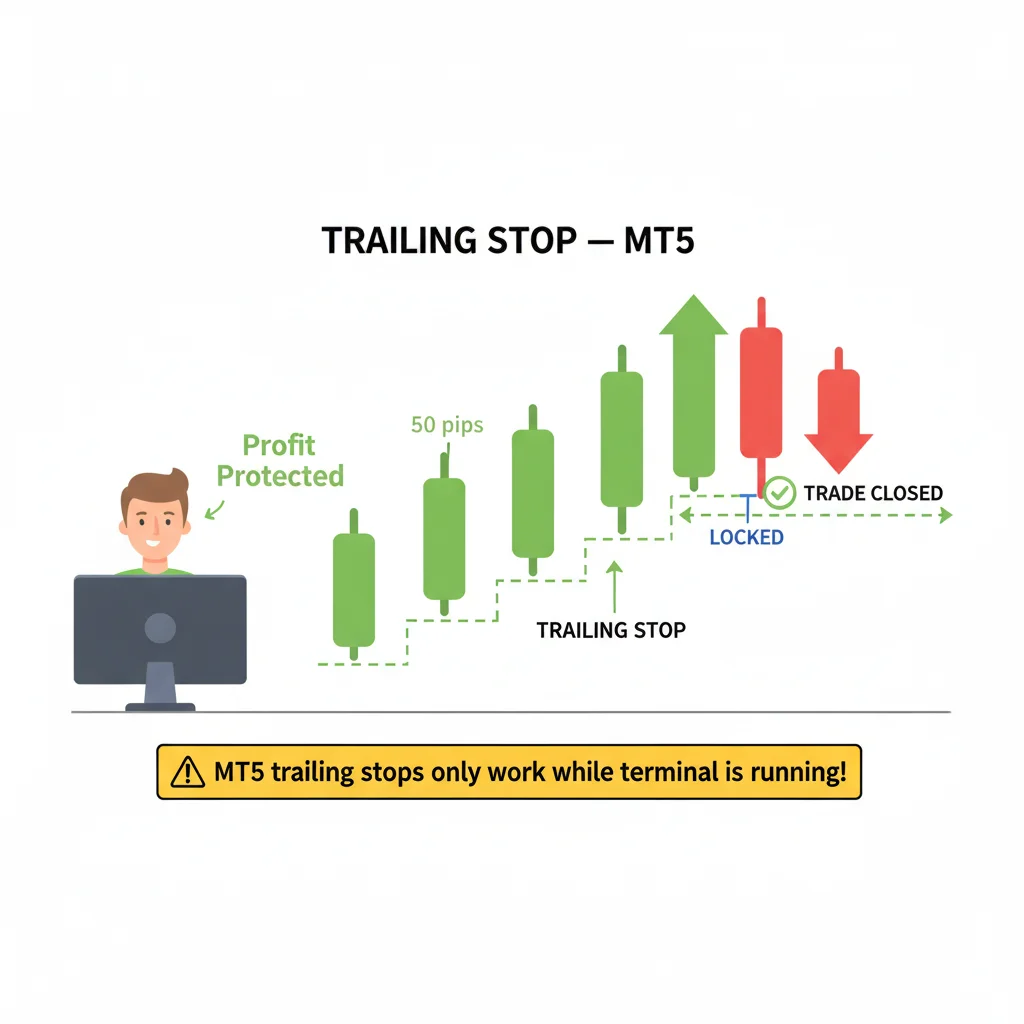
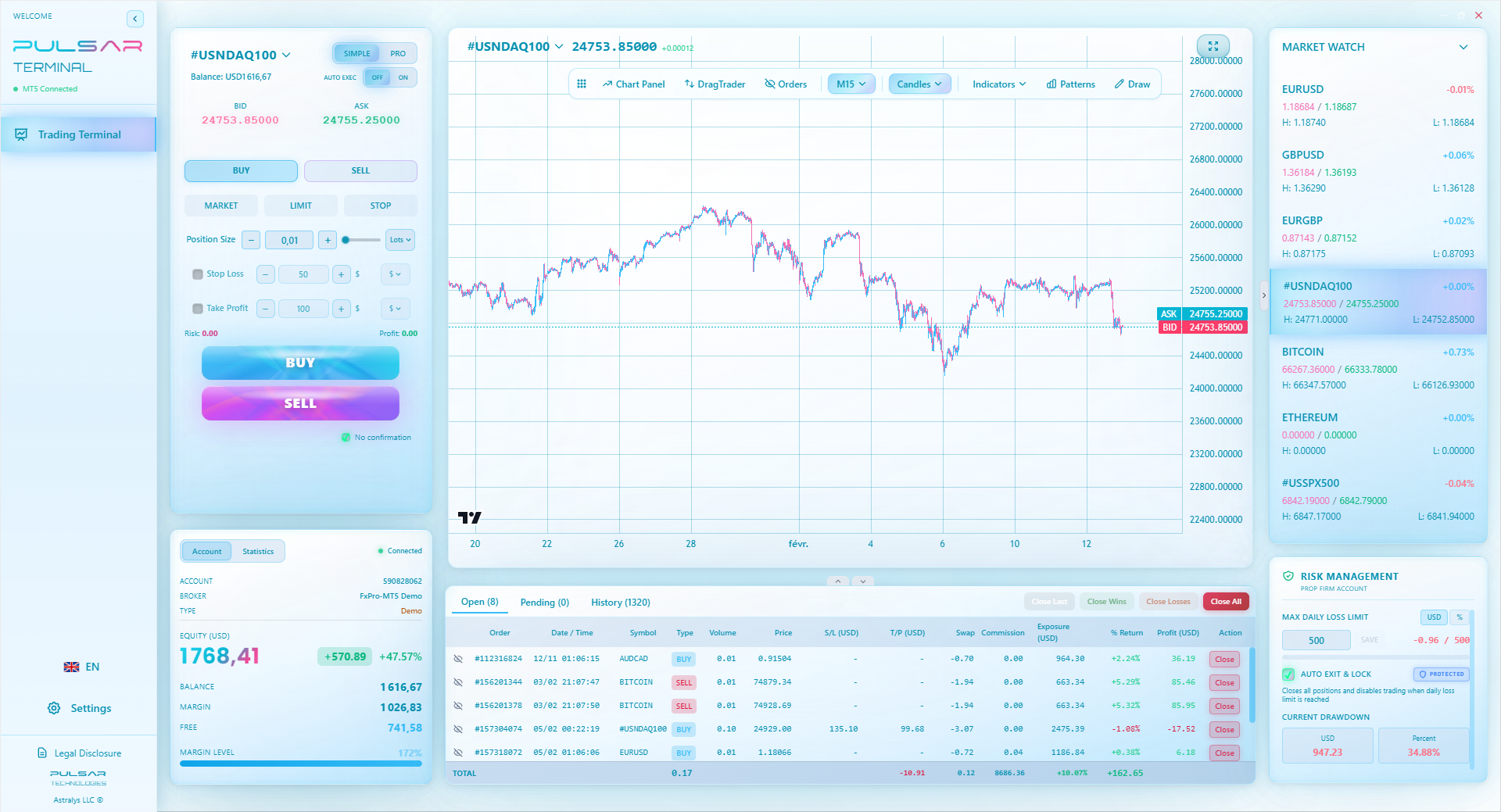
Managing multiple trades based on strength themes is complex, but tools like Pulsar Terminal let you set multi-level take-profits and trailing stops on MT5 with one click, locking in gains as the trend unfolds.
Yes, but only if you demote it from a 'signal generator' to a 'context provider.'
For South African traders, it's an especially useful tool to cut through the noise of the major forex markets. We're often trading late at night or early in the morning our time (SAST). A quick glance at a well-set-up meter can tell you the overnight theme from London and New York. It helps you avoid walking into a trade that's already going against the day's dominant flow.
It won't make you rich by itself. No indicator will. But it will make you a more selective, more disciplined trader. It will stop you from buying a currency that the entire market is selling. In a game where the goal is simply to not lose money before you can make it, that's a huge advantage.
Start with the free MYFXBOOK meter. Keep it open. Don't trade from it. Trade with it in the background, whispering the market's broader sentiment. Combine its message with solid technical analysis on your charts from a reliable platform, and you'll have a significant edge over the guy who's just staring at a single candlestick pattern, oblivious to the currency wars raging around it. That guy used to be me. Don't let it be you.
FAQ
Q1Is a forex currency strength meter a leading or lagging indicator?
It's definitively a lagging indicator. It calculates strength based on price that has already occurred. Think of it as a thermometer, not a weather forecast. It tells you the current temperature (market condition), not what it will be tomorrow.
Q2Can I use a strength meter for scalping?
You can, but it's tricky. Shorter timeframe strength readings (like 5 or 15-minute) are extremely noisy and change rapidly. If you scalp, use the 1-hour or 4-hour meter to confirm the intraday bias, then use very precise price action on the 1 or 5-minute chart for entries. Without the higher timeframe filter, scalping with just the meter is a fast track to a margin call.
Q3Why isn't the South African Rand (ZAR) on most strength meters?
Most publicly available meters track the eight major currencies, which are the most liquid and widely traded. The ZAR is an emerging market currency. To assess ZAR strength, you need to monitor key pairs like USD/ZAR and EUR/ZAR directly on your trading platform and observe their combined behaviour.
Q4How often should I check the currency strength meter?
It depends on your trading style. For swing trading, checking the daily and 4-hour readings once or twice a day is sufficient. For day trading, monitor the 1-hour and 4-hour readings at the start of your session and after major news events. Obsessively watching it tick every minute will lead to bad decisions.
Q5Do I need to pay for a good currency strength meter?
Absolutely not. Some of the best resources are free, like the ones on MYFXBOOK or Investing.com. Paid versions might offer more customisation or historical data, but the core functionality is effectively the same. Master a free one first before even considering a paid tool.
Q6Can the strength meter help me find the best pair to trade?
It can point you towards high-probability themes (e.g., USD strong, JPY weak), but it cannot pick the 'best' pair. The best pair is the one where the strength theme aligns with a high-quality technical setup (support/resistance, trend) on the actual chart. The meter suggests the play; the chart provides the timing and the specific vehicle.
Q7What's the biggest mistake beginners make with this tool?
Trading the extremes blindly. Seeing USD as #1 and EUR as #8 and immediately selling EUR/USD without any further analysis is gambling. It ignores the pair's own technical context, which is far more important for your entry, stop loss, and position size calculator.
Lekcja Prof. Winstona
:
- ✓Trade the chart, filter with the meter.
- ✓Daily & 4-hour strength alignment is mandatory.
- ✓Never enter based on meter extremes alone.
- ✓Use free tools like MYFXBOOK first.
- ✓Strength shows effect, always know the cause.
Jak przydatny był ten artykuł?
Kliknij gwiazdkę, aby ocenić
Tygodniowe analizy tradingowe
Darmowe tygodniowe analizy i strategie. Bez spamu.
O autorze
David van der Merwe
Trader Rynków Wschodzących
Trader z Johannesburga z 11-letnim doświadczeniem w walutach rynków wschodzących. Specjalizuje się w parach ZAR, handlu regulowanym przez FSCA i analizie rynku południowoafrykańskiego.
Komentarze
Może Ci się też spodobać

Cara Trading Forex Sukses: 7 Prinsip dari Trader Profesional
Cara trading forex sukses dengan 7 prinsip trader pro: manajemen modal, disiplin, journal trading, backtest. Data nyata, bukan janji profit palsu.
Jam Trading Forex Terbaik untuk Trader Indonesia: Panduan Lengkap dengan Tabel Waktu
Panduan jam trading forex untuk trader Indonesia. Tabel 4 sesi dunia, jam emas 20:00-00:00, sesi mana yang harus dihindari. Data akurat + tips dari trader berpengalaman.
Top 5 Sàn Forex Uy Tín Nhất 2026: Review Jujur dari Trader Indonesia
Top 5 sàn forex uy tín 2026 untuk trader Indonesia. Review jujur: spread, deposit, withdraw, dukungan lokal. Exness, XM, IC Markets & lebih.
All these calculators are built into Pulsar Terminal with real-time data from your MT5 account. One-click position sizing, automatic risk management, and instant calculations.
