


You want to trade the biggest market in the world, but you're doing it from Lagos, Abuja, or Port Harcourt.

Olumide Adeyemi
Pionier Tradingu w Afryce Zachodniej ·  Nigeria
☕ 11 min czytania
Czego się nauczysz:
- 1Why EUR/USD is the Nigerian Trader's Best Friend (and Worst Enemy)
- 2Your Naira is the Real Account Currency: Managing FX Risk
- 3Funding Your Fight: Brokers and Deposits for Nigeria
- 4A Simple, Actionable EUR/USD Strategy That Works Here
- 5The Psychology of Trading London from Lagos
- 6Using Tools to Compensate (Because You Have To)
- 7Your First 100 Trades: A Nigerian Roadmap

You want to trade the biggest market in the world, but you're doing it from Lagos, Abuja, or Port Harcourt. How do you make the EUR/USD work for you when your life runs on Naira? I get it. I started with a $500 account from my flat in Ikeja, watching the Euro and Dollar dance while worrying about my generator fuel. This isn't a theory lesson. It's a practical, no-fluff guide on how to trade the 'Fiber' pair when you're based in Nigeria, dealing with our unique challenges and opportunities.
Let's be honest, you're probably looking at EUR/USD because everyone else is. That's not a bad reason. It's the most traded currency pair globally, which means one thing above all else for us: liquidity. For a Nigerian trader, this liquidity is a double-edged sword. On one hand, the spreads are tight. I've seen spreads as low as 0.1 pips on a raw account with brokers like IC Markets. That means your cost to enter a trade is minimal, which is crucial when you're starting with a smaller account sized in dollars, not millions of Naira.
On the other hand, that same liquidity attracts every big bank and hedge fund on the planet. You're not just trading against other guys in your WhatsApp group; you're up against algorithms in London and New York. The volatility can be deceptive. A calm 30-pip day can erupt into a 150-pip move in an hour when ECB President Lagarde gives a speech. I learned this the hard way in 2022. I was long EUR/USD at 1.0520, thinking it was a solid support. A surprise hawkish comment from the Fed sent it crashing 90 pips in minutes. My stop-loss at 1.0480 got filled, but the slippage was another 5 pips. That's a real Naira loss that stings.

Warning: High liquidity doesn't mean no slippage. During major news events (like US Non-Farm Payrolls), your stop-loss can get filled at a much worse price than you set, especially if you're with a broker that doesn't have top-tier liquidity. Always check a broker's execution policy.
But here's the real Nigerian advantage: timing. The EUR/USD is most active during the London session (8 AM - 5 PM WAT) and the overlap with New York (1 PM - 5 PM WAT). If you have a day job, you can catch the tail end of London's moves during your lunch break or trade the New York open after work. You don't have to stay up all night like you would for the AUD/USD or NZD/USD.
“You're not just trading against other guys in your WhatsApp group; you're up against algorithms in London and New York.”
This is the part most generic guides miss. When you fund your trading account, you convert Naira to USD. Every profit and loss on your EUR/USD trade is in USD. But you live in Naira. You pay bills in Naira. This creates a hidden layer of foreign exchange risk.
Let me give you a real example from last year. I made a $1,000 profit trading EUR/USD over a quarter. I was feeling good. But when I went to withdraw, the Naira had depreciated from ₦750/$ to ₦850/$ over that same period. My $1,000, which would have been ₦750,000, was now worth ₦850,000. Sounds great, right? A ₦100,000 bonus from currency movement! But wait. I needed to pay for a new inverter. The price of the inverter had also gone up because of the same devaluation. My purchasing power didn't increase by ₦100,000. The profit was illusory.
The reverse is a disaster. Imagine you lose $500. If the Naira strengthens significantly by the time you need to replenish your account, that loss in Naira terms is even larger. You can't just look at your MT5 balance. You must think in both currencies.
A Simple Hedging Mindset
You can't easily hedge the Naira, but you can be smart. I treat a portion of my trading capital as a long-term USD asset. If I believe the Naira will weaken (a common view), I'm less hurried to convert trading profits back. I might keep them in USD within the broker or a domiciliary account, using only what I need for expenses. This requires discipline. The goal is to protect your capital's purchasing power in your local economy. Always calculate your true returns in Naira, not just in green numbers on your screen.

Pro Tip: When you calculate your position size, do it with extra caution. A 2% risk on a $1,000 account is $20. But if that $20 represents a week's transport allowance in Naira, the psychological weight is different. Use a position size calculator religiously, and then ask yourself: 'Am I comfortable losing this amount in real Naira value?'

💡 Wskazówka Winstona
Your first profit target should always be to get your risk off the table. Close half at 1:1 risk-reward and move stop to breakeven. Now you're trading with the market's money.
“Your Naira is the real account currency. Every profit and loss on your EUR/USD trade is in USD, but you live in Naira.”
Getting your money in and out is the first battle. Nigerian traders have a unique set of options and headaches. International brokers like Exness, XM, and Pepperstone are popular here for a reason: they accept local bank transfers and cards. But you have to read the fine print.
Depositing via a Nigerian debit card (Mastercard/Visa) is usually instant. The broker's payment processor converts your Naira to USD at their rate, which includes a fee. This fee can be 2-5%. Sometimes it's hidden in a poor exchange rate. I once deposited ₦100,000 with a broker. The receipt showed $122. The actual interbank rate that day should have given me about $128. That's a nearly 5% cost before I even placed a trade.
Bank transfers can be cheaper but slower (1-3 business days). You send Naira to a local intermediary bank account, which then forwards USD to the broker. Always save your transaction receipts and payment references. Customer service will ask for them.

Example: You want to deposit $500.
- Card: Deposit ₦410,000 (at ₦820/$ + 5% fee). Total cost: ~₦20,500 in fees.
- Bank Transfer: Deposit ₦400,000 (at ₦800/$ + 1.5% fee). Total cost: ~₦6,000 in fees. The bank transfer saves you ₦14,500. That's real money.
Withdrawals are the real test. Card withdrawals go back to your card and are converted to Naira by your bank. Bank transfer withdrawals come as USD to your domiciliary account (if you have one) or are converted to Naira by the intermediary. This process can take 3-7 days. Plan your finances accordingly. Never trade with money you need for rent next week. The withdrawal delay could cause a crisis. I stick with brokers known for reliable Nigerian withdrawals, which is why I often check updated reviews on sites like ours for Exness review and XM review.
“Your Naira is the real account currency. Every profit and loss on your EUR/USD trade is in USD, but you live in Naira.”
Forget complicated systems with 15 indicators. In Lagos with constant power cuts and spotty internet, you need something strong and simple. Here’s a price action-based strategy I’ve used for years, focusing on the London and New York sessions.
The London Breakout Retest:
- Identify the Range: From 7 AM WAT, watch the initial 1-hour range that forms. Let's say EUR/USD moves between 1.0850 and 1.0870.
- Wait for the Break: A strong move breaks above 1.0870 or below 1.0850 on increasing volume (you can see this with basic volume bars).
- Look for the Retest: Price often pulls back to test the broken level (now support or resistance).
- Enter on Confirmation: Place a buy order if price pulls back to 1.0870 (old resistance, now support) and shows a rejection candle (like a pin bar or bullish engulfing) on the 15-minute chart. Your stop-loss goes just below the pullback low.
I used this on March 12th. The 7 AM WAT range was 1.0920-1.0935. Price broke above to 1.0945, pulled back to 1.0936, formed a small bullish pin bar on the 15m chart. I entered long at 1.0938. Stop at 1.0929 (7 pips). Target? I used a 1:2 risk-reward, so target at 1.0952. It hit the target during the London-NY overlap. $70 profit on a 0.5 lot trade.
Why this works for us: It doesn't require all-day screen time. You set your alerts and check at key times. It uses the natural momentum of the major sessions. Combine this with classic indicators for confluence. For instance, if the retest happens at a key MACD indicator signal line or where the RSI indicator is bouncing from 30, your confidence increases. This approach is more reliable than trying to scalping strategy all day with our internet infrastructure.
💡 Wskazówka Winstona
The spread isn't just a cost; it's a signal. A suddenly widening spread on EUR/USD during quiet hours often means a big player is moving. Step aside until it settles.

“Accept that you will miss trades. There will always be another setup tomorrow. Your job is to protect your capital.”
Your environment directly impacts your trading. You're analyzing the Eurozone economy and US inflation while your neighbor is blasting music and NEPA has taken light. The psychological gap is massive.
FOMO (Fear Of Missing Out) hits differently here. You see a perfect setup form on EUR/USD, but your data is buffering. By the time it loads, the move is halfway done. You jump in late, out of frustration, and usually get burned. I've done this more times than I care to admit. The solution? Accept that you will miss trades. There will always be another setup tomorrow. Your job is to protect your capital, not catch every wave.
Another unique pressure is the societal view of forex trading. To many, it's not a 'real job.' This can lead to overtrading to prove something or to generate 'quick money' to show tangible results. This is a direct path to a margin call. You must internalize that this is a business of probabilities and patience. A 55% win rate with good risk management makes you a professional. Six winning trades in a row doesn't.
Create a ritual. Trade from a specific, organized space if you can. Use a UPS for your router and monitor. Have a checklist before you enter any trade: Is my stop-loss set? Is my position size correct? Is this trade part of my plan, or am I reacting? This discipline separates those who last from those who blow up their accounts. It's the foundation for any style, whether you're a swing trading enthusiast or a day trader.
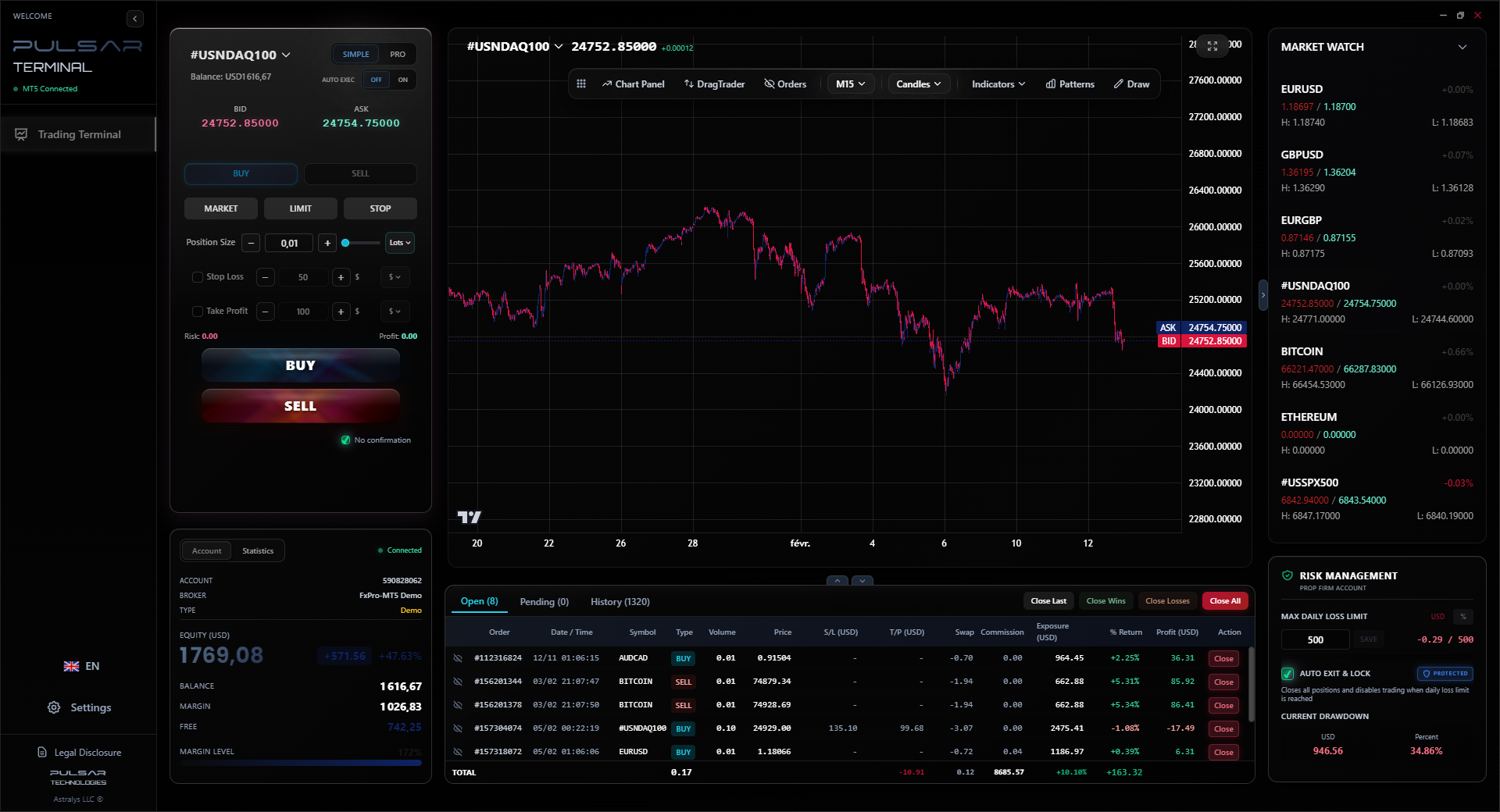
Managing multiple take-profit levels and moving stops to breakeven manually is stressful; Pulsar Terminal automates these precise risk management rules directly on your MT5 chart.
“Accept that you will miss trades. There will always be another setup tomorrow. Your job is to protect your capital.”
We don't have the fiber-optic connections of a London trading floor. So we use technology to level the playing field. This isn't optional; it's survival.
First, get a VPS (Virtual Private Server). For $15-30 a month, you can run your MT5 platform on a server in London or New York with 99.9% uptime. No more missed trades because of 'GO TV' or data network issues. Your EA's run continuously, and your charts are always live. This was a game-changer for me.
Second, master the tools on your platform. Don't just draw lines manually. Use pending orders (buy stop, sell limit) to enter trades at precise levels without watching the screen. Learn to set multiple take-profit levels. For example, on a 20-pip target, you could close 50% at +10 pips, move your stop-loss to breakeven, and let the rest run. This manages your risk and locks in some profit. Doing this manually under pressure is hard. The right software can automate it based on your rules.
Finally, understand market structure. The EUR/USD moves between clear zones of support and resistance. Tools like Volume Profile can show you where most trading activity happened - the 'point of control.' These are often strong support/resistance areas. Trading near these high-volume nodes can improve your odds. It's about working smarter, not just harder, especially when you're competing with better-equipped traders.
💡 Wskazówka Winstona
Keep a 'Naira Journal' alongside your trade journal. Note the exchange rate every time you deposit or evaluate your balance. This is your true P&L statement.
“A 10-pip loss on a 0.01 lot is $1. On a 0.1 lot, it's $10. Feel that difference before you click 'buy'.”
Here's what I wish someone had told me when I started trading EUR/USD from Nigeria.
- Open a Demo Account: But with a twist. Fund it with the exact USD amount you plan to start with live (e.g., $200). Trade it like real money for 3 months. Your goal isn't to double it. Your goal is to not blow it up and to execute 100 trades following a strict plan. Track every trade in a journal.
- Start Live Small: Your first live account should be money you can afford to lose completely. I started with $300. This small size forces you to focus on pip definition value and proper position sizing. A 10-pip loss on a 0.01 lot is $1. On a 0.1 lot, it's $10. Feel that difference.
- Specialize in One Session: Don't try to trade Tokyo, London, and New York. Pick the London session (8 AM - 12 PM WAT) or the New York open (1:30 PM WAT). Learn its personality. The EUR/USD often has a directional move in the first 2 hours of London.
- Analyze in Naira: At the end of each week, convert your USD P&L to Naira at the current rate. This is your true performance metric. It keeps you grounded in the reality of your financial life.
The EUR/USD is a fantastic pair to learn on. It's predictable in its unpredictability. The trends are clear, the news is widely analyzed, and the technical levels are respected by the market. For a deeper dive into the mechanics of this pair, our EUR/USD guide breaks down its historical behavior and key drivers. Stick with it, manage your Naira risk, and trade the plan. That's how you build something real from here.
FAQ
Q1What is the best time to trade EUR/USD in Nigeria?
The most volatile and ideal times are during the London session (8 AM to 5 PM WAT) and the first few hours of the New York session (from 1:30 PM WAT). The overlap between 1 PM and 5 PM WAT is often the most active period, offering the best opportunities for day trades.
Q2How much money do I need to start trading EUR/USD from Nigeria?
You can start with as little as $50-$100 with some brokers offering micro lots (0.01). However, I strongly recommend starting with at least $200-$500. This allows for sensible position sizing and can withstand a few losses without a margin call. Remember, you must also factor in the cost of converting your Naira to USD to fund the account.
Q3Which broker is best for EUR/USD trading in Nigeria?
There's no single 'best' broker. Look for brokers with a strong local presence, reliable Naira deposit/withdrawal methods, tight EUR/USD spreads (consistently under 1 pip on ECN accounts), and good customer support. It's wise to research current reviews for brokers like IC Markets, Pepperstone, and Exness to see which best fits your needs today.
Q4How do I handle the difference between USD profits and Naira expenses?
This is a critical risk. You must view your trading capital as partly a USD asset. Don't automatically convert all profits to Naira. If you believe the Naira will weaken, keeping profits in USD can preserve purchasing power. Always calculate your true return by converting your USD balance to Naira at the current exchange rate to understand your real financial position.
Q5Is slippage common on EUR/USD during news events?
Yes, absolutely. High-impact news like US Non-Farm Payrolls or ECB rate decisions can cause instant, large price gaps. Your market order or stop-loss can be filled at a significantly different price than you expected. To manage this, avoid trading right before major news or use guaranteed stop-loss orders (if your broker offers them, usually for a fee).
Q6Can I trade EUR/USD successfully with a slow internet connection?
It's a major handicap, but you can adapt. Use a strategy that doesn't require millisecond execution, like swing trading or end-of-day setups. Most importantly, use a Virtual Private Server (VPS) to host your trading platform. This gives you a stable, fast connection from a data center abroad, eliminating local internet issues.
Q7What's a realistic monthly return trading EUR/USD from Nigeria?
If anyone promises you a fixed monthly return, run. A realistic, professional target for a skilled retail trader is 5-10% per month on your account balance. This requires excellent risk management. Aiming for 20-50% monthly is a surefire way to take excessive risk and lose everything. Consistency over time is the real goal.
Lekcja Prof. Winstona
:
- ✓Liquidity is a double-edged sword: tight spreads but fierce competition.
- ✓Always calculate your true profit and loss in Naira, not just USD.
- ✓A simple London breakout strategy beats a complex system with spotty internet.
- ✓Use a VPS. Your trading shouldn't depend on 'NEPA'.
- ✓Your first live account should be money you can afford to lose completely.
Jak przydatny był ten artykuł?
Kliknij gwiazdkę, aby ocenić
Tygodniowe analizy tradingowe
Darmowe tygodniowe analizy i strategie. Bez spamu.
O autorze
Olumide Adeyemi
Pionier Tradingu w Afryce Zachodniej
Jeden z najaktywniejszych edukatorów tradingu forex w Nigerii. 8 lat doświadczenia tradingowego z Lagos. Specjalizuje się w strategiach niskiego kapitału i wyzwaniach prop firm dla afrykańskich traderów.
Komentarze
Może Ci się też spodobać

Cara Trading Forex Sukses: 7 Prinsip dari Trader Profesional
Cara trading forex sukses dengan 7 prinsip trader pro: manajemen modal, disiplin, journal trading, backtest. Data nyata, bukan janji profit palsu.
Jam Trading Forex Terbaik untuk Trader Indonesia: Panduan Lengkap dengan Tabel Waktu
Panduan jam trading forex untuk trader Indonesia. Tabel 4 sesi dunia, jam emas 20:00-00:00, sesi mana yang harus dihindari. Data akurat + tips dari trader berpengalaman.
Top 5 Sàn Forex Uy Tín Nhất 2026: Review Jujur dari Trader Indonesia
Top 5 sàn forex uy tín 2026 untuk trader Indonesia. Review jujur: spread, deposit, withdraw, dukungan lokal. Exness, XM, IC Markets & lebih.
All these calculators are built into Pulsar Terminal with real-time data from your MT5 account. One-click position sizing, automatic risk management, and instant calculations.
