


Most South African traders are getting their session times wrong, and it's costing them money.

David van der Merwe
Trader Rynków Wschodzących ·  South Africa
☕ 10 min czytania
Czego się nauczysz:
- 1Why Session Times Are Everything (It's Not Just About Being Awake)
- 2The Global Clock in SAST: Your Cheat Sheet
- 3Building Your South African Trading Schedule
- 4Costs & Why Timing Matters
- 5Tools & Strategies for Each Session
- 6Common Mistakes South African Traders Make
- 7Putting It All Together: Your Action Plan
Most South African traders are getting their session times wrong, and it's costing them money. They think because the market is open 24 hours, any time is a good time. That's a fast track to frustration. The truth is, your location in South Africa gives you a hidden edge if you know exactly when the global financial engines fire up. I'm going to show you the precise SAST clock times that matter, why the 3 PM to 7 PM slot is pure gold, and how to structure your entire trading day around these rhythms.
When I first started, I'd trade at all hours. Late night, early morning, during lunch. I figured if the charts were moving, I could make money. I was technically right, but I was also working five times harder for the same result. The problem wasn't my strategy; it was my timing. I was trading the Aussie session when it was dead quiet, then getting stopped out by wild volatility when London opened while I was making coffee.
Forex isn't just one market. It's a relay race where the baton gets passed from Sydney to Tokyo to London to New York. Each financial centre brings its own crowd of traders, its own economic data, and its own mood. Liquidity - the ease of buying and selling - ebbs and flows with them. Low liquidity means wider spreads (that's your broker's cut) and jerky, unpredictable price action. High liquidity means tighter spreads and smoother, more reliable trends.
For us in South Africa, understanding this global clock isn't academic. It's practical survival. It tells you when to be hyper-focused, when to set your alerts, and when to honestly just walk away and enjoy a braai. Trading the right session is like surfing: you can paddle all day, but you only catch waves when they come.

Warning: Trading during low-liquidity sessions (like the late New York/Sydney handover) is a common way to get ‘whipsawed’. The spread on your EUR/USD guide might double, and a tiny bit of news can cause a massive spike that hits your stop-loss before reversing. I've been there, watching a 15-pip stop get taken out in a 2-pip wide market, only for the price to snap back. It feels personal, but it's just bad timing.

💡 Wskazówka Winstona
The market pays you for patience, not for perspiration. Waiting for the London-New York overlap is not missing out; it's stacking the odds in your favour before you even place a trade.
Let's get specific. South African Standard Time (SAST) is GMT+2. Forget trying to convert on the fly. Here’s when the world trades, on your watch.
The Four Main Sessions
| Session | SAST Time (Approx.) | Key Players & Mood |
|---|---|---|
| Sydney | 12:00 AM – 9:00 AM | Australia, New Zealand. Often quiet, sets the early tone. Focus on AUD, NZD pairs. |
| Tokyo | 3:00 AM – 12:00 PM | Japan, China, Singapore. The ‘Asian session’. Can see steady moves. Watch JPY pairs. |
| London | 10:00 AM – 7:00 PM | UK, Europe, Middle East. The big one. Liquidity floods in. All majors move, especially EUR, GBP. |
| New York | 3:00 PM – 12:00 AM | USA, Canada. Huge volume from US banks & funds. Drives the USD and often defines the daily close. |
The Golden Hours: Session Overlaps
This is where the magic happens. When two sessions are open, the number of active traders doubles. More orders, more volume, clearer trends.
- Asian/European Overlap (8:00 AM – 10:00 AM SAST): Tokyo is winding down, London is booting up. A decent period of activity, often good for a bit of scalping strategy on EUR/JPY or GBP/JPY.
- The Main Event: London/New York Overlap (3:00 PM – 7:00 PM SAST): This is your bread and butter. For four glorious hours, both London and New York are in full swing. This is when you get the cleanest trends and the highest volume. It’s no coincidence that most major US economic data (like Non-Farm Payrolls) is released at 3:30 PM SAST, right in the heart of this overlap. The volatility is real, but so are the opportunities.
- Late Overlap (7:00 PM – 12:00 AM SAST): New York is still open, but London has closed. Activity starts to taper off. Can be good for swing trading entries if you're setting up for the next day.

Pro Tip: For trading the South African Rand (like USD/ZAR), the absolute sweet spot is that London-New York overlap, particularly from about 2 PM to 5 PM SAST. That's when global banks are most actively pricing and trading emerging market currencies. I've found my ZAR trades have the highest probability during this window.
“Trading the right session is like surfing: you can paddle all day, but you only catch waves when they come.”
You have a job, a family, a life. You can't be glued to the screen from midnight to midnight. The power of knowing session times is that you can design a schedule that fits your life and maximises your edge.
The Early Bird (Before Work): If you're up between 5 AM and 7 AM SAST, you're catching the tail end of Tokyo and the very start of London. It's a good time for analysis and planning. Check how the Asian session closed - did it respect key levels? You might place pending orders for the London open volatility at 10 AM.
The Lunchtime Hustler (10 AM - 2 PM SAST): London is in full flow. This is prime time. If you can get 30-60 minutes here, you can often catch a strong directional move. This is when I do most of my active day trading. The market has direction, and the spreads are tight.
The After-Work Professional (3 PM - 8 PM SAST): This is the superstar shift for South Africans. You're home, settled, and the London-New York overlap is live. This is perfect for both executing trades and managing existing positions. It's also the best time to decide whether to hold a trade overnight (incurring a swap definition fee) or to close it. If you only trade one block of time, make it this one.
The Night Owl (Risk Taker): After midnight SAST, it's the New York close and the Sydney open. Liquidity is thin. I avoid this unless I'm managing a long-term swing trading position. The risk of a random news spike isn't worth it for me.
My own rule? No new entries after 10 PM SAST. I might trail a stop or take profit, but I'm not opening fresh trades. That discipline has saved me from countless overnight surprises.
Session times directly hit your bottom line through spreads and commissions. Let's talk numbers.
During the dead of night (Sydney session), the spread on EUR/USD might be 1.5-2 pips on a standard account. During the London-New York overlap, that same spread can tighten to 0.8-1.0 pips. That half-pip difference is pure cost saving on every trade. On a 1-lot trade, that's $5 saved just on entry and exit.
If you're using a broker like IC Markets review or Pepperstone review with raw spreads, the difference is even starker: from 0.6 pips off-peak to 0.1 pips or less at peak times. Commissions are fixed, but a tighter spread always helps.
The other cost is slippage. In a thin market, your market order might not get filled at the price you see. I once tried to enter a gold trade (XAU/USD guide) late Sydney session. Clicked at $1810.50, got filled at $1811.90. A 1.4 point slip on a volatile asset before the trade even started! That never happens at 4 PM SAST when the market is deep.
Always use a position size calculator that factors in the spread. And assume the widest spread for your session when calculating risk.
💡 Wskazówka Winstona
Your most important tool isn't an indicator; it's a clock. Sync your trading activity to the global liquidity cycle, and you solve half your execution problems before they happen.
“Your advantage as a South African trader is that the world's most liquid overlap happens in our late afternoon and evening. That's a gift.”
Different sessions favour different styles. You wouldn't use a hammer to screw in a lightbulb.
Sydney/Tokyo (Overnight to Mid-Morning SAST): This is range-bound, mean-reversion territory. Price often bounces between the previous day's high and low. Indicators like RSI indicator (looking for overbought/oversold) or Bollinger Bands can work well. I'd avoid aggressive trend-following strategies here.
London Open (10 AM SAST): Volatility spikes. This is breakout territory. Watch for price to push through the Asian session range. A strategy like a ‘London Breakout’ works here: place buy and sell stops just outside the first hour's range. Whichever triggers, you ride it.
London-New York Overlap (3 PM - 7 PM SAST): Trend city. This is where momentum indicators like the MACD indicator or moving average crossovers can shine. The market picks a direction and often runs with it. This is also the perfect time to employ a trailing stop to lock in profits on a running trade.

Example: On a Wednesday during this overlap, I saw a clean break above resistance on GBP/USD at 1.2650. The MACD indicator was bullish. I entered at 1.2652. I set my initial stop at 1.2620 (risk: 32 pips). As the trend continued into the New York session, I used a trailing stop of 20 pips. The price ran to 1.2715 before retracing and closing me out at 1.2695. That trailing stop turned a 45-pip profit into a 43-pip profit, protecting me from the late retracement. Manual trailing is hard; automation is key.
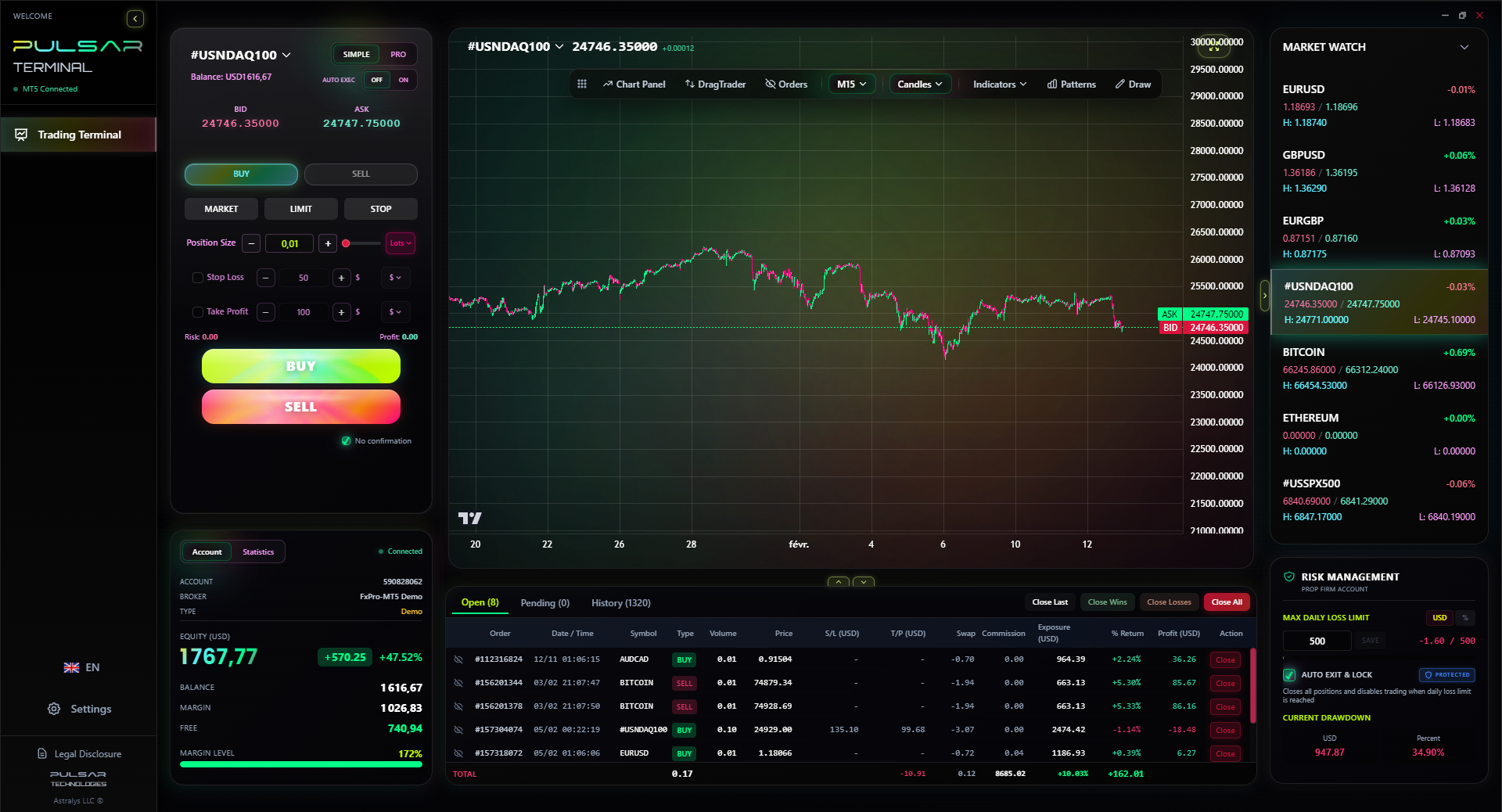
Managing trades across volatile session overlaps is stressful, but tools like Pulsar Terminal let you set multi-level take-profits and automated trailing stops directly on your MT5 charts, so you can lock in gains during the London-New York rush without micromanaging every pip.
I've made these, so you don't have to.
- Trading ZAR Pairs at the Wrong Time: USD/ZAR might move during our day, but its real liquidity comes from London and New York. Trading it heavily at 8 AM SAST is like trading a local stock when the JSE is closed. You'll get poor fills.
- Ignoring Economic Calendars: The session tells you when to trade; the economic calendar tells you when not to. High-impact news (like US CPI or SARB interest rate decisions) creates instant volatility. If you don't like gambling, avoid trading 5 minutes before and after major releases. That 3:30 PM SAST US data slot is a known minefield.
- Overtrading the Quiet Times: Boredom is a trader's enemy. Just because you're awake at 11 PM doesn't mean you should trade. Forcing trades in low-volume sessions is a surefire way to erode your capital with wide spreads and chop.
- Not Accounting for Daylight Saving: Remember, the US and UK use daylight saving time (DST). SAST doesn't. So for about half the year, the London open shifts to 11 AM SAST, and the New York open to 4 PM SAST. Mark the change in your calendar! I once missed a whole week of good setups because my mental clock was an hour off.
- Holding Through the Weekend: The market closes Friday night and reopens Sunday night. Anything can happen geopolitically over 48 hours. Unless you have a very specific long-term view, closing positions before Friday's New York close (around midnight SAST) is smart risk management. That gap risk is real.
“The goal isn't to trade every session. It's to trade the *right* sessions well.”
So, what now? Here's a simple weekly plan to get started.
Sunday Night: Market opens around 10 PM SAST. Usually very thin. I just watch, maybe note the opening gap.
Monday - Friday:
- 5:00 - 9:00 AM: Review. Check what happened in Asia. Plan for London. No rush to trade.
- 10:00 AM - 12:00 PM: Be alert. London is open. Look for breakout opportunities from the Asian range.
- 12:00 - 3:00 PM: Manage any open trades. The market can consolidate before New York.
- 3:00 - 7:00 PM (GOLDEN HOURS): Be at your screen if possible. This is execution and management time. Follow your plan.
- After 10:00 PM: Wind down. Close out or tightly manage any remaining trades. Set alerts for key levels if you must.
Friday Evening: By 10 PM SAST, I aim to be flat or have only tiny, well-managed swing positions. I check my week's position size calculator logs and review.
The goal isn't to trade every session. It's to trade the right sessions well. Your advantage as a South African trader is that the world's most liquid overlap happens in our late afternoon and evening. That's a gift. Use it. Focus your energy there, protect your capital during the quiet times, and you'll immediately put yourself ahead of the crowd who thinks trading is just about red and green candles.
FAQ
Q1What is the best time to trade forex in South Africa?
The single best time is the London-New York session overlap, from 3:00 PM to 7:00 PM SAST. This period has the highest liquidity and volatility, offering the clearest trends and tightest spreads. It's when most South African traders should focus their active trading.
Q2Can I trade the USD/ZAR pair effectively as a South African?
Absolutely, but timing is critical. The ZAR is an emerging market currency, so its deepest liquidity comes from international banks during the London and New York sessions. The most effective time to trade USD/ZAR is between 10:00 AM and 7:00 PM SAST, with peak activity during the 2:00 PM to 5:00 PM window. Avoid trading it heavily during the Asian session or late at night.
Q3Do forex market session times change?
Yes, but not the SAST times for the sessions themselves. What changes is the relationship to other timezones. The UK and US observe Daylight Saving Time (DST), while South Africa does not. This means for roughly half the year (usually March-November), the London open shifts to 11:00 AM SAST and the New York open to 4:00 PM SAST. You must adjust your schedule accordingly.
Q4Is it safe to trade during the Sydney session (overnight SAST)?
It's generally not advisable for new traders. The Sydney session (12:00 AM - 9:00 AM SAST) has the lowest liquidity of the four major sessions. This leads to wider spreads, more erratic price movements, and a higher risk of slippage. It's better used for analysis and planning for the London open.
Q5What is a 'spread' and why does it change with session times?
The spread is the difference between the buy (ask) and sell (bid) price, and it's a primary cost of trading. It's measured in pips. During busy sessions like the London-New York overlap, high competition and order volume force brokers to offer tighter spreads (e.g., 0.8 pips). In quiet sessions, with fewer participants, spreads widen (e.g., 2.0 pips) to cover the broker's risk, increasing your cost.
Q6I have a day job. Can I still trade forex effectively in SA?
Yes, South Africa's timezone makes it very possible. The London session starts at 10 AM, allowing for lunchtime trading. The prime London-New York overlap runs from 3 PM to 7 PM SAST, which is after work for most people. You can design a very effective part-time strategy focusing solely on these high-probability afternoon/evening hours.
Lekcja Prof. Winstona
:
- ✓The London-New York overlap (3-7 PM SAST) is your prime trading window.
- ✓Wider spreads in quiet sessions silently eat your profits.
- ✓Never trade ZAR pairs without checking London/NY session activity.
- ✓Adjust your schedule for US/UK Daylight Saving Time shifts.
Jak przydatny był ten artykuł?
Kliknij gwiazdkę, aby ocenić
Tygodniowe analizy tradingowe
Darmowe tygodniowe analizy i strategie. Bez spamu.
O autorze
David van der Merwe
Trader Rynków Wschodzących
Trader z Johannesburga z 11-letnim doświadczeniem w walutach rynków wschodzących. Specjalizuje się w parach ZAR, handlu regulowanym przez FSCA i analizie rynku południowoafrykańskiego.
Komentarze
Może Ci się też spodobać

Cara Trading Forex Sukses: 7 Prinsip dari Trader Profesional
Cara trading forex sukses dengan 7 prinsip trader pro: manajemen modal, disiplin, journal trading, backtest. Data nyata, bukan janji profit palsu.
Jam Trading Forex Terbaik untuk Trader Indonesia: Panduan Lengkap dengan Tabel Waktu
Panduan jam trading forex untuk trader Indonesia. Tabel 4 sesi dunia, jam emas 20:00-00:00, sesi mana yang harus dihindari. Data akurat + tips dari trader berpengalaman.
Top 5 Sàn Forex Uy Tín Nhất 2026: Review Jujur dari Trader Indonesia
Top 5 sàn forex uy tín 2026 untuk trader Indonesia. Review jujur: spread, deposit, withdraw, dukungan lokal. Exness, XM, IC Markets & lebih.
All these calculators are built into Pulsar Terminal with real-time data from your MT5 account. One-click position sizing, automatic risk management, and instant calculations.
