


I watched the USD/NGN chart on my screen in late 2024, my finger hovering over the sell button.

Olumide Adeyemi
Pionier Tradingu w Afryce Zachodniej ·  Nigeria
☕ 11 min czytania
Czego się nauczysz:
- 1Why You Blow Up Your Account (The Nigerian Edition)
- 2The Real Risk Calculator: It's in Your Head First
- 3use is Not Your Friend. It's a Dangerous Tool.
- 4Special Risks for the Nigerian Trader
- 5Building Your Personal Risk Management System
- 6Tools & Tech: From Basic Calculators to Automation
- 7Your Action Plan: Start This Today
I watched the USD/NGN chart on my screen in late 2024, my finger hovering over the sell button. The rate had just hit 1717.50, an all-time high. The temptation to short it with a huge position was overwhelming. I didn't have a plan, just a feeling. I risked 8% of my account on that one trade. Two weeks later, after a series of CBN interventions I didn't anticipate, the rate had snapped back violently. I was stopped out, down $1,200. That loss wasn't about analysis; it was a complete failure of risk management. I had no calculator, no rule, just greed. Most traders here blow up their accounts the same way. Let's fix that.
The dream sold to many new traders in Nigeria is simple: deposit small, use insane use, and catch a big move. Brokers like InstaForex offer 1:1000, and Exness even advertises 'unlimited' use. It's a trap dressed as an opportunity.
You see the Naira at 1380 in the parallel market, you hear rumors, and you go all in. The problem isn't the information; it's the execution. Without a forex risk management calculator, you're just guessing. You might think, 'I'll just risk $100 on this trade.' But with 1:500 use on a $5,000 position, a 20-pip move against you can wipe out that $100 and trigger a margin call. You're not trading pips; you're trading percentages of your account, and most people get that math catastrophically wrong.
I've seen it a dozen times. A trader funds a $100 account with XM, gets 1:1000 use, and buys a full lot of EUR/USD. The margin requirement is tiny, so it feels like 'free money.' But that one standard lot means each pip movement is worth $10. A 10-pip loss is 100% of their account. Gone. They blame the broker or the market, but the fault was in the first calculation they never made.

Warning: High use is a debt instrument, not a profit multiplier. It amplifies losses faster than gains. Using a 1:1000 use without a strict position sizing rule is a guaranteed method to send your capital to zero.
A forex risk management calculator isn't just a tool on a website. It's a disciplined process you follow before every single trade. The formula is non-negotiable, especially with the volatility we see in pairs like USD/NGN.
Here’s the only math that matters: Position Size = (Account Risk in $) / (Stop-Loss in Pips * Pip Value)
Let's break that down with Naira context. Say you have a $1,000 account with a broker like IC Markets. Your rule is to never risk more than 2% per trade. That's $20.
Step 1: Define Your Stop-Loss
You're looking at GBP/NGN. You decide, based on your chart analysis, that your trade is invalid if price moves 150 pips against you. Your stop-loss is 150 pips.
Step 2: Find the Pip Value
This is where Nigerians get tripped up. If you're trading a XXX/NGN pair (like GBP/NGN), the pip value isn't fixed. For a micro lot (0.01 lots), the pip value is roughly 100 Naira. But you need to convert that to your account currency (usually USD).
At an exchange rate of N1371/$, 100 Naira is about $0.073. So, for a micro lot on a Naira pair, one pip ≈ $0.073.

Example: Let's calculate a safe position size.
- Account: $1,000
- Risk per Trade: 2% = $20
- Stop-Loss: 150 pips on GBP/NGN
- Pip Value (micro lot): ~$0.073
- Position Size = $20 / (150 * $0.073)
- $20 / $10.95 ≈ 1.82 micro lots.
So, the maximum you should buy is 0.0182 standard lots. Most platforms will let you set this precisely. This is what a good position size calculator does automatically, but you must understand the logic.
For major pairs like EUR/USD, it's simpler (pip value for a micro lot is ~$0.10). But the principle is identical. This calculation forces you to place your stop-loss first, which is the most important risk management decision.

💡 Wskazówka Winstona
Your risk percentage isn't a suggestion. It's a law. If 2% is your law, trading at 2.1% is a felony against your own capital.
“High use is a debt instrument, not a profit multiplier.”
The Central Bank of Nigeria sets monetary policy for the real economy. In forex trading, you must set your own. Your maximum use is your most important policy.
Brokers advertise their maximum use (1:500, 1:1000) to attract clients. You should never, ever use the maximum. Your effective use should be a byproduct of your position sizing calculation, not the starting point.
Here’s a reality check. If you have a $500 account and open a 0.1 lot position on EUR/USD:
- Notional Value: 0.1 lots = €10,000. At $1.08, that's $10,800.
- Your Equity: $500.
- Effective use = $10,800 / $500 = 21.6:1.
Even though your broker might allow 1:500, you're using a sensible 1:21.6. That's the key. The broker's offer is irrelevant. Your risk calculation determines your true use.
I learned this the hard way early on. I opened an account with $200, used 1:500 use, and bought gold (XAU/USD). I was right on the direction, but a 0.5% retracement against me before the rally wiped out my entire margin. I was right on the trade and still lost everything. My effective use was suicidal. Now, I decide my risk ($10 on that $200 account), my stop (30 pips on gold), and let the calculator tell me the position size. The use figure is just a number in the background.

Pro Tip: Treat your broker's use setting like a safety cap on a power tool. Set it to a reasonable maximum (like 1:50 or 1:100) in your account settings to prevent a moment of madness from destroying you. Your disciplined position sizing will keep you well below this cap anyway.
Trading from Nigeria isn't the same as trading from London or New York. We have unique local factors that a generic risk calculator won't account for. You have to build these into your plan.
1. Currency Conversion Risk: Your capital is likely in Naira, but you trade a USD-denominated account. If you deposit NGN 500,000 when the rate is 1371/$, you get about $365. If the Naira strengthens to 1200/$ by the time you withdraw, your $365 is now only NGN 438,000, even if your trading broke even. That's a 12.4% loss just from exchange rates. Consider brokers like FXTM that offer NGN accounts to eliminate this risk.
2. Liquidity and Slippage on Exotic Pairs: You might be tempted to trade USD/NGN or other African pairs. The liquidity is often poor outside of local banking hours. This means your stop-loss order, especially on a volatile news day, might get filled at a much worse price than you set (slippage). Your risk calculation assumes a perfect stop execution. If you're trading these pairs, you must risk a smaller percentage (e.g., 1% instead of 2%) to account for this potential slippage.
3. Internet and Power Stability: This is a real operational risk. If your power goes out or your data drops during a volatile period, you can't manage your trade. I once had a profitable scalping trade turn into a max loss because NEPA took light and my generator didn't kick in fast enough. Your risk management must include a 'disaster scenario.' Use guaranteed stop-loss orders (if your broker offers them, often for a fee) for your most critical trades, or simply trade smaller sizes so that an unexpected event doesn't cripple you.
💡 Wskazówka Winstona
The most dangerous number on your screen is 'Available Margin.' The higher it is, the more temptation you have to break your rules. A good risk system leaves it looking boringly large.
“Your survival doesn't depend on predicting the news. It depends on your preparation for being wrong.”
A calculator is a single tool. You need a full system. Here’s how to build one, step by step.
1. The Foundation: Your Risk-Per-Trade Percentage. This is sacred. For beginners, 1% of your account balance per trade is plenty. Even experienced traders rarely go above 2%. This means if you have a $1,000 account with Pepperstone, you risk $10-$20 per trade. Write this rule down and tape it to your monitor.
2. The Daily and Weekly Loss Limit. This stops a bad day from becoming a catastrophe. A common rule is: stop trading for the day if you lose 3-5% of your account. Stop for the week if you lose 7-10%. This forces you to walk away, reset, and avoid revenge trading. I set a hard daily loss limit of 3% in my trading journal. Hitting it feels terrible, but it has saved my account multiple times.
3. The Position Sizing Ritual.
- Step A: Identify your trade setup and determine your logical stop-loss level on the chart. (Is it 25 pips? 150 pips?).
- Step B: Pull up your trusty position size calculator. Input your account balance, risk percentage (1%), stop-loss in pips, and the currency pair.
- Step C: The calculator gives you the lot size. Enter that exact lot size into your platform. No rounding up.
4. The Broker Factor. Choose a broker that enables your system, not one that undermines it. You need tight, reliable spreads so your stop-losses are executed cleanly. Check reviews for Exness or XM to see how their spreads behave during London/New York overlaps. Also, ensure they offer micro and nano lots so you can size positions precisely for a small account. A broker with a $500 minimum lot size is useless for a disciplined $1,000 account trader.
You don't need expensive software. You need consistent habits supported by the right tools.
Free Online Calculators: A simple Google search for 'forex position size calculator' will give you dozens. Find one that lets you input account currency, pair, and stop in pips. Bookmark it. Use it for every single trade, no exceptions.
Trading Platform Tools: MT4 and MT5 have built-in tools. Right-click on your chart, select 'Trading', then 'Risk Calculator'. You can input your risk and it will suggest a volume. The problem? It's clunky and I often found myself skipping it to 'save time.' That's how mistakes happen.
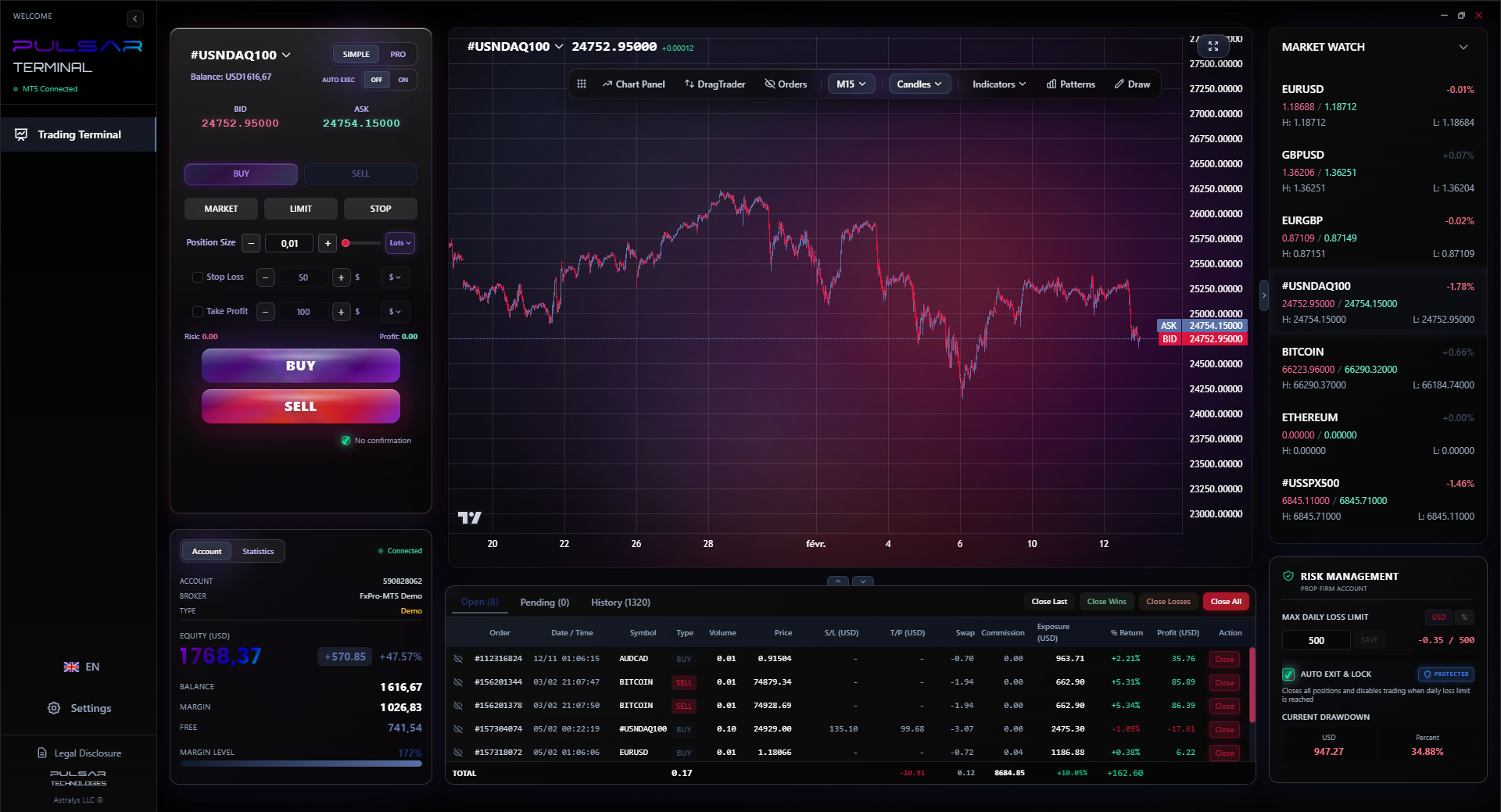
The Next Level: Automation with Pulsar Terminal. This is where you graduate from manual calculation to having a system that enforces your rules. As an MT5 add-on, Pulsar Terminal lets you set up order templates with pre-defined risk percentages. You can drag and drop an order onto the chart, and it automatically calculates the position size based on the distance to your stop-loss and your preset risk level (e.g., 1.5%).
This eliminates the mental gymnastics and emotional cheating. It also has features like multi-take-profit levels and trailing stops, which are part of advanced risk management (locking in profits, protecting breakeven). For someone trading volatile instruments or trying to pass a prop firm challenge with strict daily loss limits, this kind of automation is a game-saver. It turns your risk management plan from a notepad idea into a hard-coded part of your execution.
Manually calculating risk for every trade is where discipline fails. Pulsar Terminal automates your risk percentage directly on the MT5 chart, turning your rule into an unbreakable part of execution.
“A broker's use offer is irrelevant. Your risk calculation determines your true use.”
Theory is useless without action. Here is your checklist for the next week.
- Audit Your Last 10 Trades. Go into your broker's history. For each trade, calculate what percentage of your account you actually risked. I promise you'll be horrified by the variance. Most traders have no consistency.
- Set Your Iron-Clad Rules. Decide now: Risk per trade = __%. Daily loss limit = __%. Weekly loss limit = __%. Write them on a sticky note.
- Do a Dry Run. Before you place your next real trade, practice. Look at a chart, pick a stop, and use a calculator. Get the lot size. Then, open a demo account and place that exact trade. Do this 20 times until the process is boring and automatic.
- Choose Your Weapon. Pick one position size calculator and stick to it. Whether it's a website, your platform's tool, or an automated solution, make it a non-negotiable part of your 'pre-flight checklist.'
Remember, the goal isn't to be right on every trade. The goal is to be wrong repeatedly and still have enough capital left to be right when the big opportunity comes. In a market where the Naira can swing hundreds of pips on a CBN whisper, your survival doesn't depend on predicting the news. It depends on your preparation for being wrong. That preparation starts and ends with a simple calculation.
Your forex risk management calculator is your most important piece of trading technology. More important than any indicator, any signal service, any guru's advice. It's the difference between being a gambler who occasionally wins and being a trader who lasts.
FAQ
Q1What's a good risk percentage per trade for a beginner in Nigeria?
Start with 1% of your account balance. No more. With a $500 account, that's $5 risk per trade. It feels small, but it's designed to let you survive 20-30 losing trades in a row to learn the market. Even experienced traders here rarely exceed 2% because of local volatility and infrastructure risks.
Q2How do I calculate pip value for pairs like GBP/NGN?
For a XXX/NGN pair, the formula is: (0.0001 / Exchange Rate) * Lot Size in base currency. For a micro lot (0.01) of GBP/NGN: (0.0001 / 1) * 1,000 = 0.1 Naira. But you need this in USD. So if USD/NGN is 1371, then 0.1 Naira / 1371 ≈ $0.000073 per pip. For a 1.0 standard lot, it's ~$0.073 per pip. A good online calculator does this for you.
Q3Should I use the maximum use my broker offers?
Absolutely not. Broker use (like 1:1000) is a marketing tool, not a trading recommendation. Your actual use should be determined by your position sizing calculation. If your risk calculation tells you to buy 0.05 lots on a $200 account, your effective use might be 1:27, which is safe. Using the maximum is the fastest way to a margin call.
Q4What's more important: a tight stop-loss or correct position size?
They are two sides of the same coin, but position size is the ultimate control. You can have a 'correct' 50-pip stop, but if your position is 5 lots on a small account, you're still risking 50%. Always determine your stop-loss based on the chart first (where the trade idea is invalid), then use the position size calculator to shrink your lot size to fit your risk percentage.
Q5Can I trade forex successfully in Nigeria with a small account like $100?
Yes, but only with extreme discipline. You must use a broker like XM or FBS that offers micro and nano lots. At $100, your 1% risk is $1. That means your position sizes will be tiny - often 0.001 or 0.002 lots. Your goal with a $100 account isn't to get rich; it's to practice the risk management process for 6 months without blowing up. Consider it paid tuition.
Q6How do I handle Naira volatility in my risk management?
First, if your trading account is in USD, recognize that your deposit and withdrawals are subject to FX risk. Second, if trading Naira pairs, expect wider spreads and potential slippage. Compensate by using a wider stop-loss (so you're not stopped out by noise) and a correspondingly smaller position size to keep your dollar risk the same. Avoid trading these pairs around major CBN announcements.
Lekcja Prof. Winstona
:
- ✓Never risk more than 2% of your account on a single trade.
- ✓Calculate position size *after* setting your stop-loss.
- ✓Effective use matters more than broker's offered use.
- ✓Factor in Naira volatility and slippage for local pairs.
Jak przydatny był ten artykuł?
Kliknij gwiazdkę, aby ocenić
Tygodniowe analizy tradingowe
Darmowe tygodniowe analizy i strategie. Bez spamu.
O autorze
Olumide Adeyemi
Pionier Tradingu w Afryce Zachodniej
Jeden z najaktywniejszych edukatorów tradingu forex w Nigerii. 8 lat doświadczenia tradingowego z Lagos. Specjalizuje się w strategiach niskiego kapitału i wyzwaniach prop firm dla afrykańskich traderów.
Komentarze
Może Ci się też spodobać

Cara Trading Forex Sukses: 7 Prinsip dari Trader Profesional
Cara trading forex sukses dengan 7 prinsip trader pro: manajemen modal, disiplin, journal trading, backtest. Data nyata, bukan janji profit palsu.
Jam Trading Forex Terbaik untuk Trader Indonesia: Panduan Lengkap dengan Tabel Waktu
Panduan jam trading forex untuk trader Indonesia. Tabel 4 sesi dunia, jam emas 20:00-00:00, sesi mana yang harus dihindari. Data akurat + tips dari trader berpengalaman.
Top 5 Sàn Forex Uy Tín Nhất 2026: Review Jujur dari Trader Indonesia
Top 5 sàn forex uy tín 2026 untuk trader Indonesia. Review jujur: spread, deposit, withdraw, dukungan lokal. Exness, XM, IC Markets & lebih.
All these calculators are built into Pulsar Terminal with real-time data from your MT5 account. One-click position sizing, automatic risk management, and instant calculations.
