


Here's the brutal truth most trading gurus won't tell you: 90% of the fancy indicators on your chart are just expensive lagging decorations.

David van der Merwe
Trader Rynków Wschodzących ·  South Africa
☕ 10 min czytania
Czego się nauczysz:
- 1What Are Forex Structure Patterns? (It's Not What You Think)
- 2Key Structure Patterns Every ZAR Trader Must Know
- 3Trading Structure in the South African Context
- 4Putting It All Together: Structure + Price Action
- 5Classic Mistakes (I've Made Them All)
- 6Practical Setup: Tools & Brokers for South Africans
- 7How to Develop Your "Eye" for Structure
Here's the brutal truth most trading gurus won't tell you: 90% of the fancy indicators on your chart are just expensive lagging decorations. The real money is made by reading the raw price story - the forex structure patterns. In South Africa, where the ZAR can move like a springbok on caffeine, understanding these patterns isn't just helpful, it's survival. I've blown accounts ignoring structure and built them back up by respecting it. This guide will show you how to do the same, cutting through the noise with what actually works on our local brokers.
Forget the perfect head-and-shoulders drawings from textbooks. In the real world, a forex structure pattern is simply the map left behind by the collective fear and greed of every other trader in the market. It's the footprint of price action.
Think of it this way: price doesn't move in a random scribble. It moves in impulses (strong, directional moves) and corrections (pullbacks or pauses). How these impulses and corrections arrange themselves creates the structure. A bullish structure shows a series of higher highs and higher lows. A bearish structure shows lower lows and lower highs. It sounds stupidly simple, and that's why most traders overcomplicate it and miss it.
My first major win came from this simplicity. On USD/ZAR, I watched price make a clear higher low after a strong uptrend, then break above the last high. That was the structure telling me the trend was resuming. I entered at 14.85 and rode it to 15.40. No RSI divergence, no crazy MACD cross. Just price doing what price does. The trick is learning to see these patterns in their messy, real-time form, not the cleaned-up version you see in tutorials.

Warning: Don't confuse chart patterns (triangles, flags) with market structure. Chart patterns are specific formations within the broader structure. Structure is the overarching framework; chart patterns are the furniture inside the house. You need to identify the house first.
Higher Highs & Higher Lows (The Uptrend)
This is the foundation. For a trend to be considered healthy and intact, it needs to make a higher high (HH) than the previous swing high, and then on the pullback, it must hold above the previous swing low, forming a higher low (HL). If it breaks that previous low (HL), the uptrend structure is broken. It's not an opinion; it's a fact written in the price. I've seen countless traders try to buy a "dip" only to watch price slice through the last HL because they were using a moving average instead of reading the actual structure.
Lower Lows & Lower Highs (The Downtrend)
The inverse. Price makes a lower low (LL), then a pullback that fails to surpass the last swing high, creating a lower high (LH). The moment price pushes above that last LH, the bearish structure is in jeopardy. Trading the ZAR pairs, you'll see this pattern get very aggressive during risk-off events when money flees emerging markets.
The Structure Break: The Most Important Signal
This is where the money is made or saved. A structure break occurs when price decisively moves beyond a prior swing point that was holding the trend together. For example, in an uptrend, a break below the most recent Higher Low (HL) is a major warning sign. It doesn't automatically mean go short, but it absolutely means your long bias should be shelved. I once ignored a clear structure break on EUR/ZAR, thinking the 'fundamentals' were still bullish. I held a losing long position from 19.20, watching it dive to 18.75 before I finally admitted defeat. That lesson cost me R12,000.
Ranges and Consolidations
Markets trend only about 30% of the time. The rest, they chop. In a range, the structure is flat: price oscillates between a clear support and resistance level. The pattern here is the repetition of tests at these boundaries. The trade is to fade the edges (sell resistance, buy support) until one of those breaks. Your job is to spot when a test of support or resistance looks weaker - less momentum, less volume on the approach - which can hint at the impending structure break.

💡 Wskazówka Winstona
A market making a Higher High is like a springbok reaching new grazing ground. The real question isn't the height of the jump, but the stability of the landing - the subsequent Higher Low.
“The real money is made by reading the raw price story - the forex structure patterns.”
Trading USD/ZAR or EUR/ZAR isn't like trading EUR/USD. The spreads are wider, the moves can be gap-prone, and liquidity can dry up faster. This makes structure even more critical because your margin for error is smaller.
First, you need to adjust your timeframes. On major pairs, you might analyze structure on the 4-hour and trade off the 1-hour. For ZAR pairs, I often go one step higher: I define the primary structure on the Daily chart, then look for entries on the 4-hour. This filters out a lot of the intraday noise that can whipsaw you. A clean 4-hour structure break is a powerful thing here.
Second, mind the gaps. Our market closes when others are open. You'll often see ZAR pairs gap at the Sunday open. Does this break the structure? Not necessarily. I use a simple rule: if the gap opens beyond a key swing point (a HH, HL, LH, LL) and price closes the first 4-hour candle in that direction, I consider the structure broken. If it gaps but stays within the previous range's bounds, I largely ignore it and wait for price to fill the gap and show its hand.

Pro Tip: When trading ZAR pairs, always check the XAU/USD guide (gold) as well. Gold is a huge driver of ZAR sentiment. A strong breakdown in gold's structure often precedes pressure on the ZAR. It's not a direct correlation every time, but it's a context you can't afford to ignore.
Structure gives you the direction (or lack thereof). Price action tells you when to get in. They're the perfect couple.
Let's say the Daily chart shows a clear Higher High, Higher Low structure on USD/ZAR (uptrend). On the 4-hour chart, price is pulling back. I'm not buying blindly. I wait for the pullback to show signs of exhaustion - a pin bar right at a Fibonacci level that aligns with the 4-hour swing low support, or a simple bullish engulfing candle. That's my trigger. The structure said "look for buys." The price action said "buy NOW."
Another powerful combo is a structure break confirmed by a close. If price has been ranging between 18.50 and 19.00 on EUR/ZAR, and it finally pushes above 19.00, I don't buy the first touch. I wait. Does it close a 4-hour candle above 19.00? Even better, does it then pull back to retest 19.00 (now acting as support) and bounce with a bullish candle? That's a high-probability entry. You're seeing the old resistance become new support - a classic structural shift.
This is where most scalping strategy attempts fail. Scalpers get chopped up because they trade noise inside a range without knowing the larger structure. Are you scalping buys in a 15-minute uptrend that's actually just a pullback within a larger 4-hour downtrend? You're fighting the tide. Always move up a timeframe or two to see the real structure.
💡 Wskazówka Winstona
In Johannesburg, we understand pressure. A trading range is like the pressure building before a summer thunderstorm. The longer the compression, the more violent the eventual breakout. Don't try to predict the direction; prepare for the move.
“A break below the most recent Higher Low isn't an opinion; it's a fact written in the price.”
Mistake 1: Over-Drawing. You'll want to mark every tiny wiggle as a swing point. Don't. Focus on the significant swings - the ones that caused a clear reversal and led to a move of at least 1.5x to 2x the recent average daily range. If you have 20 lines on your chart, you have none.
Mistake 2: Ignoring the Close. A wicked spike that takes out a swing high but closes back below it is NOT a valid structure break. It's a trap (often called a stop hunt). The closing price is the market's final vote. Always wait for a candle close beyond the level to confirm. This patience has saved me more money than any indicator.
Mistake 3: Forgetting About Position Size Calculator. A clear structure pattern gives you confidence. Confidence can lead to over-leveraging. With the FSCA's 30:1 use cap for retail, you're already protected from the insane 1:1000 stuff, but you can still blow up. A 2% risk on a trade is 2%, no matter how "perfect" the structure looks. I learned this after a "sure thing" GBP/ZAR trade reversed on a political headline. My structure was right until it wasn't. Proper position sizing kept it a bad day, not a career-ender.
Mistake 4: Trading Every Break. Not every structure break leads to a new trend. Sometimes it's a false breakout before the range continues. This is where having a broker with good execution matters. A broker with slippage can turn a false break into a significant loss. I've had better experience with the execution speeds from brokers like IC Markets and Pepperstone on these fast ZAR moves compared to some others.
Manually drawing every swing high and low to spot structure breaks is tedious; Pulsar Terminal's advanced drawing tools and pattern recognition can automatically highlight these critical levels on your MT5 charts, letting you focus on the trade.
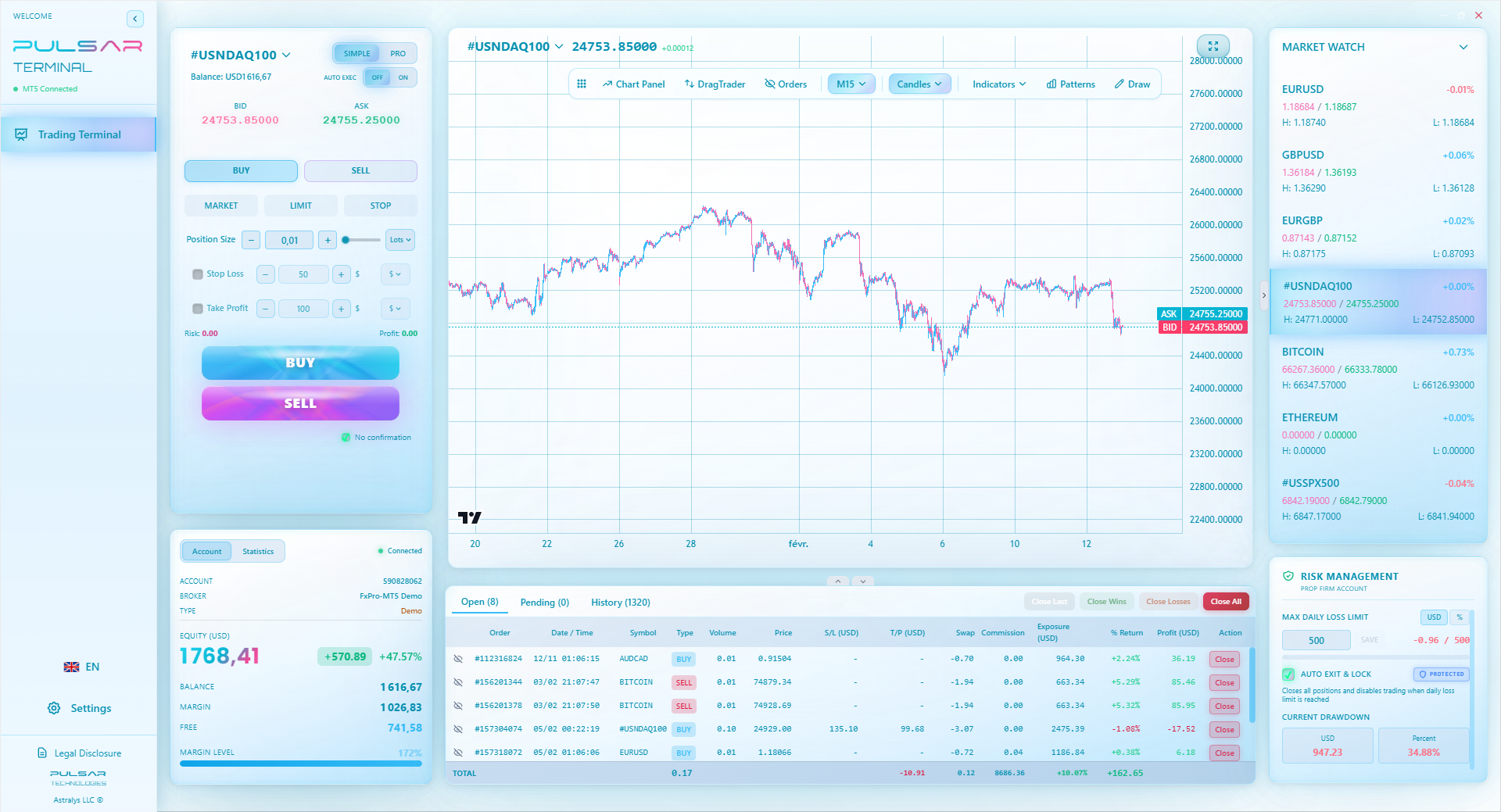
You don't need fancy software to see structure. A clean chart with candlesticks or bars is enough. However, a few tools help immensely.
Drawing Tools: You need a horizontal line tool and maybe a trendline tool. That's it. The simpler, the better. Some platforms offer auto-swing high/low indicators. Use them with caution - they often mark insignificant wicks.
The Broker Question: This is critical for South Africans. You can use an FSCA-regulated broker (safe, but 30:1 use), or an international one like Exness or XM which may offer higher use to SA clients. Here's my take: if you're learning structure patterns, start with an FSCA broker. The lower use forces you to be better at timing your entries (using price action) rather than relying on use to bail out a sloppy trade. It teaches discipline.
Once you're consistent, you can evaluate if you need the tools of an international platform. Always check their deposit/withdrawal methods for SA. Some make it easy with Instant EFT, others are a headache.
Charting Platform: Most brokers offer MT4 or MT5. MT5 is better for futures and stocks, but for forex, MT4 is still king for its simplicity. Learn to use the 'Ctrl+F' feature to flip through timeframes quickly to analyze multi-timeframe structure.
💡 Wskazówka Winstona
The FSCA's use limit is not a cage, lad. It's a seatbelt. A 30:1 limit forces you to trade the chart, not your ego. The best structure trade in the world means nothing if your position size would trigger a [margin call](/en/glossary/margin-call) on a 50-pip adverse move.
“Lower use forces you to be better at timing your entries rather than relying on use to bail out a sloppy trade.”
This isn't a one-weekend skill. It takes screen time.
1. The Daily Review (No Trading Allowed): For 20 minutes before the market opens, open your charts. Start with the Daily timeframe on USD/ZAR, EUR/ZAR, GBP/ZAR. Mark the obvious swing highs and lows from the last 3-6 months. What's the structure? Up, down, or range? Then, drop to the 4-hour. Does the 4-hour structure align? This practice is gold.
2. Trade in Simulation First. Don't risk real money until you can correctly identify the prevailing structure and potential breaks on demo for a month. I know, it's boring. But losing virtual money is better than losing real money.
3. Keep a Structure Journal. Not a trade journal. A structure journal. Screenshot your chart at the day's start with your structure lines. At the day's end, screenshot it again. Did price respect the structure? Did it break? Were you right in your read? This feedback loop is how you learn faster than any course.
Eventually, you'll glance at a chart and see the story instantly. You'll see a messy consolidation and think, "It's coiling up for a break of that weekly high." That's when you know you're getting it. It took me about 9 months of focused practice to get to that point, and it transformed my trading from guesswork to a structured process.
FAQ
Q1What's the best timeframe to identify forex structure patterns?
There's no single 'best' timeframe. Use a multi-timeframe approach. For ZAR pairs, I use the Daily chart to define the primary structure (the big picture), the 4-hour chart to see the intermediate structure and potential breaks, and the 1-hour or 4-hour for precise entry triggers. Never analyze structure on just one timeframe.
Q2How do I know if a structure break is real or a false breakout?
You never know for sure, but you can stack probabilities in your favor. Wait for a candle CLOSE beyond the key level (swing high/low). Even better, wait for a pullback to retest that broken level (now acting as support/resistance) and see if price rejects it. Also, check for momentum - a real break often has increasing volume or strong candle bodies. False breaks often look weak and quickly reverse.
Q3Does the FSCA's 30:1 use limit affect how I trade structure?
Absolutely, and in a good way. Lower use (30:1 vs. 500:1) forces you to be more precise. You can't just throw money at a fuzzy idea and hope use works for you. It makes you wait for cleaner, higher-probability structure setups and confirms with price action. It enforces better risk management, which is the foundation of using structure patterns profitably.
Q4Can I use indicators like RSI or MACD with structure patterns?
You can, but make them secondary. Structure is the boss. For example, if price is making a Higher High in an uptrend but the RSI indicator shows divergence (a lower high), it's a warning of weakening momentum, not a signal to reverse. It might tell you to tighten your stop or take partial profits, but don't go short just because of RSI while the price structure is still technically bullish.
Q5How do I handle news events when trading structure?
News is the great structure wrecker. Before a major SA event (SARB decision, budget speech) or global event (US NFP), price often goes into a tight range. The structure beforehand becomes less reliable. My rule: I either close positions before high-impact news or I widen my stop-loss significantly to avoid being taken out by the inevitable spike. I never enter a new trade based on structure right before a major news release.
Q6Is trading forex structure patterns profitable for swing trading in South Africa?
Yes, it's one of the best approaches for swing trading the ZAR. Swing trading aims to capture multi-day moves, which are defined by changes in market structure. By identifying the start of a new trend structure (a break from a range) or riding a continuation in an existing one, you can capture the meat of the move while avoiding the intraday noise that kills shorter-term traders.
Lekcja Prof. Winstona
:
- ✓Structure defines trend: HH/HL = Up, LL/LH = Down.
- ✓A structure break is your primary warning signal.
- ✓Always confirm breaks with a candle close.
- ✓Use multi-timeframe analysis (Daily > 4H > 1H).
- ✓Risk max 2% per trade, regardless of structure confidence.
Jak przydatny był ten artykuł?
Kliknij gwiazdkę, aby ocenić
Tygodniowe analizy tradingowe
Darmowe tygodniowe analizy i strategie. Bez spamu.
O autorze
David van der Merwe
Trader Rynków Wschodzących
Trader z Johannesburga z 11-letnim doświadczeniem w walutach rynków wschodzących. Specjalizuje się w parach ZAR, handlu regulowanym przez FSCA i analizie rynku południowoafrykańskiego.
Komentarze
Może Ci się też spodobać

Cara Trading Forex Sukses: 7 Prinsip dari Trader Profesional
Cara trading forex sukses dengan 7 prinsip trader pro: manajemen modal, disiplin, journal trading, backtest. Data nyata, bukan janji profit palsu.
Jam Trading Forex Terbaik untuk Trader Indonesia: Panduan Lengkap dengan Tabel Waktu
Panduan jam trading forex untuk trader Indonesia. Tabel 4 sesi dunia, jam emas 20:00-00:00, sesi mana yang harus dihindari. Data akurat + tips dari trader berpengalaman.
Top 5 Sàn Forex Uy Tín Nhất 2026: Review Jujur dari Trader Indonesia
Top 5 sàn forex uy tín 2026 untuk trader Indonesia. Review jujur: spread, deposit, withdraw, dukungan lokal. Exness, XM, IC Markets & lebih.
All these calculators are built into Pulsar Terminal with real-time data from your MT5 account. One-click position sizing, automatic risk management, and instant calculations.
