


Which forex trading books are actually worth your time and money? I've spent over a decade and thousands of pounds building a trading library, and honestly, most of it is rubbish.

Sarah Collins
Strateg Tradingowy ·  United Kingdom
☕ 9 min czytania
Czego się nauczysz:
- 1Why Books Still Matter (Even with YouTube)
- 2The Non-Negotiable Foundation
- 3Strategy-Specific Books That Actually Deliver
- 4Books to Avoid (Or Read with Extreme Caution)
- 5Applying Book Knowledge to UK Trading Realities
- 6Building Your Personal Trading Library
- 7My Biggest Mistake (So You Don't Make It)
- 8What Comes After the Books?
Which forex trading books are actually worth your time and money? I've spent over a decade and thousands of pounds building a trading library, and honestly, most of it is rubbish. The right book can save you years of painful, expensive mistakes. The wrong one can send you down a rabbit hole of useless indicators and blown accounts. Let's cut through the noise. I'll show you the books that shaped my career, the ones I wish I'd never opened, and how to apply their lessons within the strict rules of the UK's FCA-regulated market.
You can find a 'trading guru' on YouTube in five seconds. So why bother with a 300-page book written ten years ago? Depth. A good book forces you to sit with a single, coherent philosophy. It builds a system in your mind, piece by piece, instead of offering fragmented tips. In the UK, where 67-89% of retail accounts lose money on CFDs, that structured thinking is your first line of defence. Videos often sell the dream; serious books teach the grind. They explain the 'why' behind the 'what,' which is crucial when you're navigating FCA use caps of 1:30 and need to understand position sizing inside out. My early mistakes came from chasing shiny strategies online. It was only when I committed to a few key texts that my trading journal stopped being a record of failures and started showing a pattern of disciplined, repeatable decisions.

Pro Tip: Read with a notebook. Don't just highlight passages. Write down how each concept applies to your trading plan. For example, when a book discusses risk management, calculate what that means for your account size with UK use limits.
You can't build a house on sand, and you can't build a trading career on memes. These are the bedrock texts. Ignore them at your peril.
Trading in the Zone by Mark Douglas
This isn't a strategy book. It's a psychology manual. Douglas drills into the probabilistic nature of markets. The key takeaway? You can't control whether the next trade wins, but you can 100% control your process. After a brutal 2018 where I lost £2,300 trying to 'be right' on every GBP/USD trade, this book reframed everything. It taught me to focus on executing my plan flawlessly, not on the P&L of a single trade. This mindset is vital with the FCA's negative balance protection; it stops you from taking insane risks just to get back to breakeven.
The Disciplined Trader by Mark Douglas
Yes, him again. If Trading in the Zone is the theory, this is the practical workbook. It directly addresses the self-sabotage every trader faces. It forced me to confront my own tendency to move stop-losses. I still have my notes from a terrible EUR/GBP trade where I watched a 15-pip loss turn into an 85-pip disaster because I ignored every rule in this book.
Market Wizards by Jack D. Schwager
This series interviews the legends. It shows there's no single 'right' way to trade. You'll see trend-followers, arbitrageurs, and quants. The universal thread? Rigorous risk management and profound self-awareness. It's inspiring proof that success is possible, but it's never easy. It pushed me to finally build and stick to a position size calculator routine, which saved my account more times than I can count.

💡 Wskazówka Winstona
A book's age is irrelevant if it teaches a universal truth. I'd take a 50-year-old book on crowd psychology over a new one on a 'revolutionary' indicator any day.
“The right book can save you years of painful, expensive mistakes. The wrong one can send you down a rabbit hole of useless indicators.”
Once your head's on straight, you need a method. These books offer clear, actionable systems.
Technical Analysis of the Financial Markets by John J. Murphy
This is the bible. It's encyclopedic. Don't read it cover-to-cover initially. Use it as a reference. When you hear about a pattern or indicator, look it up here for the canonical explanation. It gave me the context to understand why support and resistance work, which is far more valuable than just drawing lines on a chart. It helped me refine my approach to instruments like XAU/USD, where technical levels are often respected.
Currency Trading and Intermarket Analysis by Ashraf Laidi
This is a gem for forex-specific macro thinking. Laidi connects currencies to bonds, stocks, and commodities. In today's world of central bank dominance, this intermarket perspective is gold. It helped me understand why the GBP/USD would sometimes move on US Treasury yield data more than UK data. Applying this context stopped me from making naive, single-market analyses.

Warning: Many older strategy books assume insane use (like 1:100 or 1:200). Always mentally adjust their risk examples down to the UK's 1:30 limit for majors. A '2% risk' in their example could be wildly different in reality.
I've wasted money so you don't have to. Be sceptical of:
The 'Get Rich Quick' Manuals: Any book with a Lamborghini on the cover or promising 'secret formulas' is selling a fantasy. The math doesn't lie. With typical spreads of 0.6 pips on EUR/USD and commissions, a scalping strategy needs a huge edge to overcome costs. These books ignore transaction costs.
Overly Complex Indicator Festivals: Some books invent a dozen new oscillators. Real trading is often about simplification. I once spent six months layering indicators from one such book onto my charts. My win rate didn't budge, but my confusion and latency did. I made more progress by mastering the MACD indicator and RSI indicator than by using five exotic ones poorly.
Pre-2008 Crisis Texts: The world changed after the Great Financial Crisis and again after the FCA's 2018 product intervention. Books from the early 2000s that discuss 1:400 use are historical curiosities, not operational guides. The regulatory landscape is fundamentally different now.
“My most expensive error wasn't a bad trade. It was intellectual laziness.”
Reading is one thing. Making it work under FCA rules is another. Here’s how to bridge the gap.
Translate Risk Examples: When a book says "risk 1% per trade," calculate what that means in pounds, factoring in your broker's specific spread and your chosen use. On a £10,000 account at 1:30 use, a 1% risk (£100) on GBP/USD is very different than on an exotic pair with a wider spread.
Backtest with UK Costs: Before adopting any strategy, backtest it using the actual spreads and commissions from your FCA-regulated broker, like Pepperstone or IC Markets. A strategy that looks profitable with 0.5 pip spreads might bleed money with 1.5 pip spreads.
Journal Relentlessly: This is the most important step books advocate. Your journal shouldn't just say "Bought GBP/USD." It should note: "Entered on retest of 4H support, as per Murphy's Chapter 6. Risk was 0.8% of account. Spread was 0.9 pips. Felt confident." This links theory to your personal practice.

Example: A book strategy says to place a stop-loss 20 pips away. On a standard lot (100,000 units), that's a $200 risk. With UK use of 1:30, the required margin is roughly £2,600 on GBP/USD. Is that a sensible use of your capital? Your journal helps you answer that.
💡 Wskazówka Winstona
If a trading book doesn't make you uncomfortable by challenging your assumptions, it's probably not worth the paper it's printed on.
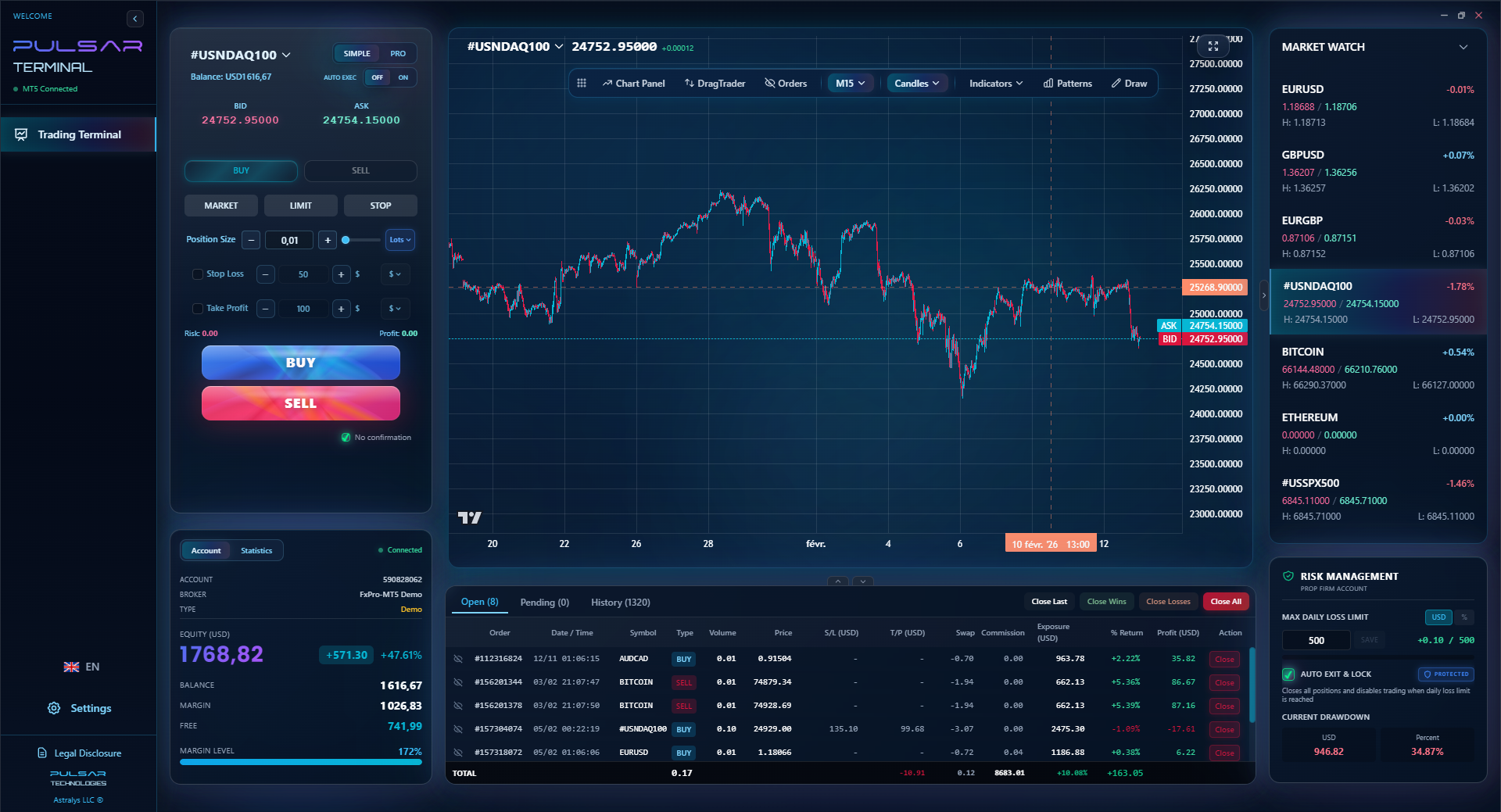
Applying complex book strategies requires precise order management, which Pulsar Terminal automates with drag-and-drop orders and multi-TP/SL tools directly on your MT5 platform.
You don't need a huge shelf. You need a core toolkit. Here’s my recommended acquisition order:
- Start with Psychology: Trading in the Zone. Free your mind first.
- Add a Strategy Primer: Technical Analysis by Murphy. Get the reference.
- Get Inspired: Market Wizards. See the possibilities.
- Specialise: Pick one strategy book that resonates (e.g., one on price action or swing trading) and study it deeply.
- Understand Your Environment: Read the FCA handbook sections on CFD trading. It's dry, but it's the rulebook for your business.
I buy physical copies. The act of writing in the margins, sticking notes on pages, and seeing it on my shelf reinforces the material. For brokers, I started with XM for their educational focus, but eventually moved to brokers with tighter pricing as my volume grew.
“Your library isn't a trophy case; it's a toolbox. Keep the useful tools sharp.”
My most expensive error wasn't a bad trade. It was intellectual laziness. I read Reminiscences of a Stock Operator (a fantastic book about Jesse Livermore) and romanticised the huge swings. I ignored the context - he traded in an unregulated, pre-digital era - and tried to emulate the drama, not the underlying discipline. I took oversized positions on a Exness demo account (simulating high use), got a few lucky wins, and then transferred that reckless confidence to my real, FCA-limited account. The result? A series of impulsive trades that violated every risk rule I knew. I gave back three months of steady profits in a week. The lesson? A book gives you ideas, not mandates. You must filter every lesson through the prism of your own personality, your risk tolerance, and the modern regulatory framework. Don't worship the author; use them as a consultant whose advice you are free to modify.
💡 Wskazówka Winstona
Your trading library should be small and worn, not large and pristine. A single, deeply understood text is worth a shelf of unread ones.
Books provide the map, but you have to walk the path. Reading about a pip is not the same as watching 50 pips slip away from your position. Here's the sequence:
- Read & Plan: Absorb 1-2 core books. Draft a simple trading plan.
- Demo Trade: Execute that plan for at least 3 months. Treat the virtual money like real money.
- Review & Refine: Use your journal. Is the strategy working? Does it suit your psychology? Tweak it.
- Go Live Small: Start with a live account so small that the gains and losses feel trivial. The goal is to test your emotional control.
- Scale Gradually: Only add capital when you have a quarter of consistent, disciplined execution.
The cycle never really ends. I still re-read sections of Trading in the Zone every few months. It's maintenance for the mind. The market changes, and you must adapt, but the core principles of risk management and discipline are eternal. Your library isn't a trophy case; it's a toolbox. Keep the useful tools sharp, and don't be afraid to discard the ones that don't fit your hands.
FAQ
Q1What is the single best forex trading book for a complete beginner in the UK?
Start with Trading in the Zone by Mark Douglas. Before you learn how to spot a trade, you need to learn how to handle loss and uncertainty. It's the best preparation for the psychological reality of trading under FCA rules, where you're protected from negative balances but still facing a high-probability losing game as a retail trader.
Q2Are forex trading books still relevant with AI and algorithms?
Absolutely. AI handles speed and pattern recognition, but books teach timeless principles of risk, probability, and human psychology - which drive the markets. An algorithm follows its code; you need the wisdom to know when to override it or adjust your strategy. Books build that foundational judgement.
Q3How do I adjust the risk management in old trading books for UK use limits?
Recalculate everything. If a book from 2005 uses 1:100 use in an example, manually rework the numbers using the UK's 1:30 cap for major pairs. Use a position size calculator to determine your exact stake per trade based on your account size, stop-loss distance, and the current spread from your FCA broker.
Q4Should I focus on books about forex specifically, or general trading books?
Prioritise general trading books on psychology and risk management first. The principles are universal. Then, add forex-specific texts for market mechanics. A great stock trader's mindset lessons apply directly to forex. The unique aspects of forex (like 24-hour markets, interest rate differentials) are the final layer of specialisation.
Q5I've read several books but still struggle. What am I missing?
You're likely missing the integration phase. Reading isn't enough. You must systematically apply the lessons in a demo journal, then a small live account. The gap between theory and practice is filled with emotional friction. Re-read the psychology books - the struggle is almost always about discipline and self-awareness, not a lack of knowledge.
Q6Are there any good books on trading tax and regulation in the UK?
For regulation, the best source is the FCA website itself - it's the primary text. For tax, HMRC's guides on Capital Gains Tax and spread betting are essential. While not 'trading books' in the classic sense, they are critical operational manuals for your business. Consider them required reading.
Lekcja Prof. Winstona
:
- ✓Psychology books are more important than strategy books.
- ✓Always recalculate risk examples for UK use limits.
- ✓Demo trade any new concept for 3 months minimum.
- ✓The FCA handbook is a mandatory trading manual.
Jak przydatny był ten artykuł?
Kliknij gwiazdkę, aby ocenić
Tygodniowe analizy tradingowe
Darmowe tygodniowe analizy i strategie. Bez spamu.
O autorze
Sarah Collins
Strateg Tradingowy
Londyńska strateg tradingowa z 12-letnim doświadczeniem na rynkach finansowych. Była analityczka w brokerstwie w City of London. Obejmuje pary GBP, rynki europejskie i handel regulowany przez FCA.
Komentarze
Może Ci się też spodobać

Cara Trading Forex Sukses: 7 Prinsip dari Trader Profesional
Cara trading forex sukses dengan 7 prinsip trader pro: manajemen modal, disiplin, journal trading, backtest. Data nyata, bukan janji profit palsu.
Jam Trading Forex Terbaik untuk Trader Indonesia: Panduan Lengkap dengan Tabel Waktu
Panduan jam trading forex untuk trader Indonesia. Tabel 4 sesi dunia, jam emas 20:00-00:00, sesi mana yang harus dihindari. Data akurat + tips dari trader berpengalaman.
Top 5 Sàn Forex Uy Tín Nhất 2026: Review Jujur dari Trader Indonesia
Top 5 sàn forex uy tín 2026 untuk trader Indonesia. Review jujur: spread, deposit, withdraw, dukungan lokal. Exness, XM, IC Markets & lebih.
All these calculators are built into Pulsar Terminal with real-time data from your MT5 account. One-click position sizing, automatic risk management, and instant calculations.
