


Everyone wants a simple forex trading broker list.

Daniel Harrington
Szef Treści
☕ 11 min czytania
Czego się nauczysz:
Everyone wants a simple forex trading broker list. They think finding the right name is the hard part. It's not. The hard part is knowing which ones will actually let you withdraw your money later, and which ones are just a fancy website waiting to take your deposit. I've seen traders spend weeks comparing spreads but never check the regulator's warning list. Let's set the record straight: a good list isn't about who's on it, but who you cross off it first.
Before you look at a single broker, you need to understand the playing field. I'm not a lawyer, but I've traded from enough countries to know this: ignoring local rules is the fastest way to get your account frozen and your funds stuck.
In Bangladesh, the official stance from the Bangladesh Bank has historically been restrictive regarding forex trading for individuals on international platforms. The local currency is the Taka (BDT), and moving large sums abroad for speculative trading can raise flags. I've had emails from traders here who couldn't get their profits back because their bank blocked the international transfer, questioning the source.
This doesn't mean no one trades. It means you must be smarter about it. Your first filter for any forex trading broker list should be: does this broker have a clear, established history of processing withdrawals for clients in similar regulatory environments? You're not looking for a broker that shouts about accepting Bangladeshi clients; you're looking for one that quietly, reliably services them.

Warning: Using international brokers often means depositing in USD or EUR. Your local bank may charge high conversion fees (3-5% isn't uncommon) and ask for documentation. Factor this hidden cost into your math.
The most common workaround is using brokers regulated by top-tier authorities (like ASIC or FCA) that accept clients globally. They have the compliance frameworks to handle cross-border transactions. Your job is to ensure your funding method is sustainable. Start small. Test the withdrawal process with a small profit before committing serious capital. I learned this the hard way early on, assuming a deposit method would work in reverse. It didn't, and it took a 45-day support ticket to resolve.

Throw away lists that rank brokers by "bonuses" or flashy ads. You need a system. I filter every broker through three non-negotiable pillars. Fail one, and they're off the list.
Pillar 1: Regulation & Safety of Funds
This is non-negotiable. You must verify this yourself. Don't trust the broker's website.
- Go to the regulator's website. Look up the broker's licensed entity name (it's often different from the trading name).
- Check what the license actually covers. A "registration" is not a full license.
- Look for negative actions. Fines, warnings, or sanctions are huge red flags.
A broker holding a client money license from a strict regulator (e.g., ASIC's AFSL) is forced to keep your funds in segregated accounts. This means if the broker goes bankrupt, your money isn't part of their assets to pay off debts. I only consider brokers with at least one top-tier regulation. Everything else is gambling.
Pillar 2: Real Trading Costs
Spreads are just the headline. The real cost is in execution.
- Average Spread on EUR/USD: During your main trading hours, what's the typical spread? Under 1.0 pip on a Raw/Razor account is good. 1.5-2.0 is standard.
- Commission: If on a Raw account, it's usually $3-$3.50 per 100k round turn.
- Swap Rates: If you hold positions overnight, these matter. They can eat profits or add cost.
- Inactivity Fees: Will they charge you if you take a month off?
I once chose a broker with a 0.9-pip spread over one with a 1.2-pip spread. Seemed smart. But the 0.9-pip broker had frequent requotes and slippage on news. The "cheaper" broker cost me more in missed entries and bad fills. True cost is spread + execution reliability.
Pillar 3: Deposit & Withdrawal Practicality
This is where your Bangladesh-specific planning hits home.
- What payment methods work? International Bank Transfer (SWIFT), Credit/Debit Cards, E-wallets (Skrill, Neteller, maybe local ones if supported).
- What are the fees? Does the broker charge for withdrawals? Does your payment provider?
- Processing Time: 1-3 business days for e-wallets, 3-7 for bank wires is standard.
- Currency Conversion: If depositing BDT, who does the conversion and at what rate?

Pro Tip: Start by funding your account with a small amount via a method you know you can also withdraw to. Make a small profit, then request a withdrawal of your initial deposit plus the profit. If that process is smooth, you've validated the pipeline. This test is more valuable than any review.

💡 Wskazówka Winstona
A broker is a pipe for your money. You want the most boring, clog-free, reliable pipe you can find. Excitement in a broker's marketing is a direct signal of risk.
“Your first filter for any broker list should be: does this broker have a clear history of processing withdrawals for clients in similar regulatory environments?”
Not all brokers are built the same. Picking the wrong type for your style is a constant friction cost.
| Broker Type | How They Make Money | Best For | Watch Out For |
|---|---|---|---|
| Market Maker (Dealing Desk) | They take the other side of your trade, profit from your loss. | Absolute beginners, tiny accounts (<$500). | Conflict of interest. Widened spreads during volatility. |
| STP/ECN (No Dealing Desk) | They route your order to liquidity providers, charge a commission. | Serious traders, scalpers, anyone who needs raw spreads. | Commissions, minimum deposit requirements ($100-$500). |
| DMA (Direct Market Access) | Your order goes directly to the interbank market. | Institutional traders, very large volumes. | High minimums, complex platforms. |
For most developing traders in Bangladesh, a well-regulated STP/ECN broker is the sweet spot. You get transparent costs (spread + commission) and no conflict of interest. Your success is not their failure. When I switched from a market maker to a true ECN broker years ago, my scalping strategy performance improved overnight - not because the strategy changed, but because my entries and exits were filled at the prices I saw, not the prices they decided to give me.
Many global brokers offer both types of accounts. For example, you might see a "Standard" account (wider spread, no commission) and a "Raw" or "Pro" account (tight spread, plus commission). Use a position size calculator to run the numbers for your typical trade size on both account types. You'll often find the Raw account is cheaper for trades above a certain volume.

Let's apply the filter. Here's a look at some globally known brokers often searched by Bangladeshi traders. This is not a recommendation. It's a demonstration of how to analyze. You must do your own due diligence as regulations and offerings change.
Example 1: IC Markets
- Regulation: Strong (ASIC, CySEC).
- Costs: True ECN spreads (often 0.0-0.1 on majors) + $3.50 commission. Benchmark for low cost.
- Practicality: Accepts international clients, many payment methods. Their IC Markets review often highlights their raw spreads.
- Verdict: Passes the three-pillar filter for an experienced trader focused on cost. The high number of liquidity providers means generally good execution.
Example 2: Exness
- Regulation: Mixed (CySEC, FCA, but also offshore). They often promote acceptance of global clients.
- Costs: Can be very low, even zero spread on some accounts. Their model is high-volume.
- Practicality: Known for a vast array of local payment methods in many countries, which could be an advantage.
- Verdict: Requires careful scrutiny. Which entity are you signing up with? Check the specific regulator for that entity. Their Exness review details this segmentation.
Example 3: Pepperstone
- Regulation: Top-tier (ASIC, FCA, others).
- Costs: Competitive ECN pricing, similar to IC Markets. Strong on technology.
- Practicality: Global reach, standard payment methods.
- Verdict: Consistently passes the safety pillar. A solid contender for any list focused on reliability. The Pepperstone review usually confirms their execution speed.
The point isn't to pick from these three. The point is to show you the questions to ask. For every name on your list, you should be able to fill out a mental checklist for Regulation, Cost, and Practicality.
“True cost is spread + execution reliability. A cheap spread with bad fills is the most expensive deal you'll get.”
This is where dreams of profits meet reality. Let's talk numbers from a Bangladesh perspective.
Scenario: You want to deposit $500.
- Your BDT is converted to USD. Your bank's rate might be 117 BDT/USD, while the market rate is 115. That's a 1.7% loss immediately.
- Your bank may charge a 1-2% international transfer fee + a flat SWIFT fee (maybe $15-30).
- The broker receives $500 minus any intermediary bank fees (another $10-20 sometimes).
You might start with only $450 of trading capital. To just break even, you need to make a 10% return just to cover funding costs. This kills most traders before they even place a trade.
The Solution Path:
- E-wallets: Services like Skrill or Neteller can act as a buffer. You fund them via local methods (possibly with lower fees), convert to USD internally, then send to the broker. Withdrawal is the reverse. Fees are often percentage-based (1%-3%). Test this with a small amount first.
- Broker Localization: Some brokers partner with local payment processors. You might see an option to pay in BDT via a local bank transfer or mobile money. This can drastically cut costs. But, you must double-check the broker's regulation in this case. An offshore broker offering too-good-to-be-true local payments can be a major red flag.
I made the bank transfer mistake once. Sent $1,000, lost $85 in fees before the trade. The psychological pressure to "make up" that loss led me to force a bad trade, which I then lost. My effective starting capital was wiped out by friction. Now, I only use vetted e-wallet paths where the total fee is under 2%.
💡 Wskazówka Winstona
Your first withdrawal request is your final exam for the broker. Make it a small, simple test. If they pass, you can proceed. If they fail, you only lost the test fee.
MetaTrader 4/5 (MT4/MT5) is the global standard for a reason. It's the common language. Most brokers offer it. Your focus should be on what enhances it.
You don't need a broker with 200 indicators. You need a stable platform with reliable data feed and the ability to use external tools. This is where a forex trading broker list should consider environment, not just flash.
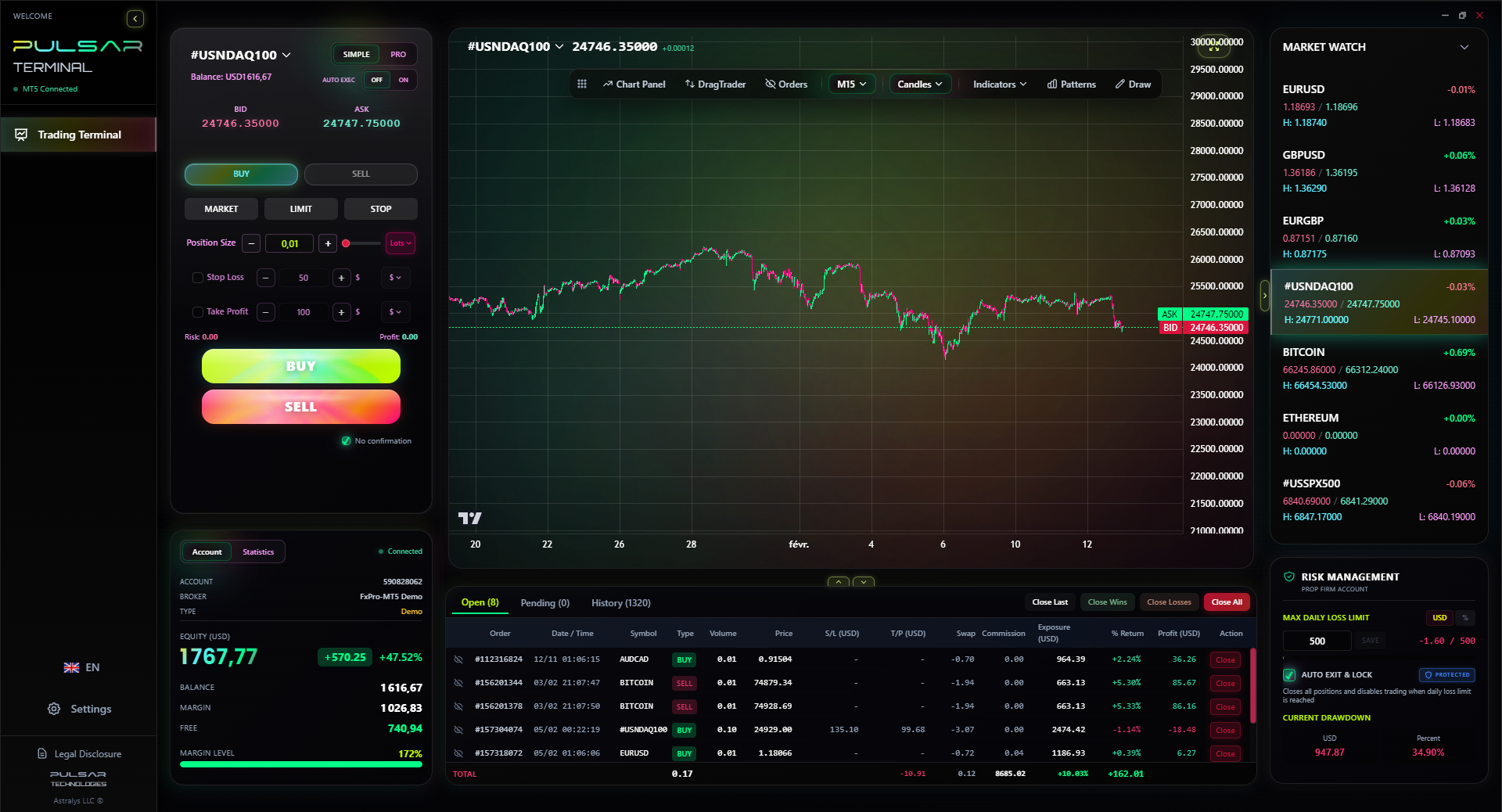
For example, tools like Pulsar Terminal (a companion app for MT5) solve practical problems. They let you set advanced order types (multiple take-profits, trailing stops, breakeven) with a drag-and-drop, which MT5 lacks natively. For a swing trading strategy where you scale out of positions, this is a game-saver. Manually moving stop-losses to breakeven on 5 charts at once is how you miss the move.
Also, check the broker's server locations. If you're scalping the EUR/USD or XAU/USD, latency matters. A broker with servers in London or New York will give you better execution than one with servers only in Cyprus, if you're trading the major sessions.
Your platform checklist:
- MT4/MT5 available (or cTrader for some ECNs).
- Stable, low-latency VPS option (often free if you trade a certain volume monthly).
- Compatibility with third-party tools you use (like trade copiers or analytics software).
- A functional mobile app for monitoring, not complex trading.
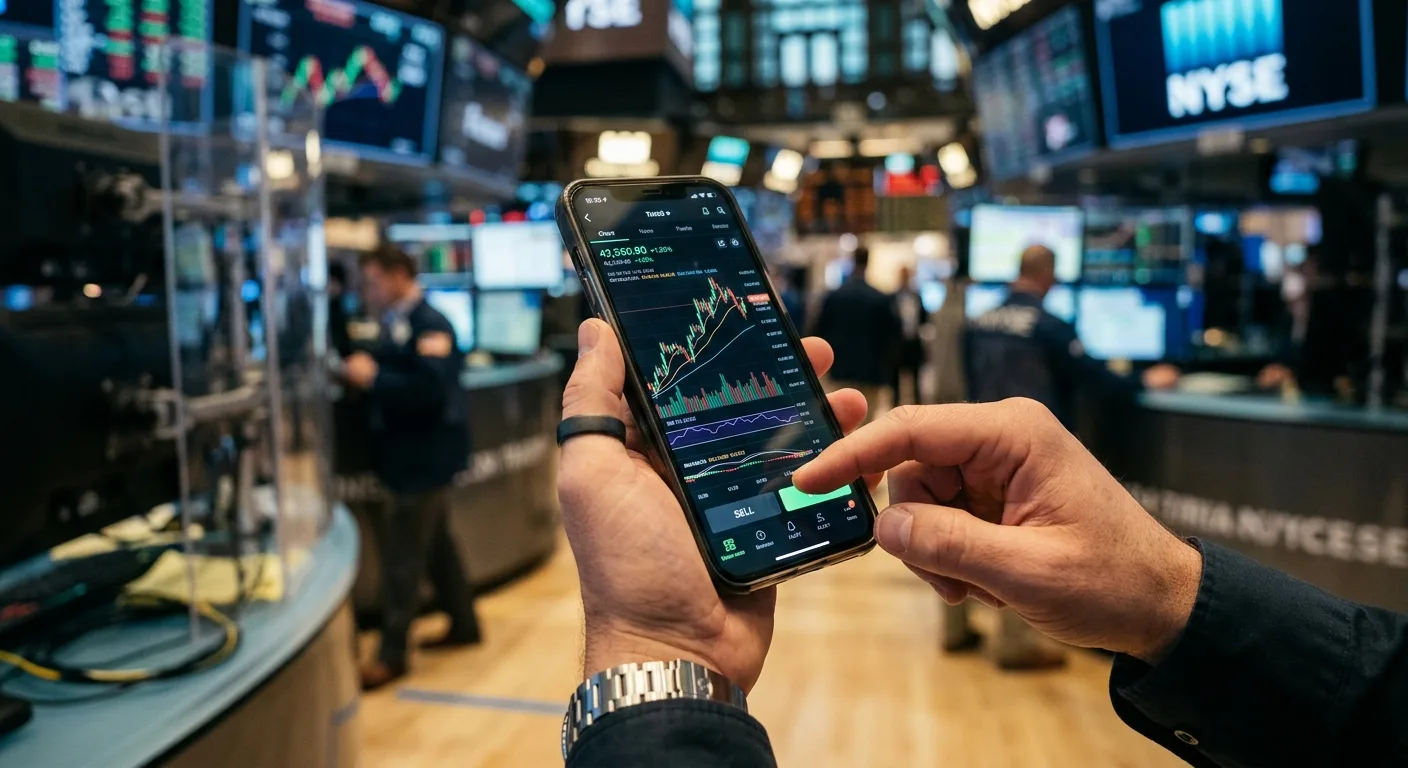
Managing complex trades with multiple take-profits and trailing stops is a common need, and tools like Pulsar Terminal automate this directly on your MT5 platform, turning manual stress into a systematic rule.
“The most boring, reliable, regulated broker is the one you want. The excitement should be in your trading edge, not in your broker's promotional emails.”
Your final forex trading broker list should have 2-3 names, max. More than that and you're just procrastinating. Here's the action plan:
- Gather 5-7 Names: From reputable comparison sites, forums, or word-of-mouth. Ignore the "#1 Rated!" banners.
- Apply the Three-Pillar Filter: Cross off any without verifiable top-tier regulation. Cross off any with consistently poor reviews about withdrawal delays. You'll likely cut 3-4 here.
- Open Demo Accounts: For the remaining 2-3, open a demo. Don't just look at the spreads. Test execution during volatile times (like London open). Try placing and closing orders. See how the platform feels.
- Contact Support: Ask a specific question about withdrawal methods for Bangladesh. Gauge their response time and clarity. If they're vague or slow on demo, imagine them with your real money.
- Make Your Choice and Test: Deposit the minimum amount (not a dollar more) into your top choice. Execute your planned withdrawal test.
Remember, the broker is a utility. It shouldn't be exciting. The most boring, reliable, regulated broker is the one you want. The excitement should be in your trading edge, not in your broker's promotional emails. Once you have a broker that works, your focus should shift entirely to your strategy, risk management, and psychology. The margin call doesn't care who your broker is.

FAQ
Q1Is forex trading legal for individuals in Bangladesh?
The Bangladesh Bank (the central bank) does not authorize or license international forex brokers for retail speculative trading by individuals. Trading with international brokers operates in a gray area. While many do it, you assume the risks, including potential issues with banks processing international transfers for this purpose. You are responsible for understanding the legal and financial implications.
Q2What is the best payment method for funding from Bangladesh?
There's no single 'best' method. International bank wires are direct but have high fees and conversion costs. E-wallets like Skrill/Neteller often have lower percentage fees and can be funded via local methods, acting as a useful buffer. The critical step is to test the entire cycle - deposit and withdrawal - with a small amount before committing significant capital.
Q3How much money do I need to start?
Technically, some brokers allow starts as low as $10-$50. Practically, starting with less than $200-500 is a severe handicap after factoring in funding costs and proper position sizing. A tiny account forces you to take excessive risk per trade to see meaningful gains, which is a classic blow-up recipe. Start with an amount whose loss wouldn't cripple you, but is large enough to trade with realistic risk (e.g., 1-2% per trade).
Q4Do I need to pay taxes on forex trading profits in Bangladesh?
Tax laws are complex and you should consult a local tax professional. Generally, if you generate income, it may be taxable. The challenge is that trading with international brokers may not generate local documentation like a TIN certificate. You are responsible for reporting income according to the National Board of Revenue (NBR) rules. Ignorance is not a defense.
Q5What's more important: low spreads or good regulation?
Good regulation, always. A broker with a 0.1-pip spread is useless if they disappear with your money or refuse your withdrawal. Regulation ensures safety of funds, segregated accounts, and a dispute resolution process. Once you have a shortlist of well-regulated brokers, then you compare their costs and execution.
Q6Can I use a robot or Expert Advisor (EA) with any broker?
Most brokers supporting MT4/MT5 allow EAs. However, some restrict certain types (like high-frequency scalping EAs) or may have rules against arbitrage strategies. Always check the broker's terms of service regarding automated trading. Also, test your EA thoroughly on their demo server first, as latency and execution differences can break a strategy.
Lekcja Prof. Winstona
:
- ✓Regulation is non-negotiable. Verify it yourself.
- ✓Test the withdrawal pipeline before large deposits.
- ✓Factor in ALL funding costs (FX conversion, fees).
- ✓Choose broker type (ECN/STP) that matches your strategy.
Jak przydatny był ten artykuł?
Kliknij gwiazdkę, aby ocenić
Tygodniowe analizy tradingowe
Darmowe tygodniowe analizy i strategie. Bez spamu.
O autorze
Daniel Harrington
Szef Treści
Szef działu treści w The Trading Mentor. Doświadczony trader z pasją do upraszczania złożonych koncepcji handlowych. Obejmuje tematy globalne, strategie i przewodniki po platformach.
Komentarze
Może Ci się też spodobać

Cara Trading Forex Sukses: 7 Prinsip dari Trader Profesional
Cara trading forex sukses dengan 7 prinsip trader pro: manajemen modal, disiplin, journal trading, backtest. Data nyata, bukan janji profit palsu.
Jam Trading Forex Terbaik untuk Trader Indonesia: Panduan Lengkap dengan Tabel Waktu
Panduan jam trading forex untuk trader Indonesia. Tabel 4 sesi dunia, jam emas 20:00-00:00, sesi mana yang harus dihindari. Data akurat + tips dari trader berpengalaman.
Top 5 Sàn Forex Uy Tín Nhất 2026: Review Jujur dari Trader Indonesia
Top 5 sàn forex uy tín 2026 untuk trader Indonesia. Review jujur: spread, deposit, withdraw, dukungan lokal. Exness, XM, IC Markets & lebih.
All these calculators are built into Pulsar Terminal with real-time data from your MT5 account. One-click position sizing, automatic risk management, and instant calculations.
