


Let me be blunt: most of what you hear about forex trading in India is either outdated or a straight-up lie.

Rajesh Sharma
Starszy Analityk Forex ·  India
India
☕ 11 min czytania
Czego się nauczysz:
Let me be blunt: most of what you hear about forex trading in India is either outdated or a straight-up lie. The dream of easily trading EUR/USD from your Mumbai apartment while paying minimal tax? That's a fast track to a hefty penalty notice from the RBI. The reality is a tightly controlled, highly regulated environment with specific tax rules you can't ignore. I've seen too many traders get burned by not understanding this. In this guide, I'll walk you through the exact legal framework, the real numbers you'll pay in tax, and how to structure your trading so you keep more of your profits and stay on the right side of the law.
First things first, you need to know what you're allowed to trade. This isn't about finding a clever loophole, it's about operating within a system designed to protect the rupee.
You can only legally trade currency derivatives on Indian exchanges like the NSE or BSE through a SEBI-regulated broker. Forget about those slick ads for offshore platforms. The permitted pairs are strictly limited:
- INR Pairs: USD/INR, EUR/INR, GBP/INR, JPY/INR.
- Cross-Currency Pairs (No INR): EUR/USD, GBP/USD, USD/JPY.
That's it. Trading AUD/USD, GBP/JPY, or any exotic pair through an international broker like Exness or IC Markets is a violation of FEMA. Yes, those brokers might accept you through an offshore entity, but you're taking a real regulatory risk. The Liberalised Remittance Scheme (LRS) is for education, travel, or gifts, not for funding a speculative forex account in Cyprus.

Warning: Using an international broker for non-INR pairs isn't just 'grey area' - it's illegal for speculative trading. Getting your profits back to India can trigger scrutiny, and repeated violations can lead to serious penalties.
The brokers you should be looking at are Indian entities like Zerodha, Upstox, Angel One, or ICICI Direct for your legal trading. They handle all the exchange reporting for you, which makes the tax part (which we'll get to) much cleaner.

This is where most of the confusion lies. Your forex trading profits are absolutely taxable. The big question is: are they Business Income or Capital Gains? The Indian tax department (and you) will decide this based on the frequency, volume, and intent of your trades.
Business Income: You're a Professional Trader
If trading is your primary activity or you're executing multiple trades daily/weekly, your profits will almost certainly be treated as business income. This isn't bad, it just has specific rules.
- Tax Rate: Profits are added to your total income and taxed at your applicable slab rate (0%, 5%, 20%, 30%).
- The Big Benefit: You can deduct business expenses. This includes broker commissions, data feed subscriptions, internet bills, a portion of your rent/home loan interest if you have a dedicated home office, and even the cost of trading education or a position size calculator tool.
- Presumptive Taxation (Section 44AD): If your total turnover (the sum of all your trades, not profit) is under ₹2 crores, you can opt for this. You simply declare 6% of your turnover as profit (8% if not digital) and pay tax on that. You can't claim expenses, but it simplifies accounting massively.
Capital Gains: The Occasional Investor
If you place a few trades a year and hold positions for longer periods, you might argue it's an investment.
- Short-Term Capital Gains (STCG): Held for less than 36 months. Added to your income and taxed at your slab rate. (Note: For equity shares, it's 15%, but for currency derivatives, the 36-month rule generally applies).
- Long-Term Capital Gains (LTCG): Held for more than 36 months. Gains above ₹1 lakh are taxed at 10% without indexation benefit.
My experience? Unless you're literally buying and holding a USD/INR contract for years (which is unusual), the tax officer will see frequent trading as a business. I learned this the hard way early on. In the 2019 financial year, I made about ₹8 lakh in profits from scalping strategy USD/INR. I tried to file it as STCG. The assessing officer reclassified it as business income. It was more paperwork, but I could then deduct my ₹1.2 lakh in expenses (brokerage, software, home office), which actually lowered my final tax bill.

Example: Let's say you make ₹15 lakh in profit from trading in a year, and your other income puts you in the 30% tax slab.
- As Business Income (with ₹2 lakh expenses): Taxable profit = ₹15L - ₹2L = ₹13L. Tax = 30% of ₹13L = ₹3.9 lakh.
- As STCG (no expenses): Taxable gain = ₹15L. Tax = 30% of ₹15L = ₹4.5 lakh. Proper classification and expense tracking saved ₹60,000.
Remember, the first ₹2.5 lakh of your total income (including trading profits) is tax-free under the basic exemption limit.
“The dream of easily trading EUR/USD from your Mumbai apartment while paying minimal tax? That's a fast track to a hefty penalty notice.”
Apart from income tax, you pay Goods and Services Tax (GST) on the services you use for trading. This is non-negotiable and often overlooked when calculating net profitability.
GST is levied at 18% on the brokerage fee or commission you pay to your broker. It is NOT charged on the total value of your trade.
Let's break it down with real numbers. Say your broker charges ₹20 per executed order for trading USD/INR futures.
- Brokerage: ₹20
- GST @ 18% on brokerage: ₹3.60
- Total cost per trade: ₹23.60
This is a critical number for your strategy. If you're a high-frequency trader making 10 trades a day, that's ₹236 in costs daily, or over ₹60,000 a year (assuming 250 trading days). It eats directly into your bottom line. This is why understanding your broker's fee structure is as important as your strategy. A broker with a slightly tighter spread definition but higher per-trade commission might be worse for a scalper than one with a wider spread but zero commission.
There's also a Stamp Duty, which is a tiny percentage of the turnover, but it's usually negligible for most retail traders. The key takeaway? Factor the GST-inclusive brokerage into your risk-reward calculations for every single trade. A trade that looks like a 1:2 risk-reward ratio before costs might be closer to 1:1.5 after you account for the entry and exit fees.

💡 Wskazówka Winstona
The market doesn't care about your tax bracket. Your trading plan must account for costs (brokerage + GST) *after* you've found an edge. A strategy that's breakeven before costs is a guaranteed loser.
Here's a rule that catches almost every new profitable trader off guard: Advance Tax.
If your estimated tax liability for the year (from all sources, including trading) exceeds ₹10,000, you cannot wait until March 31st to pay. You must pay it in installments during the year itself.
The due dates are:
| Installment | Due Date | Percentage of Tax Due |
|---|---|---|
| 1st | June 15th | 15% |
| 2nd | September 15th | 45% (cumulative) |
| 3rd | December 15th | 75% (cumulative) |
| 4th | March 15th | 100% (cumulative) |
Why does this matter? Because trading income is unpredictable. In January, you might be down for the year, but a great February and March could push your profit - and tax due - sky-high. If you haven't been paying advance tax, you'll be hit with interest penalties under Sections 234B and 234C.
I got penalized in my third year. I had a quiet first three quarters, then a massive swing trading win on EUR/INR in Q4. My tax liability shot up. Because I hadn't paid enough advance tax earlier, I owed an extra ₹18,000 in interest. Now, I do a rough profit calculation every quarter and pay the advance tax accordingly.
The Tax Audit Threshold (₹10 Crore)
You need a mandatory tax audit by a Chartered Accountant if your business turnover (again, total trade value, not profit) exceeds ₹10 crore. For most retail traders, this is a distant star. But if you're trading huge volumes, be prepared for this compliance step. It's another reason to maintain clean, detailed records from day one.

“The single most important habit for an Indian forex trader isn't mastering an indicator, it's bookkeeping.”
The single most important habit for an Indian forex trader isn't mastering the MACD indicator, it's bookkeeping. If you can't prove your income and expenses, you're vulnerable.
What you need to track:
- Trade Logs: Every single trade. Entry date/price, exit date/price, instrument (e.g., USDINR APR FUT), quantity, P&L. Your broker provides statements, but maintain your own spreadsheet or journal.
- Brokerage Notes: These are your invoices. They show the brokerage and the GST paid. Keep them all. They are your proof for expense deductions.
- Bank Statements: All deposits to and withdrawals from your trading account. This creates a clear money trail.
- Expense Receipts: Receipts for trading software (like charting tools), internet bills, seminars, market data subscriptions - anything related to your trading business.
I use a simple Google Sheet with tabs for trades, monthly brokerage summaries, and expenses. At the end of the year, I give this to my CA. It takes me 30 minutes a week, and it saved me thousands during that business income reclassification I mentioned.

Pro Tip: Start this from your very first trade. It's much easier to maintain a log than to reconstruct a year's worth of trades from scattered broker statements next March. A good trading journal also makes you a better trader - you can review what's working.
This discipline is what separates the hobbyists from the serious traders. It also makes using tools for risk management, like setting a stop-loss to avoid a margin call, part of a professional process.
💡 Wskazówka Winstona
Treat your advance tax payments like a non-negotiable trade expense. The penalty for missing them is a 100% guaranteed loss, the kind no risk management can recover from.

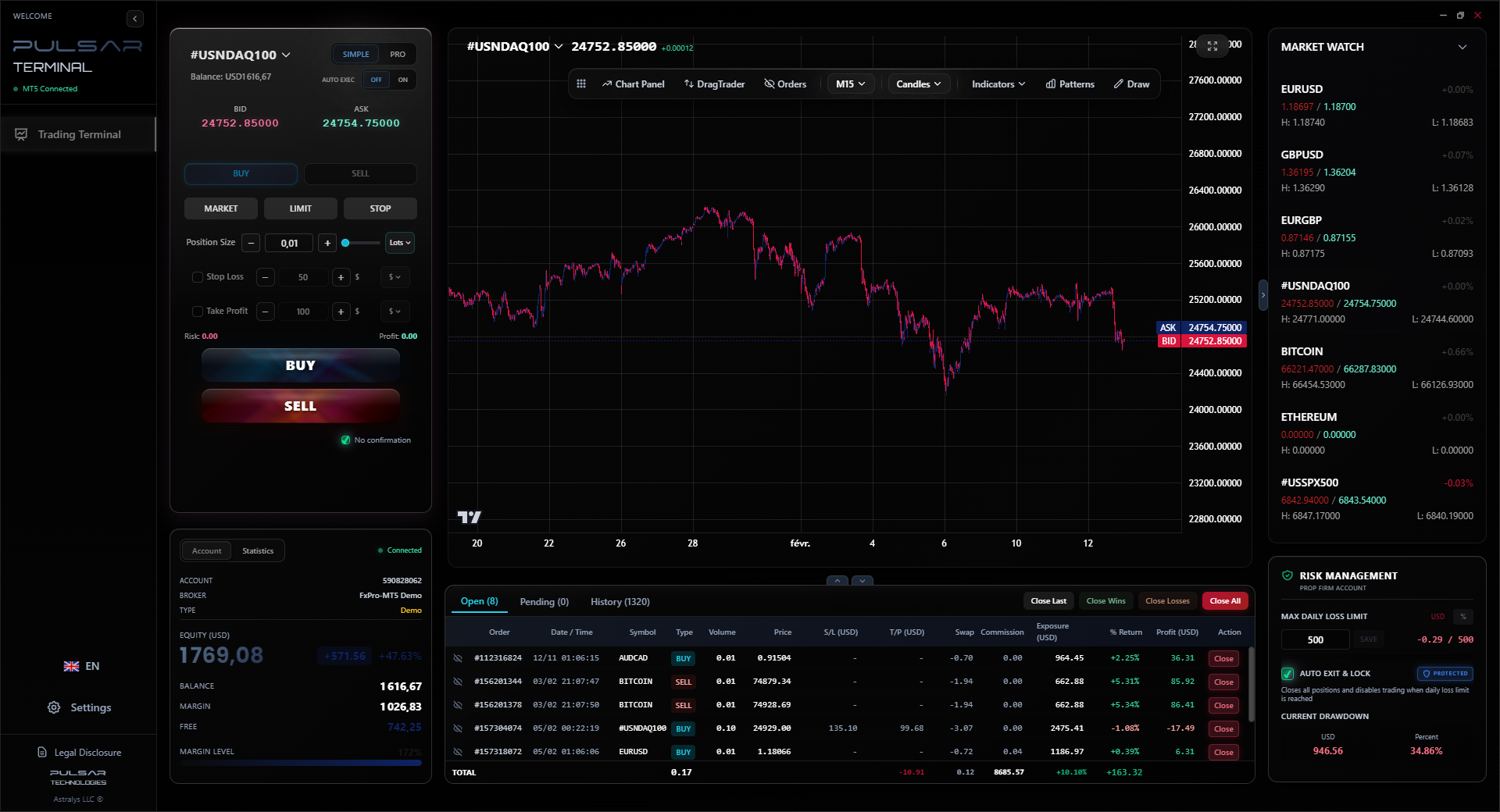
Maintaining a precise trade log for tax purposes is easier when your trading platform, like Pulsar Terminal on MT5, gives you clear, exportable data on every entry, exit, and associated order.
Let's talk about the pitfalls so you can steer clear.
Mistake 1: Ignoring Advance Tax. We covered this. The penalty interest is a guaranteed loss. Set calendar reminders for the four due dates.
Mistake 2: Trading Illegal Pairs. The temptation is real. The spreads on EUR/USD might be better on an international platform. But the risk isn't just a 'slap on the wrist.' It can involve freezing of funds and legal complications. Stick to the seven permitted pairs on Indian exchanges. If you want exposure to gold, look at MCX, not XAU/USD on an offshore CFD platform.
Mistake 3: Poor Record Keeping. Walking into a tax professional with a shoebox full of papers is a recipe for high CA fees and potential errors. Disorganization is expensive.
Mistake 4: Not Consulting a CA Who Understands Trading. Your family CA who handles salaried income might not get the nuances of business income vs. capital gains for trading, or what constitutes a valid expense. Find a professional who has other trader clients. Their fee is a deductible business expense and worth every rupee.
Mistake 5: Thinking You're Too Small to Matter. The tax department's systems are increasingly automated. Mismatches between your bank deposits (trading profits) and your filed income can trigger an inquiry, even for modest amounts. It's easier to be compliant from the start than to respond to a notice later.
“Disorganization is expensive. A shoebox full of brokerage notes is a recipe for high CA fees and missed deductions.”
Q: Are forex trading losses tax deductible? A: Yes, but it depends. If you file trading as business income, you can carry forward business losses for up to 8 years to set off against future business profits. If filed as capital gains, capital losses can be set off only against capital gains, and Long-Term Capital Losses can only be set off against LTCG.
Q: Do I need a separate GST registration for trading? A: Generally, no. You are the consumer of the broker's service (on which they charge you GST). You don't need your own GSTIN unless your trading turnover exceeds ₹20 lakhs (₹10 lakhs for special category states) and you are required to provide taxable services to others.
Q: How is income from international brokers taxed if I still use them? A: It's still taxable as income in India. The bigger issue is the illegality of the activity under FEMA. For tax purposes, you'd still need to declare the profit, but bringing that money into India could raise red flags with the RBI. It's a risky, complicated position I strongly advise against.
Q: Can I trade in cryptocurrencies instead to avoid these rules? A: No. Crypto trading has its own set of tax rules (30% flat tax on gains, no loss set-off) and regulatory uncertainty. It's not an escape from regulation or taxation.
Q: What if I trade very infrequently? A: If you make only a few trades a year and hold positions for long periods, you have a stronger case for declaring it as capital gains. Document your investment intent. But remember, the tax officer has the final say based on the overall picture.

FAQ
Q1What is the tax rate on forex trading profits in India?
There's no single rate. If classified as business income (common for active traders), profits are added to your total income and taxed at your slab rate (0%, 5%, 20%, or 30%). You can deduct expenses. If classified as capital gains, short-term gains (under 36 months) are taxed at your slab rate, and long-term gains may be taxed at 10% over ₹1 lakh.
Q2Is trading with international brokers like XM or IC Markets legal for Indians?
Using international brokers for speculative trading in non-INR pairs (like EUR/USD, GBP/JPY) is illegal under India's Foreign Exchange Management Act (FEMA). You can only legally trade the 7 permitted pairs (4 INR-based, 3 crosses) through SEBI-regulated brokers on Indian exchanges like NSE or BSE.
Q3Do I have to pay GST on my forex trades?
Yes, but not on the trade value. You pay 18% GST on the brokerage fee or commission charged by your broker. For example, on a ₹20 brokerage fee, you pay ₹3.60 GST. This cost must be factored into your trading strategy.
Q4What is advance tax and do I need to pay it?
If your total estimated tax liability for the financial year (including from trading) exceeds ₹10,000, you must pay advance tax in four installments (June, Sept, Dec, March). Failure to do so results in interest penalties. Most profitable traders will need to pay it.
Q5Can I deduct losses from forex trading?
Yes, but how depends on classification. Business losses can be carried forward for 8 years to set off against future business income. Capital losses can only be set off against capital gains of the same type (short-term vs. long-term).
Q6What records do I need to keep for tax purposes?
Keep everything: detailed trade logs (entry/exit, P&L), all brokerage notes (showing fees & GST), bank statements for funding/withdrawals, and receipts for trading-related expenses (software, internet, education). Good records are essential for filing correctly and claiming deductions.
Q7Is there a tax-free limit for trading income?
Trading income itself doesn't have a separate tax-free limit. However, it forms part of your total income. The basic exemption limit for individuals (currently ₹2.5 lakh for those under 60) applies to your total income, including trading profits.
Lekcja Prof. Winstona
:
- ✓Legal trading is restricted to 7 pairs on Indian exchanges.
- ✓Active trading profits are usually taxed as business income at your slab rate.
- ✓You must pay 18% GST on brokerage fees, not trade value.
- ✓Advance tax is mandatory if liability exceeds ₹10,000.
- ✓careful records are your best tax defense and planning tool.
Jak przydatny był ten artykuł?
Kliknij gwiazdkę, aby ocenić
Tygodniowe analizy tradingowe
Darmowe tygodniowe analizy i strategie. Bez spamu.
O autorze
Rajesh Sharma
Starszy Analityk Forex
Ponad 10 lat doświadczenia na rynkach indyjskich i południowoazjatyckich. Zaczynał od instrumentów pochodnych NSE, zanim przeszedł na międzynarodowy forex. Specjalizuje się w USD/INR i parach rynków wschodzących.
Komentarze
Może Ci się też spodobać

Cara Trading Forex Sukses: 7 Prinsip dari Trader Profesional
Cara trading forex sukses dengan 7 prinsip trader pro: manajemen modal, disiplin, journal trading, backtest. Data nyata, bukan janji profit palsu.
Jam Trading Forex Terbaik untuk Trader Indonesia: Panduan Lengkap dengan Tabel Waktu
Panduan jam trading forex untuk trader Indonesia. Tabel 4 sesi dunia, jam emas 20:00-00:00, sesi mana yang harus dihindari. Data akurat + tips dari trader berpengalaman.
Top 5 Sàn Forex Uy Tín Nhất 2026: Review Jujur dari Trader Indonesia
Top 5 sàn forex uy tín 2026 untuk trader Indonesia. Review jujur: spread, deposit, withdraw, dukungan lokal. Exness, XM, IC Markets & lebih.
All these calculators are built into Pulsar Terminal with real-time data from your MT5 account. One-click position sizing, automatic risk management, and instant calculations.
