


You're in Chennai, you've heard about forex trading, and you're wondering where to even start.
Rajesh Sharma
Starszy Analityk Forex ·  India
India
☕ 10 min czytania
Czego się nauczysz:
You're in Chennai, you've heard about forex trading, and you're wondering where to even start. Should you sign up for that expensive weekend workshop in Nungambakkam? Download a fancy app? The truth is, most 'training' out there is either useless or downright dangerous for Indian traders. I've been trading for over a decade, and I've seen the good, the bad, and the ugly of what's offered in our city. Let's cut through the noise. This isn't about getting rich quick. It's about understanding what you can legally trade, how to build skills that last, and how to spot the difference between real education and a polished sales pitch.
Before we talk about a single chart or indicator, we have to get this straight. This is the most important lesson any forex trading training in Chennai should teach you, but most skip it entirely because it's not sexy.
You are a resident Indian. The Foreign Exchange Management Act (FEMA) is the law of the land. Forget everything you see on YouTube about trading EUR/USD with some offshore broker. For you, that's illegal spot trading. Full stop. The RBI publishes an alert list of unauthorized platforms, and using them can get you in serious trouble.
So what can you do? You can trade currency derivatives on Indian exchanges. This means futures and options contracts where the Indian Rupee (INR) is one half of the pair. The main ones are USD/INR, EUR/INR, GBP/INR, and JPY/INR. SEBI has also recently allowed trading in cross-currency pairs like EUR/USD on exchanges, which is a big step. You do this through a SEBI-regulated broker like Zerodha, ICICI Direct, or Angel Broking on platforms like the NSE or BSE.

Warning: Any 'training' that pushes you to open an account with an unregulated international broker for spot forex is leading you into a legal grey area. Your funds won't be protected, and you could face penalties. Real education starts with the rules.
The trading hours are 9 AM to 5 PM IST. The margin requirements are strict (typically 2-3% for futures), which is actually a good thing - it prevents the insane use that blows up international accounts. Your profit is speculative income and will be taxed accordingly. This is your sandbox. Learn to play well here first.
I learned this the hard way early on. I funded a small $500 account with an offshore broker back in 2015, attracted by the 1:500 use. I made 30% in a week and felt like a genius. Then I tried to withdraw. The process was a nightmare of delays and hidden fees. I got my money out, but the stress wasn't worth it. I realized I was building skills on a foundation that could be pulled away at any moment by regulators. I switched to trading USD/INR futures, and while the moves are smaller, I sleep much better.

💡 Wskazówka Winstona
The market doesn't care about your analysis. It only cares about your risk. A well-managed 1% loss is a better trade than a poorly managed 5% win.
Walk down Anna Salai or browse online, and you'll see ads promising 'Master Forex in 7 Days' or 'Guaranteed Profit Systems.' Let me be blunt: these are scams. Real trading skill is built, not bought in a weekend package.
The Hallmarks of a Scam
- Guarantees of Profit: The market guarantees nothing. Anyone who says otherwise is lying.
- High-Pressure Sales: 'Limited seats!' 'Special Chennai discount!' It's all manipulation.
- Focus on Tools Over Mindset: Selling you a 'secret indicator' instead of teaching risk management.
- Vague on Legality: They won't clearly explain the FEMA rules because their business model might depend on you breaking them.
The Components of Real Education
Good forex trading training in Chennai, or anywhere, should be a balanced diet:
- Market Mechanics: How the NSE/BSE currency derivative market works. Understanding contract sizes, expiry, spreads, and rollover.
- Price Action & Technical Analysis: Learning to read the chart itself. This includes support/resistance, candlestick patterns, and using indicators like the RSI indicator or MACD indicator as context, not crystal balls.
- Risk Management: This is 80% of the game. It's about position sizing (use a position size calculator), setting stop-losses, and never risking more than 1-2% of your capital on a single trade. This alone will save you from a margin call.
- Trading Psychology: Dealing with fear, greed, and frustration. This is the inner work most courses ignore.
- Record Keeping: Journaling every trade - why you took it, your emotional state, the outcome. This is how you improve.
I once paid ₹25,000 for a 'premium' course from a guy with a fancy car in his ads. He taught a complicated system of 10 simultaneous indicators. It was paralyzing. In live markets, by the time all his indicators aligned, the move was over. I lost money trying to follow it. The best 'course' I ever took was a ₹3,000 book on trading psychology and hundreds of hours of watching the USD/INR chart on a demo account.
“Your goal for the first year is not profit; it's to not blow up your account.”
You don't need to spend lakhs. With discipline, you can construct a world-class education. Here’s how I’d do it if I were starting today in Chennai.
Phase 1: Foundation (Months 1-2)
- Read the Rulebook: Go to the SEBI and RBI websites. Read the FAQs on currency derivatives. Boring? Yes. Essential? Absolutely.
- Open a Demo Account: Use a demo from a SEBI-regulated broker. Don't touch real money yet.
- Learn the Lingo: Understand a pip, spread, margin, and lot size in the context of INR contracts.
Phase 2: Skill Acquisition (Months 3-6)
- Price Action: Find free resources on YouTube (be critical) or invest in one well-regarded book on price action. Practice identifying highs, lows, and trends on your demo.
- Pick ONE Strategy: Don't collect 20. Master one. Maybe it's a simple swing trading method based on daily chart support/resistance. Or a disciplined scalping approach on the 15-minute chart. Paper trade it relentlessly.
- Integrate a Tool: Once you understand price action, learn one advanced tool to deepen your analysis. For understanding where big trades happen, learning about the Volume Profile is a game-changer (but you have to know how to read a chart first).

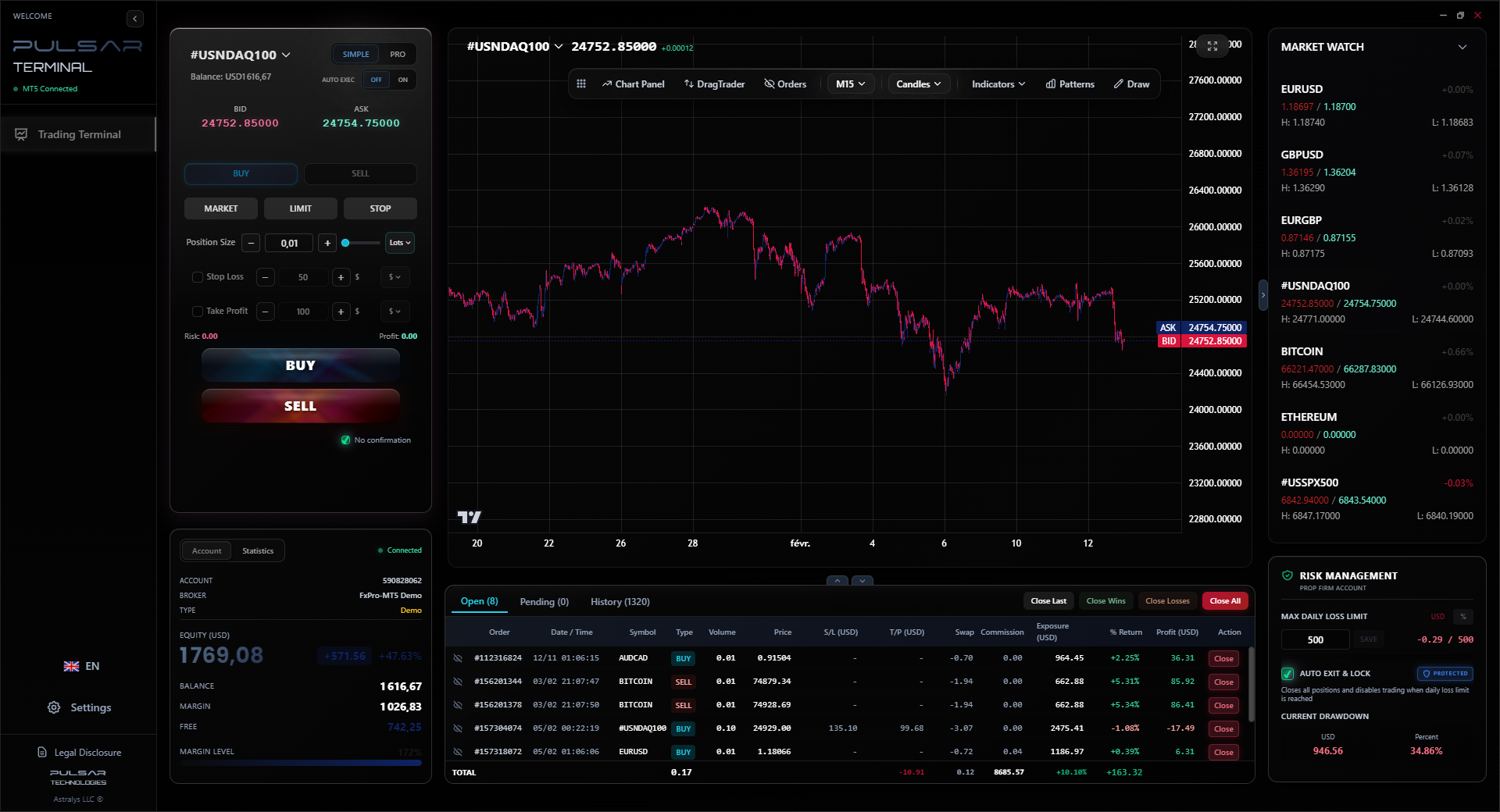
Pro Tip: Your trading platform matters. Most brokers offer MT4 or MT5. These are powerful, but their native order management is clunky. This is where tools like Pulsar Terminal come in - they plug into MT5 and let you set complex orders (like multiple take-profits or automated trailing stops) with a drag and drop. It turns a good platform into a great one, but remember, it's a tool for executing your plan, not creating one.
Phase 3: Integration & Live Trading (Month 6+)
- Start Small: Fund your live account with money you can afford to lose completely. Your goal for the first year is not profit; it's to not blow up your account.
- Journal Religiously: Use a spreadsheet. Note everything.
- Find a Community: Not a signal group. A community of serious learners where you can discuss trades and psychology. This is often the missing piece in self-directed learning.
💡 Wskazówka Winstona
Your first ₹50,000 is for paying tuition to the market. Expect to lose it. If you can't, you're not ready to trade. Use a demo until the money feels real.
Executing a complex trade plan with multiple profit targets and a trailing stop on MT5 is clunky by hand, but tools like Pulsar Terminal automate it with a single drag-and-drop, letting you focus on analysis, not order entry.
So, are there any good local options for forex trading training in Chennai? The physical classroom scene is, frankly, mixed. You'll find big institutes offering generic financial market courses that include a forex module. These can be okay for the very basics but are often too theoretical.
The real value in Chennai is in its community of serious traders. Look for meetups (often posted on sites like Meetup.com or trading forums) where traders discuss markets. The vibe in a coffee shop in T Nagar with a few dedicated traders sharing real charts and real mistakes is worth more than any lecture hall.
Be wary of 'seminars' held in hotels that are just long sales pitches for a ₹50,000 course. Your goal is to find practitioners, not promoters.
Online, your location doesn't matter. Your network is global. Follow reputable international traders who focus on education (not bragging), and adapt their principles to the INR market. The key is to filter out the noise. For broker specifics, we maintain detailed reviews of global brokers like Exness, IC Markets, and Pepperstone, but remember, for live INR trading, your primary relationship must be with a SEBI-regulated entity.
“The psychological damage of a single over-leveraged trade lasts longer than the financial loss.”
Let me save you some money and heartache. Here’s my hall of shame.
Mistake 1: Chasing the Exotic Pair. I got bored with USD/INR. The moves felt slow. I started analyzing GBP/JPY on an offshore demo, attracted by the volatility. I developed a 'great' system on demo, then funded a small live account. I lost 40% in two weeks. Why? The liquidity and behavior during Asian session (when I was trading) were completely different from the London session I'd practiced on. I was a stranger in a strange market.
Mistake 2: Overleveraging on a 'Sure Thing.' This was on USD/INR futures. I had a strong technical setup and positive RBI news flow. Instead of my normal 1% risk, I went all in with about 7% of my capital. The trade went my way initially, then reversed violently on unexpected intervention talk. I was stopped out for a 5% total account loss in one trade. It took me two months of disciplined trading to dig out of that hole. The psychological damage lasted longer.
Mistake 3: Not Having a Clear Exit Plan. I bought a USD/INR futures contract at 74.50, targeting 75.00. It hit 74.90 and stalled. Greed set in. 'Let's just get to the target.' It reversed back to 74.60, and I watched my profit vanish, eventually exiting at breakeven. I hadn't defined what 'stalling' looked like or set a trailing stop. Now, I always have a clear plan for partial profits and moving my stop to breakeven. Tools that automate this are useful for removing emotion.
💡 Wskazówka Winstona
The best indicator is the one you understand completely. A simple 20-period moving average you trust is better than a complex system you doubt.
Alright, let's make this practical. Here is your step-by-step plan for getting real forex trading training in Chennai.
Week 1-2: Become a regulatory expert. Bookmark the SEBI and RBI pages on currency derivatives. Understand the four main INR pairs.
Week 3-4: Open a demo account with a major Indian broker. Don't trade. Just watch the USD/INR chart for 2 hours a day. Get used to how it moves. Note the timing of big moves (often around 9 AM open and during RBI news).
Month 2: Pick one educational resource. I suggest starting with a classic book on trading psychology (like 'Trading in the Zone') and one on basic technical analysis. Apply it only to your USD/INR demo chart.
Month 3: Define a simple rule-based strategy. Example: 'I will look for a buy only if price is above the 50-period moving average on the 1-hour chart and has bounced off a prior support level on the 15-minute chart.' Back-test it visually on your demo chart for the past 3 months.
Month 4-6: Paper trade that strategy. Every day. Journal the setup, your confidence level, and the result. Tweak only one variable at a time.
Month 6+: If your journal shows consistency over 100+ paper trades, start a live account with the smallest amount your broker allows. Your only mission is to execute your plan with real money on the line. The goal is emotional control, not profit.
Remember, this is a marathon. The best traders in Chennai aren't the ones shouting in seminar rooms. They're the quiet ones in the corner of a library or cafe, reviewing their journal, respecting the rules, and treating the market with the humility it demands. That's the real training.
FAQ
Q1Is forex trading legal in Chennai/India?
Yes, but with strict conditions. Resident Indians can legally trade currency derivatives (futures & options) involving the Indian Rupee (like USD/INR, EUR/INR) on SEBI-regulated exchanges like NSE or BSE. Spot forex trading with international brokers on platforms like MT4/MT5 for pairs like EUR/USD is not permitted under FEMA rules.
Q2What is the minimum amount needed to start forex trading in India?
For legal trading on Indian exchanges, it depends on the broker and the contract size of the currency future. It can be as low as a few thousand rupees for the initial margin. For example, the margin for a single USD/INR futures contract might be around ₹15,000-₹20,000. Never start with money you can't afford to lose completely.
Q3Are there any good classroom-based forex trading courses in Chennai?
Be very cautious. Many are expensive sales pitches. Look for courses that heavily emphasize Indian regulations (FEMA, SEBI), risk management, and trading psychology over 'secret signals.' Often, you're better off with a combination of reputable online resources and connecting with local serious traders through meetups.
Q4Can I use international brokers like XM or IC Markets in India?
While some international brokers like XM or IC Markets may accept Indian clients, using them for spot forex trading falls into a legal grey area and is not in line with RBI regulations. Your funds may not be protected, and you could face penalties. For learning and demo trading, their platforms are fine. For live trading, you must use a SEBI-regulated broker for INR pairs.
Q5What is the most important skill for a beginner from Chennai to learn?
Risk management. Before analyzing a single chart, learn how to calculate your position size so you never risk more than 1-2% of your capital. Learn to set a stop-loss on every trade. This skill will keep you in the game long enough to learn everything else. Use a position size calculator religiously.
Q6How are forex trading profits taxed in India?
Profits from trading currency derivatives are considered 'speculative business income' for most individual traders. This income is added to your total income and taxed according to your applicable income tax slab rate. It's crucial to maintain detailed records of all your trades for tax filing purposes.
Lekcja Prof. Winstona
:
- ✓Trade only SEBI-regulated INR pairs (USD/INR, EUR/INR).
- ✓Risk a maximum of 1-2% per trade, always.
- ✓Spend 6 months on demo before live money.
- ✓Journal every trade, especially the losers.
- ✓Platforms are tools; your plan is the blueprint.
Jak przydatny był ten artykuł?
Kliknij gwiazdkę, aby ocenić
Tygodniowe analizy tradingowe
Darmowe tygodniowe analizy i strategie. Bez spamu.
O autorze
Rajesh Sharma
Starszy Analityk Forex
Ponad 10 lat doświadczenia na rynkach indyjskich i południowoazjatyckich. Zaczynał od instrumentów pochodnych NSE, zanim przeszedł na międzynarodowy forex. Specjalizuje się w USD/INR i parach rynków wschodzących.
Komentarze
Może Ci się też spodobać

Cara Trading Forex Sukses: 7 Prinsip dari Trader Profesional
Cara trading forex sukses dengan 7 prinsip trader pro: manajemen modal, disiplin, journal trading, backtest. Data nyata, bukan janji profit palsu.
Jam Trading Forex Terbaik untuk Trader Indonesia: Panduan Lengkap dengan Tabel Waktu
Panduan jam trading forex untuk trader Indonesia. Tabel 4 sesi dunia, jam emas 20:00-00:00, sesi mana yang harus dihindari. Data akurat + tips dari trader berpengalaman.
Top 5 Sàn Forex Uy Tín Nhất 2026: Review Jujur dari Trader Indonesia
Top 5 sàn forex uy tín 2026 untuk trader Indonesia. Review jujur: spread, deposit, withdraw, dukungan lokal. Exness, XM, IC Markets & lebih.
All these calculators are built into Pulsar Terminal with real-time data from your MT5 account. One-click position sizing, automatic risk management, and instant calculations.
