


You've seen it a hundred times in Telegram groups and on Twitter (X).

Olumide Adeyemi
Pionier Tradingu w Afryce Zachodniej ·  Nigeria
☕ 10 min czytania
Czego się nauczysz:
- 1The Brutal Difference Between an Opinion and a View
- 2How to Build a View: It's Not Just the Chart
- 3The Timeframe Trap: Why Your Scalp View Fails
- 4Your Most Important View: The Risk View
- 5When to Change Your Mind: Updating Your View Isn't Failure
- 6How Your Broker Distorts Your Forex View
- 7The Nigerian Trader's Forex View Checklist

You've seen it a hundred times in Telegram groups and on Twitter (X). Someone posts a chart with a few lines drawn on it and declares their 'forex view' for the week. EUR/USD is going to 1.1500, they say with absolute certainty. But what is a forex view, really? Is it a guess, a hope, or a calculated assessment? Most traders here in Nigeria treat it like the first two, and that's why their accounts vanish faster than light bills after a salary drop. A genuine forex view isn't about being right; it's about understanding the probabilities and managing the risk of being wrong.
Let's get this straight. Your cousin's hot tip on GBP/NGN is an opinion. A forex view is something you build. It's the conclusion of a process, not the starting point.
An opinion is emotional. It's what you want to happen. Maybe you're long on USDT/NGN in the black market and you're praying for a crash, so your 'view' is that the naira will weaken. That's not analysis, that's a prayer wrapped in a chart. A real view is cold, logical, and, most importantly, falsifiable. You must be able to point to a specific price level or condition that, if reached, proves your view wrong.
I learned this the hard way early on. Back in 2017, I was convinced oil would keep rallying, which meant USD/NGN would drop (inverse relationship, generally). My 'view' was based on hope and a few bullish news headlines. I didn't have a level where I'd admit defeat. I watched my position sink for weeks, adding to it, thinking the market just didn't see what I saw. I turned a 2% loss into a 15% account blow-up. That wasn't a trading view, it was a stubborn opinion with use.

Warning: If your 'view' doesn't have a clear, pre-defined invalidation point - a price where you say 'I am wrong' and exit - you are gambling, not trading.
A proper forex view answers three questions: What's the setup? (The technical or fundamental reason). What's the target? (Your profit objective). And what's the invalidation? (The price that breaks the trade thesis). Miss one, and you're just throwing darts.

💡 Wskazówka Winstona
A view without an invalidation level is a wish. A trade without a risk limit is a donation.
“A genuine forex view isn't about being right; it's about understanding the probabilities and managing the risk of being wrong.”
Nigerian traders love the 15-minute chart. I get it, it's exciting. But your view on the 15-minute chart is meaningless if you don't know what the daily chart is doing. You're trying to predict the next wave without knowing if the tide is coming in or going out.
Start with the Higher Timeframes
Your first job is to identify the dominant trend. Open the weekly and daily charts. Is price making higher highs and higher lows? Or is it stuck in a range? This isn't just drawing a line. Look at the structure. For a currency like the EUR/USD, this tells you the broad direction of capital flow. Trading a pullback to support in an uptrend is a high-probability view. Trying to pick a top in a strong uptrend because the RSI indicator is 'overbought' is a great way to lose money.
Add the Fundamental Lens
In Nigeria, we feel fundamentals acutely - dollar scarcity, CBN policies, oil prices. These create the underlying currents. Your technical view on USD/NGN might be bullish, but if the CBN is about to inject $500 million into the market, your view needs a serious disclaimer. A view incorporates this. It might be: 'Technically, price is testing resistance. However, with the upcoming MPC meeting likely to hike rates, I will only take a short position if price rejects this level and the news confirms hawkish sentiment.'
The Confluence Zone
A strong view is born where multiple factors agree. Maybe the daily trend is up, price is pulling back to a key Fibonacci level and a prior support area, and the MACD indicator is showing a potential bullish crossover on the 4-hour chart. That's confluence. The more independent reasons you have, the stronger your view. But remember, even the strongest view can be wrong. That's where your position size calculator and stop loss come in.
“If your 'view' doesn't have a clear, pre-defined invalidation point, you are gambling, not trading.”
Here's a classic Nigerian trader story. You see a perfect pin bar on the 5-minute chart for XAU/USD (gold). You take the short, expecting a quick 5-pip profit. Two minutes later, you're stopped out. You check the 1-hour chart and see gold is in a massive rally, and your pin bar was just a tiny blip in a big move.
You got caught in the timeframe trap. You formed a micro view that contradicted the macro view. Scalping strategies can work, but only when the short-term moves align with the higher-timeframe momentum. Your view must be nested. The 1-hour chart gives you direction, the 15-minute chart gives you entry timing, the 5-minute chart gives you precision. If they're all saying different things, you have no view, you have noise.
I used to be a scalp junkie, glued to screens. My best month scalping made me 8%. My worst month lost me 22%. The stress was insane. I switched to a higher-timeframe, swing trading approach. My view now lasts days or weeks, not minutes. I check charts twice a day. Last quarter, I made 14% with about 1/10th of the screen time and heart palpitations. The longer your timeframe, the more reliable your view tends to be, because you're filtering out market noise and focusing on actual price movement.

Pro Tip: Before you take any trade, do the 'zoom out' test. Look at the chart one timeframe higher and two timeframes higher. If your trade idea looks stupid on those bigger charts, scrap it. Your view isn't strong enough.
💡 Wskazówka Winstona
The higher your timeframe, the fewer the views, but the stronger the signal. Stop chasing every 5-minute squiggle.

“If your 'view' doesn't have a clear, pre-defined invalidation point, you are gambling, not trading.”
You can have the most brilliant market view in the world and still blow up. How? By having a terrible risk view. Your risk view answers: 'How much of my capital am I willing to lose if this brilliant idea is completely wrong?'
Most traders here don't have one. They see a 'sure' opportunity and throw 10% or 20% of their account at it. One loss, and their account is crippled. A professional's forex view is incomplete without the risk parameters attached.
This is non-negotiable:
- Position Size: This is derived from your stop loss distance. If your stop is 50 pips away, and you only want to risk 1% of your $1000 account ($10), then your position size must be calculated so that a 50-pip loss equals $10. Never guess this. Always use a position size calculator.
- Risk-Reward: Your view should include a profit target that justifies the risk. A 1:1 risk-reward ratio means you need to be right more than 50% of the time just to break even. A view that only offers 1:1 is a weak view. Aim for a minimum of 1:1.5 or 1:2. This means if your stop loss is 30 pips, your target should be at least 45-60 pips away.
- Account Risk Per Day/Week: This is your ultimate risk view. I set a hard rule: no more than 3% total account loss in a day. If I hit that, I'm done. No revenge trading. This single rule has saved me from myself more times than I can count. It forces you to have a view on your own emotional state, which is just as important as your view on the market.
“Stubbornness is a Nigerian trader's kryptonite. We attach our ego to our view.”
Stubbornness is a Nigerian trader's kryptonite. We attach our ego to our view. Admitting the market has proven us wrong feels like personal failure. So we hold, we average down, we pray - right into a margin call.
A real forex view is a living thing. It must be updated with new price information. This isn't flip-flopping, it's being responsive.
Let's say your view was bullish on EUR/NGN, with an invalidation below 1600. Price drops to 1595. Your view is objectively wrong. The market has voted. The disciplined action is to close the trade at a loss, step back, and form a new view. Maybe the new view is now neutral or bearish. The sin isn't in being wrong; the sin is in staying wrong.

Example: You buy USD/JPY at 150.00, with a stop at 149.50 and a target at 151.00 (1:2 risk-reward). Price moves to 150.80, then starts stalling. A new bearish pattern forms on the 4-hour chart. A rigid view says 'hold for target.' A flexible, professional view says 'My original thesis is weakening. I will move my stop to breakeven at 150.00 to lock in no loss, or take partial profit at 150.80 and adjust my target.' You've updated your view with new evidence. This is how you protect capital.
Tools that help you manage trades dynamically are crucial here. Manually moving stops for 10 trades is a hassle. Automation helps you stick to your updated view without emotion.
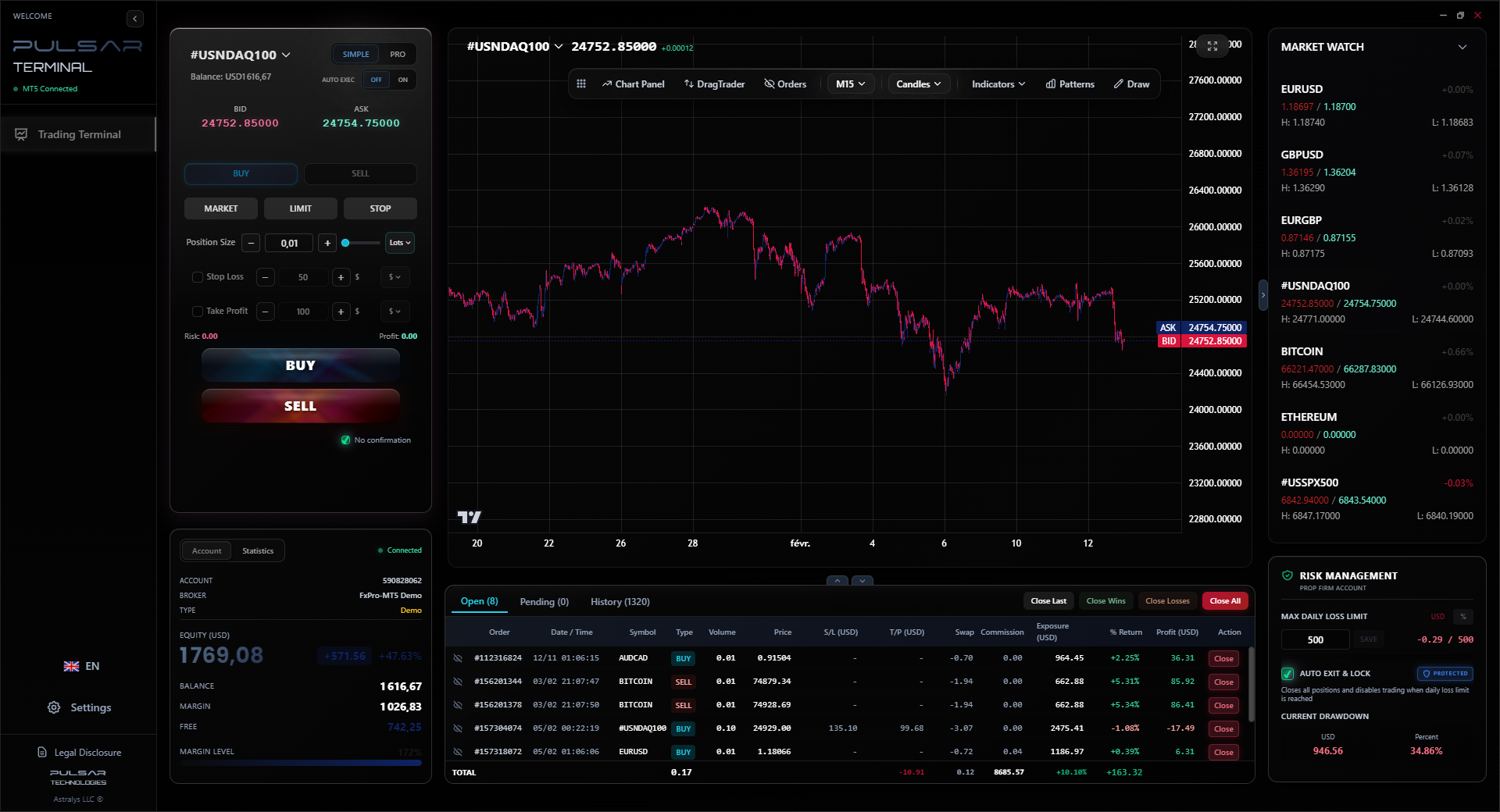
Manually adjusting stops and targets for multiple trades as your view evolves is tedious and emotional; Pulsar Terminal automates partial closures, breakeven moves, and trailing stops directly on your MT5 charts, so your execution matches your updated view.
“Stubbornness is a Nigerian trader's kryptonite. We attach our ego to our view.”
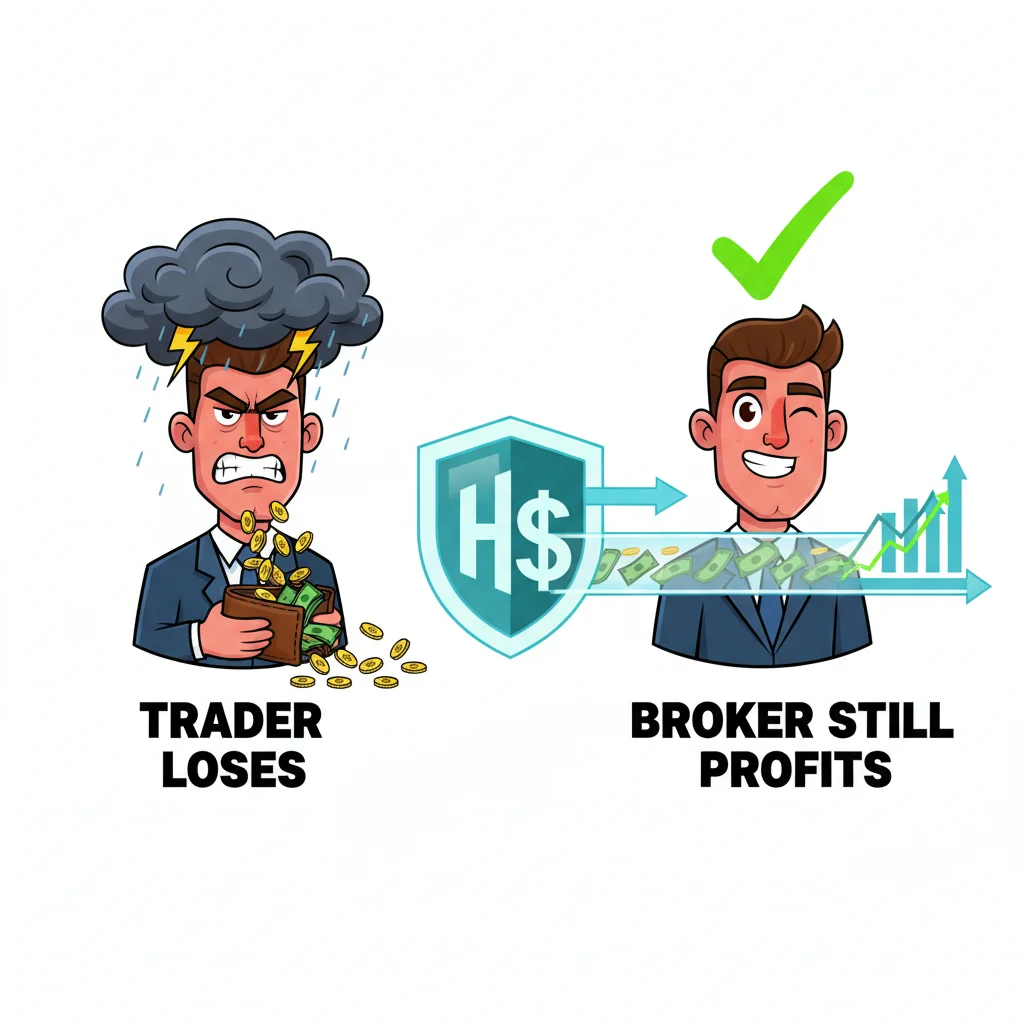
This is a quiet killer for Nigerian traders. You form a perfect view on a volatile pair like GBP/JPY. You enter the trade, and suddenly the spread widens from 2 pips to 15 pips during the London open. Your stop loss gets triggered prematurely, you take a loss, and then price rockets in your original direction. Your view was right, but your broker's execution made it wrong.
Your trading environment shapes your view. If you're with a broker that has unreliable execution, frequent requotes, or massive slippage, your view on short-term moves is practically useless. You're trying to read a sign through foggy glass.
I've traded with local platforms and international ones. The difference in being able to trust your entry and exit prices is night and day. It allows you to form views on precise levels. When choosing a broker, look for tight, stable spreads and instant execution. Read reviews from other traders. Good options we've tested for Nigerian traders include Exness for its local deposit options and IC Markets for its raw spreads. XM and Pepperstone are also solid contenders with good reputations. Don't let a bad broker be the reason your correct view turns into a losing trade.
💡 Wskazówka Winstona
Your broker's spread is part of your trade cost. A 5-pip spread on a 10-pip target means you need to be right 100% of the time just to scrape a profit. Choose your battlefield wisely.
“Your trading environment shapes your view. If you're with a broker that has unreliable execution, your view on short-term moves is practically useless.”
So, how do you turn this from theory into practice? Before you place any trade, run through this checklist. If you can't answer 'yes' to all, you don't have a trade-worthy view.
| Question | Your Answer (Must Be Yes) |
|---|---|
| 1. Is my view based on higher-timeframe (H4/Daily) trend alignment? | |
| 2. Have I identified a clear, logical invalidation level (stop loss)? | |
| 3. Is my profit target at least 1.5x my risk? | |
| 4. Is my position size calculated to risk ≤2% of my account? | |
| 5. Is there a fundamental catalyst or confluence (2+ indicators/levels) supporting this? | |
| 6. Am I entering at a precise level (support/resistance, trendline), not in the middle of nowhere? | |
| 7. Have I checked for major news events that could void my technical view? | |
| 8. If price hits my invalidation, will I exit immediately without hesitation? |
Print this. Stick it next to your screen. A forex view is a discipline, not a feeling. It's the process of connecting the dots between what you see on the chart, what you know about the world, and what you're willing to lose. Master that process, and you stop being a gambler with opinions. You become a trader with a view.
FAQ
Q1What's the biggest mistake Nigerian traders make with their forex view?
Confusing a hope or a tip for a view. They get an idea, often from social media, and trade it with no clear plan for where they'll exit if wrong. They attach their ego to being 'right' instead of managing the risk of being wrong.
Q2How many timeframes should I look at to form a view?
At least three. I use the 'triple timeframe' method: One higher for trend (e.g., Daily), one for trade direction and key levels (e.g., 4-Hour), and one lower for precise entry (e.g., 1-Hour). They should all tell a somewhat similar story.
Q3Is technical analysis enough for a good forex view?
For short-term moves, sometimes. For a durable view, no. You must consider fundamentals, especially in Nigeria where CBN policies and oil prices directly impact the Naira pairs. A view based purely on a chart pattern ignoring a scheduled MPC meeting is incomplete.
Q4How often should I change my forex view?
Change it whenever price action objectively invalidates your original thesis (hits your stop loss). Don't change it every 5 minutes because of a small counter-move. Have the conviction to let your trade breathe, but the humility to exit when proven wrong.
Q5What's a realistic win rate if I have a solid view process?
Aiming for a 60-70% win rate is a trap that leads to poor risk-reward. With a solid process focusing on 1:2 or 1:3 risk-reward, you can be profitable with a win rate as low as 40-50%. Focus on the quality of your views (risk/reward), not just how often they're right.
Q6Can I use a forex view for black market USD/NGN trading?
The principles are the same - assess trend, find levels, manage risk - but the 'market' is far less liquid and more prone to sharp, news-driven gaps. Your risk view must be even stricter, with wider stops if possible, and an acute awareness of liquidity (can you actually get your naira out?).
Lekcja Prof. Winstona
:
- ✓A view requires a clear entry, target, and invalidation level.
- ✓Always analyze from higher timeframes down to lower ones.
- ✓Never risk more than 2% of your account on a single view.
- ✓Update your view with new price action; stubbornness destroys accounts.
- ✓Your broker's execution quality is part of your trading edge.
Jak przydatny był ten artykuł?
Kliknij gwiazdkę, aby ocenić
Tygodniowe analizy tradingowe
Darmowe tygodniowe analizy i strategie. Bez spamu.
O autorze
Olumide Adeyemi
Pionier Tradingu w Afryce Zachodniej
Jeden z najaktywniejszych edukatorów tradingu forex w Nigerii. 8 lat doświadczenia tradingowego z Lagos. Specjalizuje się w strategiach niskiego kapitału i wyzwaniach prop firm dla afrykańskich traderów.
Komentarze
Może Ci się też spodobać

Cara Trading Forex Sukses: 7 Prinsip dari Trader Profesional
Cara trading forex sukses dengan 7 prinsip trader pro: manajemen modal, disiplin, journal trading, backtest. Data nyata, bukan janji profit palsu.
Jam Trading Forex Terbaik untuk Trader Indonesia: Panduan Lengkap dengan Tabel Waktu
Panduan jam trading forex untuk trader Indonesia. Tabel 4 sesi dunia, jam emas 20:00-00:00, sesi mana yang harus dihindari. Data akurat + tips dari trader berpengalaman.
Top 5 Sàn Forex Uy Tín Nhất 2026: Review Jujur dari Trader Indonesia
Top 5 sàn forex uy tín 2026 untuk trader Indonesia. Review jujur: spread, deposit, withdraw, dukungan lokal. Exness, XM, IC Markets & lebih.
All these calculators are built into Pulsar Terminal with real-time data from your MT5 account. One-click position sizing, automatic risk management, and instant calculations.
