


I blew $489 on a 'risk-free' prop firm challenge in 2021.

James Mitchell
Starszy Analityk Tradingowy
☕ 13 min czytania
Czego się nauczysz:
- 1What 'Free' Really Means (Spoiler: It's Not Free)
- 2The Rules You Can't Afford to Ignore
- 3Crunching the Real Numbers: Costs, Odds, and Payouts
- 4Picking the Right Firm (Beyond the 'Free' Tagline)
- 5A Boring, Effective Strategy to Actually Pass
- 6Life After the Challenge: Getting Paid & Staying Funded
- 7The Regulatory Winds Are Changing (2025-2026)
I blew $489 on a 'risk-free' prop firm challenge in 2021. The ad promised a full refund if I passed. I hit the profit target in three days, feeling like a genius. Then I got an email: my account was flagged for 'overtrading' - a rule buried in clause 14.B of their terms. No payout, no refund. That loss taught me more about this industry than any win ever could. Let's talk about what 'free' really means, how to spot the traps, and how to actually walk away with a funded account.
When you see 'free prop firm challenge,' your brain lights up. Who wouldn't want a shot at trading someone else's money for nothing? Here's the cold truth: it's almost always a marketing hook. In the US, prop firms operate in a legal gray area. They're not handing out charity; they're running a business model based on evaluation fees.
There are three common versions of 'free':
- The Refundable Fee: You pay upfront - say, $99 for a $50,000 challenge. If you pass and get your first payout, they refund your $99. It's not free to start, but it becomes free if you win. This is the most common and legitimate structure.
- The Tiny Trial: You might pay $1 or $5 for a one-week mini-challenge on a small account. It's a taste. The real fee comes later for the full evaluation.
- The 'Pay After You Pass': You start the challenge with no money down. If you pass, you're then charged the full evaluation fee (often hundreds of dollars) before you can access the live account. If you fail, you owe nothing.

Warning: The 'pay after you pass' model can be a psychological trap. You pass, get excited, and then feel obligated to pay the large fee. It doesn't feel like a cost; it feels like a ticket you've already earned. That's by design.
The firms that survive are the ones with sustainable models. The evaluation fee acts as a serious filter. It covers their administrative costs and, frankly, represents a significant portion of their revenue from the 90%+ of traders who don't make it. Think of it as a registration fee for a very difficult test. The promise of a 'free prop firm challenge' is the lure, but the fee is the gatekeeper.
My $489 lesson? I didn't read the rules closely enough. Now, I use a simple checklist before I even look at the price: transparent rules, a clear path to payout, and a verifiable track record of paying traders. The fee is secondary.

💡 Wskazówka Winstona
The 'free' in 'free challenge' is a siren's song. The real cost is your time, focus, and emotional capital. Budget all three.
“Passing a challenge isn't about making money. It's about passing a very specific test under a microscope.”
Passing a challenge isn't just about making money. It's about passing a very specific test under a microscope. The rules are designed to see if you can trade like a risk-averse professional, not a gambler. Get these wrong, and you'll fail without even hitting a profit target.
The Daily Loss Limit: Your #1 Priority
This is the rule that catches most people. It's usually a fixed dollar amount or a percentage of your starting balance (e.g., 5%). Let's say your challenge account is $100,000 with a 5% daily loss limit. That's $5,000.
Here’s where it gets tricky: it's often based on your starting balance each day, not your running balance. If you start Monday at $100,000 and lose $3,000, you're fine. But if you start Tuesday at $97,000, your new daily loss limit is still calculated from the original $100,000 - so you still have $5,000 to lose before breaching, not $4,850. You must know which method your firm uses. A breach is an instant fail, no questions asked.
The Maximum Drawdown: The Slow Killer
This is your overall loss limit for the entire challenge. It's typically larger than the daily limit (e.g., 10%). Using our $100k example, your max drawdown is $10,000. This is a trailing limit. If you climb to $105,000, your max loss line might also rise to $95,000. But if you then drop back to $100,000, that line stays at $95,000. You can't let your equity dip below that line at any point. This rule forces consistency and prevents you from giving back all your gains.
The Profit Target: The Obvious One
You need to hit a certain profit percentage (e.g., 10% in 30 days) without breaking the other rules. Seems simple, right? The trap is trying to hit it too fast. That's when you take oversized risks and violate the loss limits. I learned this the hard way with my failed challenge. I was so focused on the 8% target I ignored the position size for my scalping strategy, which led to the 'overtrading' violation.

Pro Tip: Your first goal in any challenge is not to make profit. Your first goal is to not hit the daily loss limit. Survive the first week without a major loss, and you're already ahead of 70% of participants.
A firm's rules tell you everything about their risk tolerance. If the rules are vague or full of loopholes (like my 'overtrading' example), walk away. Your time is worth more.
“For every 100 people who try a prop firm challenge, 90 to 95 fail on their first attempt.”
Let's talk dollars, cents, and cold, hard statistics. This is where dreams meet reality.
The Cost of Entry: Don't be fooled by the $39 special. While challenges can start that low, the average serious trader spends between $800 and $4,300 on evaluation fees across multiple attempts. The fee for a $100,000 account typically ranges from $200 to $600. A truly 'free' path is vanishingly rare.
The Success Rate (The Sobering Part): This is the most important number you'll read. Industry-wide, the first-time pass rate for a prop firm challenge is between 5% and 10%. Let that sink in. For every 100 people who try, 90 to 95 fail on their first attempt. Of all people who buy a challenge, only about 7% ever receive a single payout. Long-term, consistently funded traders? They're the top 1-3% of all applicants.
Why? It's not just trading skill. It's the psychological pressure of the rules, the time limit, and the fear of losing the fee. It's a completely different game from trading your own account.
The Reward (The Motivator): If you make it, the splits are good. Most firms offer a 70% to 90% profit split in your favor. Some even offer 100% on the first chunk of profits (e.g., first $10,000). The big firms are paying out real money. For example, Apex Trader Funding has paid over $598 million to traders since 2022. The money is there, but it's concentrated in the hands of the few who can play the game correctly.
| Item | Typical Statistic | What It Means For You |
|---|---|---|
| First-Time Pass Rate | 5% - 10% | You will likely fail your first try. Plan for it. |
| Payout Recipients | ~7% of all challengers | Getting funded is a real achievement. |
| Average Challenge Fee | $200 - $600 | Consider this tuition, not a ticket. |
| Profit Split | 70% - 90% (Trader) | The incentive is strong if you can perform. |
| Payout Speed | 5 hrs - 2 days | Fast payouts are now the industry standard. |
These numbers aren't meant to discourage you. They're meant to calibrate your expectations. I failed two challenges before I passed my third. Each failure cost me money but taught me a specific lesson about patience and my position size calculator.
“For every 100 people who try a prop firm challenge, 90 to 95 fail on their first attempt.”
With over 2,000 prop firms globally and 62% based in the US, choice is not the problem. Picking a legitimate one is. The regulatory landscape is shifting fast. In 2024, MetaQuotes (the company behind MT4 and MT5) cracked down, pulling licenses from firms without proper broker setups. Dozens of firms folded. You need a firm that will be around to pay you.
Look for these green flags:
- Transparent, Simple Rules: The rules for the challenge and the funded account should be clear, easy to find, and easy to understand. No novel-length terms of service.
- A Clear Payout Track Record: Can you find evidence of recent payouts? Look for firm-verified leaderboards or transparent payout reports. A firm like Apex publicly shares its monthly payout totals.
- Responsive Support: Send a pre-sales question about their rules. See how long it takes to get a clear answer. If they're vague now, imagine trying to get help with a payout.
- Sustainable Trading Conditions: Look at the spreads and commissions. Are they using a reputable broker partner? Some firms offer raw spreads from 0.0 pips, which is crucial if you're a high-volume scalping trader. Check reviews on sites like Forex Peace Army for user experiences.
Red Flags to Run From:
- Overly Complex or Hidden Rules: If you need a lawyer to interpret the challenge parameters, it's a trap.
- No Verifiable Payout Proof: If all you see are marketing testimonials, be skeptical.
- Pressure to Use Specific EAs or Signals: A legitimate firm doesn't care how you trade profitably within the rules, as long as you do.
- Suspending US Traders: Due to the MetaQuotes issue, many firms temporarily stopped accepting US clients. If a firm is openly welcoming US traders today, ensure they've solidly migrated to a platform like cTrader, DXtrade, or Tradovate.
My advice? Start small. Don't go for the $500,000 challenge right away. Buy a small, cheap evaluation on a $10k or $25k account. The goal isn't the money; it's to learn the process and the platform stress-free. Treat it like a paid simulation.
💡 Wskazówka Winstona
Your trading platform is your cockpit. If their platform is clunky or unreliable during the challenge, it will be worse with real money. Test it thoroughly in the demo phase.
“Your first goal in any challenge is not to make profit. Your first goal is to not hit the daily loss limit.”
Forget about hitting home runs. Passing a challenge is about hitting consistent singles. You need a process, not a miracle trade.
Phase 1: The Survival Week (Days 1-7) Your only objective is to not hit the daily loss limit. I'm serious. I start every challenge by trading micro lots, even on a large simulated account. I might aim for a laughably small profit target of 0.5% for the entire week. This does two things: it gets me comfortable with the platform's order execution and it builds a small buffer against the max drawdown. The psychological weight of being 'in the green' from the start is huge.
Phase 2: The Grind (Days 8-25) Now you can work toward the profit target. Use a strict risk-per-trade model. I never risk more than 0.5% of the account's starting balance on any single trade. On a $100k account, that's $500. This is non-negotiable. It keeps any single loss from derailing you.
I focus on one or two setups I know inside out. For me, that's often a simple MACD indicator divergence on the 4-hour chart for swing trading ideas, or key support/resistance plays on XAU/USD. I don't get fancy. I take 5-10 high-probability trades over these two weeks, aiming for a 2:1 reward-to-risk ratio. If I'm up 3% by day 20, I'm right on track.
Phase 3: The Finish Line (Days 26-30) This is the most dangerous phase. You're close to the target and fear of failure peaks. Do NOT increase your lot size. Do NOT chase the target. If you're at 8% profit with a 10% target and two days left, be patient. One good trade might do it. Forcing trades is how you blow up. If you don't make it, you retry. A lost fee is cheaper than a blown account that teaches you nothing.

Example: $100k Account, 10% Target.
- Daily Loss Limit: $2,000 (2%)
- Max Risk per Trade: $500 (0.5%)
- Weekly Goal (Weeks 1-3): ~3.3%
- Trades per Week: 5-7
- Avg. Take Profit: $1,000 (1% per win) This slow, steady approach is boring. It's also how you pass.
Managing multiple take-profit levels and a trailing stop manually under challenge pressure is stressful; Pulsar Terminal automates these advanced order types directly on your MT5 chart, so you can focus on the trade, not the mechanics.
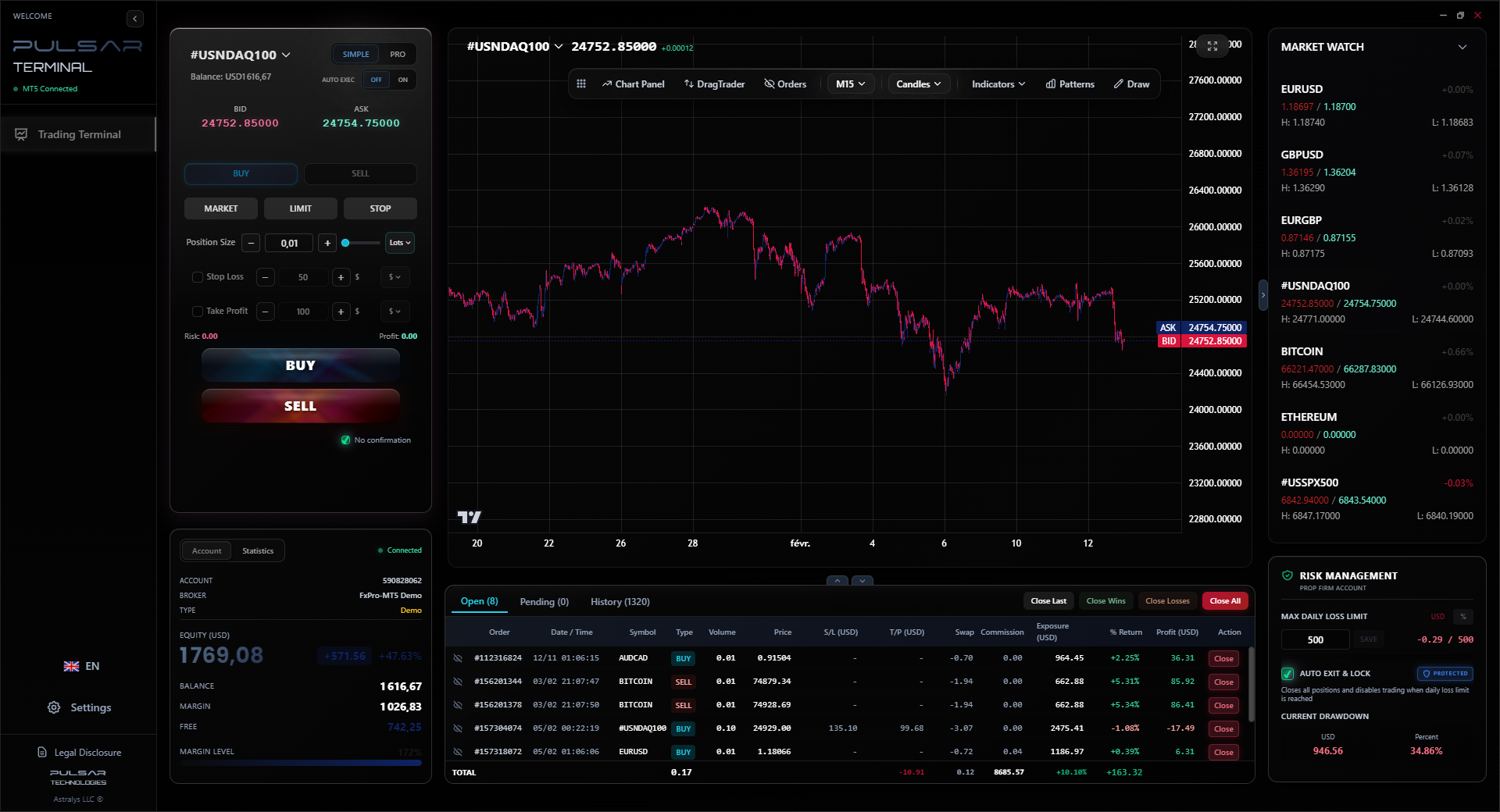
“Your first goal in any challenge is not to make profit. Your first goal is to not hit the daily loss limit.”
Congratulations, you passed! Now the real work begins. The funded account is not a lottery win; it's a job interview that never ends.
The Payout Process: Most firms have moved to fast payouts - often within 24 hours, some even same-day. You'll usually request a payout on a specific day each month. They'll calculate your profit, take their split, and send you your share via bank transfer, PayPal, or crypto. Firms like Apex use Deel for payments, which is smooth. The first payout is the sweetest, especially if it makes your challenge fee refundable.
Staying Funded: The rules still apply, but they often loosen slightly. The daily loss limit might stay, but the profit target is gone. Your new goal is consistent, incremental growth. The biggest threat now is yourself. Without the pressure of a challenge deadline, some traders get lazy with risk management or go for huge scores. That's how you get a margin call on someone else's capital and lose the account.
I keep a trading journal for my funded account just like I did for the challenge. Every trade, every reason. I review it weekly. The firm is constantly evaluating your risk-adjusted returns. They want calm, professional traders, not volatile gamblers.
The Big Picture: Passing a challenge is a fantastic milestone. It validates your strategy and discipline. But don't let it become your entire identity. The ultimate goal is to build your own capital over time. The funded account is a tool to accelerate that, not the final destination. I know traders who've built six-figure personal accounts from prop firm payouts. That's the real freedom.
“The funded account is not a lottery win; it's a job interview that never ends.”
You can't talk about US prop trading without talking about regulators. The party of the last few years is getting quieter. The SEC and CFTC are paying attention.
In early 2025, the SEC is pushing rules that could force more prop firms to register as broker-dealers. The CFTC is looking at potentially classifying evaluation firms as Commodity Trading Advisors (CTAs), which brings a whole new rulebook. What does this mean for you?
- More Scrutiny, More Safety: In the long run, this is good. It will push out the shady firms with opaque rules. The ones that survive will have clearer compliance, better risk management, and more transparent operations. Your payout is more secure with a regulated entity.
- Tighter use & Rules: Expect maximum use to drop, especially on volatile pairs. The 100:1 you might see now on forex could become 30:1 or less, mirroring retail CFD rules. Automated trading (EAs) will face more pre-trade checks.
- Platform Shifts: The MT4/MT5 crackdown was just the beginning. The future is on platforms built for this model, like cTrader, DXtrade, and TradeLocker.
This isn't a reason to panic. It's a reason to be selective. Choose firms that are proactively adapting, not fighting the changes. A firm that's transparent about its legal structure and partner brokers today is a firm that plans to be here tomorrow. Your due diligence is more important than ever.
💡 Wskazówka Winstona
Regulation is coming. Partner with firms that aren't just surviving the wave, but learning to surf it. Their longevity is your security.
FAQ
Q1Are there any truly 100% free prop firm challenges with no fees?
Genuinely, no. If you find one, it's likely a demo contest with no real funding at the end, or a high-pressure sales funnel. The sustainable business model for prop firms is built on evaluation fees. The closest you get are refundable fees or 'pay-after-pass' models, but money changes hands eventually.
Q2What's the single biggest reason people fail prop firm challenges?
Violating the daily loss limit. It's not missing the profit target. Traders get emotional after a losing trade, double down to recover, and blow past that fixed daily loss number in hours. It's an instant, automatic fail. Risk management isn't just part of the challenge; it's the entire point of it.
Q3Can I use my Expert Advisor (EA) or trading robot?
Most firms allow EAs, but you must check their specific rules. Some prohibit fully automated trading, others restrict certain strategies like arbitrage or ultra-high-frequency trading. The EA must also operate within all the challenge rules (daily loss, max drawdown). If your EA normally risks 2% per trade, you'll need to adjust it down to 0.5% or less for the challenge.
Q4How much money can I realistically make with a funded account?
It varies wildly. A conservative, professional trader aiming for 3-5% monthly return on a $100k account could take home $2,100-$3,500 per month after an 80% split. The top performers make much more, but they are outliers. Focus on consistency over home runs. Remember, the firm can withdraw your funding if you breach rules, so preserving capital is job one.
Q5Is my challenge fee tax deductible?
This is not tax advice, and you must consult a US-based CPA. However, generally, expenses incurred in the pursuit of business income (like evaluation fees to qualify for a trading job) can potentially be deductible as business expenses on a Schedule C if you are trading professionally. Keep all your receipts and documentation.
Q6What happens if I pass the challenge but then blow the funded account?
Most firms offer a 'reset' or 'reactivation' option. You pay a fee (often significantly less than the original challenge fee) to get the funded account back to its starting balance. It's a second chance, but it comes out of your pocket. Some firms have limits on how many times you can reset.
Lekcja Prof. Winstona
:
- ✓'Free' usually means refundable or deferred fee.
- ✓Daily loss limit breaches cause 80% of failures.
- ✓First-time pass rate is only 5-10%.
- ✓Choose firms adapting to new 2025 regulations.
- ✓Funded success requires even more discipline.
Jak przydatny był ten artykuł?
Kliknij gwiazdkę, aby ocenić
Tygodniowe analizy tradingowe
Darmowe tygodniowe analizy i strategie. Bez spamu.
O autorze
James Mitchell
Starszy Analityk Tradingowy
Z siedzibą w Nowym Jorku, ponad 9 lat doświadczenia w tradingu. Koncentruje się na głównych parach USD, wyzwaniach prop firm i amerykańskim otoczeniu regulacyjnym.
Komentarze
Może Ci się też spodobać

Cara Trading Forex Sukses: 7 Prinsip dari Trader Profesional
Cara trading forex sukses dengan 7 prinsip trader pro: manajemen modal, disiplin, journal trading, backtest. Data nyata, bukan janji profit palsu.
Jam Trading Forex Terbaik untuk Trader Indonesia: Panduan Lengkap dengan Tabel Waktu
Panduan jam trading forex untuk trader Indonesia. Tabel 4 sesi dunia, jam emas 20:00-00:00, sesi mana yang harus dihindari. Data akurat + tips dari trader berpengalaman.
Top 5 Sàn Forex Uy Tín Nhất 2026: Review Jujur dari Trader Indonesia
Top 5 sàn forex uy tín 2026 untuk trader Indonesia. Review jujur: spread, deposit, withdraw, dukungan lokal. Exness, XM, IC Markets & lebih.
All these calculators are built into Pulsar Terminal with real-time data from your MT5 account. One-click position sizing, automatic risk management, and instant calculations.
