


Let's cut through the noise.

David van der Merwe
Trader Rynków Wschodzących ·  South Africa
☕ 12 min czytania
Czego się nauczysz:
- 1What Exactly Is a "Free Welcome Bonus"? (It's Not What You Think)
- 2The FSCA Rules: Your Safety Net (Use It!)
- 3Comparing Real Broker Bonuses for South African Traders
- 4The Killer in the Fine Print: Trading Volume Requirements
- 5A Veteran's Game Plan for Using Bonuses
- 6Red Flags and Outright Scams to Avoid
- 7The Final Verdict: Should a South African Trader Use Welcome Bonuses?
Let's cut through the noise. Every new trader in South Africa gets bombarded with ads for 'free welcome bonus forex' cash. It sounds like free money, right? Wrong. I've seen more accounts blown up by bonus greed than by bad analysis. Most traders see the bonus amount and ignore the 2,000-word terms doc written in legal gobbledygook. This guide isn't about chasing the biggest number; it's about understanding the game so you can use these offers to your advantage, not your ruin. I'll show you what's real, what's a trap, and how to play it smart under FSCA rules.
A free welcome bonus is promotional trading capital a broker gives you, usually when you open an account or make your first deposit. The key word here is 'promotional.' It's not a gift. It's a marketing tool with strings attached so thick they could tow a truck.
There are two main types you'll see advertised to South Africans:
1. The No-Deposit Bonus: This is the holy grail for beginners. You sign up, verify your ID, and the broker credits a small amount to your account - no deposit required. Think $30, $50, maybe $140 if you're lucky. The dream is to turn that into real, withdrawable profit. The reality is a minefield of trading volume requirements.
2. The Deposit Match Bonus: You put in your own money, say 1,500 ZAR, and the broker matches it 100% (or 50%, or 20%). Suddenly your 1,500 ZAR account has a 3,000 ZAR balance. Feels great, doesn't it? This is where the psychology gets dangerous. You feel richer, you take bigger risks, and that's exactly what the broker's risk department expects.

Warning: The bonus capital itself is almost never withdrawable. You can only withdraw the profit you make from trading it, and only after hitting specific targets. If you don't read the terms, you will get burned.
I learned this the hard way early on. I took a 100% deposit bonus on a $500 account. Turned it into $1,200 total. Thought I was a genius. Went to withdraw my $700 profit and got rejected. I hadn't traded the required 25 standard lots. My 'profit' was just locked-up bonus money. I had to trade more, got impatient, and blew the entire account. A $500 lesson in reading the fine print.
The FSCA knows these offers can be misleading. They mandate that all terms be clear. A legit FSCA-regulated broker like XM or Exness will spell it out. A shady offshore one will hide it.

💡 Wskazówka Winstona
View a no-deposit bonus as a paid research grant. Your deliverable isn't profit; it's data on the broker's execution and your own emotional responses.
“The bonus capital itself is almost never withdrawable. You can only withdraw the profit you make from trading it.”
This is the most important section for any South African trader. The Financial Sector Conduct Authority (FSCA) isn't just some government acronym. It's your first and best line of defence.
Before the FSCA, we had the FSB. The switch to the FSCA was a big deal because it streamlined oversight and, crucially, made it easier for brokers to offer direct ZAR accounts. No more messing with USD conversions for every deposit and withdrawal.
Here’s what the FSCA does for you regarding bonuses:
1. They Force Transparency. Brokers can't just say "Get a 100% Bonus!" in big letters and hide the terms in size-2 font at the bottom. The offer, all conditions, and the risks must be clearly disclosed. If it's not crystal clear, the broker is breaking FSCA rules.
2. They Segregate Client Funds. This is non-negotiable. When you deposit 5,000 ZAR with an FSCA-regulated broker, that money goes into a separate bank account in your name (or a pooled client account). The broker can't use it to pay their office rent. If the broker goes bankrupt, your money should be safe. This is why I only ever use FSCA-regulated brokers for my main accounts. You can check our deep dive on IC Markets, which is FSCA regulated, to see how a top-tier broker handles this.
3. They Issue Warnings. The FSCA regularly publishes lists of unregistered entities. If you see a bonus from a firm on that list, run. It's not worth the risk.
My rule of thumb: If a bonus offer seems too good to be true (a 200% no-deposit bonus?), check the FSCA's website to see if the broker is licensed. If they're not, that "free" money could cost you your entire deposit. Your trading strategy means nothing if your broker isn't legit.
“Your trading strategy means nothing if your broker isn't legit.”
Let's look at real numbers from brokers that are popular or regulated here. This isn't about who's "best," it's about showing you the landscape. Remember, the lowest minimum deposit doesn't mean it's the right account for you.
| Broker | FSCA Regulated? | Welcome Bonus Offer | Key Condition / Note |
|---|---|---|---|
| XM | Yes | $30 No-Deposit Bonus | Must trade 10 standard lots to withdraw profits. A classic, straightforward offer. |
| XM | Yes | 100% Deposit Bonus (up to $5,000) | You need to trade a volume multiple of the bonus to unlock it. Common structure. |
| FBS | Check FSCA* | $140 No-Deposit Bonus | Can be increased from $70 via their app. High value, but always verify regulation status yourself. |
| AvaTrade | Yes | 20% First Deposit Bonus (up to $10,000) | Lower percentage, but high potential cap. Good for larger deposits. |
| HFM (HotForex) | Yes | 100% Deposit Bonus | Another common deposit match. Compare their spreads with others. |
| Tickmill | Yes (FSP 49464) | $30 No-Deposit Bonus | For new verified clients. A reputable, well-regulated choice. |
| Exness | Yes | Cashback Program | Not a traditional welcome bonus, but a rebate on trades. Lowers your effective spread. |
*Always, always confirm regulation on the FSCA website. A broker's marketing site might say "regulated" but could be referring to a license in Cyprus, not South Africa. You want the local FSCA license for maximum protection.

Pro Tip: Use the no-deposit bonus to test two things: 1) The broker's platform execution and slippage. 2) Your own discipline with risk-free capital. It's a demo account with real money consequences. Don't just YOLO it on a gold trade. Practice your scalping strategy or test a new indicator like the RSI in live conditions.
I used a $30 no-deposit bonus from XM years ago to test a high-frequency EUR/USD scalping idea. The idea failed, but I learned the platform's quirks without losing a cent of my own money. That intel was worth more than the bonus.
“Your trading strategy means nothing if your broker isn't legit.”
This is where they get you. The bonus isn't free. The price is trading volume, often measured in lots. You must trade a certain amount before you can touch a single cent of profit.
Let's break down a typical example from the research: "Profits withdrawable after trading 10 standard lots."
Sounds simple. Let's do the math.

Example: You get a $30 no-deposit bonus. A standard lot is 100,000 units of currency. For EUR/USD, 1 standard lot = $10 per pip. To trade 10 lots, you need to open and close positions whose total volume sums to 10 lots.
You can't just open one 10-lot trade. You need to turn over that volume. If you trade 0.1 lots per trade, you need to make 100 trades. Each trade has a spread cost. If the spread is 1 pip on EUR/USD, each 0.1 lot trade costs you $1. Over 100 trades, that's $100 in spread costs... on a $30 account. You see the problem?
The broker isn't stupid. The volume requirement is designed so that, on average, the spread and commission you pay them will equal or exceed the bonus value. It's a break-even marketing cost for them.
How to Approach Volume Realistically
- Calculate the Cost: Before you accept any bonus, use a position size calculator. Figure out what your typical trade size is. How many trades will it take to hit the volume? What's the total spread cost?
- Don't Change Your Strategy: The biggest mistake is to start trading larger sizes or more frequently just to hit the volume. That's a guaranteed path to a margin call. Stick to your plan.
- Consider It a Rebate: The smartest way to view a deposit match bonus is as a potential rebate on your trading costs if you were going to trade that volume anyway. If you're a long-term swing trader who places 2 trades a month, a volume requirement of 20 lots is a trap.
I once calculated that to unlock a 100% bonus on a $1,000 account, I needed to trade 50 lots. My average trade was 0.2 lots. I'd need 250 trades. My strategy at the time yielded about 10 trades a month. It would take over two years. I declined the bonus. My account thanked me.
💡 Wskazówka Winstona
If the bonus terms require a spreadsheet to track, you've already lost. Complexity in terms equals risk for the trader, not the broker.
“The volume requirement is designed so that the spread you pay will equal or exceed the bonus value.”
Okay, so you've found a legit FSCA broker with a clear bonus offer. How do you actually use it without self-destructing?
Step 1: The No-Deposit Bonus Test Drive. This is your tool. Don't aim to get rich. Aim to gather data.
- Test Execution: Place a few small trades on major pairs during high volatility (London open, US open). Watch for slippage and requotes. Is the platform stable?
- Test Your Psychology: It's "free" money, but it's on a live chart. Do you feel the urge to gamble? If you can't treat this $30 with the same respect as your own R5,000, you have a psychological leak to fix.
Step 2: The Deposit Bonus as a Cushion (Not Cannon Fodder). If you take a 50% deposit match, mentally add only 25% of it to your trading capital. Why? Because you need to be prepared to lose the bonus portion without it affecting your core risk management.
Let's say you deposit 4,000 ZAR and get a 4,000 ZAR bonus (8,000 ZAR total). In your mind, your account is 5,000 ZAR (your 4,000 + 1,000 of the bonus). You risk 1% per trade, which is 50 ZAR. You do not risk 1% of 8,000 (80 ZAR). This conservative framing stops you from over-leveraging.
Step 3: Document the Terms. Write down the key numbers: Required volume for withdrawal: 15 lots. Bonus expires in: 90 days. Stick it on your monitor. Track your cumulative volume in a spreadsheet. Don't rely on the broker's counter; keep your own.
Step 4: The Exit. Once you hit the volume target and have a profit, consider withdrawing that profit immediately. Reinforce the behaviour of taking money off the table. The bonus has served its purpose.
Pro Tip: The best "bonus" for a developing trader isn't cash. It's a broker with tight spreads, reliable execution, and a good platform. Sometimes paying a slightly higher commission with a broker like Pepperstone with no bonus will make you more money in the long run through better fills. Focus on the cost of doing business, not the sign-up glitter.
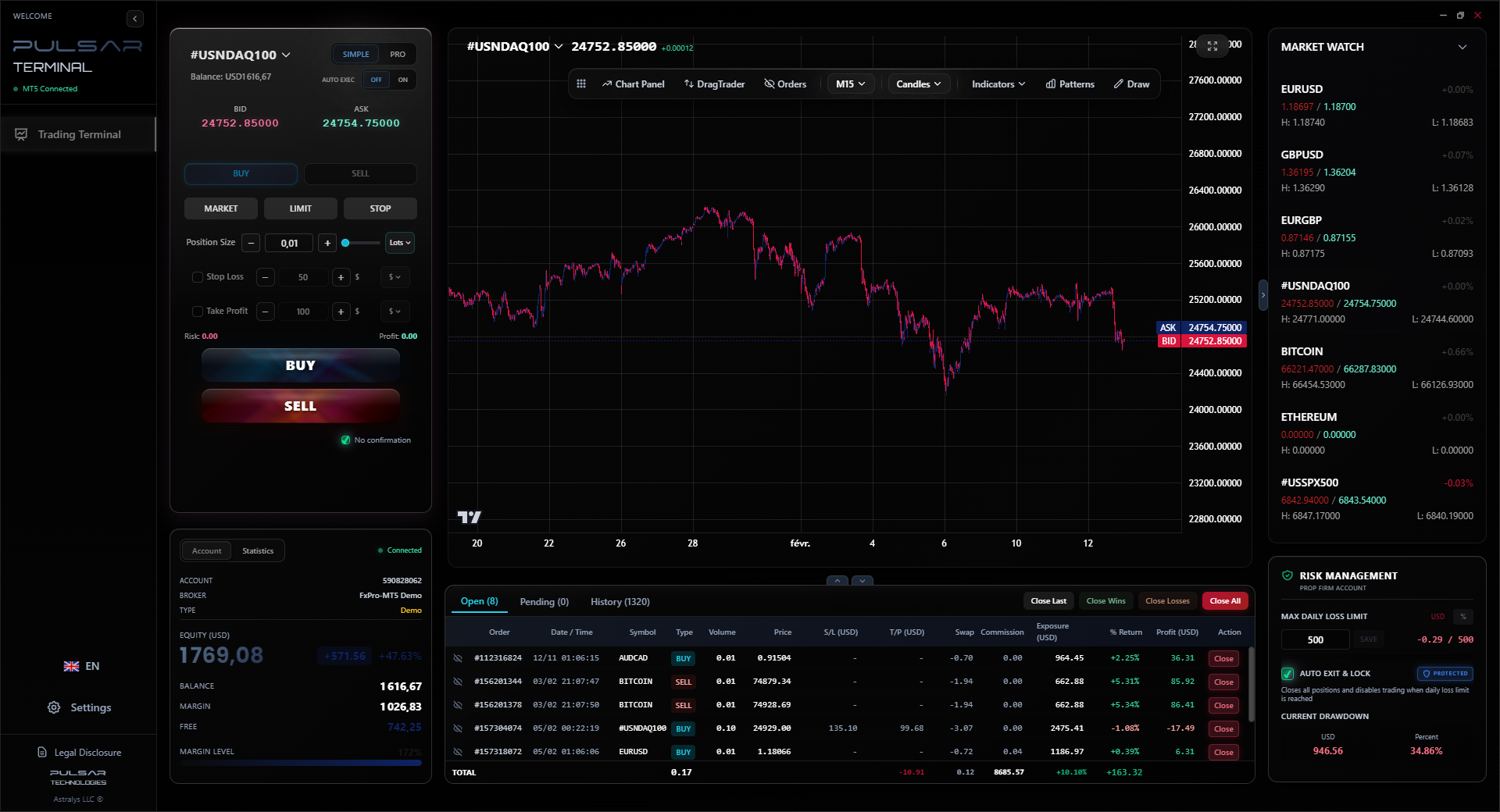
Managing complex bonus volume targets requires precise trade tracking, a task made effortless with Pulsar Terminal's advanced trade management tools on MT5.
“The volume requirement is designed so that the spread you pay will equal or exceed the bonus value.”
Not all that glitters is gold. Some offers are designed to separate you from your deposit. Here’s what screams "walk away":
1. The Guaranteed Profit Bonus. Any offer that promises specific profits is illegal under FSCA rules. Forex trading is inherently risky. Guarantees are lies.
2. The Bonus You Can't Refuse. If you're automatically enrolled in a bonus program without clicking "I agree," that's a major red flag. It means the terms are likely predatory, and they don't want you to see them.
3. The Offshore Regulator Shuffle. The broker's website says "Regulated by the FSCA" but when you click the license number, it links to some obscure offshore island authority you've never heard of. That's intentional misdirection. South African regulation is a selling point; they wouldn't hide it.
4. The Sky-High Volume Requirement. A $50 no-deposit bonus requiring 50 lots of volume is mathematically impossible for a retail trader to overcome profitably. It's not a bonus; it's a clickbait ad.
5. Pressure to Deposit More to "Unlock" or "Keep" the Bonus. A classic scam tactic. "Your bonus will expire unless you deposit another $500 in the next 24 hours!" Legitimate brokers don't operate like this.
A personal story: I once opened an account with a flashy broker offering a 200% deposit bonus. The platform was slick. I deposited $200. The bonus of $400 appeared. Then I tried to place a trade. The spreads were 15 pips on EUR/USD (normally 1-2). The volume requirement was 100 lots. It was a prison, not an account. I couldn't trade without losing instantly to the spread. I forfeited the bonus, withdrew my $200 (which took 3 weeks of complaints), and closed the account. The lesson? Test with tiny size first. Always.
💡 Wskazówka Winstona
The most valuable bonus is a broker with a 1-pip spread on EUR/USD. It saves you money on every single trade, with no strings attached.
“Treat every free welcome bonus forex offer with extreme skepticism.”
My answer is a qualified yes, but with a massive caveat.
For the complete beginner: A no-deposit bonus is a fantastic, risk-free tool. Use it to learn the mechanics of a live platform, to feel the emotional tug of a moving P&L, and to practice your basic analysis. It bridges the gap between demo and real trading. Just go in with the goal of learning, not earning.
For the experienced trader: A deposit bonus can be a small edge, but only if the terms align with your existing trading style. Are you a high-volume trader? Does the required lot volume match your typical 3-month turnover? If yes, it's like a small rebate. If no, it's a distraction. Your edge comes from your analysis and discipline, not from a 20% top-up on your capital.
The bottom line: The bonus is the least important factor in choosing a broker. Regulation (FSCA first), execution quality, spreads/commissions, and platform stability are what actually make you money. A bonus on a bad platform is a liability. No bonus on a great platform like the one enhanced by tools such as Pulsar Terminal is an asset.
Treat every free welcome bonus forex offer with extreme skepticism. Read the terms like your financial life depends on it - because it does. Use them as a controlled tool for specific purposes, never as the main reason to fund an account. The market is hard enough without you tying one hand behind your back with complicated bonus rules. Keep it simple, trade smart, and let your strategy be your real edge.
FAQ
Q1Can I actually withdraw money from a no-deposit bonus in South Africa?
Yes, but only the profit you generate, not the bonus itself. You must first meet the broker's trading volume requirements, which are always specified in the terms. For example, you might need to trade 10 standard lots before your profits become withdrawable. Always check the specific conditions of the FSCA-regulated broker offering the bonus.
Q2What is the best free welcome bonus for forex in South Africa?
There's no single 'best' bonus. The most useful for beginners is often a small, straightforward no-deposit bonus (like $30) from a well-regulated broker like XM or Tickmill, as it allows for risk-free testing. For funded traders, a deposit match from a broker with tight spreads might be more valuable. The 'best' is the one whose terms you fully understand and that fits your trading style.
Q3Are forex trading bonuses banned in South Africa?
No, they are not banned. However, they are strictly regulated by the FSCA. Brokers must present all terms and conditions clearly and cannot offer guarantees or misleading promotions. The FSCA's role is to ensure these offers are transparent and fair, not to ban them outright.
Q4Why do brokers offer free welcome bonuses?
Primarily as a marketing cost to attract new clients. The complex volume requirements are designed so that, statistically, the trading costs (spreads, commissions) paid by the trader to meet those requirements will roughly equal or exceed the value of the bonus. It's a customer acquisition strategy, not charity.
Q5Is my money safe with a broker offering a big bonus?
Only if the broker is properly regulated, preferably by the South African FSCA. A big bonus from an unregulated offshore broker is a major red flag. Safety comes from regulation and segregated client funds, not from the size of the promotional offer. Always verify the broker's regulatory status independently.
Q6What happens if I don't meet the bonus trading requirements?
Typically, the bonus and any profits generated from it will be forfeited or removed from your account when you request a withdrawal or when the bonus promotion period expires. Your original deposit is usually safe (with a regulated broker), but you won't be able to withdraw any profits linked to the unmet bonus terms.
Q7Can I use a bonus for prop firm challenges?
Almost never. Prop firm challenges have strict rules against using external capital or benefits that alter your risk profile. Using a broker's bonus to fund a challenge account would violate their terms and likely result in instant failure. Keep prop firm trading and broker bonuses completely separate.
Lekcja Prof. Winstona
:
- ✓Always verify FSCA regulation first, bonus second.
- ✓Calculate the trading volume cost before accepting any bonus.
- ✓Use no-deposit bonuses for platform testing, not get-rich schemes.
- ✓Mentally halve any deposit bonus to avoid over-leveraging.
Jak przydatny był ten artykuł?
Kliknij gwiazdkę, aby ocenić
Tygodniowe analizy tradingowe
Darmowe tygodniowe analizy i strategie. Bez spamu.
O autorze
David van der Merwe
Trader Rynków Wschodzących
Trader z Johannesburga z 11-letnim doświadczeniem w walutach rynków wschodzących. Specjalizuje się w parach ZAR, handlu regulowanym przez FSCA i analizie rynku południowoafrykańskiego.
Komentarze
Może Ci się też spodobać

Cara Trading Forex Sukses: 7 Prinsip dari Trader Profesional
Cara trading forex sukses dengan 7 prinsip trader pro: manajemen modal, disiplin, journal trading, backtest. Data nyata, bukan janji profit palsu.
Jam Trading Forex Terbaik untuk Trader Indonesia: Panduan Lengkap dengan Tabel Waktu
Panduan jam trading forex untuk trader Indonesia. Tabel 4 sesi dunia, jam emas 20:00-00:00, sesi mana yang harus dihindari. Data akurat + tips dari trader berpengalaman.
Top 5 Sàn Forex Uy Tín Nhất 2026: Review Jujur dari Trader Indonesia
Top 5 sàn forex uy tín 2026 untuk trader Indonesia. Review jujur: spread, deposit, withdraw, dukungan lokal. Exness, XM, IC Markets & lebih.
All these calculators are built into Pulsar Terminal with real-time data from your MT5 account. One-click position sizing, automatic risk management, and instant calculations.
