


I lost ₦120,000 in 15 minutes.

Olumide Adeyemi
Pionier Tradingu w Afryce Zachodniej ·  Nigeria
☕ 9 min czytania
Czego się nauczysz:
I lost ₦120,000 in 15 minutes. That was my first real lesson in how to buy forex. I'd spent weeks studying charts, picked a broker with a flashy ad, and went all-in on EUR/USD because it 'felt right.' A surprise news spike wiped my account before I even understood what a stop-loss was. That pain is avoidable. This guide cuts through the noise to show you the legal, practical steps to trade forex in Nigeria without handing your money to the market.
Let's clear this up first. When you 'buy forex' in Nigeria, you're almost never physically exchanging Naira for dollar notes. You're speculating on the price movement of currency pairs through a broker, using a contract for difference (CFD). You're betting the price will go up or down.
The legal framework is tight and getting tighter. The Central Bank of Nigeria (CBN) and the Securities and Exchange Commission (SEC) are the main regulators. The CBN's new Nigerian Foreign Exchange (FX) Code, effective from late 2024, is the big rulebook now. It demands transparency and real-time reporting. Crucially, the CBN prohibits you from using brokers not licensed by them. The SEC echoes this, warning against unregulated platforms.
What does this mean for you? That offshore broker with the 1:2000 use might still accept you, but they aren't operating under Nigerian law. Your protection comes from their home regulator (like CySEC or the FCA). Your path to funding them is also about to get a lesson in Nigerian banking reality.

Warning: Trading with an unlicensed broker isn't just risky, it's explicitly against CBN rules. If they vanish with your money, you have zero local recourse.

💡 Wskazówka Winstona
Your first goal isn't to make money. It's to not lose money. Survive for six months. Most don't.
This is where most Nigerians get it wrong. You don't pick a broker based on who has the highest use or the shiniest Instagram promo. You pick based on regulation, reliability, and how easily you can get money in and out.
Regulation is Your Safety Net
Since local retail forex broker licensing is rare, you'll likely use an international broker. Their offshore entity (often based in Cyprus, Seychelles, or South Africa) will accept Nigerian clients. Your safety depends on their license. Look for brokers regulated by the Cyprus Securities and Exchange Commission (CySEC), the Financial Conduct Authority (FCA) in the UK, or the Australian Securities and Investments Commission (ASIC). These bodies enforce client fund segregation, meaning your money is kept separate from the broker's operating funds.
The Real Cost: Spreads and Fees
The advertised 'commission-free' trading is a myth. You pay through the spread - the difference between the buy and sell price. A tight spread on EUR/USD might be 0.6 pips on a raw account, while a standard account could be 1.2 pips or more. Over dozens of trades, that difference eats your profits. Check our Pepperstone review for an example of a broker offering raw spreads from 0 pips.
Minimum Deposits and use Traps
Yes, you can start with $1. I don't recommend it. With a $1 account and 1:500 use, you're one bad trade from a margin call. A realistic starting capital for proper risk management is between ₦50,000 and ₦100,000. For standard accounts, brokers typically ask for $50 to $500 minimum. At an exchange rate of roughly ₦1,200/$1, that's ₦60,000 to ₦600,000. Don't be seduced by unlimited use; it's a tool that will blow up in your hands if you don't know how to use a position size calculator.
| Broker | Key Regulation | Min. Deposit (Approx. in Naira) | Notable for Nigerian Traders |
|---|---|---|---|
| Exness | CySEC, FCA | From ₦12,000 (Standard) | Popular, high use options, good local support. |
| XM | CySEC, ASIC | From ₦6,000 | Strong education, $30 no-deposit bonus (check eligibility). |
| HF Markets | CySEC, FSCA | Often ₦0 min, but funding minimums apply | Offers Naira-denominated accounts. |
| IC Markets | ASIC, CySEC | From ₦72,000 (Raw Spread) | Institutional-grade spreads, great for scalping strategy. |
| FBS | CySEC, IFSC | From ₦1,200 | Very low entry point, but be cautious with use. |
“use is a tool that will blow up in your hands if you don't know how to use a position size calculator.”
This is the hardest part. Nigerian banks and card networks make international forex deposits a headache with fees and restrictions.
Your main options:
- E-wallets (Neteller, Skrill, PayPal): This is the most common workaround. You fund the e-wallet (which can be tricky itself), then transfer to your broker. Withdrawal is the reverse. Fees apply at each step.
- Bank Transfer: You can wire money from your Nigerian domiciliary account to the broker's overseas bank. Your bank will convert your Naira at their rate (which will be worse than the market rate) and charge a wire fee (often $25-$50). The CBN's 10-minute real-time reporting rule means the bank will document this.
- Debit/Credit Cards: Some brokers accept them. Your Nigerian bank might block the transaction, flagging it as 'international forex trading.' If it goes through, expect a foreign transaction fee of up to 3%.
- Cryptocurrency: A growing number of brokers accept deposits in Bitcoin or USDT. You buy crypto on a local exchange, send it to your broker, and they credit your trading account. Volatility during transfer is a risk, but it often bypasses banking hurdles.

Pro Tip: Before depositing a large amount, test the withdrawal process with a small sum. If you can't get $20 out smoothly, you won't get $2,000 out later. I learned this the hard way with a now-defunct broker; it took 3 months and countless emails to recover ₦45,000.
You've funded your account with, say, ₦100,000 (about $83). Now what? Let's walk through buying EUR/USD on MetaTrader 5.
- Analyze & Decide: You believe the Euro will strengthen against the Dollar. Your analysis (using tools like the RSI indicator or MACD indicator) suggests an uptrend.
- Open Order Window: Right-click on EUR/USD in the Market Watch, select 'New Order'.
- Set Volume (Your Position Size): This is critical. With $83, using a 0.01 lot (a micro lot) controls 1,000 units of currency. The margin required might be just $5. This is sane. Do NOT trade 0.1 lots ($10,000 control) with an $83 account.
- Set Stop Loss (SL) & Take Profit (TP): BEFORE you click buy. If the current price is 1.0850, you might place a stop loss at 1.0820 (risking 30 pips) and a take profit at 1.0900 (aiming for 50 pips). This gives you a positive risk-reward ratio.
- Click 'Buy': You are now long EUR/USD.

Example:
- Account Balance: $83 (₦~100,000)
- Trade: BUY 0.01 lots EUR/USD @ 1.0850
- Stop Loss: 1.0820 (30 pips risk)
- Take Profit: 1.0900 (50 pips target)
- Value per Pip: $0.10 (for a 0.01 lot)
- Total Risk: 30 pips x $0.10 = $3 (about ₦3,600)
- Potential Gain: 50 pips x $0.10 = $5 (about ₦6,000)
This is how you manage risk. You're risking 3.6% of your account for a potential 6% gain. Most beginners risk 20% on a 'sure thing' and are gone in five trades.
💡 Wskazówka Winstona
If you can't explain your trade setup in one sentence, you don't have a strategy. You have a hope.
“Making money is one thing. Keeping it is the real skill.”
Making money is one thing. Keeping it is the real skill.
Risk Management is Non-Negotiable
Never risk more than 1-2% of your account on a single trade. Use stop losses religiously. A trailing stop can lock in profits as a trade moves your way. I once turned a ₦75,000 profit on a gold trade into a ₦15,000 loss because I got greedy and moved my stop loss. Don't be me.
The Tax Man Cometh
Forex trading profits are taxable income in Nigeria. You're subject to Capital Gains Tax or Personal Income Tax, depending on how the FIRS views your activity (are you an occasional investor or a professional trader?). Rates are progressive, from 7% to 24% of your taxable income. You are required by law to report this income. Keep detailed records of all your trades, deposits, and withdrawals. A simple spreadsheet with dates, pairs, profit/loss, and broker statements is your best friend during tax season.
The Hidden Cost: The Naira Itself
Remember, you're trading in USD but living in Naira. If you make a $100 profit and the Naira strengthens from ₦1,200/$1 to ₦1,000/$1 by the time you withdraw, your ₦120,000 profit becomes ₦100,000. Currency risk works both ways. This is another reason why swing trading over days/weeks requires a different mindset than quick scalps.
Managing multiple trades and setting precise stop-losses is complex, but tools like Pulsar Terminal automate this directly on your MT5 platform, turning your risk rules into action.
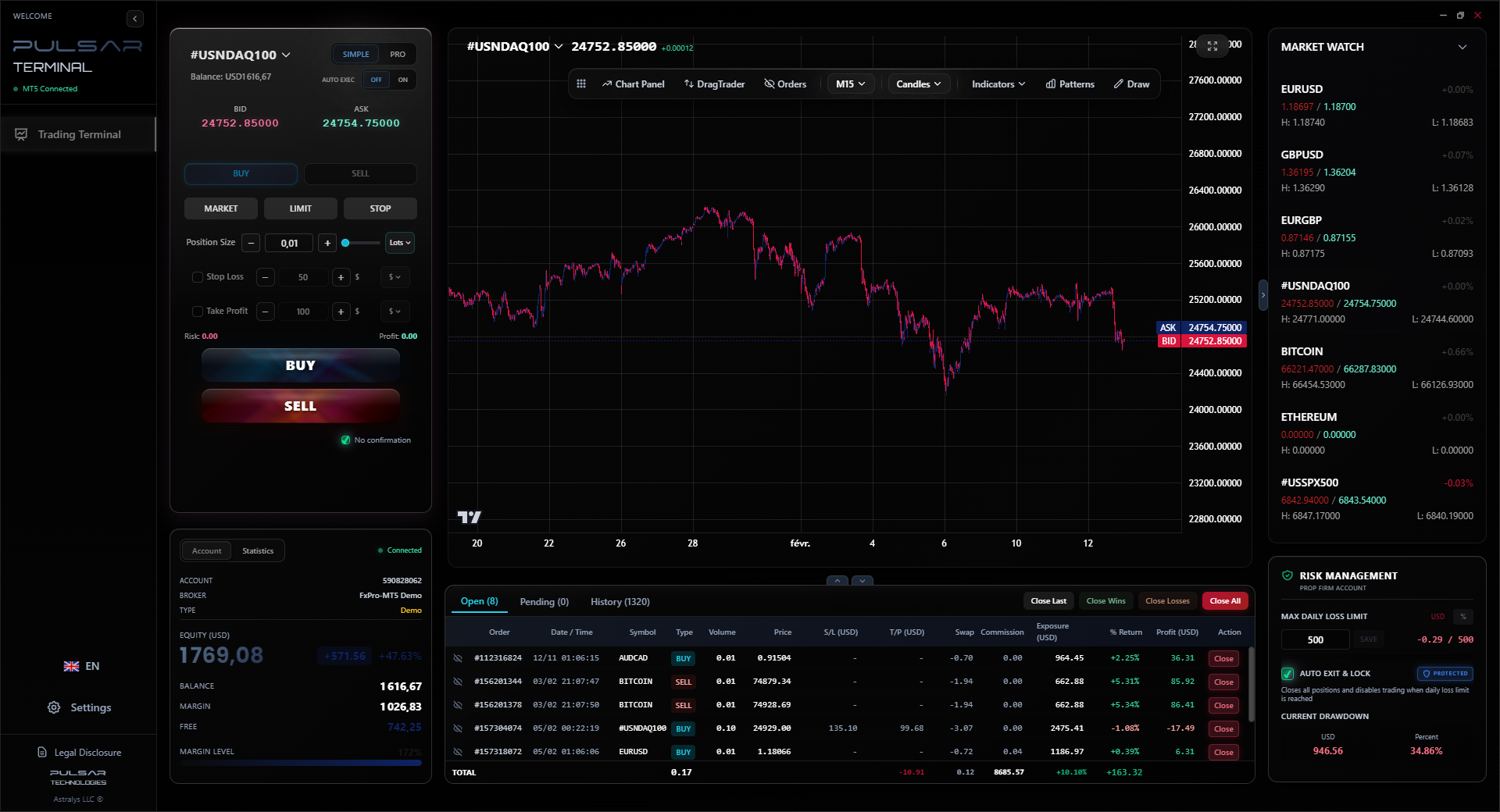
Let's get personal. Here's where I set my money on fire so you can see the flames.
Pitfall 1: Chasing the 'Nigerian Guru'. Paid ₦50,000 for a 'signal service' from a guy in Lagos with Lamborghini pics. His signals were just reposted from free Telegram channels. The only thing that got rich was his Instagram feed.
Pitfall 2: Over-leveraging on USD/NGN hopes. When there was buzz about Naira devaluation, I loaded up on USD/JPY, thinking 'dollar strength.' I used 1:500 use. A sudden Bank of Japan intervention spiked the Yen. I lost 60% of my account in an hour because my position was 10x too big. use amplifies losses faster than gains.
Pitfall 3: Ignoring the news. I was in a nice long-term XAU/USD guide trade. Then the US Federal Reserve made a surprise hawkish statement. Gold tanked $50 in minutes. My stop-loss was too far away, thinking I was 'safe' for the week. I wasn't. Economic calendars are free. Use them.
Pitfall 4: Withdrawal delays. I once had a ₦300,000 profit stuck for weeks because I used an obscure payment method the broker was 'reviewing.' Always use the broker's main, recommended deposit/withdrawal channels. The convenience of a weird e-wallet isn't worth the panic.
💡 Wskazówka Winstona
The market doesn't care about your rent, your bills, or your 'sure thing.' Trade the price, not your need.
“That ₦6,000 loss on demo feels nothing like a ₦6,000 loss of real money.”
Buying forex is easy. Profiting consistently is a profession. Here's how to build your edge.
Start with a Demo Account, But Not Forever. Practice for 3-6 months. Test strategies. Get used to the platform. Then, move to a live account with the minimum deposit. The psychological shift is real. That ₦6,000 loss on demo feels nothing like a ₦6,000 loss of real money.
Specialize. Don't trade 28 pairs. Pick 2-3 major pairs like EUR/USD and learn their personality - when they're most volatile (during London/N.Y. overlap), what news moves them. Become an expert in a tiny slice of the market.
Journal Everything. Every trade. Your entry reason, your emotion, your exit. Review weekly. My biggest turning point was realizing 80% of my losses came from trades I entered out of boredom, not strategy.
Continuous Education. The market changes. The CBN's policies in 2026 (like the waiver on USD withdrawal limits) affect liquidity and sentiment. Stay informed on local and global economics. It's not just charts.
FAQ
Q1Is forex trading legal in Nigeria?
Yes, it's legal for individuals. However, you must use a broker licensed by the Central Bank of Nigeria (CBN) or, more commonly for retail traders, a reputable international broker regulated by a recognized foreign authority like CySEC or the FCA. Trading with unlicensed platforms is prohibited by the CBN.
Q2How much money do I need to start trading forex in Nigeria?
Technically, some brokers allow you to start with as little as $1 (about ₦1,200). Practically, this is a terrible idea. To apply proper risk management and not get wiped out by a single trade, a more realistic starting capital is between ₦50,000 and ₦100,000. This allows you to trade sensible position sizes and survive the inevitable learning-curve losses.
Q3How do I fund my forex trading account from Nigeria?
The most common methods are through e-wallets (like Neteller or Skrill), bank transfers from a domiciliary account, or cryptocurrency (like USDT). Direct debit/credit card deposits often face restrictions or high fees from Nigerian banks. Always check your broker's specific options for Nigerian clients.
Q4Do I pay tax on my forex trading profits in Nigeria?
Yes. Profits from forex trading are considered taxable income by the Federal Inland Revenue Service (FIRS). You may be liable for Capital Gains Tax or Personal Income Tax at progressive rates (7% to 24%). You are legally required to keep records and declare this income.
Q5What's the difference between a pip and the spread?
A pip definition is the smallest price move a currency pair can make, usually 0.0001 for most pairs. The spread definition is the difference between the buy (ask) and sell (bid) price, measured in pips. It's the broker's fee. A tight spread (e.g., 0.6 pips) is cheaper to trade than a wide spread (e.g., 1.5 pips).
Q6Which trading platform is best for beginners in Nigeria?
MetaTrader 4 (MT4) or MetaTrader 5 (MT5) are the industry standards and are offered by almost all brokers serving Nigeria. They are reliable, have countless free indicators, and a huge community for support. Start with MT4 if you're brand new; it's slightly simpler than MT5.
Q7Can I trade forex with my phone in Nigeria?
Absolutely. All major brokers offer mobile apps for MT4/MT5 or their own proprietary apps. You can analyze charts, place trades, and manage your account from your smartphone. Just ensure you have a stable internet connection, as a dropped connection during a volatile market can be costly.
Lekcja Prof. Winstona
:
- ✓Risk only 1-2% of your account per trade.
- ✓Start with at least ₦50,000 for realistic management.
- ✓Use brokers regulated by CySEC, FCA, or ASIC.
- ✓Fund via e-wallets or crypto to avoid bank hurdles.
- ✓You must pay tax on your trading profits to FIRS.
Jak przydatny był ten artykuł?
Kliknij gwiazdkę, aby ocenić
Tygodniowe analizy tradingowe
Darmowe tygodniowe analizy i strategie. Bez spamu.
O autorze
Olumide Adeyemi
Pionier Tradingu w Afryce Zachodniej
Jeden z najaktywniejszych edukatorów tradingu forex w Nigerii. 8 lat doświadczenia tradingowego z Lagos. Specjalizuje się w strategiach niskiego kapitału i wyzwaniach prop firm dla afrykańskich traderów.
Komentarze
Może Ci się też spodobać

Cara Trading Forex Sukses: 7 Prinsip dari Trader Profesional
Cara trading forex sukses dengan 7 prinsip trader pro: manajemen modal, disiplin, journal trading, backtest. Data nyata, bukan janji profit palsu.
Jam Trading Forex Terbaik untuk Trader Indonesia: Panduan Lengkap dengan Tabel Waktu
Panduan jam trading forex untuk trader Indonesia. Tabel 4 sesi dunia, jam emas 20:00-00:00, sesi mana yang harus dihindari. Data akurat + tips dari trader berpengalaman.
Top 5 Sàn Forex Uy Tín Nhất 2026: Review Jujur dari Trader Indonesia
Top 5 sàn forex uy tín 2026 untuk trader Indonesia. Review jujur: spread, deposit, withdraw, dukungan lokal. Exness, XM, IC Markets & lebih.
All these calculators are built into Pulsar Terminal with real-time data from your MT5 account. One-click position sizing, automatic risk management, and instant calculations.
