


I lost R4,200 in under an hour on a single USD/ZAR trade.

David van der Merwe
Trader Rynków Wschodzących ·  South Africa
☕ 11 min czytania
Czego się nauczysz:
I lost R4,200 in under an hour on a single USD/ZAR trade. My analysis was right, the trend was my friend, but my position size was a monster. I'd thrown 8% of my account at it because I was 'sure'. The rand spiked on a surprise SARB comment, my stop-loss got vaporized in the spread, and I was left staring at a screen, feeling sick. That day, I learned the hard way that knowing how to calculate position size in forex isn't just math, it's the difference between staying in the game and going back to a 9-to-5. Let's make sure you never have that same lesson.
Everyone obsesses over the perfect entry, the magic indicator, the secret strategy. I did too. But after 12 years, I'll tell you this straight: your entry point is maybe 20% of the battle. The other 80% is how much you bet. That's your position size. It's the single biggest lever you control. A brilliant trade with a reckless size will wipe you out. A mediocre trade with a perfectly calculated size will leave you with capital to fight another day. In South Africa, with the ZAR's famous volatility, getting this wrong is a fast track to the poorhouse. Think of it this way: you're a lion hunter. Your trading strategy is your aim. Your position size is whether you're using a rifle or a peashooter. Miss with the rifle, you're fine. Miss with the peashooter... well, you're lunch. The FSCA can't protect you from yourself here. This is pure self-discipline.

Warning: Trading ZAR pairs like USD/ZAR or EUR/ZAR? Their spreads are wider - sometimes 5 to 14 pips. If your stop-loss is only 10 pips away, the spread alone can eat half your risk before the trade even starts moving. Your position size calculation must account for this slippage and cost.
Forget the fancy jargon. Calculating your position size boils down to answering one question: "How many rands am I willing to lose on this trade?" Once you know that, the rest is just arithmetic. Here's the universal formula you need to tattoo on your brain:
Position Size (in Lots) = (Risk Amount in ZAR) / (Stop-Loss in Pips × Pip Value per Lot in ZAR)
Let's unpack each piece, because if you get one wrong, the whole thing falls apart.
Your Risk Amount: The Sacred Number
This is not a guess. It's a rule. Most pros risk between 1% and 2% of their total account balance on any single trade. I use 1.5%. That's my hard ceiling. So, if you have a R20,000 account, your max risk per trade is R300 (20,000 * 0.015). That R300 is your Risk Amount. It's what you mentally write off before you even click 'buy' or 'sell'. This is non-negotiable.
Your Stop-Loss in Pips: The Distance to Pain
This isn't about where you hope the price won't go. It's a technical level where your trade idea is objectively wrong. You determine this from your charts before you calculate anything. Is it 25 pips away on EUR/USD? 80 pips away on USD/ZAR? This number is critical. A tighter stop means you can trade a bigger size for the same risk. Sounds great, right? But a stop that's too tight will get you stopped out by market noise constantly. You need to find the balance. I often use the Average True Range (ATR) indicator to gauge market noise and set a sensible stop.
Pip Value: The Tricky Bit for ZAR Traders
This is where many South Africans mess up. Pip value depends on your account currency (usually ZAR or USD) and the pair you're trading.
- If your account is in USD: For a standard lot (100,000 units) of EUR/USD, 1 pip is usually $10. For a mini lot (10,000 units), it's $1.
- If your account is in ZAR (or you're trading a ZAR pair): It gets more complex. The pip value fluctuates with the USD/ZAR rate. Most brokers' platforms will show you the estimated pip value in your account currency before you place the trade. You must check this.

Example: Let's say your account is in USD, you have $10,000, and you risk 1% ($100). You want to sell EUR/USD with a 50-pip stop-loss. Pip value for a standard lot is ~$10. Position Size = $100 / (50 pips * $10) = 0.2 standard lots (or 2 mini lots). That's it. You trade 20,000 units. Not 25,000, not 100,000. Twenty thousand. Discipline.

💡 Wskazówka Winstona
If the calculated position size feels too small to be exciting, you're doing it right. Excitement in trading is usually expensive.
“Your entry point is maybe 20% of the battle. The other 80% is how much you bet.”
Let's get local. In early 2023, I was trading a USD/ZAR breakout. My account was R50,000. My 1.5% risk rule meant I could lose R750 on this trade.
- My Analysis: Price broke above 18.5000. I entered a buy at 18.5050.
- My Stop-Loss: I placed it at 18.4550, a 50-pip stop. (Yes, 50 pips on USD/ZAR is tight, lesson coming).
- The Broker Data: I was with a broker offering ~6 pip spreads on USD/ZAR. My platform showed the pip value for a standard lot was roughly R1,000 (this changes daily!).
- The Calculation: Position Size = R750 / (50 pips * R1000) = 0.015 standard lots.
That's a tiny position: 1,500 units (a micro lot and a half). It felt pathetic. My ego screamed, "That's not enough to make real money!" So I broke my rule. I quintupled it to 0.075 lots (7,500 units).
The trade went my way... for about 20 minutes. Then it reversed, spiked down through my stop, and with the 6-pip spread, my fill was awful. My loss? R3,800. Not R750. I broke every rule in the book because the calculated size didn't feel big enough. That emotional itch is what kills traders. The math was right. I was wrong. Use a position size calculator if you must, but understand the numbers it spits out.

Pro Tip: When trading volatile exotics like EUR/ZAR, consider using a 'cents' or micro account if your broker offers it. It allows you to trade much smaller, more precise position sizes that match your risk, without the temptation to over-use a standard account. Brokers like XM and Exness are popular here for this reason.
Ah, use. The siren song of the South African trader. "Trade with 1:500 use!" brokers shout. It sounds like free money. It's not. It's borrowed risk. use doesn't change your risk amount (that R750), it changes the amount of capital you need to put up (margin) to control a position.
Let's go back to that USD/ZAR example. To control that 0.015 standard lot position (worth about R277,500 at 18.50), my broker might only require 0.2% margin with 1:500 use. That's about R555 from my account. My risk was still R750. See the danger? My margin (R555) was less than my potential loss (R750). If the trade went south, I could lose more than the margin I put up. That's how you get a margin call.
use amplifies the size you can control, not your edge. It makes precise position sizing more critical, not less. A common newbie mistake is to look at their available margin and think, "I can open a position this big," rather than calculating, "I should open a position this small." High use is a tool for efficiency, not for gambling with oversized positions. I treat anything above 1:30 with extreme caution for my main account.
💡 Wskazówka Winstona
Write your max loss in Rands on a sticky note and stick it to your monitor before every trade. It makes the risk real, not abstract.
“use amplifies the size you can control, not your edge. It makes precise position sizing more critical, not less.”
Trading the rand is a different beast. You can't just copy-paste EUR/USD logic. Here’s what’s different:
1. Wider Spreads: This is the big one. While you might get 0.1 pips on EUR/USD with an ECN broker, USD/ZAR spreads of 5-8 pips are normal. This massively impacts your effective risk. If your stop is 20 pips away, the spread is already 25-40% of that distance. You must use wider stops on ZAR pairs, which means your position size gets smaller for the same monetary risk.
2. Volatility: The ZAR is news-driven. SARB announcements, political noise, load-shedding reports – they all cause spikes. Your stop-loss must be placed outside the range of regular daily noise, which is larger than for majors.
3. Broker Selection: Your choice of broker directly affects your position sizing math. You need to know their typical spreads on the pairs you trade. A broker like Pepperstone might offer raw spreads but charge a commission. Another like IC Markets might have similar conditions. You must factor the commission into your risk. If you pay $7 per lot round turn, that's a cost that shrinks your potential profit and must be considered.
4. Overnight Financing (Swap): Holding ZAR pairs overnight can incur hefty swap fees, especially if you're short the rand during a high-interest-rate environment. For a swing trading position, these costs can eat into your profits over time, another factor to weigh.
A Local Cost Table:
| Cost Type | Typical Range (ZAR Pairs) | Impact on Position Sizing |
|---|---|---|
| Spread | 5 - 14 pips (e.g., EUR/ZAR) | Forces wider stops, smaller size. |
| Commission (if applicable) | $5 - $10 per standard lot | Reduces net profit; a fixed cost to overcome. |
| Bank Transfer Fees | R250 - R350 for int'l deposits/withdrawals | Erodes trading capital; deposit larger sums less often. |
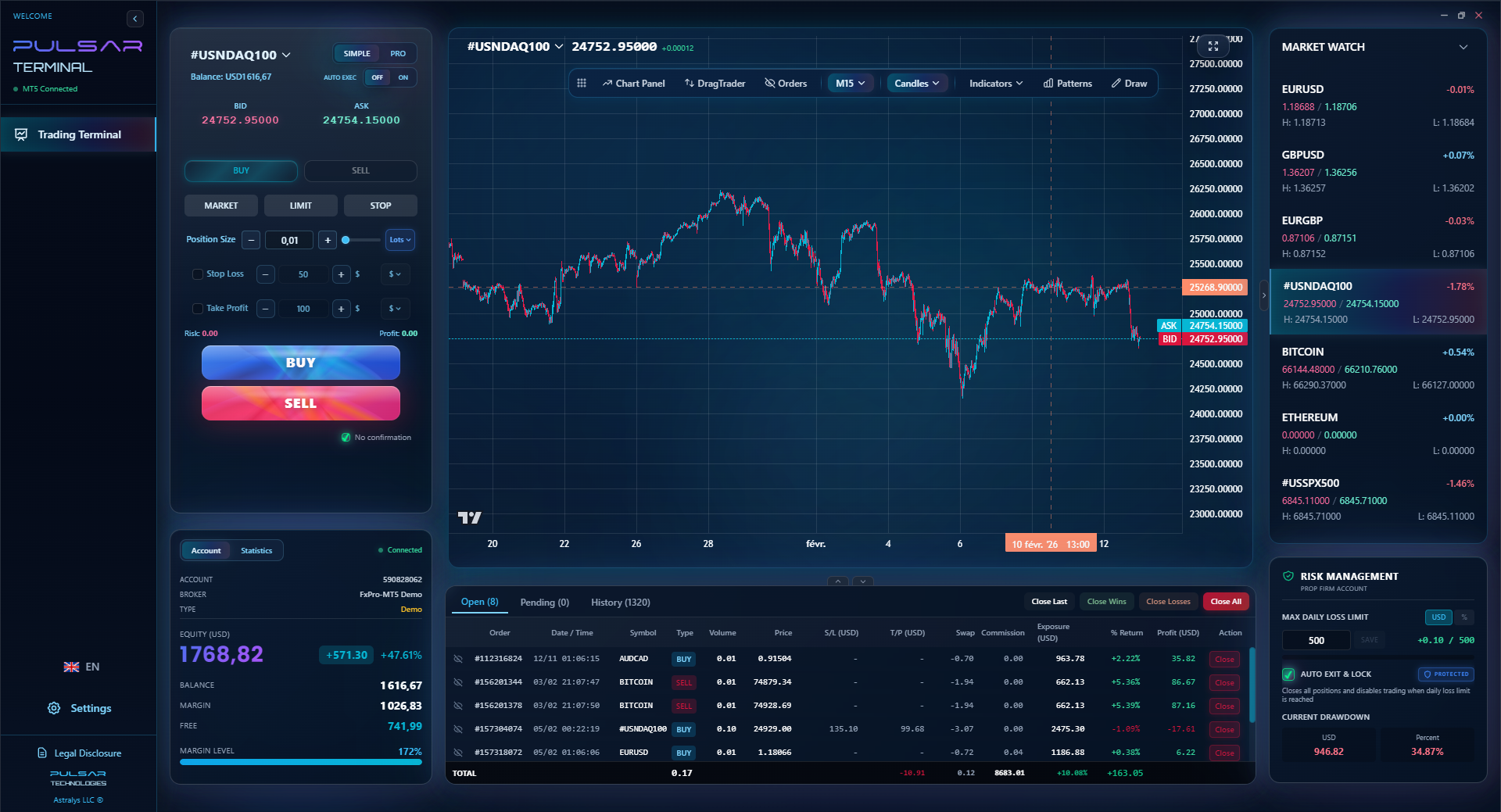
Managing multiple trades with precise stops and takes-profits is key to risk management, and Pulsar Terminal lets you set them all with a single drag-and-drop directly on your MT5 chart.
Knowing the formula is one thing. Applying it consistently under pressure is another. Here's what works for me.
1. The Pre-Trade Checklist: I have a physical checklist next to my screen. The top item: "Calculate Position Size." I do the math on a notepad or a simple Excel sheet before I even open the order window. This separates the analytical phase from the emotional execution phase.
2. Use a Calculator, But Verify: Online position size calculators are great. Input your account balance, risk %, stop in pips, and pair. But don't blindly trust them. Understand the output. Why is it suggesting 0.07 lots? Run the numbers yourself once in a while to stay sharp.
3. The 'What If' Scenarios: Before hitting buy, I ask: "If I lose 1.5% here, how will I feel?" If the answer is "angry" or "devastated," my risk percentage is too high. I drop it to 0.5%. Your risk tolerance must match your emotional tolerance.
4. Adjusting for a Losing Streak: This is advanced, but crucial. If I have three losing trades in a row (each losing 1.5%), my account is down 4.5%. My next trade's risk is still 1.5%, but 1.5% of a smaller number. The system automatically reduces my position size after losses, preserving capital. Never try to 'double down' to recover.
Pro Tip: If you're into scalping strategies with very tight stops, your position size formula is even more sensitive. A 5-pip stop on a pair with a 2-pip spread means 40% of your risk buffer is gone instantly. Your win rate and reward-to-risk ratio need to be exceptional to overcome this. It's a tough game.
💡 Wskazówka Winstona
Your first job after a losing trade isn't to find a new setup. It's to recalculate your position size for the next one, based on your new, smaller account balance.
“If the calculated position size feels too small to be exciting, you're doing it right.”
Enough theory. Here's exactly what to do on your next trade.
- Determine Account Risk: Decide your fixed risk percentage (Start with 1%). Multiply by your account balance. That's your Rand Risk Amount.
- Find Your Stop: Analyze the chart. Place a logical, technical stop-loss. Measure the distance from entry to stop in pips.
- Find Pip Value: Check your trading platform's order window. It will show the estimated pip value for 1 lot on your chosen pair. Note it.
- Do The Math: Risk Amount / (Stop-Loss Pips * Pip Value per Lot) = Position Size in Lots.
- Check Against Margin: Ensure the required margin for that size is a fraction of your equity. If it's using 50% of your balance, your use is too high or your size is still too big.
- Place the Trade: Enter the exact lot size from step 4. Set your stop-loss and take-profit orders immediately.
- Walk Away: Seriously. You've done the work. The machine is now running. Don't fiddle.
This process turns trading from a gut-wrenching gamble into a managed, probabilistic business. The market will give and take. Your job isn't to predict every gift and curse. Your job is to ensure that when it takes, it never takes enough to knock you out of the ring. That's the power of knowing how to calculate position size in forex. It's boring. It's unsexy. It's the most important skill you'll ever learn.
FAQ
Q1What's a good risk percentage for a beginner in South Africa?
Start at 0.5% per trade. Not 1%, definitely not 2%. With the ZAR's volatility and the emotional rollercoaster of starting out, 0.5% lets you learn from mistakes without crippling your account. You can scale up to 1% once you have a proven, consistent strategy over at least 6 months.
Q2My broker's platform calculates position size for me. Should I just use that?
You can, but you must understand and verify its inputs. What risk percentage is it using? Does it account for the current spread? Treat it as a helper, not a brain replacement. Always know what your max loss should be in Rands before you trust any automated tool.
Q3How does trading ZAR/USD differ from EUR/USD for position sizing?
Two major differences: cost and volatility. USD/ZAR has much wider spreads (5+ pips vs. <1 pip), so your stop-loss must be wider, leading to a smaller position size for the same monetary risk. Its price swings are also more violent, meaning a stop that's too tight is almost guaranteed to get hit by random noise.
Q4I only have R2,000 to start. Can I still use proper position sizing?
Yes, but you must use a broker that offers micro lots (1,000 units) or cent accounts. With R2,000, a 1% risk is R20. On USD/ZAR with a 50-pip stop, that might mean a position size of 0.004 lots (4 micro lots). A standard account that only allows 0.01 lot minimums would force you to risk 5%, which is far too high.
Q5Should I adjust my position size if I'm on a winning or losing streak?
On a losing streak, your system should automatically shrink your size because you're risking a percentage of a smaller capital base. That's correct. On a winning streak, resist the urge to dramatically increase your risk percentage. You can gradually increase it (e.g., from 1% to 1.2%) as your confidence grows, but never abandon the percentage-based model. That's how winning streaks turn into catastrophic losses.
Q6How do swap rates affect my position size calculation?
Swap rates (overnight financing) don't directly affect the initial position size calculation for risk management. They are a holding cost. However, if you are a swing trader holding for days or weeks, a large negative swap can significantly erode profits. You should factor this into your overall trade viability, perhaps avoiding pairs with heavily negative swaps for your strategy, but your initial size is still based on your stop-loss risk.
Lekcja Prof. Winstona
:
- ✓Never risk more than 1-2% of your capital on a single trade.
- ✓Wider ZAR pair spreads demand wider stops and smaller sizes.
- ✓Calculate size before emotion enters the order window.
- ✓use is for margin efficiency, not for reckless bets.
Jak przydatny był ten artykuł?
Kliknij gwiazdkę, aby ocenić
Tygodniowe analizy tradingowe
Darmowe tygodniowe analizy i strategie. Bez spamu.
O autorze
David van der Merwe
Trader Rynków Wschodzących
Trader z Johannesburga z 11-letnim doświadczeniem w walutach rynków wschodzących. Specjalizuje się w parach ZAR, handlu regulowanym przez FSCA i analizie rynku południowoafrykańskiego.
Komentarze
Może Ci się też spodobać

Cara Trading Forex Sukses: 7 Prinsip dari Trader Profesional
Cara trading forex sukses dengan 7 prinsip trader pro: manajemen modal, disiplin, journal trading, backtest. Data nyata, bukan janji profit palsu.
Jam Trading Forex Terbaik untuk Trader Indonesia: Panduan Lengkap dengan Tabel Waktu
Panduan jam trading forex untuk trader Indonesia. Tabel 4 sesi dunia, jam emas 20:00-00:00, sesi mana yang harus dihindari. Data akurat + tips dari trader berpengalaman.
Top 5 Sàn Forex Uy Tín Nhất 2026: Review Jujur dari Trader Indonesia
Top 5 sàn forex uy tín 2026 untuk trader Indonesia. Review jujur: spread, deposit, withdraw, dukungan lokal. Exness, XM, IC Markets & lebih.
All these calculators are built into Pulsar Terminal with real-time data from your MT5 account. One-click position sizing, automatic risk management, and instant calculations.
