


Thinking about how to join forex trading from South Africa? You're not alone.

David van der Merwe
Trader Rynków Wschodzących ·  South Africa
☕ 11 min czytania
Czego się nauczysz:
Thinking about how to join forex trading from South Africa? You're not alone. With over 190,000 active traders here and the market growing fast, it's a tempting space. But between FSCA rules, SARS tax implications, and a sea of brokers, it's easy to get lost before you even place your first trade. I've been trading from SA for over a decade, and I'll walk you through the real process - not the get-rich-quick fantasy. Let's get you started the right way.
Before you even look at a chart, you need to know the local playing field. Trading is legal here, but it's not the wild west. The Financial Sector Conduct Authority (FSCA) calls the shots.
The biggest rule? use is capped at 30:1 for retail traders. That means if you deposit R10,000, the most you can control is R300,000. It might sound restrictive compared to brokers offering 1:2000 offshore, but trust me, it's a lifesaver. I blew up my first account in 2015 using 1:500 use on gold. A 20-pip move wiped me out. The 30:1 rule forces you to use proper position size calculator discipline from day one.
Then there's SARS. This is where most new traders get a nasty surprise. If you're trading frequently for profit, it's considered income, not capital gains. You'll pay your marginal income tax rate on your net profits. No, your broker won't send SARS a tax certificate. You need to keep every single statement. I use a simple spreadsheet: date, pair, profit/loss. Come tax season, it's a breeze.

Warning: Speculating directly against the ZAR with an international broker is a big no-no due to exchange controls. You trade majors like EUR/USD or USD/JPY. The USD/ZAR pair you see is for hedging and commercial purposes, not for your retail trading account.
Your first step isn't downloading a platform. It's bookmarking the FSCA's financial services provider register. Any broker you consider must be on that list. If they're not, your funds have zero local protection.

💡 Wskazówka Winstona
Your first R10k is tuition, not investment. The goal isn't to double it. The goal is to pay as little as possible for the most lessons.
With the rules clear, let's talk brokers. The list is long, but your choice boils down to costs, platform, and how you like to trade.
The Spread is King
Your main cost is the spread - the difference between the buy and sell price. A 'tight' spread on EUR/USD might be 0.9 pips with one broker and 0.1 with another. That 0.8 pip difference adds up fast. Some brokers offer 'raw' accounts with spreads from 0.0 pips but charge a commission per lot.
Let me give you a real example from last month. I took a 2-lot buy on EUR/USD.
- On a standard account with a 1.0 pip spread: Cost = 2 lots * 1.0 pip = $20 (1 pip = $10 per lot).
- On a raw account with 0.1 pip spread + $7 commission: Cost = (2 lots * 0.1 pip = $2) + (2 * $7 = $14) = $16.
The raw account was cheaper. But for tiny accounts, the commission can hurt. For a beginner with a small account, a simple, all-in spread might be easier.
Local Deposits & Withdrawals
You want a broker that accepts local EFTs in ZAR. Waiting 5 days for an international SWIFT transfer while a trade setup slips away is agony. Most top FSCA brokers have local bank accounts with Bidvest or FNB. Deposits are usually instant; withdrawals take 1-2 business days.
Here's a quick comparison of a few solid, FSCA-regulated options for beginners:
| Broker | Min. Deposit (Approx. ZAR) | Typical EUR/USD Spread | Good For... |
|---|---|---|---|
| XM | ~R90 ($5) | From 0.8 pips | Absolute beginners, small accounts |
| Exness | ~R180 ($10) | From 0.0 pips* | Traders wanting ultra-low spreads |
| Pepperstone | R0 | From 0.0 pips* | Serious beginners ready for MT5/ctrader |
| IC Markets | ~R3,600 ($200) | From 0.0 pips* | Traders committed to larger accounts |
*Usually with a commission per lot traded.
I started with a broker that had a R1,500 minimum. It felt like a huge commitment. Today, you can start with the price of a burger at XM. The barrier to entry is low, but that doesn't mean you should rush. Open a demo account with at least two first.

Pro Tip: The platform matters as much as the broker. If you want to learn standard scalping strategy, you'll likely use MetaTrader. If a broker's proprietary platform looks flashy but you can't find basic tools, it's a red flag.
“Your first step isn't downloading a platform. It's bookmarking the FSCA's financial services provider register.”
You've picked a broker. Now, how much do you actually deposit? This is the most personal question in trading.
The old adage is 'only risk what you can afford to lose.' It's true, but vague. Here's my rule: Your starting capital should be an amount that, if it went to zero, would sting but not change your life. For me, that was R5,000 in 2014. For you, it might be R1,000 or R20,000.
Never deposit your 'savings' or money for bills. The psychological pressure will make you a terrible trader. You'll hold losers hoping they come back and cut winners short out of fear.
The Golden Rule of Position Sizing
This is the non-negotiable skill. Let's say you have a R10,000 account. A good risk rule is to never risk more than 1-2% of your account on a single trade. That's R100-R200.
How does that work in practice? You want to buy EUR/USD at 1.0850, and you'll place your stop loss at 1.0820 - a 30-pip risk. If 1 pip on a mini lot (0.1 lot) is $1, then a 30-pip loss would be $30 (about R550). That's over 5% of your account! Way too high.
You need to use a position size calculator to figure out the correct lot size. In this case, to risk only R100 (~$5.50), you could only trade a tiny 0.02 lot size. It feels small, but it keeps you in the game. I ignored this for months, constantly risking 5-10%. One bad week wiped out three weeks of careful gains.

Example: Account: R10,000. Risk per trade: 1% = R100. Trade: USD/JPY. Entry: 150.00, Stop Loss: 149.70 (30 pip risk). Pip value for 1 standard lot: ~¥1000. Calculator says: Position size = ~0.03 lots. You risk R100, not your entire account.
Here's the hard truth: your first R10,000 is tuition. You will likely lose it. The goal is to learn as much as possible for that price.
Start in Demo, But Not Forever
Live trading feels nothing like demo. The emotions are real. But demo is perfect for learning the platform mechanics: placing orders, setting stops, reading charts. Spend 2-4 weeks in demo until placing a trade is second nature. Then go live with a tiny account.
Pick One Pair & One Timeframe
Don't jump from EUR/USD to gold to the JSE Top 40. It's overwhelming. Pick one major pair like EUR/USD - it's the most liquid and has the tightest spreads. Then, pick one timeframe to analyze. If you're learning swing trading, start with the 4-hour chart. Watch how it moves for a month.
Learn Price Action & One Indicator
Forget buying a 10-indicator 'system' from a guru online. Start with pure price action: support, resistance, and trendlines. Then, add ONE oscillator to help. The RSI indicator or MACD indicator is a great start. Learn what overbought and oversold really mean in a trend. I spent my first year trying to make the Stochastic work on 5-minute charts. It was a mess. Switching to 4-hour charts with simple trendlines changed everything.
Your first year is not about profit. It's about building a repeatable process. Can you find a setup, define your risk, execute, and manage the trade according to your plan? If you can do that consistently, even at a small loss, you're ahead of 90% of beginners.
💡 Wskazówka Winstona
If you can't explain your trade setup in one simple sentence ('buying the pullback to the 4-hour trendline'), it's not a trade. It's a gamble.
“The old adage is 'only risk what you can afford to lose.' It's true, but vague. Here's my rule: Your starting capital should be an amount that, if it went to zero, would sting but not change your life.”
We all make mistakes. Here are the local classics I see (and made).
1. Chasing Offshore 'High use' Brokers: That 1:2000 use from an unregulated broker in St. Vincent looks amazing. Until you have a dispute and there's zero recourse. Your money is gone. The FSCA's 30:1 is frustrating but protective. Stick with it.
2. Ignoring Tax Until July: SARS doesn't care if you forgot. Keep a log from trade #1. A simple Profit & Loss statement from your broker is not enough detail for them. They want to see the activity.
3. Trading Around SARB Announcements: The South African Reserve Bank interest rate decisions cause massive ZAR volatility. If you're trading USD/ZAR CFDs (which some brokers offer on international indices), or even just trading when local liquidity is thin, be extra careful. I once got stopped out on a perfectly good EUR/USD trade because a surprise SARB comment caused wild spreads at 3 PM local time.
4. Not Understanding the 'Spread' Cost: When you click buy, you're already at a loss by the spread amount. If the EUR/USD spread is 1.0 pip, the price needs to move 1 pip in your favor just to break even. On a scalping strategy aiming for 5-pip profits, that's 20% of your target gone immediately. Always factor it in.
5. Letting a Loss Run Into a Margin Call: This is the account killer. You're in a losing trade, you move your stop loss further away 'giving it room to breathe.' The loss grows, your used margin increases, and suddenly your broker's system automatically closes all your positions to prevent a negative balance. It's a gut punch. Use your stop loss and respect it.
Sticking to your pre-defined stop loss and take profit levels is the core of discipline, and Pulsar Terminal lets you set and manage these orders visually right on your MT5 chart.
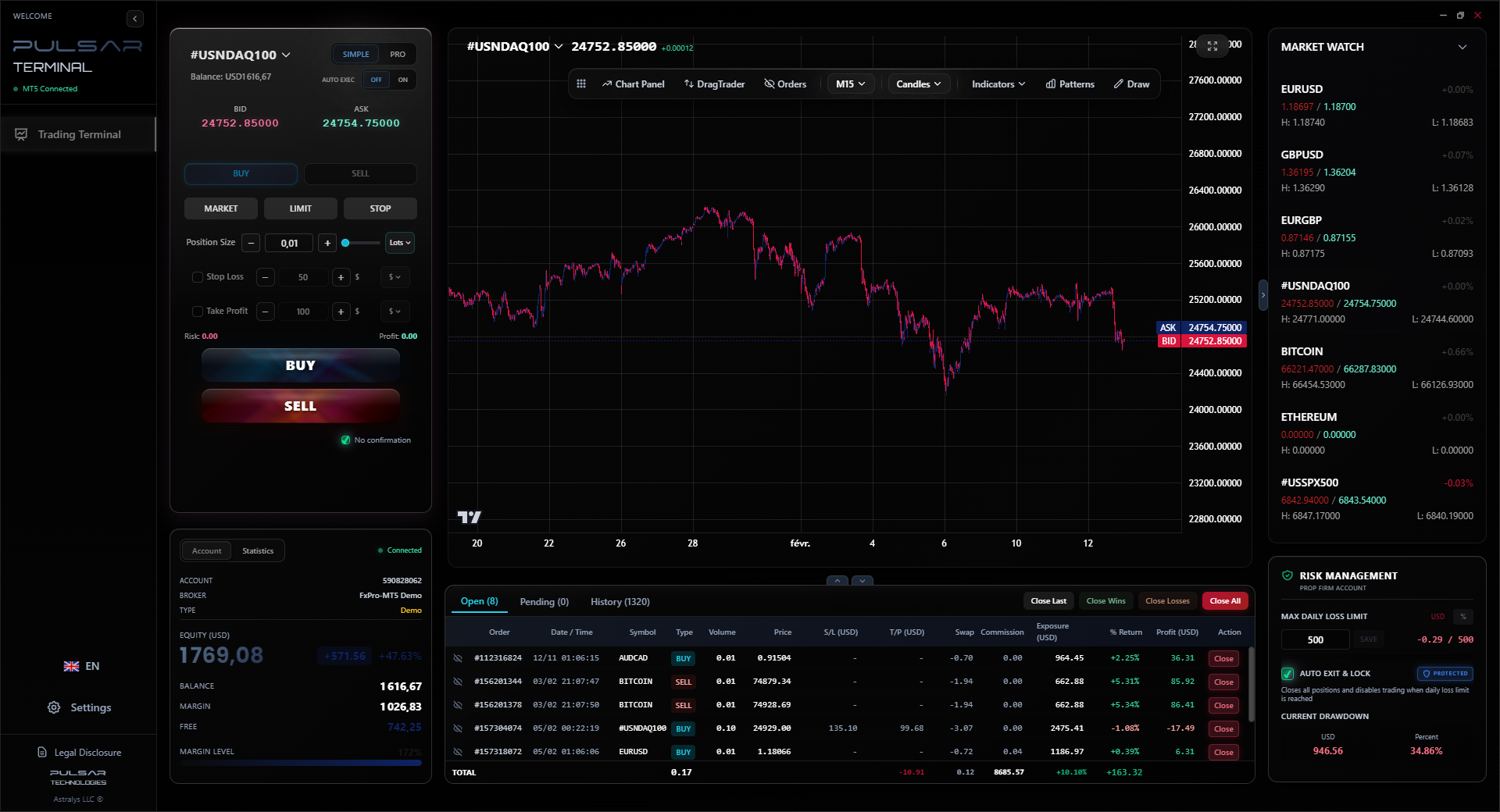
Ready to pull the trigger? Follow this list. I still have a version of it on my desk.
- Analysis: Did you find this setup on your chosen pair and timeframe? Is there a clear reason (e.g., bounce off support, trend continuation)?
- Plan the Trade:
- Entry Price: Exactly where will you enter? (e.g., 1.0850)
- Stop Loss Price: Exactly where will you admit you're wrong? (e.g., 1.0820). This defines your risk in pips (30 pips).
- Take Profit Price: Where will you take profit? (e.g., 1.0910). Your potential reward is 60 pips.
- Risk/Reward Ratio: Is it at least 1:2? (Here, 30 pip risk vs 60 pip reward = 1:2). Good.
- Calculate Position Size: Plug your account balance (e.g., R10,000), your risk % (e.g., 1% = R100), and your pip risk (30) into a calculator. It tells you your lot size (e.g., 0.03 lots).
- Place the Order: Enter the trade with your predetermined entry, stop loss, and take profit. Do NOT place the trade without the stops.
- Manage the Trade: Once it's live, walk away. Don't stare at it. Let your plan work. The only reason to adjust is if new information appears that invalidates your original thesis.
- Review: After the trade closes (win or lose), review it. Did you follow your plan? What did the market teach you? Write down one lesson.
That's it. The complexity of trading isn't in the click. It's in the disciplined preparation before the click. Anyone can get lucky on one trade. Your job is to build a process that works over a hundred trades.
💡 Wskazówka Winstona
The FSCA's 30:1 use limit feels like a leash. In your first year, it's actually a helmet, knee pads, and a safety net all in one.
“The complexity of trading isn't in the click. It's in the disciplined preparation before the click.”
You now know how to join forex trading in South Africa. The path is clear: learn the rules, pick a solid FSCA broker, start small, focus on education, and build discipline.
The market isn't going anywhere. That USD/ZAR pair will still be swinging next month and next year. There's no rush. The biggest edge you have as a new trader is patience. Don't feel pressured to trade every day. Some of my most profitable months have come from taking only 2 or 3 high-quality setups.
Finally, connect with other local traders. Find a serious forum or community (not a Telegram pump group) where you can discuss analysis and share mistakes. It makes the journey less lonely.
Remember, every pro trader started where you are now - confused, excited, and probably a bit nervous. The difference between those who make it and those who don't is persistence and a willingness to learn from every single trade. Good luck, and trade safe.
FAQ
Q1Is forex trading legal in South Africa?
Yes, it's completely legal. However, you must use a broker licensed by the Financial Sector Conduct Authority (FSCA) as a Financial Service Provider (FSP). Trading with unregulated offshore brokers is risky and offers you no local legal protection.
Q2How much money do I need to start forex trading in South Africa?
Technically, you can start with as little as $5 (about R90) with some brokers. However, a more practical starting amount is between R2,000 and R5,000. This allows for proper position sizing without over-leveraging and gives you room to absorb learning losses while still taking trading seriously.
Q3How are my forex trading profits taxed by SARS?
If you trade frequently with the intention of making a profit, SARS views this as income. Your net profits (total profits minus total losses and allowable expenses) are added to your other income and taxed at your marginal income tax rate. You are responsible for declaring this income and keeping detailed records of all trades.
Q4Can I trade the South African Rand (ZAR) from my forex account?
As a retail trader, you cannot directly speculate on the ZAR against other currencies through a standard international forex brokerage due to South Africa's exchange control regulations. You will primarily trade major pairs like EUR/USD, GBP/USD, and USD/JPY. Some brokers offer ZAR-based CFDs on international indices.
Q5What's the best trading platform for beginners in SA?
MetaTrader 4 (MT4) or MetaTrader 5 (MT5) are the most common and are excellent for beginners. They are stable, widely supported, and have a huge library of free educational resources and indicators. Most FSCA-regulated brokers, like XM or IC Markets, offer them.
Q6What is a pip and why is it important?
A pip is the smallest price move a currency pair can make, usually the fourth decimal place (e.g., a move from 1.0850 to 1.0851). It's the basic unit for measuring profit and loss. Understanding the pip definition and its monetary value is critical for calculating your risk on every trade.
Q7Can I become a full-time forex trader in South Africa?
It's possible, but it's a long, difficult journey. Don't plan on quitting your job for at least 2-3 years. You need a consistently profitable strategy, significant capital to generate a liveable income after costs and taxes, and immense psychological discipline. Treat it as a serious part-time business first.
Lekcja Prof. Winstona
:
- ✓Start with an FSCA broker, always.
- ✓Risk a maximum of 1-2% of your account per trade.
- ✓Your first year's goal is process, not profit.
- ✓Log every trade for SARS from day one.
Jak przydatny był ten artykuł?
Kliknij gwiazdkę, aby ocenić
Tygodniowe analizy tradingowe
Darmowe tygodniowe analizy i strategie. Bez spamu.
O autorze
David van der Merwe
Trader Rynków Wschodzących
Trader z Johannesburga z 11-letnim doświadczeniem w walutach rynków wschodzących. Specjalizuje się w parach ZAR, handlu regulowanym przez FSCA i analizie rynku południowoafrykańskiego.
Komentarze
Może Ci się też spodobać

Cara Trading Forex Sukses: 7 Prinsip dari Trader Profesional
Cara trading forex sukses dengan 7 prinsip trader pro: manajemen modal, disiplin, journal trading, backtest. Data nyata, bukan janji profit palsu.
Jam Trading Forex Terbaik untuk Trader Indonesia: Panduan Lengkap dengan Tabel Waktu
Panduan jam trading forex untuk trader Indonesia. Tabel 4 sesi dunia, jam emas 20:00-00:00, sesi mana yang harus dihindari. Data akurat + tips dari trader berpengalaman.
Top 5 Sàn Forex Uy Tín Nhất 2026: Review Jujur dari Trader Indonesia
Top 5 sàn forex uy tín 2026 untuk trader Indonesia. Review jujur: spread, deposit, withdraw, dukungan lokal. Exness, XM, IC Markets & lebih.
All these calculators are built into Pulsar Terminal with real-time data from your MT5 account. One-click position sizing, automatic risk management, and instant calculations.
