


Ever looked at a forex chart covered in squiggly lines and wondered what the heck any of it means? You're not alone.

David van der Merwe
Trader Rynków Wschodzących ·  South Africa
☕ 11 min czytania
Czego się nauczysz:
Ever looked at a forex chart covered in squiggly lines and wondered what the heck any of it means? You're not alone. Most South African traders start by loading up every indicator they can find, hoping one will magically predict the market. I did the same thing back in 2014, and let me tell you, it cost me. The truth is, learning how to use indicators in forex trading isn't about finding a crystal ball. It's about using the right tools to tilt the odds in your favour, while keeping your costs low and staying on the right side of our local regulations.
Before we even talk about moving averages, we need to talk about our backyard. Trading from South Africa comes with specific rules that directly impact how you should approach your strategy.
The Financial Sector Conduct Authority (FSCA) caps use at 30:1 for retail traders. That's not just a random number - it changes your risk calculus completely. When I first traded with a broker offering 500:1 (before the cap), a small move could wipe me out. Now, with 30:1, your position sizing needs to be more deliberate. You can't just rely on huge use to make small moves profitable; your entries need to be sharper. This is where indicators shift from being 'nice-to-have' to essential for pinpointing better entries.
Also, remember you can't legally speculate directly against the ZAR for delivery through most online brokers. You're trading currency pairs like EUR/USD or GBP/USD. This means you're always dealing with the spreads and volatility of major and minor pairs, not exotic ZAR crosses (though some brokers offer USD/ZAR CFDs with massive spreads, sometimes over 300 pips).

Warning: Always check if your broker is FSCA-regulated. I learned this the hard way with an offshore broker that froze withdrawals during a profitable run. Local regulation through the FSCA means client funds are segregated. Brokers like Exness and XM have FSCA licenses, which adds a layer of security for your capital.
Here's the biggest misconception: indicators predict the future. They don't. They analyse the past to describe the current market condition. Think of them like the gauges on your car's dashboard. They tell you your speed (trend), how much fuel you have left (momentum), and if the engine is overheating (overbought/oversold). They don't tell you where to drive.
Indicators fall into three main families, and understanding this is the first step in learning how to use indicators in forex trading effectively.
Trend-Following Indicators
These are your 'what's happening' tools. Moving Averages are the classic. They smooth out price noise to show you the general direction. A price above a rising 200-period Simple Moving Average (SMA) suggests an uptrend. Simple, right? The problem is they're lagging. By the time the 200 SMA turns up, you've missed a chunk of the move.
Oscillators
These are your 'how extreme is this move' tools. The RSI indicator and MACD indicator live here. They bounce between levels, typically showing overbought (above 70 on RSI) and oversold (below 30). In a strong trend, though, these signals can fire early. I once shorted EUR/USD because the RSI hit 75, only to watch it rocket to 85 and stay there for days as the trend continued. The loss? About 2% of my account.
Volume & Support/Resistance Tools
These include tools like Volume Profile (showing where most trading happened) and Fibonacci retracements. They help you see where the market might pause or reverse based on past activity. In our market, with pairs like USD/ZAR, these levels can be respectably sticky due to institutional activity.

Pro Tip: No single indicator type gives the full picture. Using only trend indicators makes you late. Using only oscillators gets you faded out of strong trends. The magic (and the challenge) is in the combination.

💡 Wskazówka Winstona
A clean chart is a profitable chart. If you can't see the price action behind your indicators, you have too many. Price is the primary indicator; everything else is just a derivative.
“Indicators don't predict the future; they organise the past to describe the present.”
Let's get practical. You don't need 10 indicators. In fact, starting with more than three is a recipe for confusion. Here's a strong, two-indicator system I've used for swing trading major pairs, keeping our 30:1 use in mind.
The Core Setup:
- A Trend Filter: The 100-period Exponential Moving Average (EMA) on the 4-hour chart. Why exponential? It reacts faster to price changes than a simple MA. The rule: I only look for long trades when price is above the 100 EMA, and short trades when it's below. This instantly filters out 50% of the noise and keeps you trading with the higher-timeframe trend.
- A Momentum Confirmation: The MACD indicator (12,26,9) on the 1-hour chart. I wait for the MACD line to cross above the signal line for a potential long entry (and vice versa for a short), but ONLY if the 4-hour trend filter agrees.
A Real Trade Example (From Last Year): GBP/USD was trading above its 4H 100 EMA. On the 1H chart, price pulled back to a previous support level, and the MACD crossed back above its signal line. Entry: 1.2650. Stop Loss: 1.2600 (50 pips). With 30:1 use on a standard lot ($100,000), the margin required was about $3,333. My risk was 50 pips = $500 per lot. I used a position size calculator to ensure this was only 1.5% of my account. I took partial profit at 1.2750 (+100 pips) and let the rest run with a trailing stop. The final takeaway was +142 pips.
The key here is that the indicators didn't create the trade. They provided a structured framework for assessing trend and momentum, which allowed for disciplined entry and risk management - something crucial with our use limits.

Example: On a R50,000 account risking 1.5% per trade (R750), with a 50-pip stop on GBP/USD, your position size is R750 / (50 pips * ZAR per pip value). You must do this math every time. Guessing leads to a margin call.
Here's the part most guides skip. Indicators have a transaction cost, and I'm not just talking about the broker's fee.
Spread Impact: Let's say you're a scalping strategy trader using a 5-minute chart with the Stochastic oscillator. Your system might give you 10 signals a day. If you're trading EUR/USD with a 1-pip spread, that's 10 pips gone before you even start. On a standard lot, that's $100 a day in spread costs. Now imagine using a similar system on a pair with a 5-pip spread. You're fighting a massive uphill battle. This is why knowing your broker's raw spread is vital. ECN brokers like IC Markets or Pepperstone often have raw spreads from 0.0 pips plus a commission, which can be cheaper for high-frequency strategies.
Indicator Lag: Every indicator is backward-looking. A moving average crossover happens AFTER the move has started. This lag is a real cost - it means your entry is worse and your stop loss is wider. The wider your stop, the smaller your position size has to be to maintain proper risk, which eats into potential profits. It's a silent performance tax.
False Signals in Ranging Markets: This is the killer. Oscillators like RSI will scream 'overbought' and 'oversold' in a sideways market, leading to terrible whipsaw losses. I blew up a small test account in 2019 trying to fade every RSI extreme in a ranging EUR/CHF market. The lesson? Always know the market context. A trend filter (like our 100 EMA) is your best defence against this.
Warning: If you find yourself constantly tweaking indicator settings after losses - changing the RSI from 14 to 10 periods, then to 7 - you're curve-fitting. You're making the indicator fit past data perfectly, guaranteeing it will fail on future data. Find strong settings and stick to them for at least 50 trades.
💡 Wskazówka Winstona
Spend 80% of your time learning about risk management and position sizing, and 20% on indicators. A mediocre entry with excellent risk management will outperform a brilliant entry with poor risk management every single time.
“The wider your stop loss, the smaller your position size must be. This is the silent tax of lagging indicators.”
Once you're comfortable with a basic system, you can explore concepts that add depth.
Divergence: This is one of the more powerful signals. It's when the price makes a new high, but the indicator (like RSI or MACD) fails to make a new high. It suggests weakening momentum and a potential reversal. In early 2023, I spotted a clear bearish divergence on the daily XAU/USD guide chart. Price made a higher high near $1950, but the MACD histogram was significantly lower. It was a key warning before a $150 drop.
Multi-Timeframe Analysis: Use a higher timeframe (like daily) to establish the trend with one indicator, and a lower timeframe (like 1-hour) for your entry signal with another. This aligns with the trading adage: 'Trade in the direction of the higher timeframe trend.'
Market Profile & Volume: While not traditional 'indicators,' tools that show where volume is concentrated can show you where the big players are active. These are key support and resistance zones. In liquid markets like the EUR/USD guide, these zones often align beautifully with Fibonacci retracement levels or previous swing highs/lows.
The goal isn't complexity. It's to use a few complementary tools to build conviction. My most profitable year came from using just three things: a higher-timeframe EMA for trend, MACD for momentum alignment, and horizontal lines on the chart for support/resistance. That's it.
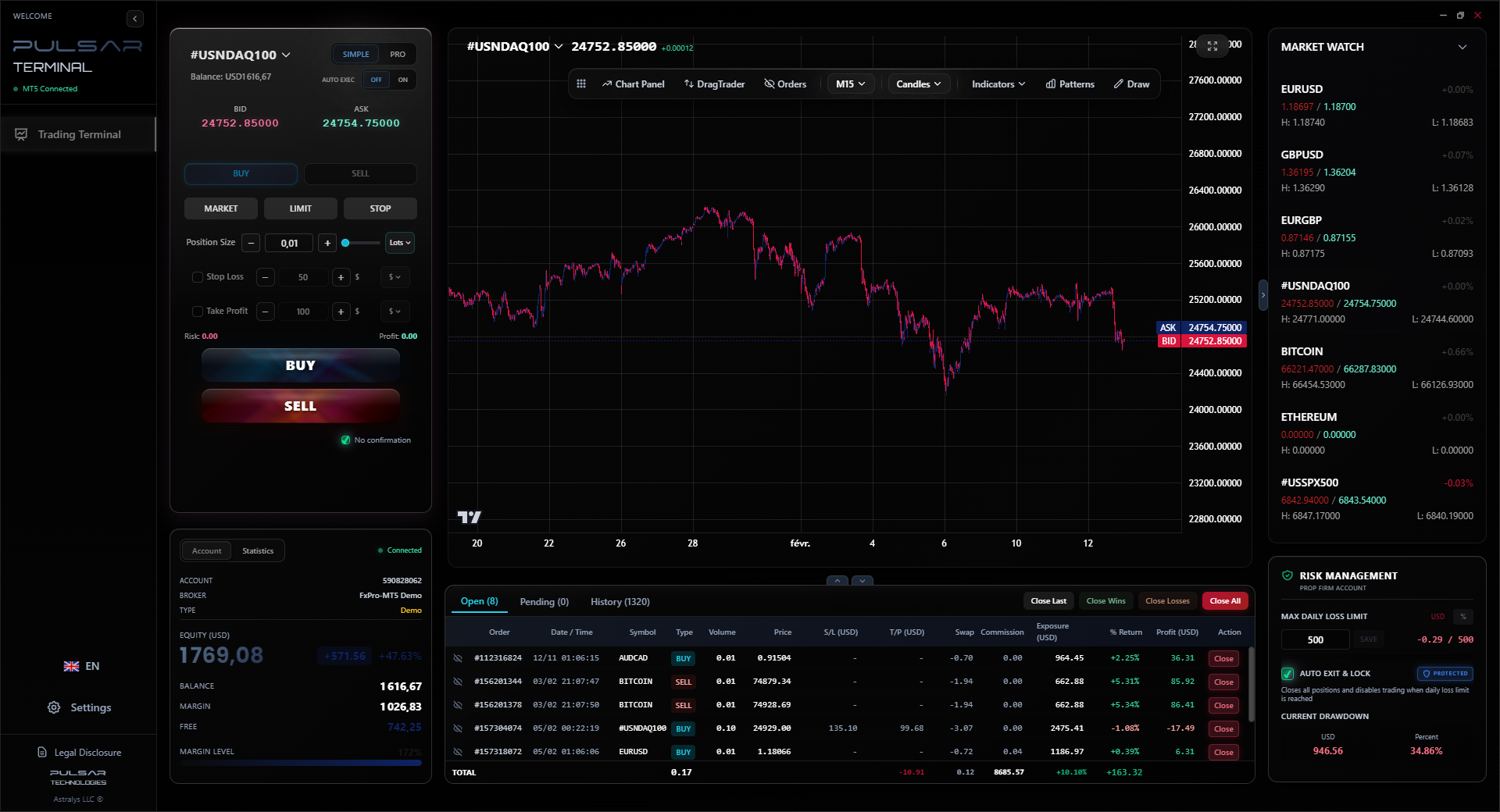
Managing multiple trades and complex exits is easier with tools that let you set multi-level take-profits and trailing stops directly on your MT5 chart.
Let me save you some time and money by listing my greatest hits of failure.
- The Indicator Overload: My chart once had 14 indicators. Bollinger Bands, RSI, three moving averages, MACD, Stochastic, CCI… you name it. The chart was a rainbow-coloured mess. When all of them aligned, the signal was so late the move was almost over. I missed the forest for the trees.
- Ignoring the Spread: I tried to scalp USD/ZAR. The spread was 50 pips. My profit target was 15 pips. My strategy was mathematically doomed from the start. I needed the market to move 65 pips in my favour just to break even on a 15-pip target. Never confuse the quoted spread with the effective spread you need to overcome.
- Changing Timeframes to Justify a Trade: The 15-minute chart looks bearish, but you're bullish. So you jump to the 5-minute chart to find a supporting indicator signal. This is self-deception. Decide your trading timeframe (e.g., 1-hour) and stick to its signals.
- Not Accounting for News: Indicators are pure price math. They don't know about SARB interest rate announcements or US NFP data. I once had a beautiful MACD crossover long signal on GBP/USD that got vaporised 10 minutes later by a surprise hawkish Fed comment. A 40-pip profit turned into a 25-pip loss in seconds. Always check an economic calendar.
The antidote to most of this is a written trading plan. Before you put on a trade, write down: Which chart timeframe? Which two indicators are giving the signal? What is the exact pip definition distance to your stop loss? What is your position size? If you can't write it down clearly, you shouldn't take the trade.
“Your most important tool isn't on your chart; it's the trading journal where you review your decisions.”
Learning how to use indicators in forex trading is a journey, not a weekend project. Here's your roadmap.
Step 1: Go Simple. Pick ONE trend indicator (like a 100 EMA) and ONE oscillator (like MACD). Apply them to the EUR/USD chart on a demo account. Don't trade yet. Just watch for a week. See how they interact in trends and ranges.
Step 2: Define Your Rules. Write a one-paragraph strategy. 'I will only consider a buy if price is above the 100 EMA on the 4H chart AND the MACD is above its signal line on the 1H chart. My stop loss will be placed at the most recent swing low.'
Step 3: Demo Trade with Real Numbers. Use your demo account as if it's real. Calculate your position size for every trade using your real intended account size and a 1-2% risk rule. Track every trade in a journal. Note the spread definition at the time of entry.
Step 4: Review and Refine. After 20-30 demo trades, review your journal. Is your system profitable before costs? After estimated spreads? Are you following your rules, or did you cheat? This review is more valuable than any indicator.
Step 5: Start Small Live. When you have consistent demo results, fund a live account with an amount you can afford to lose. Start trading with micro lots. The psychology is different with real money, and you need to experience that pressure.
Remember, the best indicator in the world is a disciplined mind. The tools just give you a framework to apply that discipline. Start small, keep your costs low, and focus on consistency over chasing mythical 1000-pip wins. That's how you build something that lasts in the South African trading scene.
FAQ
Q1What are the best forex indicators for beginners in South Africa?
Start with just two: a Simple Moving Average (like the 100-period) to identify the trend, and the RSI to gauge momentum. They're available on every platform like MT4/MT5, are easy to understand, and teach you the core concepts of trend-following and overbought/oversold conditions without overwhelming you.
Q2How many indicators should I use on one chart?
Rarely more than three. Using too many leads to 'analysis paralysis' where you get conflicting signals and do nothing, or you cherry-pick the signal you want to see. A strong system uses one indicator for trend, one for momentum/entry timing, and maybe one for support/resistance. More isn't better.
Q3Why do my indicators work in backtesting but fail with real money?
Two main reasons. First, backtesting often ignores the real cost of the spread and slippage. Second, and more importantly, it's psychology. With real money, fear and greed cause you to deviate from your plan - you move your stop loss, take profit early, or ignore a signal. The indicator didn't fail; your execution did.
Q4Are paid indicators better than free ones?
Almost never. The core mathematical concepts (moving averages, oscillators) are free and built into all trading platforms. Expensive 'black box' indicators that promise secret formulas are usually just repackaged versions of free tools with fancy graphics. Save your money for education and a good internet connection.
Q5How do I adjust indicators for volatile pairs like USD/ZAR?
You adjust your risk parameters, not necessarily the indicator settings. USD/ZAR has much wider spreads (often 50+ pips) and higher volatility. This means you need to use a wider stop loss, which forces a smaller position size to maintain your risk percentage. Your indicator signals might be valid, but the trade might not be viable due to the massive spread cost.
Q6Do I need different indicators for scalping vs. swing trading?
The indicator types are often the same, but the settings and timeframes change. A scalper might use a fast Stochastic (like 5,3,3) on a 5-minute chart, while a swing trader uses a standard RSI (14) on a 4-hour chart. The bigger difference is in risk management: scalping requires tighter stops and a ruthless focus on spread cost.
Lekcja Prof. Winstona
:
- ✓Start with 1 trend and 1 momentum indicator only.
- ✓Always apply a higher-timeframe trend filter first.
- ✓Factor in the real spread cost before taking any trade.
- ✓Your stop loss distance determines your position size, not your greed.
Jak przydatny był ten artykuł?
Kliknij gwiazdkę, aby ocenić
Tygodniowe analizy tradingowe
Darmowe tygodniowe analizy i strategie. Bez spamu.
O autorze
David van der Merwe
Trader Rynków Wschodzących
Trader z Johannesburga z 11-letnim doświadczeniem w walutach rynków wschodzących. Specjalizuje się w parach ZAR, handlu regulowanym przez FSCA i analizie rynku południowoafrykańskiego.
Komentarze
Może Ci się też spodobać

Cara Trading Forex Sukses: 7 Prinsip dari Trader Profesional
Cara trading forex sukses dengan 7 prinsip trader pro: manajemen modal, disiplin, journal trading, backtest. Data nyata, bukan janji profit palsu.
Jam Trading Forex Terbaik untuk Trader Indonesia: Panduan Lengkap dengan Tabel Waktu
Panduan jam trading forex untuk trader Indonesia. Tabel 4 sesi dunia, jam emas 20:00-00:00, sesi mana yang harus dihindari. Data akurat + tips dari trader berpengalaman.
Top 5 Sàn Forex Uy Tín Nhất 2026: Review Jujur dari Trader Indonesia
Top 5 sàn forex uy tín 2026 untuk trader Indonesia. Review jujur: spread, deposit, withdraw, dukungan lokal. Exness, XM, IC Markets & lebih.
All these calculators are built into Pulsar Terminal with real-time data from your MT5 account. One-click position sizing, automatic risk management, and instant calculations.
