


Over 300,000 Nigerians are actively trading forex, making us the second-largest market in Africa.

Olumide Adeyemi
Pionier Tradingu w Afryce Zachodniej ·  Nigeria
☕ 10 min czytania
Czego się nauczysz:
Over 300,000 Nigerians are actively trading forex, making us the second-largest market in Africa. Yet, the cold, hard statistic remains: roughly 8 out of 10 retail traders lose money. So, is forex trading safe? That's the wrong question. The real question is: can you trade safely? The difference is everything. Safety isn't a feature of the market itself; it's a result of your choices, your broker, and your discipline. Let's cut through the hype and look at what actually determines your safety in the Nigerian forex scene.
This is where most confusion starts. Yes, forex trading is legal for individuals in Nigeria. You won't get arrested for having a trading account. But the regulatory picture is... let's call it murky.
The Central Bank of Nigeria (CBN) and the Securities and Exchange Commission (SEC) are the main players. The CBN cares about the big picture: monetary stability and how dollars flow in and out of the country. They're not sitting there approving your MetaTrader 5 platform. The SEC is more relevant to us. They've said online forex trading is a securities activity. Their main job lately has been shutting down shady "Forex Investment Schemes" - those guys on WhatsApp promising you 50% monthly returns for pooling your money. That's illegal. Trading your own capital on a legitimate platform? That's fine.
Here's the practical reality most Nigerian traders face: because local regulation for retail forex isn't super strong, many of us use internationally regulated brokers. Think brokers licensed by the UK's FCA, Australia's ASIC, or Cyprus's CySEC. This is perfectly allowed. You just need to remember that any profit you make is subject to Nigeria's 10% capital gains tax. The legality isn't the scary part. The lack of clear, strong local consumer protection is what shifts the safety burden onto your shoulders.

Warning: Any platform or individual asking you to pool funds with them for "managed forex trading" is almost certainly a scam. The SEC has been very clear on this. Only trade with your own money on your own regulated account.

💡 Wskazówka Winstona
Safety isn't the absence of risk, it's the management of it. Your stop-loss is your life jacket. Never board the trading boat without one.
“Safety in trading isn't a feature of the market; it's a result of your choices.”
Forget generic "market risk." Let's talk about the specific dangers that hit close to home.
1. Broker Risk and Outright Scams
This is enemy number one. The internet is flooded with "brokers" that are just fancy websites designed to steal your deposit. They'll offer insane bonuses, crazy use like 1:2000, and smooth-talk you on the phone. Once you deposit, good luck withdrawing. They'll ask for more "fees" or your account will mysteriously blow up. I learned this the hard way early on, losing about ₦150,000 to a platform that just vanished one day. Always, always verify a broker's license with the actual regulator's website (not a link the broker gives you).
2. The use Trap
High use is a double-edged sword, and in Nigeria, that sword is often razor-sharp. Some brokers offer 1:500 or even 1:1000. It sounds amazing - turn ₦50,000 into controlling ₦50,000,000! But here's the math: on a 1:1000 account, a mere 10-pip move against you on a standard lot can wipe out your entire margin. It happens in seconds. use doesn't just amplify profits; it amplifies losses faster than you can blink. Using a proper position size calculator is non-negotiable.
3. Naira Volatility and Currency Risk
You're trading to make money, but your own currency is on a rollercoaster. The USD/NGN pair is wildly volatile. In 2022, the Naira lost about 36% of its value in the parallel market. If you're funding your account in Naira and the currency dips further, your trading capital effectively shrinks before you even place a trade. You're not just trading forex; you're also exposed to the value of your deposit currency. It adds a whole other layer of complexity most beginner guides don't mention.
“High use is a double-edged sword, and in Nigeria, that sword is often razor-sharp.”
This is your single most important safety decision. A good broker won't make you a profitable trader, but a bad one will guarantee you lose.
Look for brokers regulated by what we call Tier-1 authorities. These are strict regulators with strong client money protection rules:
- Financial Conduct Authority (FCA) in the UK
- Australian Securities and Investments Commission (ASIC)
- Cyprus Securities and Exchange Commission (CySEC) - very common for international brokers
These regulators require brokers to keep client funds in segregated accounts (so the broker can't use your money for their own bills) and often participate in investor compensation schemes.
Don't just look at the fancy ads. Check the fine print:
- Spreads & Commissions: What are the real costs? A "zero spread" account often has a high commission. For a major pair like EUR/USD, a spread under 1.0 pip on a standard account is decent.
- Deposit/Withdrawal: How do you get your money in and out? What are the fees and processing times? Local bank transfer options are a big plus.
- Platform: Most use MetaTrader 4 or 5. Is it stable?
Based on my experience and consistent community feedback, brokers like Exness (popular for local payment options), IC Markets (great for raw spreads), and XM are commonly used by experienced Nigerians because they accept clients here and are properly regulated overseas. Do your own due diligence every single time.

Pro Tip: Before depositing real money, test the broker's withdrawal process with the smallest amount possible. If they drag their feet or give you excuses on a $50 withdrawal, imagine trying to get your profits out.
💡 Wskazówka Winstona
A regulated broker is your first line of defense. It's the difference between playing a game with a referee and playing in a dark alley.
“High use is a double-edged sword, and in Nigeria, that sword is often razor-sharp.”
Safety in trading is 90% risk management. It's boring, but it's what keeps you in the game.
The 1% Rule: Never risk more than 1% of your account balance on a single trade. If you have a ₦500,000 account, that's ₦5,000 max risk per trade. This means your stop-loss distance and position size are calculated together. If your stop is 50 pips away, you need to size your trade so that 50 pips lost equals ₦5,000, not ₦50,000.
Use Stop-Losses. Always. I don't care if you're a psychic. Place a stop-loss order the moment you enter a trade. This is your pre-defined "I was wrong" exit point. Letting a losing trade run hoping it will come back is the fastest path to a margin call.
Understand Correlation: If you're in three different trades but they're all betting on a stronger US Dollar (e.g., long USD/JPY, short EUR/USD, long USD/CAD), you're not diversified. You're just taking one massive, leveraged bet. You're risking way more than you think.
Have a Trading Plan: This isn't a fancy document. It's just your rules. What pairs do you trade? What's your strategy? What's your daily loss limit? (Mine is 3%. If I lose 3% of my account in a day, I'm done. Computer off). Write it down and stick to it. Emotion is your biggest enemy; a plan is your shield.
My worst trading month ever came from breaking these rules. I got cocky after a few wins, risked 5% on a "sure thing" gold trade (XAU/USD), didn't use a tight stop, and watched it drop $50 against me. Wiped out two weeks of careful profits in one afternoon. The lesson was expensive, but it stuck.
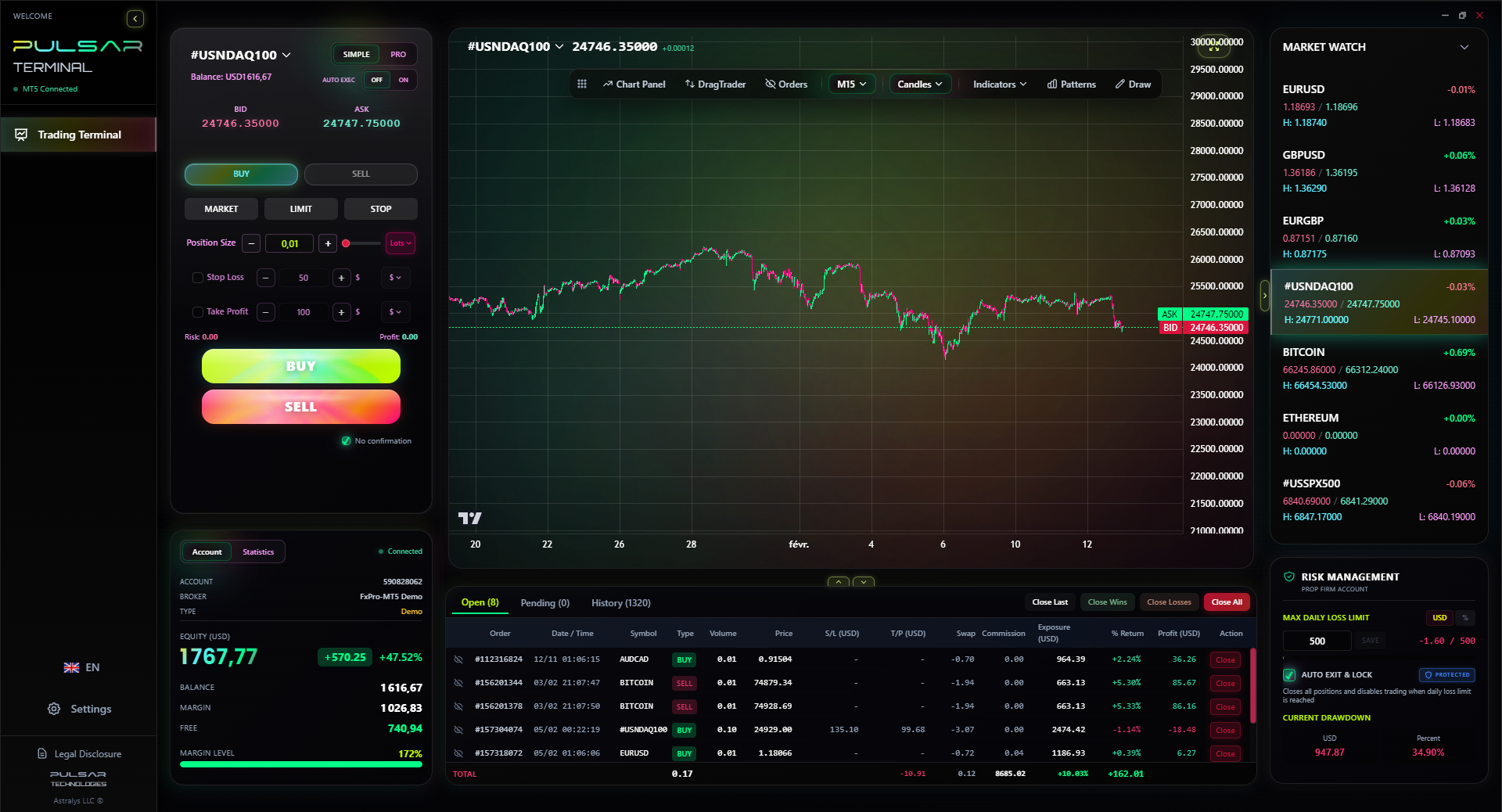
Sticking to your risk management rules is hard when emotions run high, but a tool like Pulsar Terminal can automate stop-losses, take-profits, and even trailing stops directly on your MT5 charts, removing the temptation to interfere.
“Your first goal shouldn't be 'make 100% return.' It should be 'have three consecutive months without blowing up my account.'”
Let's be brutally honest. The dream sold online - quit your job, trade from the beach, make millions - is a fantasy for 99.9% of people. But can you make consistent, supplemental income? Absolutely. It's just a much harder, slower grind than anyone wants to admit.
Think of it like learning a skilled profession. You wouldn't expect to be a master surgeon after a 6-week online course. Trading is similar. The market pays you for being right about uncertainty, and that skill takes time to develop.
Start by aiming for consistency, not riches. Your first goal shouldn't be "make 100% return." It should be "have three consecutive months without blowing up my account." Then, "have three consecutive months with a small net profit."
Focus on the process, not the payout. Did you follow your plan? Did you manage your risk properly? If you did but still lost, that's a good trade. A bad trade where you got lucky and made money is far more dangerous in the long run. It teaches you the wrong habits.
Consider starting with a longer-term approach like swing trading instead of frantic scalping. It gives you more time to think and reduces the impact of spreads and slippage. Use indicators like the RSI or MACD to confirm trends, not to predict the future on their own.
💡 Wskazówka Winstona
The market doesn't care about your hopes, your bills, or your 'sure thing.' It only respects math and discipline. Trade the chart, not your emotions.
“Your first goal shouldn't be 'make 100% return.' It should be 'have three consecutive months without blowing up my account.'”
Nigerian traders are prime targets. Know the enemy's playbook.
1. The Signal Seller Scam: "Pay me ₦50,000 monthly for my winning signals!" They'll show you fake screenshots of massive wins. Here's the truth: if their signals were so good, they'd be trading with their own money and quietly becoming billionaires, not hustling for your subscription fee.
2. The Account Manager/Prop Firm Bypass: Someone offers to "manage" your account or "help" you pass a prop firm challenge for a fee. They'll often ask for your login details. At best, they'll blow up your account. At worst, they'll empty it directly. Prop firms have rules against this for a reason.
3. The Fake Broker (Clone Firm): They'll copy the website and name of a real, regulated broker. The URL might be slightly different (e.g., .co instead of .com). You deposit, and your money is gone. Always type the broker's official URL yourself, don't click links from social media.
4. The Recovery Scam: You've been scammed. Then someone contacts you, maybe even claiming to be from the "regulatory authority," saying they can help recover your funds for an upfront fee. This is a scam on top of a scam. They're preying on your desperation.
The rule is simple: if it sounds too good to be true, it is. No legitimate opportunity requires you to pay large upfront fees, share your passwords, or act with urgent secrecy.
“Forex trading is as safe as you make it. The market is a neutral arena.”
So, is forex trading safe in Nigeria?
It's as safe as you make it.
The market itself is a neutral arena. It's not out to get you, but it's not there to give you free money either. The dangers - scam brokers, excessive use, poor risk management - are all within your control to mitigate.
Your safety checklist:
- Broker: Only use a well-regulated international broker. This is non-negotiable.
- Education: Invest time in learning before you invest money in trading. Understand what a pip and spread really mean.
- Risk Management: Never trade without a stop-loss. Never risk more than 1-2% per trade. Have a daily loss limit.
- Capital: Only trade with money you can afford to lose completely. Never trade with rent money, school fees, or a loan.
- Mindset: Be patient. Expect to lose money at the start. Your goal is survival long enough to learn.
Forex trading isn't a get-rich-quick scheme. It's a serious financial skill with a very high failure rate. But if you approach it with respect, caution, and a relentless focus on protecting your capital first, you can navigate the risks. You can trade safely. The rest - the potential for profit - comes only after you've mastered that.
FAQ
Q1Which forex broker is the safest for Nigerians?
There's no single "safest" broker. Safety comes from choosing a broker regulated by a top-tier authority like the UK's FCA, ASIC, or CySEC. Brokers like Pepperstone, IC Markets, and Exness (through their international entities) are popular choices among experienced Nigerian traders because they hold these licenses and accept clients from Nigeria. Always verify the license on the regulator's official website.
Q2Can I trade forex with 10,000 Naira?
Technically, yes. Many brokers have minimum deposits under $20 (about ₦27,000). However, with ₦10,000, your risk is extremely high. Even a micro lot (1,000 units) requires significant margin, and small account balances are very vulnerable to being wiped out by a few bad trades or even the spread costs. It's better to save more capital first or use a demo account to practice until you can fund with a more realistic amount, like ₦100,000 or more.
Q3Do I pay tax on forex trading profits in Nigeria?
Yes. According to Nigerian tax law, profits from forex trading are considered capital gains and are subject to a 10% Capital Gains Tax (CGT). You are responsible for declaring this income and paying the tax. Keep detailed records of all your trades, deposits, and withdrawals.
Q4What is the best use for a beginner?
The lowest use you can find. Seriously. Start with 1:10 or 1:20 maximum. High use (like 1:500) is a beginner's trap. It lets you control a huge position with little money, which means even a tiny market move can cause massive losses. Low use forces you to focus on proper position sizing and reduces the chance of a catastrophic loss while you're learning.
Q5How can I spot a forex trading scam?
Look for these red flags: 1) Guaranteed profits or high daily returns. 2) Pressure to deposit quickly. 3) Unregulated or offshore "brokers" with no clear license. 4) People asking you to send money to a personal bank account. 5) "Account managers" asking for your login password. 6) Complicated withdrawal processes with extra fees. If you're unsure, search the broker's name + "scam" or "review" online and read experiences from other traders.
Q6Is forex trading better than cryptocurrency trading?
"Better" depends on you. Forex markets are generally more liquid and have longer trading hours (5 days a week). They are influenced by macroeconomic data (interest rates, employment) which can be analyzed. Cryptocurrency markets are open 24/7, are far more volatile, and are often driven by sentiment and speculation. Forex might be more suitable if you prefer structure and economic analysis. Crypto might appeal if you can handle extreme volatility. Both are high-risk. Never assume one is 'safer' than the other.
Lekcja Prof. Winstona
:
- ✓Verify your broker's license on the regulator's official website.
- ✓Never risk more than 1% of your account on a single trade.
- ✓Use a stop-loss on every trade, no exceptions.
- ✓Start with use no higher than 1:20 as a beginner.
- ✓Assume any offer of guaranteed returns is a scam.
Jak przydatny był ten artykuł?
Kliknij gwiazdkę, aby ocenić
Tygodniowe analizy tradingowe
Darmowe tygodniowe analizy i strategie. Bez spamu.
O autorze
Olumide Adeyemi
Pionier Tradingu w Afryce Zachodniej
Jeden z najaktywniejszych edukatorów tradingu forex w Nigerii. 8 lat doświadczenia tradingowego z Lagos. Specjalizuje się w strategiach niskiego kapitału i wyzwaniach prop firm dla afrykańskich traderów.
Komentarze
Może Ci się też spodobać

Cara Trading Forex Sukses: 7 Prinsip dari Trader Profesional
Cara trading forex sukses dengan 7 prinsip trader pro: manajemen modal, disiplin, journal trading, backtest. Data nyata, bukan janji profit palsu.
Jam Trading Forex Terbaik untuk Trader Indonesia: Panduan Lengkap dengan Tabel Waktu
Panduan jam trading forex untuk trader Indonesia. Tabel 4 sesi dunia, jam emas 20:00-00:00, sesi mana yang harus dihindari. Data akurat + tips dari trader berpengalaman.
Top 5 Sàn Forex Uy Tín Nhất 2026: Review Jujur dari Trader Indonesia
Top 5 sàn forex uy tín 2026 untuk trader Indonesia. Review jujur: spread, deposit, withdraw, dukungan lokal. Exness, XM, IC Markets & lebih.
All these calculators are built into Pulsar Terminal with real-time data from your MT5 account. One-click position sizing, automatic risk management, and instant calculations.
