


Lucid Trading is the new kid on the block promising lightning-fast payouts and trader-friendly rules.

James Mitchell
Starszy Analityk Tradingowy
☕ 10 min czytania
Czego się nauczysz:
Lucid Trading is the new kid on the block promising lightning-fast payouts and trader-friendly rules. They’re not lying about the speed, but that’s the bait. The hook is that their evaluation model, like every other prop firm, is designed for you to fail. I’ve traded with half a dozen of these firms, and the math never changes. In this guide, I’ll break down exactly how Lucid works, show you the numbers that matter, and explain why passing their challenge has less to do with skill and more to do with not being an idiot.
Lucid Trading is a US-based proprietary trading firm that launched in early 2025. They give you a simulated account (an 'evaluation'), and if you hit their profit target without breaking their rules, they give you a funded account with their capital. Sounds simple, right?
Here’s the catch you need to understand: they are not a broker. They partner with Dorman, a real Futures Commission Merchant (FCM), to execute trades. You pay Lucid a fee for the chance to trade their capital. This is a service fee, not an investment. This legal distinction is why they aren't registered with the CFTC or NFA... yet. That’s changing, and the regulatory hammer is coming down in 2026, which could upend the entire model.
Their whole pitch is speed and simplicity. Fast evaluations, fast payouts. And I’ll give them this: the payout speed isn’t marketing fluff. I know traders who’ve gotten paid the next day. But getting to that point is where 95% of people wash out.

Warning: Don't confuse a prop firm with a broker. You're paying for an audition, not a trading account. Your fee is gone the second you click 'buy.' It's a sunk cost. Never trade to 'get your fee back.'
The instruments are pure CME futures: ES, NQ, CL, GC, YM. If you're not trading these, Lucid isn't for you. They support all the major platforms like NinjaTrader, Sierra Chart, and Quantower, which is a plus for serious futures traders.
This is where you need to put on your risk manager hat. The rules aren't just guidelines; they're a minefield designed to catch emotional, impatient traders.
Account Sizes and Fees
You've got a few options, but the structure is straightforward. You pay a one-time fee for the evaluation. There's no monthly subscription for the trading account itself, which is better than some firms.
| Account Size | Evaluation Fee (LucidTest) | Profit Target | Max Contracts (Mini) |
|---|---|---|---|
| $25,000 | $110 | $1,500 (6%) | 2 |
| $50,000 | $135 | $3,000 (6%) | 4 |
| $100,000 | $285 (LucidPro Eval) | $6,000 (6%) | 6 |
Notice the pattern? A 6% profit target. That's not crazy, but it's not easy either, especially with the other rules breathing down your neck.
The Two Big Killers: Drawdown and Consistency
1. Trailing Drawdown (End-of-Day): This is the silent account killer. Your starting drawdown is the account size plus the target. For a $50k account, you start with a $53,000 balance. Your drawdown is trailing, but it only updates at the end of the day (EOD). If your account hits $50,000 at any point, you're out. This means a bad intraday move can wipe you out before the EOD update saves you. You must use a stop loss on every trade. Period. Relying on the EOD rule is a recipe for a margin call.
2. The Consistency Rule: This is Lucid's secret weapon. For their popular LucidFlex eval, your largest single-day profit cannot be more than 50% of your total profit. So, if you have a $3,000 target, you can't make a $1,600 day and then grind out $1,400. That big win would violate the rule and fail you.

Example: You're in a $50k LucidFlex challenge. Your progress:
- Day 1: +$800
- Day 2: +$1,700 (This is a problem. $1,700 is >50% of your $2,500 total profit)
- Day 3: You need to be very careful. A loss here could make that Day 2 profit an even larger percentage of your total, failing you.
This rule forces a slow, grinding approach. It actively punishes the 'home run' mentality that attracts most beginners. It's a good rule for building discipline, but it's why aggressive scalping strategies often blow up here.

💡 Wskazówka Winstona
The consistency rule isn't your enemy; it's your teacher. It forces the slow, compounding growth that real trading careers are built on. Fight it, and you'll pay the fee. Embrace it, and you might learn something.
“You sized for the prize, not for the drawdown. That's the guaranteed failure scenario.”
Let's say you pass. Congrats. Now the real game begins, and the rules shift slightly.
First, the profit split is genuinely good. You keep 100% of the first $10,000 you earn across all your accounts with them. After that, it's a 90/10 split in your favor. No hidden fees, no 'activation' cost. This is a major advantage over firms that charge you just to get your funded account.
Now, for the restrictions that keep you from cashing out:
Payout Consistency Rule: For LucidPro funded accounts, you face a 40% consistency rule for payouts. Your biggest single day in a payout cycle can't be more than 40% of that cycle's total profit. You also need 5 profitable days meeting a minimum threshold. This is designed to prevent you from hitting one lucky trade and running.
LucidFlex (The 2026 Darling): Once funded, LucidFlex accounts have no consistency rule and no daily loss limit. This is huge. It gives skilled traders room to breathe and manage drawdown their own way. However, you can only withdraw 50% of your account balance, up to $2,000 max per request. So if you run a $50k account up to $60k, you can request $2,000 (50% of the $10k profit). This controls their risk.
The Payout Speed: This is Lucid's killer feature. Requests are processed daily, and funds hit via Crypto, Plaid, or WorkMarket fast - often within 24 hours. This builds tremendous trust. I had a payout hit my account in under 12 hours. When a firm pays quickly, it removes a massive psychological burden.
But here's the rub: to request a payout, you must have traded a minimum number of days (5 for LucidPro, 8 for LucidDirect). This ties you to the screen, forcing activity, which inevitably leads to overtrading. The fastest way to blow a funded account is to trade just to hit a day count. I've done it myself, taking silly EUR/USD setups just to log a day, and watched a 3% gain turn into a 1% loss.
It's not the rules. It's you. Specifically, it's your inability to manage position size and string together losses.
Let me walk you through the guaranteed failure scenario. You buy a $50k evaluation for $135. You're smart, so you aim for the $3,000 target. That's just 60 pips on the NQ with a decent size, right? You think, 'I can do that in a week.'
You start trading 2 mini contracts. A bad day on the NQ is a 50-point move against you. That's $1,000 per contract, so $2,000 total. In one day, you've used 2/3 of your allowable drawdown for the entire challenge. The psychological pressure is now immense. Your next trade is fearful, you move your stop loss, and another 30-point loss seals it. You're below the trailing threshold and failed.
You broke the cardinal rule: you sized for the prize, not for the drawdown. Your risk per trade should be a tiny fraction of your total allowable loss, not your account size.

Pro Tip: Use a position size calculator religiously. For a $50k challenge with a $3,000 drawdown buffer, your true risk capital is that $3,000. Never risk more than 1% of that ($30) on a single trade. That means trading micro contracts, not minis. It feels slow, but slow is the only way that works.
The consistency rule compounds this. To pass, you need a series of small, steady wins. The moment you get greedy and try to force a big win to 'get ahead of schedule,' you violate the rule and fail. The evaluation is a test of patience, not trading genius. Most people fail because they think they're smarter than the test. I did. My first prop firm attempt years ago, I blew up trying to trade XAU/USD news events with massive size. I made $2,800 in a morning and lost $3,200 by lunch, failing instantly. The lesson was expensive.
💡 Wskazówka Winstona
Your evaluation fee is tuition, not a ticket to riches. If you learn proper position sizing and survive the consistency gauntlet, that $135 is the best trading education you'll ever buy. If not, it's just another receipt for a lesson you refused to learn.
“The only capital that truly matters is the risk capital between your ears.”
The prop firm space is crowded. Here’s how Lucid stacks up on the metrics that matter.
Payout Speed & Splits: Lucid wins, full stop. The 100% first $10k and daily, fast payouts are industry-leading. Most firms like FTMO or The5ers have weekly or bi-weekly payouts with an 80/90 split from the first dollar.
Rule Flexibility: The new LucidFlex account (no daily loss, no consistency once funded) is a game-changer for experienced traders. It’s more forgiving than the strict daily loss limits of a firm like Apex Trader Funding. However, firms like Topstep have well-established, predictable rules.
Cost: Lucid is mid-range. Their fees are competitive, but you can find cheaper evals (Apex often has $50 sales). The value is in the payout structure, not the entry fee.
Platform & Broker: Partnering with Dorman and supporting Rithmic/CQG is a pro. You get professional-grade data and execution. This is better than some firms that use sketchy offshore brokers with huge spreads.
The Big Unknown: Regulation. This is the elephant in the room. The CFTC is looking hard at these firms in 2026. Lucid, and all firms like it, could be reclassified as Commodity Trading Advisors. That means possible registration, audits, and rule changes. Your funded account today might not exist under the same terms in a year. This isn't a Lucid-specific risk, but a systemic one for the entire 'evaluation' model.
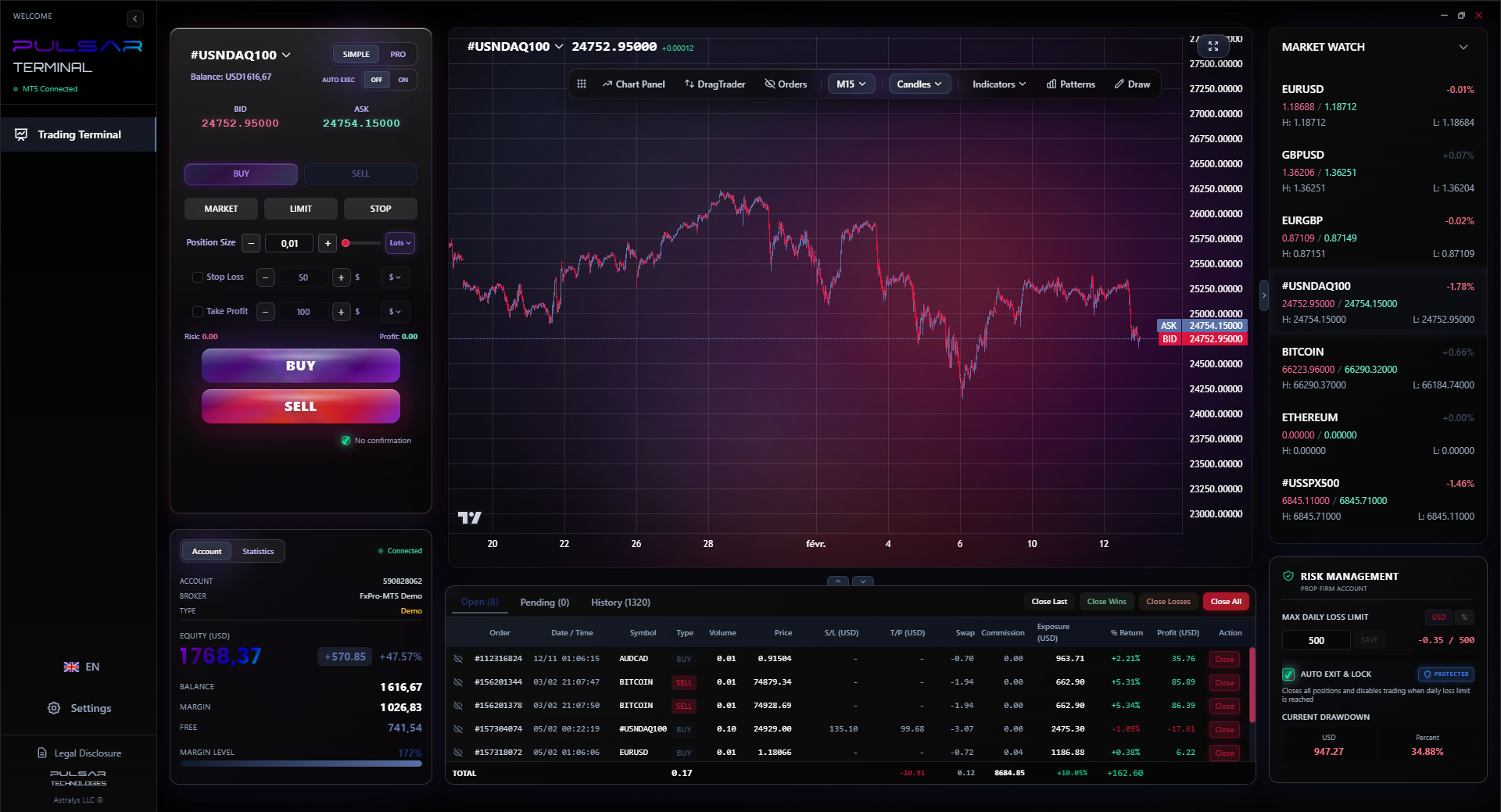
Managing the complex rules of a prop firm challenge—like trailing drawdown and consistency—is easier when your trading terminal can automate the math and the stress, letting you focus on the trade.
Maybe, but only if you check these boxes:
- You are a disciplined futures trader already. This is not a place to learn. You should have a proven, mechanical strategy for ES or NQ with a clear edge.
- You treat it as a business expense. The evaluation fee is a cost of doing business. If losing $135 would hurt you, you're not ready. Save that money for a Pepperstone account to practice real money management.
- You can trade micro contracts patiently. Your goal is to pass, not get rich on the eval. That means using a position size calculator and risking $10-$30 per trade, grinding out the target over 20+ trading days.
- You understand the regulatory risk. You're betting that the model survives the coming CFTC scrutiny.
If you're just looking for a cheap way to gamble on futures, save your money. You will lose. The evaluation is a filter, and it's very effective.
For the right trader - a systematic, patient, risk-averse futures specialist - Lucid's LucidFlex program is one of the best deals in the prop space right now due to its funded account flexibility and stellar payout speed. But that's a very small subset of people who visit their website.
For everyone else, it's just another expensive lesson. I've had more of those than I care to admit. The biggest one was learning that no prop firm's rules can save you from yourself. The only capital that truly matters is the risk capital between your ears.
FAQ
Q1Is Lucid Trading a scam?
No, they are a legitimate business operating a common prop firm model. They charge a fee for an evaluation service and pay out profits from their own capital to traders who pass. Their fast payouts are well-documented by users. However, the business model is designed where most evaluators fail, which is a point of criticism but not illegitimacy.
Q2What's the difference between LucidTest and LucidFlex?
LucidTest is their standard evaluation with a 50% consistency rule during the challenge. LucidFlex is a newer (2026) product with a 50% consistency rule only during the evaluation. Once funded, LucidFlex accounts have no consistency rule and no daily loss limits, offering much more trading freedom.
Q3How fast are Lucid Trading payouts really?
Extremely fast by industry standards. Payouts are processed daily, and many users report receiving funds via methods like Crypto or Plaid within minutes to 24 hours of a request being approved. This is a core part of their positive reputation.
Q4What platforms can I use with Lucid?
They support a wide range through their broker partner Dorman. This includes platforms using Rithmic data (Quantower, Sierra Chart, Jigsaw) and CQG data (NinjaTrader, Tradovate, TradingView). You are not locked into a proprietary platform.
Q5What is the consistency rule?
It's a rule that limits how much of your total profit can come from a single day. In a LucidFlex evaluation, your largest winning day cannot exceed 50% of your total profit. This forces a more consistent, gradual approach and prevents passing the challenge on one lucky trade.
Q6Can I trade stocks or forex with Lucid?
No. Lucid Trading provides capital exclusively for trading CME Group futures contracts like the E-mini S&P 500 (ES), E-mini Nasdaq (NQ), crude oil (CL), and gold (GC).
Q7Is there a discount code for Lucid Trading?
Lucid frequently runs promotions offering 50% or more off evaluation fees. These are widely shared by affiliate partners and on trading forums. Always check for a current code before purchasing an evaluation.
Lekcja Prof. Winstona
:
- ✓Risk a maximum of 1% of your *drawdown buffer*, not your account size.
- ✓The 50% consistency rule makes micro contracts your best friend.
- ✓Fast payouts build trust, but they don't change the pass/fail math.
- ✓Prop firms are a business where most customers (traders) are designed to fail.
Jak przydatny był ten artykuł?
Kliknij gwiazdkę, aby ocenić
Tygodniowe analizy tradingowe
Darmowe tygodniowe analizy i strategie. Bez spamu.
O autorze
James Mitchell
Starszy Analityk Tradingowy
Z siedzibą w Nowym Jorku, ponad 9 lat doświadczenia w tradingu. Koncentruje się na głównych parach USD, wyzwaniach prop firm i amerykańskim otoczeniu regulacyjnym.
Komentarze
Może Ci się też spodobać

Cara Trading Forex Sukses: 7 Prinsip dari Trader Profesional
Cara trading forex sukses dengan 7 prinsip trader pro: manajemen modal, disiplin, journal trading, backtest. Data nyata, bukan janji profit palsu.
Jam Trading Forex Terbaik untuk Trader Indonesia: Panduan Lengkap dengan Tabel Waktu
Panduan jam trading forex untuk trader Indonesia. Tabel 4 sesi dunia, jam emas 20:00-00:00, sesi mana yang harus dihindari. Data akurat + tips dari trader berpengalaman.
Top 5 Sàn Forex Uy Tín Nhất 2026: Review Jujur dari Trader Indonesia
Top 5 sàn forex uy tín 2026 untuk trader Indonesia. Review jujur: spread, deposit, withdraw, dukungan lokal. Exness, XM, IC Markets & lebih.
All these calculators are built into Pulsar Terminal with real-time data from your MT5 account. One-click position sizing, automatic risk management, and instant calculations.
