


Let's get one thing straight: the MT4 vs MT5 debate is mostly nonsense.

James Mitchell
Starszy Analityk Tradingowy
☕ 8 min czytania
Czego się nauczysz:
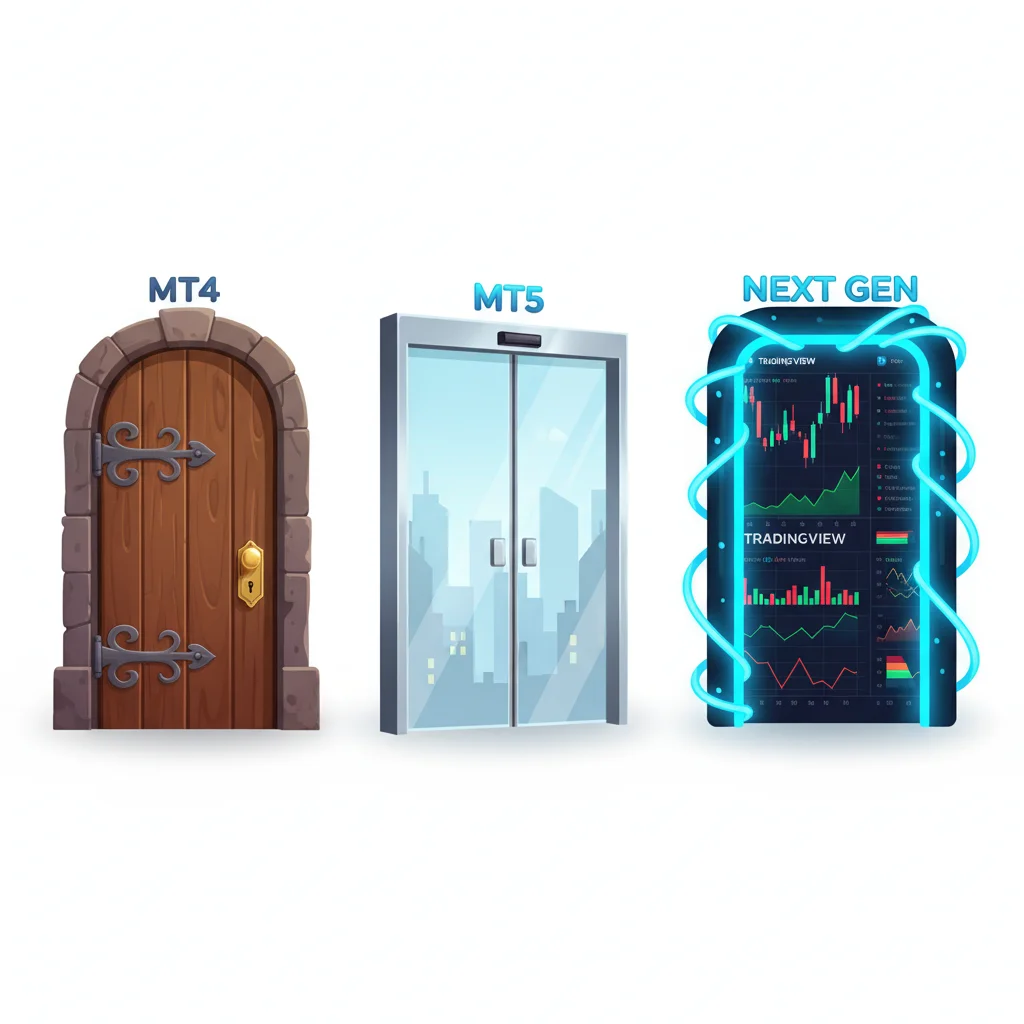
Let's get one thing straight: the MT4 vs MT5 debate is mostly nonsense. You've been fed a line about more timeframes and a built-in economic calendar. Who cares? The real difference is whether the platform will even let you trade in the US without getting your account shut down. I've traded on both for over a decade, watched the regulations strangle one platform, and seen the other adapt (barely). I'll show you the actual, practical differences that affect your P&L, not just the brochure features.
Forget the number of indicators. The single most important difference between MT4 and MT5 for a US trader is regulatory compliance. The CFTC and NFA rules, especially the FIFO (First-In, First-Out) rule, changed everything after 2016.
MT4 was built for a global, unrestricted market. Its architecture didn't naturally handle FIFO, where you must close your oldest position first. Brokers had to implement clunky workarounds. Many just gave up. Overnight, platforms like Exness review or IC Markets review became off-limits to US residents.
MT5 was built with more complex order accounting in mind. While it's not "FIFO-ready" out of the box, its structure made it easier for brokers like FOREX.com to configure it for US compliance. This isn't a feature you'll see on a chart, but it's the reason your choice is so limited. If you're in the US and want MetaTrader, you're often choosing between the few brokers who bothered to make it work.

Warning: Don't assume an international broker's MT4/MT5 offering applies to you. If you fund an account with a non-US regulated broker as a US citizen, they will freeze and return your money. It's not a suggestion; it's the law.
This is where MT5 has a tangible, though often overstated, advantage. MT4 shows you the best bid/ask. MT5's Depth of Market (DOM) shows you the order book - the stacked bids and offers behind that price. In theory, this gives you insight into liquidity.
Here's my experience: In 2021, I was scalping the EUR/USD during the ECB announcement on FOREX.com's MT5. The DOM showed a massive sell wall at 1.1750 that wasn't visible on MT4's simple quote. I placed my sell limit just ahead of it at 1.1748, caught the bounce, and took 12 pips. On MT4, I would have just seen the price stall. That's a real difference.
But let's be honest. For 95% of retail trades, especially if you're using a basic scalping strategy, the spread and execution speed from your broker matter far more than seeing the order book. A fast IC Markets review server on MT4 will beat a slow MT5 connection every time.
The Hedging Illusion
Globally, MT5 allows true hedging (long and short on the same pair). In the US, this feature is completely disabled to comply with the No Hedging rule. So that "advantage" is irrelevant for you and me. It's a phantom feature.

💡 Wskazówka Winstona
The platform is just the cockpit. Your edge is the pilot. Don't spend 80% of your time optimizing software and 20% on your strategy. It should be the other way around.
“The real difference is whether the platform will even let you trade in the US without getting your account shut down.”
MetaQuotes tried to fix what wasn't broken. The MT4 interface is a masterpiece of efficiency. Everything is where your muscle memory expects it. MT5 feels like they hired a designer who'd never traded a day in their life.
Placing an order in MT4: Right-click, "New Order," box pops up. Fast. In MT5: You get a separate, draggable window. It's clunky. Finding your account history requires more clicks. Even something as simple as modifying a stop-loss feels less intuitive. It took me six months to stop grumbling every time I opened MT5.
They did add more timeframes - 21 vs 9 in MT4. Do you need a 2-hour or 8-hour chart? Maybe. But you can get those on TradingView for free. This isn't a killer feature. The learning curve is a real cost, especially when you're in a trade and fumbling for a button.
If you code your own Expert Advisors (EAs) or indicators, this is the most significant technical difference. MQL5 is a more modern, powerful language. It supports object-oriented programming, more data types, and direct access to the economic calendar.
But power comes with complexity. An EA I wrote in MQL4 in 300 lines of code ballooned to nearly 500 in MQL5 just to handle the more rigid event-handling structure (OnTick() vs start()). The migration isn't automatic. I had to rewrite a simple moving average crossover bot from scratch.
For most traders who download EAs, this is a downside. The vast, vast library of free and paid MT4 EAs and indicators does not directly port to MT5. The MT5 library is growing, but it's still playing catch-up. That favorite custom RSI indicator you use on MT4? You might be out of luck on MT5.

Pro Tip: If you rely on specific, obscure indicators, check for an MT5 version BEFORE you commit to a broker that only offers MT5. I learned this the hard way losing my favorite volume-based tool.

“MT5's Depth of Market showed a massive sell wall that wasn't visible on MT4. That's a real difference.”
MT4 was built for forex. MT5 was built as a multi-asset platform. This is a genuine, meaningful difference.
On MT5 with a supporting broker, you can trade stocks, futures, and commodities from the same terminal. The platform natively understands these instruments, their trading hours, and contract specifics. On MT4, brokers often hack in CFDs on stocks, but it's not the same.
In practice for US traders? It's mixed. Most US-regulated MetaTrader brokers focus on forex and CFDs. You're not going to get direct access to the NASDAQ on MT5. But the underlying architecture is future-proofed. If regulations ever loosen (a big if), MT5 is ready. MT4 is not.
This multi-asset backbone also improves backtesting. MT5's strategy tester can use multiple currency pairs and different asset data simultaneously, which is impossible on MT4. For testing complex, multi-instrument strategies, MT5 is objectively superior.
💡 Wskazówka Winstona
If your broker offers both, open a demo account on MT5 and try to replicate your exact MT4 workflow. The frustration you feel is the tax for future-proofing.
You'll hear that MT5 is "faster" because it's 64-bit and can use more RAM. In theory, yes. In practice, on a modern computer, you won't notice a difference charting a few pairs. Where it matters is if you're running 15 charts with complex indicators and an EA on each. MT5 will handle that load more gracefully without freezing.
However, MT4 has one huge advantage: stability through simplicity. Its codebase is mature. I've had MT4 running for weeks on a VPS without a crash. Early MT5 builds were buggier. They've improved massively, but the sheer complexity of MT5 means there are more potential points of failure. I once lost a trade because MT5's DOM window froze during a news spike, while MT4 on the same machine kept ticking. Never fully trusted it the same way after that.
The backtester is a different story. MT5's tester is multithreaded. Testing a 10-year EA optimization on MT4 could take hours. On MT5, it can cut that time by 60-70%. If you develop systems, this is a game-changer.
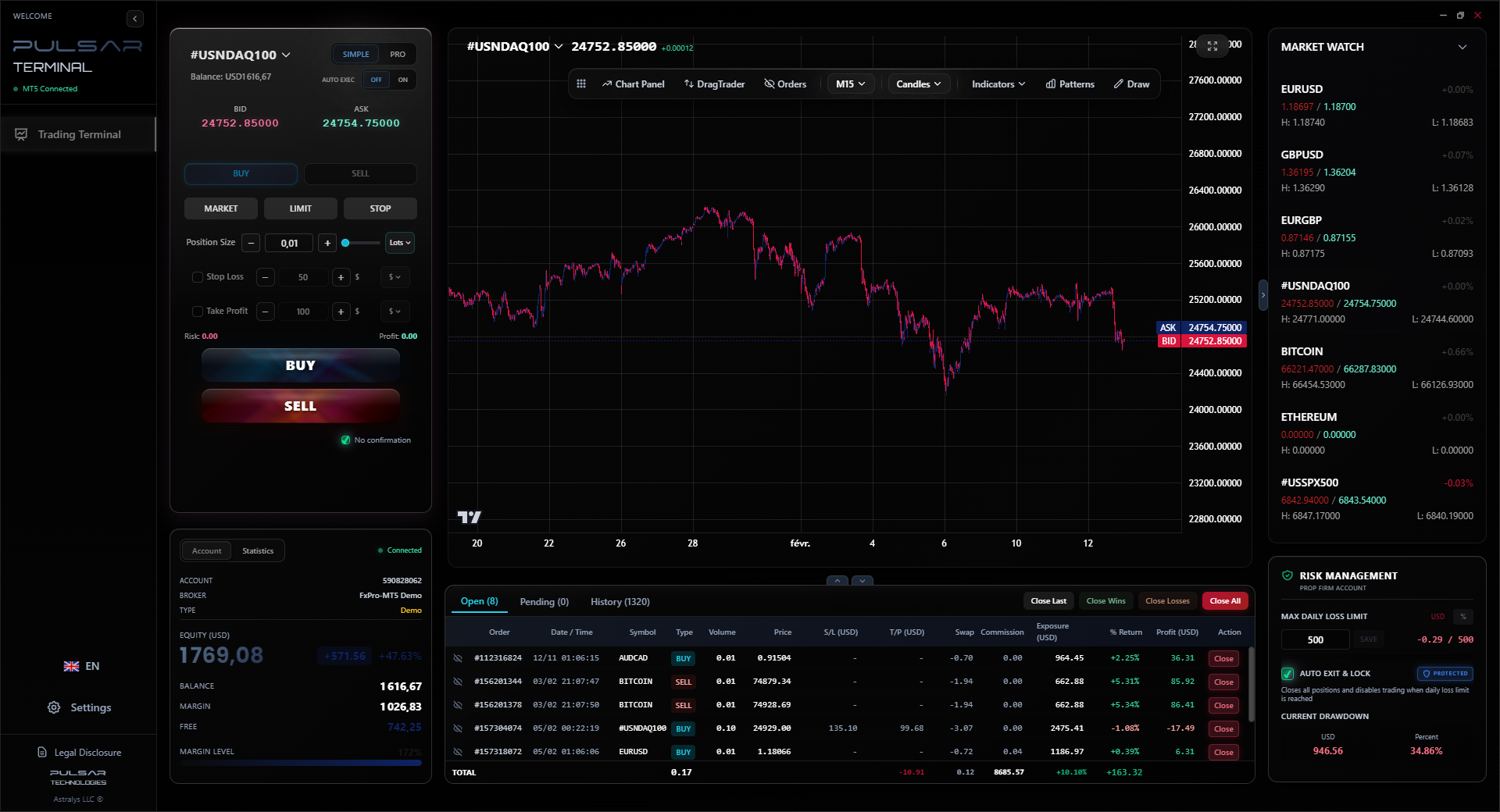
Managing complex orders and risk across multiple charts is where MT5's native tools fall short, which is why a companion app like Pulsar Terminal, with its drag-and-drop orders and automated multi-TP/SL management, is so valuable.
“MT4 is a reliable old wrench. MT5 is a newer, more complicated multi-tool. Sometimes you just need the wrench.”
Let's talk brass tacks. What can you actually get in the US? Here’s the lay of the land from someone who has accounts with most of them.
| Broker | Platform(s) Offered | Key Point for US Traders |
|---|---|---|
| OANDA | MT4 Only | The old reliable. Spreads are decent, execution is solid. No MT5 option means you're in the legacy environment. |
| FOREX.com | MT4 & MT5 | The only major US broker giving you a choice. Their MT5 setup is compliant. This is where I test MT5 strategies. |
| tastyfx (IG) | MT4 Only | Clean, simple offering. Good for traders who want MT4 and nothing else. |
| Trading.com | MT5 Only | An example of a broker skipping MT4 entirely. Proof of where the industry is (slowly) heading. |
The global trend is clear. MetaQuotes has stopped developing MT4. It's on life support. Over 68% of brokers globally now offer MT5. The volume has already tipped in its favor. Your next platform migration is inevitable, whether you like it or not. The question is timing.
If you're starting fresh today with a US broker that offers both, I'd lean towards MT5. You're learning the platform that will be around in 5 years. Just be prepared for the janky interface and use a good position size calculator because the lot size change (MT5 uses standard lots for forex, 1.0 = 100,000 units) can trip you up.
💡 Wskazówka Winstona
The best feature of any platform is reliability. If it crashes during a volatile news event, nothing else matters. Test stability with your specific setup before going live.
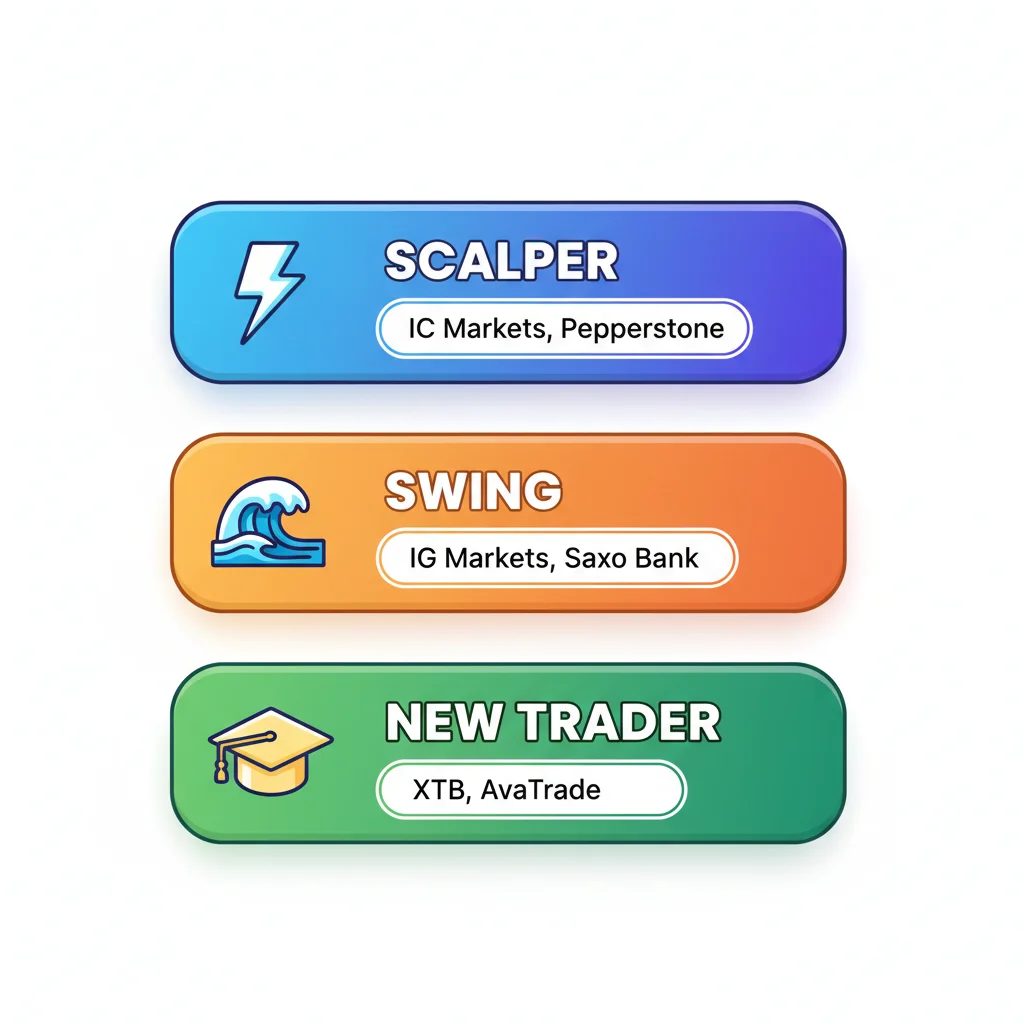
Stop thinking about which platform is "better." Start thinking about which platform serves your strategy and your regulatory reality.
Stick with MT4 if: You're a forex-only trader, you rely on a library of specific MT4 EAs/indicators that don't have MT5 versions, you value the simple, familiar interface above all else, and your US broker (like OANDA) only offers MT4. There's no shame in it. It still works perfectly.
Move to MT5 if: You trade multiple asset classes (where available), you code your own EAs and want a more powerful language, you heavily rely on backtesting and optimization, or you're just starting out and want to be on the platform that's being actively developed. You'll grumble about the interface for a month, then get over it.
My personal setup? I run MT4 from OANDA for my core, simple forex swing trading strategies where I use my trusted custom tools. I run MT5 from FOREX.com for testing new multi-instrument systems and for the occasional trade where the Depth of Market provides a real edge. I'm not loyal to a platform. I'm loyal to what makes me money.
The bottom line is this: the metatrader 4 vs metatrader 5 differences aren't about winning features. They're about choosing the right tool for a very specific, regulated job. MT4 is a reliable old wrench. MT5 is a newer, more complicated multi-tool. Sometimes you just need the wrench.
FAQ
Q1Can I use MT4 or MT5 with any broker as a US trader?
Absolutely not. You can only use MT4 or MT5 with brokers registered with the CFTC and NFA that explicitly accept US clients. Most international brokers (like Pepperstone or XM) are prohibited from serving you. Using a VPN to circumvent this is illegal and will get your account locked and funds returned.
Q2Does MT5 have better charting than MT4?
Marginally. It has more built-in drawing tools and timeframes. But for pure charting analysis, most serious traders connect their broker data to TradingView, which blows both MetaTraders out of the water. The charting difference alone isn't a reason to switch.
Q3I have a profitable MT4 EA. Can I use it on MT5?
Not directly. The code languages (MQL4 vs MQL5) are different. You must rewrite or hire someone to convert the EA. Many simple EAs can be converted, but complex ones may need a full rebuild. Always test a converted EA thoroughly in a demo account first.
Q4Is it true that MT4 will be shut down?
MetaQuotes has ceased active development. They won't add new features. They will provide critical security updates for the foreseeable future. It's not being "shut down," but it's entering a long, managed retirement. Brokers will support it for years because too many clients still use it.
Q5Why do so many traders prefer MT4 over MT5?
Familiarity and inertia. MT4 was the dominant platform for over a decade. People know it, their tools are built for it, and change is hard. The initial releases of MT5 were also poorly received, leaving a bad first impression that has lasted for years.
Q6What's the deal with lot sizes? I heard they're different.
Yes, this is a practical pitfall. In MT4, a standard lot is 1.0 (100,000 units). In MT5 for forex, a standard lot is also 1.0. However, MT5 also allows trading in volumes less than 0.01 (a micro lot), offering more precision. Just double-check your order size when you first switch to avoid a nasty surprise.
Lekcja Prof. Winstona
:
- ✓US regulation (FIFO) is the #1 differentiator, not features.
- ✓MT5's Depth of Market can provide a real liquidity edge.
- ✓The MT5 interface is clunkier; expect a learning curve.
- ✓MQL5 is more powerful but requires rewriting MT4 EAs.
- ✓MT5 is the future; MT4 is in maintenance mode.
Jak przydatny był ten artykuł?
Kliknij gwiazdkę, aby ocenić
Tygodniowe analizy tradingowe
Darmowe tygodniowe analizy i strategie. Bez spamu.
O autorze
James Mitchell
Starszy Analityk Tradingowy
Z siedzibą w Nowym Jorku, ponad 9 lat doświadczenia w tradingu. Koncentruje się na głównych parach USD, wyzwaniach prop firm i amerykańskim otoczeniu regulacyjnym.
Komentarze
Może Ci się też spodobać

Cara Trading Forex Sukses: 7 Prinsip dari Trader Profesional
Cara trading forex sukses dengan 7 prinsip trader pro: manajemen modal, disiplin, journal trading, backtest. Data nyata, bukan janji profit palsu.
Jam Trading Forex Terbaik untuk Trader Indonesia: Panduan Lengkap dengan Tabel Waktu
Panduan jam trading forex untuk trader Indonesia. Tabel 4 sesi dunia, jam emas 20:00-00:00, sesi mana yang harus dihindari. Data akurat + tips dari trader berpengalaman.
Top 5 Sàn Forex Uy Tín Nhất 2026: Review Jujur dari Trader Indonesia
Top 5 sàn forex uy tín 2026 untuk trader Indonesia. Review jujur: spread, deposit, withdraw, dukungan lokal. Exness, XM, IC Markets & lebih.
All these calculators are built into Pulsar Terminal with real-time data from your MT5 account. One-click position sizing, automatic risk management, and instant calculations.
